
In an era of persistent purchasing power erosion, the most sophisticated institutional portfolios are no longer looking toward traditional bonds for safety. These investors are increasingly utilizing shipping investments as an inflation hedge because maritime assets offer an intrinsic link to the rising costs of global trade. You’ve likely recognized that stagnant yields and the volatility of speculative digital assets cannot provide the structural integrity your capital requires in 2026. This reality demands a transition toward regulated, physical assets that thrive when global demand increases.
This guide demonstrates why maritime debt instruments are emerging as a premier defensive strategy, providing a stable yield that outpaces CPI through direct exposure to the world’s most essential supply chains. We’ll explore the current valuation surge where five-year-old Capesize carriers have reached $72 million, the critical impact of the upcoming EU ETS allowance deadlines, and the methodology behind our EU-regulated ship investment bonds. By integrating ShipCheckAI for deep transparency with institutional-grade oversight, we show you how to access a unified ecosystem that transforms global trade into a governed, transparent, and high-yielding investment vehicle.
Key Takeaways
- Understand why shipping investments as an inflation hedge offer a superior alternative to traditional fixed income by capturing the direct correlation between freight rates and global trade costs.
- Analyze how the rising replacement costs of vessels-driven by steel prices and labor-protect your capital from the purchasing power erosion seen in 2026.
- Compare the yield profiles of maritime debt against traditional hedges like gold and real estate to identify where real-world cash flow meets long-term value retention.
- Discover how AI-powered transparency through ShipCheckAI and EU-regulated frameworks are democratizing access to a high-stakes industry once reserved for the largest institutional players.
The Inflation Challenge of 2026: Why Traditional Hedges Are Faltering
An inflation hedge is an asset expected to retain or increase in value as the purchasing power of currency declines. In the complex economic environment of 2026, cash is no longer a neutral reserve; it’s a structural liability that actively erodes capital. Many institutional investors have historically relied on “paper hedges” to shield their portfolios, yet these instruments are currently failing to meet the challenge. Utilizing shipping investments as inflation hedge vehicles has emerged as a sophisticated method to capture value within the physical economy, allowing capital to stay synchronized with the actual price of global commerce. Traditional protections are faltering for several specific reasons:
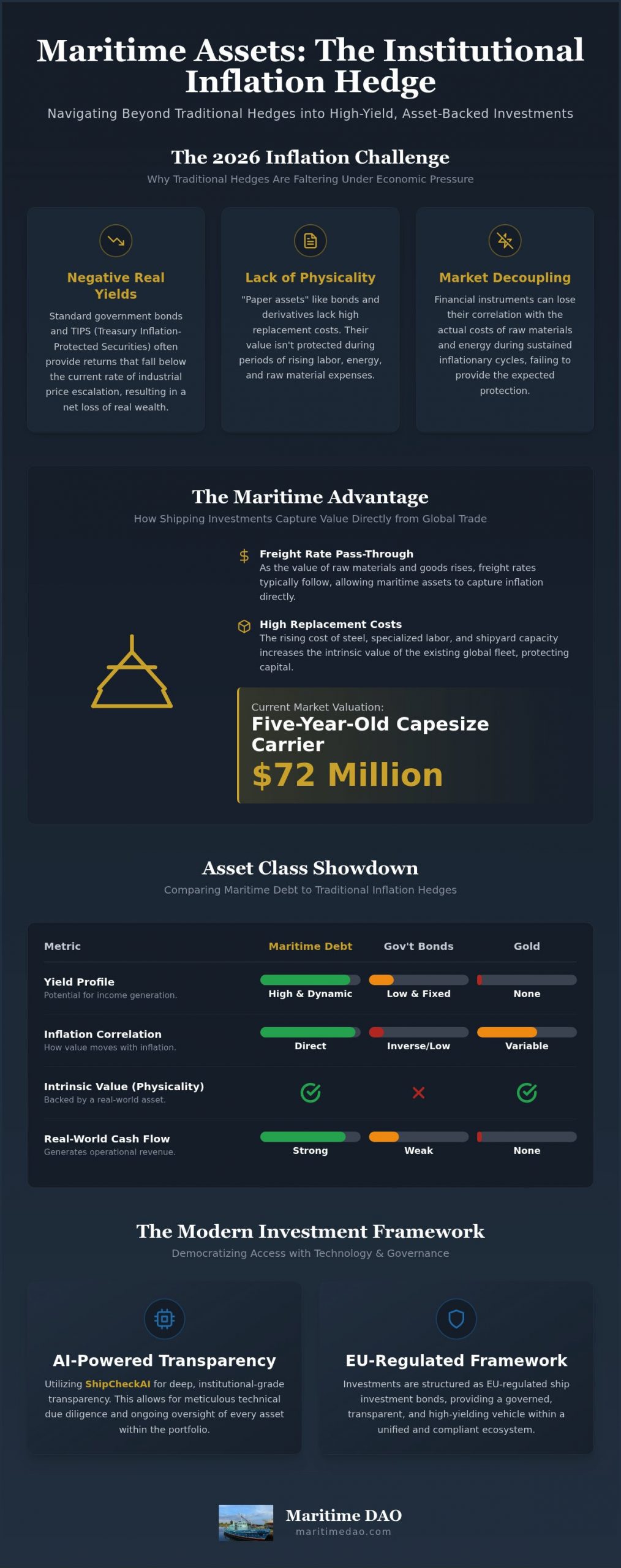
- Negative Real Yields: Standard government bonds and TIPS often provide returns that sit below the current rate of industrial price escalation.
- Lack of Physicality: Paper assets don’t possess the high replacement costs that protect value during periods of rising labor and material expenses.
- Market Decoupling: Financial derivatives often lose their correlation with the actual costs of raw materials and energy during sustained inflationary cycles.
The shift toward real-world assets (RWA) reflects a broader institutional desire for structural integrity and transparency. By moving capital into the backbone of global trade, investors can avoid the speculative volatility found in digital asset circles while securing a position in the world’s most essential infrastructure.
Eroding Purchasing Power in the Current Economy
The 2026 CPI data reveals a persistent “yield gap” where traditional safe-haven assets result in a net loss of real wealth. This disparity has triggered a psychological shift among asset managers. They’re no longer content with digital numbers on a screen that lose value every month. There’s a growing demand for asset-backed allocation that provides a direct link to the physical economy. When currency devalues, the price of transporting essential goods typically rises, making shipping investments as inflation hedge strategies a logical choice for those seeking to maintain their capital’s core strength. Investors don’t just want to store value; they need their capital to work within a productive, governed ecosystem.
The Search for Intrinsic Value
Intrinsic value is found where replacement costs are high and utility is absolute. Global trade remains the primary engine of the global economy, and maritime vessels are its essential infrastructure. As a recognized alternative investment in shipping, these assets possess a unique defensive profile. When the price of steel, specialized labor, and shipyard capacity increases, the value of the existing global fleet rises in tandem. This creates a natural “pass-through” effect. Maritime assets aren’t just speculative entries on a ledger; they’re governed, physical entities that facilitate the vast majority of global trade. By focusing on assets with massive replacement thresholds, investors ensure their capital remains anchored to the fundamental drivers of economic activity rather than the whims of monetary policy.
The Maritime Advantage: Why Shipping Yields Outpace Rising Prices
Shipping functions as a critical pass-through mechanism for global price increases. Unlike fixed-income instruments that offer static returns, maritime yields are intrinsically tied to the market value of the goods they carry. When the price of raw materials or finished products rises, the cost of transporting those assets typically follows. This direct correlation makes shipping investments as inflation hedge strategies a robust choice for institutional portfolios seeking to avoid the stagnation of traditional bond markets. Maritime assets don’t just exist alongside inflation; they actively capture it through freight rate adjustments and rising equity valuations.
Freight Rates and the Commodity Link
The link between freight and commodities is mechanical. As the value of cargo increases, charterers are often willing to pay higher rates to secure reliable transport for their high-value inventories. Historical data indicates that shipping performance often peaks during high-inflation cycles because the industry controls the literal gateways of trade. We project that the freight rate pass-through will drive a double-digit increase in average charter yields across the tanker and dry bulk sectors by the end of 2026. This trend is further complicated by the intersection of shipping regulations and inflation, where the costs of environmental compliance and new safety standards are frequently passed directly to the end-user. Contractual protections, such as inflationary escalators in long-term time charters, ensure that operational revenue keeps pace with rising fuel and labor expenses.
Vessel Equity as a Physical Store of Value
Vessel values are driven by the tangible costs of steel, energy, and specialized labor required for construction. In July 2026, newbuild VLCC prices reached approximately $132 million, yet the scarcity of available tonnage drove resale prices for the same vessels to $172 million. This premium for immediate availability highlights how existing fleets benefit from shipyard backlogs and rising industrial costs. The secondhand vessel price index reached 210.97 points in June 2026, providing a clear signal that maritime equity is outpacing currency devaluation.
Scrap value, determined by the global price of recycled steel, acts as a definitive hard floor for maritime investment risk; it ensures that even at the end of a vessel’s operational life, a significant portion of the capital remains recoverable in any currency. This makes shipping investments as inflation hedge vehicles a superior alternative to paper assets that lack such physical recourse. If you’re looking for a way to ground your capital in these high-value physical assets, you might consider how Maritime DAO facilitates access through its governed ecosystem. By holding debt secured by these multi-million dollar vessels, investors gain a tangible alternative to the volatility of purely digital or currency-based markets.
Strategic Roundup: Shipping vs. Traditional Inflation Hedges
Institutional portfolios have historically relied on a triad of defensive assets: gold, real estate, and inflation-linked bonds. The 2026 economic environment has exposed fundamental weaknesses in these legacy choices. Gold offers no yield; real estate is increasingly tethered to localized regulatory burdens; and traditional bonds struggle to maintain real value against rising industrial costs. Utilizing shipping investments as inflation hedge vehicles provides a distinct advantage by combining the physical security of a hard asset with the active cash flow of a global service industry. This evolution from direct vessel ownership to regulated maritime debt represents a systemic shift toward more liquid, accessible, and transparent capital allocation.
Shipping vs. Gold: Yield vs. Stagnation
Gold is frequently cited as the ultimate safe haven, yet its lack of yield is a significant disadvantage in a high-rate environment. Bullion is a passive store of value that requires price appreciation alone to offset the eroding power of currency. Maritime income is inherently active. EU-regulated ship investment bonds generate consistent yield derived from the actual movement of global trade. While gold sits in a vault, a vessel operates as a productive asset within a governed ecosystem, capturing revenue from freight rates that historically adjust to reflect inflationary pressures. The volatility profile of shipping is grounded in physical demand, whereas gold often fluctuates based on speculative sentiment rather than industrial utility.
Shipping vs. Real Estate: Global vs. Local Exposure
Real estate offers tangible value but remains highly sensitive to localized economic shifts, property taxes, and regional interest rates. Maritime assets provide exposure to the entire global economy. A ship can be redeployed to high-growth routes, such as the expanding intra-Asian or transatlantic corridors, ensuring that capital follows demand wherever it emerges. Managing physical property involves significant overhead, maintenance, and tenant risk. Digital maritime platforms have unified these processes, using automated intelligence to streamline oversight and reduce operational drag.
The barrier to entry has also transformed. Historically, maritime finance was an exclusive domain for the world’s largest capital holders. By understanding how to invest in maritime assets through regulated debt instruments, a broader range of institutional and professional investors can now access shipping yields. This democratization allows for a more diversified strategy where shipping investments as inflation hedge instruments provide superior risk-adjusted returns compared to the stagnant rental yields found in many over-saturated property markets. In 2026, the secondhand vessel price index reached 210.97 points, illustrating a robust appreciation of maritime equity that far outpaces many residential or commercial real estate benchmarks.
Technical Due Diligence: Safeguarding Maritime Capital in 2026
Protecting institutional capital requires more than simply identifying a high-growth sector. When you utilize shipping investments as inflation hedge instruments, the underlying vessel’s operational integrity becomes your primary shield against capital loss. A ship’s value isn’t a static number; it’s a dynamic variable influenced by maintenance, regulatory compliance, and structural health. To manage this complexity, we employ a tripartite due diligence framework that integrates legal standing, technical condition, and financial viability. This unified structure ensures that every bond is backed by a vessel that is not only seaworthy but also legally compliant and economically optimized within the 2026 market.
Transparency acts as the primary antidote to maritime investment risk. Historically, the industry suffered from siloed data and infrequent reporting, leaving bondholders exposed to hidden operational failures. Modern institutional-grade vehicles have replaced these legacy systems with a governed ecosystem where data flows freely and verification is automated. By anchoring debt to physical assets that are continuously monitored, investors can avoid the speculative pitfalls of purely digital markets while maintaining the security of a hard-asset allocation.
ShipCheckAI: The New Standard in Asset Assessment
Traditional maritime finance often relied on manual inspections that provided only a single snapshot in time. This created significant blind spots between inspection dates. AI ship inspection tools like ShipCheckAI have transformed this process by providing a continuous stream of digital monitoring. These systems move beyond static annual reports to offer real-time transparency into an asset’s condition. Investors no longer have to wait for a quarterly update to understand the health of their collateral. Instead, they gain access to a transparent record that verifies the ship’s adherence to the latest 2026 safety standards, including the mandatory lifting appliance regulations that went into effect on January 1st.
Mitigating Physical Risk through Technology
Asset longevity is a direct function of maintenance quality and regulatory foresight. Utilizing AI in maritime due diligence allows bondholders to verify that predictive maintenance schedules are strictly followed, preventing small mechanical issues from becoming catastrophic financial liabilities. This is particularly critical as ships face stricter environmental requirements, such as the 11% carbon intensity reduction factor required by the 2026 CII ratings. AI-driven data streams eliminate the traditional information asymmetry between shipowners and investors by providing an objective, verifiable record of ship performance that cannot be altered or obscured.
The legal pillar of our due diligence also leverages the established Marshall Islands DAO framework, which recognizes these entities as separate legal entities, providing a robust layer of security for bondholders. This ensures that the shipping investments as inflation hedge you choose are governed by clear, enforceable legal frameworks. To secure your capital within a transparent, AI-governed ecosystem, you can explore our EU-regulated maritime bonds and gain direct exposure to the world’s most essential supply chains.
Accessing Regulated Maritime Debt through Maritime DAO
The transition from exclusive, opaque maritime finance to a democratized and transparent ecosystem is now complete. For decades, the high capital requirements of ship ownership restricted access to institutional-grade yields to only the largest global entities. By utilizing shipping investments as inflation hedge strategies through a regulated framework, a broader spectrum of professional investors can now secure their portfolios against currency devaluation. This shift is powered by a unified system that integrates physical asset security with the efficiency of digital governance, ensuring that capital remains protected, productive, and compliant within the 2026 regulatory landscape.
Maritime DAO serves as the authoritative gateway to this sector, providing the structural integrity required for significant capital allocation. Our approach moves beyond the speculative nature of unregulated digital assets, anchoring every instrument in the sober reliability of institutional finance. By combining EU-regulated debt structures with automated intelligence, we’ve built a solution that identifies systemic inefficiencies in maritime capital markets and replaces them with a high-tech, governed alternative.
The Regulated Innovation of Maritime DAO
Our structural framework is built upon EU regulated ship investment bonds, which provide a legally enforceable link between bondholders and physical vessels. This architecture utilizes tokenization not as a speculative tool, but as a mechanism for providing liquidity and transparency to a traditionally illiquid market. The DAO structure ensures that governance is decentralized yet strictly governed by legal frameworks, including the MiCA (Markets in Crypto-Assets) regulations that define the 2026 European financial landscape. This ensures maritime investment compliance at every stage of the bond lifecycle, from initial capital allocation to the final distribution of yields. By automating profit distribution and reporting, we eliminate the operational drag that typically erodes returns in traditional shipping finance.
Building Your 2026 Inflation-Resistant Portfolio
Determining the optimal allocation for maritime alternative investments requires a focus on risk-adjusted returns and physical recourse. Many institutional managers are now allocating 5% to 15% of their defensive portfolios to maritime debt to balance the volatility of equities and the low yields of government bonds. To get started with the Maritime DAO platform, investors must complete a verified onboarding process designed to meet all EU financial standards. Once registered, you can access a transparent dashboard that displays real-time data from our ShipCheckAI assessments, ensuring that your shipping investments as inflation hedge vehicles are performing according to their technical and financial benchmarks. Before committing capital, ensure your strategy meets this final checklist:
- Verification of the vessel’s 2026 CII rating and environmental compliance status.
- Confirmation of the bond’s regulatory standing under EU debt instrument frameworks.
- Review of the automated distribution schedule and governance rights within the DAO.
The relationship between physical trade and digital governance is the cornerstone of modern asset management. By grounding your capital in the multi-million dollar reality of global shipping, you ensure that your portfolio thrives as the cost of global commerce rises.
Securing Your Capital in the Physical Economy of 2026
The 2026 economic environment has proven that traditional paper assets are insufficient against persistent purchasing power erosion. By grounding capital in the physical reality of maritime commerce, you can finally bridge the gap between speculative digital markets and the sober reliability of institutional finance. Utilizing shipping investments as inflation hedge instruments allows your portfolio to capture the intrinsic value of global trade while benefiting from the high replacement costs of modern vessels.
We’re redefining institutional maritime finance by providing an EU-regulated compliance framework that ensures every transaction meets the highest legal standards. Through AI-powered transparency via ShipCheckAI, we’ve eliminated the information asymmetry that once plagued this industry, offering you a governed gateway to a multi-layered ecosystem of opportunity. It’s time to transition from passive stores of value to productive, asset-backed debt that thrives in a high-inflation environment.
Explore EU-Regulated Ship Investment Bonds at Maritime DAO and secure your position in the future of global trade.
Frequently Asked Questions
Is shipping a better inflation hedge than real estate in 2026?
Shipping provides a more dynamic exposure to global economic activity than localized real estate. While property values are often suppressed by regional interest rate hikes, maritime assets benefit from the ability to be redeployed to high-growth trade routes. This mobility ensures that capital follows demand, making shipping investments as inflation hedge vehicles particularly effective in a fragmented 2026 global economy where regional growth varies significantly.
How do freight rates respond to global inflation?
Freight rates typically function as a pass-through mechanism for rising industrial costs. As the price of raw materials and energy increases, shipowners adjust charter rates to maintain margins and reflect the higher value of the cargo being transported. This mechanical link ensures that revenue remains synchronized with the broader inflationary environment, providing a natural buffer that traditional fixed-income securities cannot replicate during sustained periods of currency devaluation.
What are EU-regulated ship investment bonds?
These are debt instruments issued within a strictly governed European legal framework, ensuring institutional-grade oversight and investor protection. Unlike unregulated digital assets, these bonds are structured as compliant securities that represent a claim on the cash flows generated by specific maritime vessels. They provide a transparent, legally enforceable gateway for capital to enter the shipping market while adhering to the rigorous transparency requirements of the 2026 EU financial landscape.
Can individual investors access maritime debt markets?
Professional and institutional investors can now access these traditionally exclusive markets through fractionalized bond platforms. By utilizing a decentralized autonomous organization (DAO) structure, the high capital barriers associated with direct vessel ownership are removed. This democratization allows for more granular capital allocation into shipping investments as inflation hedge strategies, enabling a broader range of participants to benefit from the stable, asset-backed yields of the global maritime sector.
How does ShipCheckAI protect bondholders?
ShipCheckAI protects bondholders by replacing infrequent manual inspections with continuous, AI-driven technical oversight. The tool analyzes multiple inspection data points to provide an objective assessment of a vessel’s structural health and regulatory compliance. This real-time transparency ensures that the physical collateral backing the investment remains in optimal condition, drastically reducing the risk of operational failure or environmental penalties that could otherwise impact bondholder returns.
What are the primary risks of investing in maritime assets?
Primary risks include cyclical market volatility, shifting environmental regulations, and physical asset depreciation. While maritime yields are robust, they are sensitive to changes in global trade volumes and geopolitical disruptions. To mitigate these risks, investors should focus on modern, eco-compliant tonnage and utilize platforms that provide deep technical due diligence and transparent governance. Diversification across different vessel segments further balances these inherent sector risks.
How does the Maritime DAO ensure regulatory compliance?
The Maritime DAO ensures compliance by integrating rigorous KYC/AML protocols with established legal frameworks like the Marshall Islands DAO Act. Every bond issuance is structured to meet the 2026 EU standards for tokenized securities, providing a clear legal bridge between digital governance and physical assets. This methodical approach to compliance ensures that all participants operate within a transparent, legally recognized ecosystem that prioritizes security and institutional-grade oversight.
What is the expected yield for maritime asset-backed securities?
Yields for maritime asset-backed securities are typically structured to provide a significant premium over traditional government bonds. These returns are derived from the underlying charter agreements and are designed to outpace the core inflation rate. While specific yields vary based on vessel type and market conditions, the objective is to provide a stable, income-generating instrument that retains its real-world value even as the purchasing power of fiat currencies fluctuates.