
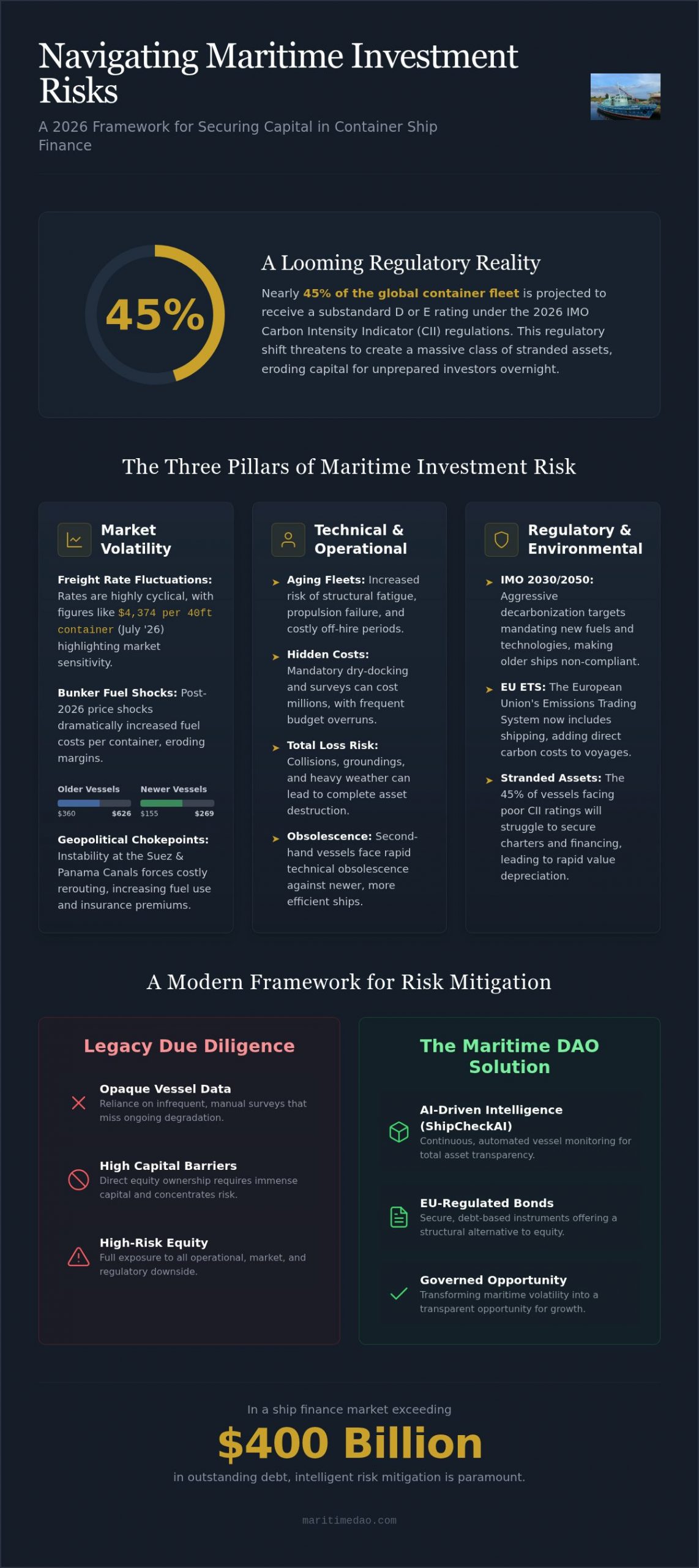
Nearly 45% of the global container fleet is projected to receive a D or E rating under the 2026 IMO Carbon Intensity Indicator regulations, a reality that threatens to strand assets and erode capital overnight. You understand that the risks of investing in container ships have traditionally been clouded by opaque vessel data, high capital barriers, and volatile freight rates like the $4,374 per 40ft container seen this July. It’s a high-stakes environment where legacy due diligence often fails to account for rapid regulatory shifts and geopolitical disruptions. This guide promises to demystify these complexities, offering a clear path to secure your portfolio through regulated financial instruments and automated intelligence.
We’ll provide a comprehensive risk-mitigation framework that distinguishes between equity and debt exposure, while demonstrating how ShipCheckAI provides the transparency required for institutional-grade compliance. You’ll learn how a unified ecosystem of EU-regulated bonds, transparent governance, and AI-driven assessments can transform maritime volatility into a governed opportunity for growth. By the end of this analysis, you’ll possess the technical insight and strategic confidence to lead in a ship finance market that now exceeds $400 billion in outstanding debt.
Key Takeaways
- Analyze how macroeconomic shifts and supply chain disruptions create volatility in global trade volumes and container freight rate stability.
- Identify the technical hazards and environmental mandates, including IMO 2030/2050 and the EU ETS, that threaten to create stranded assets.
- Learn to mitigate the risks of investing in container ships by replacing legacy manual surveys with continuous, AI-driven vessel condition monitoring.
- Evaluate the structural advantages of EU-regulated ship investment bonds as a secure, debt-based alternative to high-risk maritime equity.
- Master the use of ShipCheckAI to produce standardized, institutional-grade due diligence reports that ensure total transparency in asset condition.
Market Dynamics and Macroeconomic Volatility in Container Shipping
Global trade functions as a sensitive barometer for economic health, making container shipping a sector defined by inherent cyclicality and abrupt shifts. When consumer demand fluctuates in major economies like the U.S. or the EU, the ripple effects through the maritime supply chain are immediate and profound. Shipping investments require a sophisticated understanding of these patterns, especially as freight rates experience ongoing corrections. As of July 2026, Drewry’s World Container Index stood at $4,374 per 40ft container, a figure that underscores the volatility investors must manage when projecting long-term returns.
Operating margins are similarly exposed to the volatility of bunker fuel prices. Following the oil price shock in early 2026, fuel costs for a standard China-to-U.S. West Coast voyage climbed significantly. For the oldest vessels in the fleet, costs rose from $360 to $626 per 20-foot container, while even the newest ships saw increases from $155 to $269. These price swings represent one of the primary risks of investing in container ships, as they can rapidly erode the profitability of a charter agreement. Sophisticated investors treat fuel price exposure not as a secondary concern, but as a core pillar of their risk assessment framework.
The Bull-Whip Effect in Maritime Logistics
In the 2026 maritime context, the bull-whip effect is the systemic amplification of demand signals that triggers excessive ordering of new vessels during market peaks, often resulting in a capacity glut by the time those ships are delivered. The multi-year lag between capital commitment and vessel delivery creates a persistent mismatch between supply and demand. This leads to periods of overcapacity where freight rates plummet as carriers compete for dwindling cargo volumes. Managing this risk requires a disciplined approach to timing and a focus on assets that can remain competitive even when the market is oversupplied.
Geopolitical and Trade Policy Hazards
Chokepoints such as the Suez Canal and the Panama Canal remain vulnerable to regional instability and environmental constraints. Ongoing disruptions in these areas often force vessels onto longer, more expensive routes, which increases both fuel consumption and insurance premiums. Learning how to invest in maritime assets effectively involves building a strategy for geopolitical hedging. Sudden shifts in trade policy, including new tariffs, regional embargoes, or trade lane closures, can render established shipping routes obsolete overnight. Investors must evaluate the risks of investing in container ships by considering how these external pressures impact the specific vessels and trade lanes in their portfolio.
Operational and Technical Risks of Container Vessel Assets
Direct ownership of maritime hardware introduces a layer of physical vulnerability that financial markets often overlook. Structural integrity, engine reliability, and operational continuity are not just technical metrics; they’re the fundamental safeguards of your capital. In aging fleets, the risk of fatigue cracking or catastrophic propulsion failure increases exponentially. These technical failures lead to off-hire periods, where the vessel earns zero revenue while expenses continue to mount. Identifying these risks of investing in container ships requires more than a cursory glance at a balance sheet; it demands a deep technical audit of the hull and machinery.
Mandatory surveys and dry-docking represent the most significant hidden costs in a vessel’s lifecycle. Every few years, a ship must enter a shipyard for hull cleaning, painting, and mechanical overhauls to maintain its class certification. These events can cost millions, and if technical mismanagement has occurred, the final bill often exceeds initial estimates. Beyond these planned expenses, the threat of total loss remains a sober reality. Collisions, groundings, and heavy weather damage can result in the complete destruction of the asset. While insurance mitigates the financial blow, the loss of a long-term charter contract can still disrupt a fund’s projected cash flow.
Newbuilding vs. Second-Hand Vessel Hazards
Investors face a stark choice between the high capital commitment of newbuilding contracts and the technical obsolescence of second-hand tonnage. New ships offer the latest efficiency gains but require massive upfront payments and face delivery delays. Conversely, older vessels risk becoming uncharterable as 45% of the global fleet is projected to receive a D or E rating by 2026 under new environmental standards. This technical obsolescence makes the “Steel Value” floor, the scrap price of the raw materials, the only reliable valuation in a severe market downturn.
Asset Liquidity and Resale Challenges
Physical ships are notoriously illiquid assets. Unlike liquid bonds, exiting a vessel position during an industry-wide recession is difficult and often requires accepting a significant haircut. This makes AI in maritime due diligence a critical tool for modern investors. By maintaining a transparent, AI-verified record of a vessel’s condition, owners can prove asset value and accelerate the resale process even in tight markets. Utilizing a unified platform like Maritime DAO helps bridge the gap between physical asset management and institutional liquidity.
Regulatory and Environmental Compliance Hazards
Regulatory shifts are transforming the maritime sector from a loosely governed frontier into a strictly monitored financial ecosystem. The Carbon Intensity Indicator (CII) represents the most immediate threat to asset liquidity and long-term valuation. As of 2026, the IMO has mandated an 11% cumulative reduction in carbon intensity relative to 2019 levels. This is not a suggestion; it is a hard operational ceiling that directly impacts the risks of investing in container ships. Owners of vessels that received a failing “E” rating in 2025 face a rigid deadline of April 30, 2026, to submit a Corrective Action Plan. Failure to secure a Statement of Compliance by May 31, 2026, effectively renders a ship uncharterable in premium markets.
The EU Emissions Trading System (ETS) further complicates the investment landscape by placing a direct price on carbon for all voyages touching European ports. This creates a two-tier market where older, Heavy Fuel Oil (HFO) burning vessels are marginalized in favor of modern, eco-efficient tonnage. Retrofitting these ships with green technologies, such as wind-assist propulsion or dual-fuel engines, requires significant capital that many equity investors are not prepared to deploy. This financial pressure accelerates the risk of “stranded assets,” where the cost of compliance eventually exceeds the vessel’s remaining earning potential.
The Decarbonization Mandate
Propulsion technology is currently at a critical crossroads. While HFO remains the legacy standard, the industry is pivoting toward LNG, Ammonia, and Hydrogen to meet the IMO 2030 and 2050 goals. This transition creates a technical hedge but also introduces new operational complexities and safety requirements. In 2026, the financial penalty for non-compliance often manifests as a tiered tax on carbon output that can exceed the daily profit margin of a standard charter agreement.
Sanctions and Financial Compliance
Beyond environmental law, the rise of the “dark fleet” introduces severe legal hazards for institutional capital. Accidental proximity to sanctioned entities or participation in prohibited trade lanes can trigger immediate asset freezes and permanent reputational damage. Robust maritime investment compliance protocols are essential to protect bondholders from these invisible liabilities. By integrating AML and KYC requirements into a transparent governance model, investors can navigate international maritime law with the security of a regulated financial framework.
Mitigating Risk through AI-Driven Due Diligence
Traditional maritime due diligence has long relied on manual, periodic surveys that are susceptible to human error, subjective bias, and localized corruption. These static reports often fail to capture the real-time degradation of an asset, leaving investors exposed to the structural and operational risks of investing in container ships. By 2026, the industry has shifted toward continuous AI monitoring, utilizing big data to predict asset depreciation, mechanical failure, and fuel inefficiency with surgical precision. This technological evolution moves the sector away from reactive maintenance and toward a proactive, data-governed model of asset management.
The implementation of automated intelligence allows for the standardization of vessel condition reports across global fleets. With the maritime AI market now valued at $4.13 billion and the EU AI Act transparency obligations set to begin on August 2, 2026, institutional investors are increasingly demanding technical transparency that legacy systems can’t provide. AI algorithms analyze vast datasets, including hull vibration patterns, engine thermal efficiency, and fuel consumption metrics, to identify anomalies before they manifest as costly off-hire events. This level of granular insight is essential for stress-testing an investment against the market volatility and regulatory pressures discussed in previous chapters.
ShipCheckAI: The New Standard for Vessel Assessment
A sophisticated AI ship inspection tool like ShipCheckAI represents the pinnacle of this technological shift. By performing multi-type assessments, including hull integrity and engine health analysis, ShipCheckAI eliminates the need for costly downtime during the due diligence phase. These high-fidelity data points are integrated directly into bond pricing models, ensuring that the financial instrument accurately reflects the physical condition of the underlying asset. This fusion of heavy industry data and financial engineering creates a unified ecosystem where risk is quantified, governed, and transparently reported.
The 5-Step Due Diligence Framework for 2026
To navigate the complexities of modern maritime finance, a methodical framework is required. This systematic approach ensures that every pillar of risk is scrutinized under a transparent governance model:
- Historical Performance Verification: Scrutinizing maintenance logs and operational history through immutable data records.
- AI-Powered Physical Assessment: Utilizing ShipCheckAI to identify structural weaknesses or engine inefficiencies.
- Regulatory and Emissions Audit: Ensuring the vessel meets the 11% CII reduction factor required by July 2026.
- Sanctions and Compliance Screening: Checking for “dark fleet” proximity and identifying risks like GPS spoofing.
- Market Valuation Stress Testing: Modeling the asset’s liquidity and resale value against potential supply chain shocks.
By adopting these advanced protocols, you can transform opaque maritime variables into actionable financial intelligence. You can explore how ShipCheckAI secures your maritime portfolio to begin standardizing your asset assessments today.
Regulated Bonds: A Structural Solution to Container Ship Risk
Direct equity ownership in maritime assets often places the investor at the center of a perfect storm where technical, regulatory, and market pressures converge. While the potential for high returns exists, the risks of investing in container ships are disproportionately concentrated in the equity layer, as these investors are the first to lose capital during market corrections or off-hire events. Transitioning from equity to debt through asset-backed bonds offers a more resilient alternative. Debt holders sit higher in the capital stack, meaning their returns are secured by the physical asset itself and prioritized over equity payouts, providing a vital safety net in a sector defined by cyclicality.
EU financial regulation provides a robust layer of protection that traditional ship brokerage services cannot offer. With the ship finance market now exceeding $400 billion in outstanding debt, the move toward regulated innovation has become the institutional standard for 2026. These regulated frameworks mandate total transparency in asset valuation and operational reporting, ensuring that investors aren’t blind to the technical condition of the underlying fleet. By utilizing EU-regulated structures, maritime finance is no longer an exclusive, opaque club but a transparent ecosystem accessible to a global audience of sophisticated investors.
The Maritime DAO Advantage
A decentralized autonomous organization (DAO) provides more than just technological efficiency; it solves the historical principal-agent problem by aligning the interests of vessel managers and bondholders. Through a unified governance model, every operational decision and technical audit is recorded on an immutable ledger, creating a transparent record of asset health. EU regulated ship investment bonds within this ecosystem insulate capital from operational failure by using automated compliance triggers. Additionally, the tokenization of these bonds enables secondary market liquidity, allowing investors to exit positions with a speed that was previously impossible in the physical ship market.
Next Steps: Securing Your Maritime Position
Securing a position in the 2026 maritime market requires a shift from speculative betting to methodical, debt-based strategy. Investors should focus on bond offerings that are backed by modern, CII-compliant container vessels and verified by AI-driven due diligence. By consulting with regulated maritime fintech platforms, you can ensure your portfolio is hedged against the volatile freight rates and environmental mandates that define the current era. It’s time to move beyond the limitations of legacy ship finance and embrace a governed, high-tech approach to global trade. Explore EU-Regulated Ship Investment Bonds at Maritime DAO to begin your transition into secure maritime debt.
Securing Your Position in the 2026 Maritime Ecosystem
The landscape of global trade is undergoing a fundamental transformation where transparency and regulatory compliance are no longer optional. Successfully managing the risks of investing in container ships requires a shift from legacy manual processes to a unified, data-driven ecosystem. This framework integrates proprietary ShipCheckAI inspection technology, a transparent DAO-led asset governance model, and the sober reliability of institutional finance. By digitizing the physical condition of the fleet, you can finally eliminate the blind spots that have historically plagued maritime due diligence.
Moving your capital into an EU-regulated financial framework ensures that every bond is backed by verified assets and governed by rigorous legal standards. It’s an opportunity to replace the volatility of traditional shipping with a methodical, secure, and technologically advanced strategy. You can secure your maritime portfolio with EU-regulated bonds and participate in the democratization of global trade. The path toward a more resilient maritime portfolio is now clear, governed, and accessible.
Frequently Asked Questions
What is the biggest risk when investing in container ships today?
The primary risk involves the convergence of market cyclicality and rapid regulatory obsolescence. While freight rate volatility impacts immediate cash flow, the enforcement of stricter environmental standards creates a more permanent threat by potentially turning older vessels into stranded assets. Investors must account for these risks of investing in container ships by prioritizing assets that meet modern benchmarks and maintain high operational efficiency.
How do EU-regulated ship bonds differ from traditional maritime equity?
EU-regulated ship bonds represent a debt-based instrument that prioritizes capital preservation over speculative growth. Unlike equity, where investors bear the first loss during a market downturn, bondholders occupy a senior position in the capital stack and are protected by a robust legal framework. This structure provides a governed, asset-backed security that mitigates the high-stakes volatility inherent in direct vessel ownership or private equity shares.
Can AI really predict vessel maintenance issues?
AI identifies mechanical anomalies by analyzing real-time datasets such as engine thermal efficiency and hull vibration patterns. By moving away from periodic manual surveys, automated intelligence can predict component failures before they lead to expensive off-hire periods. This proactive approach utilizes big data to standardize technical due diligence, providing institutional investors with a level of transparency that was previously unattainable through legacy inspection methods.
What happens to my investment if a container ship is involved in an accident?
Physical accidents are typically mitigated through comprehensive hull and machinery insurance. For bondholders, the risk is further insulated because the investment is structured as a regulated debt instrument rather than direct operational exposure. While a total loss might disrupt a specific charter contract, the asset-backed nature of the bond and the underlying insurance payouts ensure that the structural integrity of the investment remains governed and protected.
How does the IMO 2030 regulation affect current ship investments?
IMO 2030 forces a critical shift in how the industry evaluates the long-term value of maritime hardware. As carbon intensity targets tighten, vessels burning traditional heavy fuel oil face increasing financial penalties and potential exclusion from premium trade lanes. This regulation accelerates the depreciation of older tonnage, making it essential to invest in ships equipped with dual-fuel engines or wind-assist technologies that align with the 2030 decarbonization roadmap.
Is it better to invest in new ships or second-hand vessels?
Newbuildings offer the highest efficiency and regulatory compliance but require significant capital and face delivery delays. Second-hand vessels provide quicker market entry but carry higher risks of technical obsolescence and increased maintenance costs. For most institutional investors, a balanced approach involves targeting modern, eco-efficient second-hand ships that have been verified by ShipCheckAI to ensure they meet the 2026 environmental standards without the premium cost of a shipyard contract.
How does Maritime DAO ensure transparency in vessel inspections?
Transparency is maintained by recording every ShipCheckAI assessment on an immutable ledger within a governed DAO framework. This ensures that vessel condition data, maintenance logs, and compliance ratings are unified and accessible to all bondholders. By removing the principal-agent problem, the platform provides a transparent, third-party verification of asset health that cannot be altered or obscured by vessel managers or operators.
What is the minimum capital required for regulated maritime bonds?
Regulated ship investment bonds are designed to democratize access to a sector that previously required millions in upfront capital. While traditional ship ownership is restricted to ultra-high-net-worth individuals and institutional funds, these tokenized instruments allow for more inclusive participation. This lower barrier to entry does not compromise safety, as every bond remains governed by the same EU-regulated financial frameworks and institutional-grade due diligence protocols.