
In 2026, private credit accounts for nearly 25% of all new maritime debt originations, creating a unique window for investors to utilize maritime debt instruments for portfolio stability. You’ve likely noticed that the old guard of stocks and bonds moves in lockstep lately, leaving your portfolio vulnerable to systemic shocks. It’s frustrating to watch your diversification strategy fail while high-entry markets like global shipping remain locked behind institutional gates or obscured by a lack of transparent asset data.
This guide demonstrates how EU-regulated instruments provide the non-correlated yields and structural integrity required for modern wealth preservation. You’ll discover a sophisticated ecosystem where AI-verified asset data, decentralized governance, and rigorous regulatory frameworks converge to eliminate the “black box” nature of maritime finance. We’ll break down how to secure stable income streams through a platform that unites physical global trade with digital-first security, ensuring your capital is governed by logic rather than speculation.
Key Takeaways
- Understand why tangible maritime assets provide a structural hedge against inflation by anchoring your capital in physical entities with intrinsic utility.
- Learn how to utilize maritime debt instruments for portfolio stability by prioritizing senior secured bonds that use vessels as high-value collateral.
- Discover how EU-regulated frameworks establish a standardized safety net, while AI-driven due diligence eliminates the traditional opacity of maritime investments.
- Evaluate the yield spreads of maritime private credit against 10-year Treasuries to identify where the illiquidity premium offers superior risk-adjusted returns.
- Explore how the Maritime DAO ecosystem integrates ShipCheckAI to provide a transparent, continuous truth layer for every underlying ship asset.
The Case for Investing in Real Assets for Stable Returns
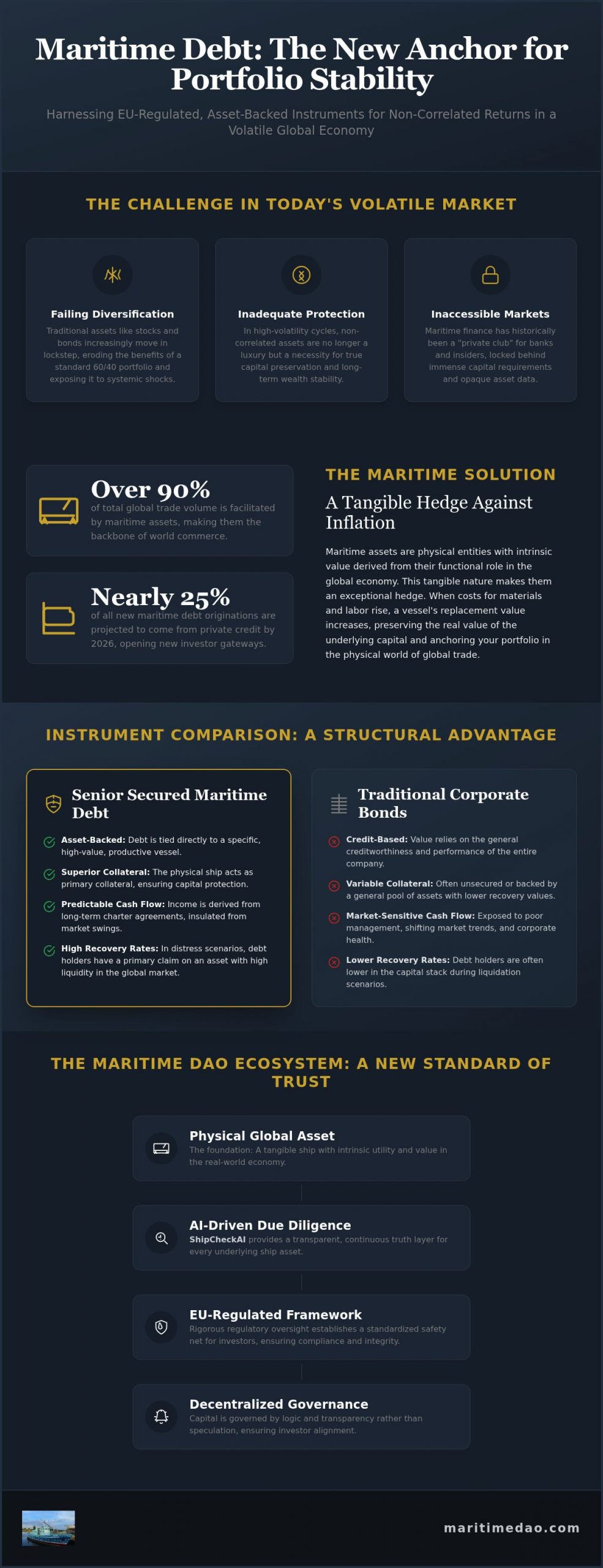
Real assets are tangible, physical entities that possess intrinsic value and utility. Their worth isn’t derived from a digital ledger or a government promise but from their functional role in the global economy. Ships represent the most vital category within this asset class. They are the backbone of global commerce, facilitating over 90% of total trade volume by moving the world’s energy, food, and commodities. This physical presence makes them an exceptional hedge against inflation. When the costs of raw materials and labor surge, the replacement value of a vessel rises accordingly, preserving the real value of the underlying capital.
The investment landscape is currently undergoing a fundamental shift. We’ve moved beyond the speculative hype of pure digital assets toward a model of “regulated innovation.” This approach combines the efficiency of a digital-first ecosystem with the sober reliability of institutional finance. By utilizing maritime debt instruments for portfolio stability, investors can anchor their wealth in the physical world of global trade while benefiting from modern, transparent governance structures.
Why Stability Matters in a Volatile Macro Economy
The traditional 60/40 portfolio has struggled to provide adequate protection in recent years. High-volatility cycles often cause stocks and bonds to move in the same direction, eroding the benefits of diversification. Non-correlated assets are no longer a luxury; they’re a necessity for capital preservation. Maritime debt provides this stability through consistent cash flows generated by lease and debt payments. These payments are often tied to long-term charter agreements, ensuring a predictable income stream that remains insulated from the daily fluctuations of equity markets.
Maritime Assets: The Untapped Frontier of Real Asset Investing
For decades, maritime finance was a “private club” restricted to Tier-1 banks and specialized shipping families. The barriers to entry were immense, requiring massive capital outlays and deep technical expertise. Financing typically involved a complex ship mortgage that was rarely available to the broader market. However, the industry has evolved. The transition from private bank clubs to public debt markets has opened new gateways for sophisticated investors. Understanding how to invest in maritime assets in 2026 is about identifying platforms that unite physical assets, govern them through EU-regulated frameworks, and open opportunities for non-correlated growth. This democratization ensures that maritime debt instruments for portfolio stability are now a viable pillar for any diversified strategy.
Understanding Maritime Debt Instruments as a Stability Layer
Maritime debt instruments for portfolio stability serve as a foundational pillar for investors seeking to decouple their returns from the volatility of traditional equity markets. These instruments, which encompass bonds, asset-backed securities (ABS), and private credit, provide a structural advantage through their “senior secured” status. In this framework, the debt is directly collateralized by the physical vessel, ensuring that the capital is protected by a tangible asset with global utility. If a maritime counterparty faces financial distress, the debt holder maintains a primary legal claim on the ship, which can be liquidated in a high-volume international market.
The reliability of this asset class is driven by a precise tripartite relationship between the shipowner, the charterer, and the debt holder. The shipowner manages the technical operations, the charterer provides steady revenue through long-term service contracts, and the debt holder receives fixed-income payments derived from these operational earnings. This ecosystem creates a predictable cash flow cycle that is fundamentally different from the speculative nature of growth stocks. By focusing on the debt layer, investors capture the steady “rent” of global trade without the direct exposure to the fluctuating profits of shipping companies.
Ship Investment Bonds vs. Traditional Corporate Bonds
Traditional corporate bonds rely on the general creditworthiness of a parent company, which can be eroded by poor management or shifting market trends. In contrast, ship investment bonds are asset-backed, meaning the value is tied to a specific, productive piece of infrastructure. Historical data indicates that recovery rates for maritime debt in liquidation scenarios often exceed those of generic corporate credit. The security of these assets has reached a new institutional standard in 2026 through EU regulated ship investment bonds, which provide investors with a harmonized legal “safety net” across European jurisdictions.
The Mechanics of Maritime Asset-Backed Securities (ABS)
Asset-Backed Securities allow for the pooling of individual vessel revenues into a unified, tradable instrument. This structure utilizes cash-flow waterfalls, a methodical hierarchy of payments that ensures bondholders are satisfied before any capital is distributed to lower-tier participants. Investors can choose between fleet-based debt for broad diversification or single-ship debt for concentrated exposure. Modern risk assessment must also account for regulatory costs, such as the EU Emissions Trading System for maritime transport, which influences the net income available to service the debt. For those ready to integrate these structures into their strategy, the Maritime DAO ecosystem offers a gateway to institutional-grade debt opportunities.
Risk Mitigation: The Role of EU Regulation and AI Due Diligence
The efficacy of maritime debt instruments for portfolio stability depends on a rigorous tripartite mitigation strategy that addresses operational, technical, and regulatory exposures. Operational risk involves the management and crewing of the vessel, while technical risk centers on the physical integrity of the hull and machinery. Regulatory risk has become increasingly complex in 2026, with the full implementation of Basel IV and tightening carbon intensity targets. EU financial regulation provides a standardized safety net by requiring strict prospectus disclosures and capital adequacy, ensuring that investors aren’t navigating the “black box” environments typical of legacy offshore maritime clubs.
Transparency is further fortified through the governance of a Decentralized Autonomous Organization (DAO). In this ecosystem, capital deployment is governed by transparent, on-chain protocols rather than the opaque decision-making of traditional private funds. This unified approach ensures that every dollar invested is tracked, governed, and protected by both legal frameworks and automated intelligence. By removing the veil of secrecy that once defined ship finance, we enable a more democratic and secure environment for institutional-grade capital.
ShipCheckAI: Transforming Physical Inspection into Financial Data
Technical risk has historically been the most difficult variable to quantify, often relying on subjective manual surveys that vary in quality. The emergence of the AI ship inspection tool has fundamentally altered this dynamic by utilizing multi-layered assessments to identify structural anomalies before they become financial liabilities. We have moved from a reliance on expert opinion to a reliance on granular, AI-driven data points. AI vessel surveys establish a definitive truth layer by converting physical steel condition into immutable financial data for bondholders.
Navigating the 2026 Regulatory Landscape
Success in the current market requires a commitment to maritime investment compliance frameworks that align with EU standards. These frameworks protect investors from jurisdictional ambiguity and ensure that all debt instruments adhere to modern ESG and anti-money laundering requirements. Smart contracts play a pivotal role here, automating compliance checks and coupon distributions to eliminate human error. This systematic approach ensures that maritime debt instruments for portfolio stability remain secure, liquid, and fully compliant with the evolving global regulatory architecture.
Comparing Maritime Debt to Traditional Fixed-Income Assets
The yield spread of maritime debt instruments for portfolio stability is particularly compelling when measured against the 10-year Treasury note. In July 2026, private maritime debt yields typically range from 550 to 900 basis points over the Secured Overnight Financing Rate (SOFR). When including original issue discounts and exit fees, the all-in yield often exceeds 10% to 12%. This represents a substantial premium over traditional fixed-income assets, driven largely by the “illiquidity premium.” Investors aren’t just buying a coupon; they’re providing essential capital to a sector where traditional bank lending has contracted due to Basel IV regulations, which increased capital requirements for ship loans by 15% to 25% this year. This supply-demand imbalance allows debt holders to command institutional-grade returns while maintaining a superior security position.
The relationship between maritime debt and global equity indices is characterized by low correlation, as shipping rates are driven by the physical constraints of global trade rather than market sentiment. During different stages of the economic cycle, maritime debt behaves with a predictable resilience. In inflationary periods, the value of the underlying vessel increases, while in contractionary phases, the essential nature of maritime transport ensures that senior debt remains serviced. This creates a stable, non-correlated income stream that protects the modern diversified portfolio from the “lockstep” movements typical of stocks and bonds.
Yield, Risk, and Correlation: A Side-by-Side Analysis
Default rates for senior secured maritime debt remain historically lower than those of high-yield corporate bonds. This is because a ship is a mobile, liquidatable asset with a global market, unlike a factory or a corporate headquarters. The impact of global trade volume on stability is mitigated by long-term charter agreements that lock in revenue regardless of short-term rate fluctuations. This structure makes maritime debt a defensive real asset play, offering a yield profile that rivals “junk” bonds but with the security of a physical, productive entity. Investors in 2026 also benefit from the “Green Discount,” where ESG-compliant vessels meeting IMO targets receive favorable financing terms, further de-risking the asset pool.
Portfolio Diversification Strategy
A balanced portfolio in 2026 should consider a strategic allocation to real asset debt to offset the high correlation of traditional financial instruments. Many sophisticated investors use the steady, high-yielding payments from maritime debt to fund opportunistic equity purchases during market downturns. The role of maritime DAO investment has been pivotal in modernizing this strategy, providing fractional access to a market that was once the exclusive domain of Tier-1 banks. With the on-chain value of tokenized real-world assets reaching $33.69 billion in May 2026, the infrastructure for this diversification is now both mature and regulated. You can access these institutional-grade yields today through our EU-regulated ecosystem.
Accessing the Future: Maritime DAO and Regulated Ship Bonds
The traditional barriers to maritime finance have finally been dismantled through the integration of decentralized governance and institutional-grade compliance. Maritime DAO functions as a visionary architect and a reliable gatekeeper, bridging the gap between the physical world of global shipping and the digital needs of global investors. By utilizing maritime debt instruments for portfolio stability, the platform democratizes access to a sector that was once the exclusive domain of elite bank syndicates. This ecosystem ensures that capital is no longer locked behind high entry minimums or opaque fund structures but is instead governed by transparent protocols and secured by physical, productive assets.
The structural integrity of this model relies on the continuous monitoring provided by ShipCheckAI. Unlike traditional investments where asset data is often static or outdated, our ecosystem provides bondholders with a persistent truth layer. This technology ensures that the value of the underlying vessel is verified through multi-layered assessments, protecting the bond’s collateral from technical deterioration or operational neglect. This fusion of heavy industry and high finance creates a first-of-its-kind opportunity for investors to participate in the growth of global trade with the security of a regulated framework.
The Maritime DAO Ecosystem: Governance Meets Compliance
Tokenized ship investment bonds function within a rigorous EU-regulated framework, providing the legal certainty required for significant capital allocation. The DAO structure allows the community to oversee the AI in maritime due diligence process, ensuring that every asset added to the ecosystem meets strict criteria for technical and financial viability. This creates a level of transparency that traditional quarterly fund statements cannot match. Investors benefit from real-time reporting and on-chain governance, where compliance is automated through smart contracts and every transaction is immutable. This unified approach provides a superior level of oversight, ensuring that capital deployment remains efficient, transparent, and fully aligned with investor interests.
Next Steps for the Stability-Focused Investor
Building a resilient portfolio with maritime debt requires a methodical assessment of your risk tolerance for alternative real assets. You should begin by evaluating specific ship bond issuances using the granular data provided by ShipCheckAI, focusing on the vessel’s age, technical condition, and charterer creditworthiness. EU-regulated fractional ownership allows you to diversify across multiple vessels or sectors, further de-risking your position while maintaining a high-yield profile. The path to non-correlated stability is no longer a “black box” reserved for institutions. You can explore the Maritime DAO platform today to begin integrating institutional-grade maritime debt into your diversification strategy.
Securing Your Position in the Global Trade Ecosystem
The integration of physical global trade with digital governance marks a definitive shift in how sophisticated capital is preserved. By choosing maritime debt instruments for portfolio stability, you’re anchoring your wealth in a tangible asset class that remains fundamentally non-correlated with traditional equity markets. We’ve moved beyond the era of opaque ship finance into a new standard of “regulated innovation.” This framework ensures that every investment is protected by an EU-regulated legal structure, verified through multi-layered ShipCheckAI vessel assessments, and governed by transparent DAO protocols.
Success in 2026 requires more than just diversification; it demands the structural integrity of real-world assets paired with the precision of automated intelligence. This ecosystem doesn’t just offer yields; it provides a methodical gateway to institutional-grade stability that was once inaccessible to the broader market. You’re now equipped with the data and the framework to protect your capital against inflationary pressures and market volatility. Secure your portfolio stability with EU-regulated maritime bonds at Maritime DAO and join a community of forward-thinking investors who value order, security, and the democratization of complex finance. It’s time to build a more resilient financial future.
Frequently Asked Questions
Are maritime debt instruments safer than shipping equities?
Maritime debt instruments for portfolio stability are generally considered lower risk than shipping equities because they’re anchored by senior secured status. While equity holders are exposed to the full volatility of corporate profits and market sentiment, debt holders maintain a primary legal claim on the physical vessel. This structure ensures that even if the operating company faces financial distress, your capital is protected by a tangible asset that can be liquidated in a high-volume international market.
How does EU regulation protect me when investing in ship bonds?
EU regulation provides a standardized legal safety net through strict prospectus requirements and capital adequacy frameworks that govern every issuance. By operating within these jurisdictions, ship bonds must adhere to rigorous transparency standards that eliminate the jurisdictional ambiguity often found in offshore maritime clubs. This oversight ensures that all financial instruments are governed by established legal precedents, protecting your capital from the “black box” risks of unregulated investment circles.
What happens to my investment if a ship in the portfolio is damaged?
Every vessel in a regulated bond portfolio is protected by mandatory, comprehensive insurance policies, including Hull and Machinery (H&M) and Protection and Indemnity (P&I) coverage. In the event of physical damage, insurance proceeds are typically assigned directly to the debt holders to ensure the bond’s principal remains secure. This structural safeguard ensures that technical operational risks don’t translate into permanent capital loss for the stability-focused investor.
Can retail investors access maritime debt instruments in 2026?
Yes, the democratization of maritime finance in 2026 allows retail investors to access fractional ship bonds through regulated, digital-first platforms. By utilizing a decentralized ecosystem, Maritime DAO bridges the gap that previously restricted this asset class to institutional tier-1 banks. While traditional entry requirements were once prohibitively high, tokenized structures now enable broader participation while maintaining strict EU-compliant onboarding and governance protocols.
How does ShipCheckAI actually verify the value of a vessel?
ShipCheckAI utilizes a multi-layered assessment protocol to convert physical vessel conditions into objective, data-driven financial reports. The system analyzes granular data points, including hull integrity, machinery performance, and maintenance history, to identify structural anomalies that manual surveys might overlook. This AI-driven approach establishes a definitive “truth layer” for the asset’s value, ensuring that the collateral backing your bond is accurately appraised and continuously monitored.
What is the typical maturity period for a maritime investment bond?
Typical maturity periods for ship investment bonds range from three to seven years, often aligned with the duration of the vessel’s underlying charter contracts. This timeframe provides a stable window for generating consistent cash flow while accounting for the cyclical nature of global trade. The specific duration depends on the vessel type and the strategic lifecycle of the asset within the broader maritime ecosystem.
How do maritime debt instruments perform during a global recession?
Maritime debt instruments for portfolio stability often demonstrate resilience during global recessions because they’re anchored by the essential movement of global commodities. While consumer-facing sectors may contract, the global demand for energy, grain, and raw materials maintains a baseline level of maritime activity. As senior secured creditors, bondholders are positioned at the top of the payment hierarchy, ensuring they receive distributions before equity partners or junior lenders.
Is there a secondary market for regulated ship investment bonds?
Yes, the integration of blockchain technology has facilitated a robust secondary market for tokenized ship bonds that didn’t exist in traditional finance. Unlike private maritime loans, which were notoriously illiquid, these digital-first instruments can be traded within a regulated ecosystem. This provides you with an exit gateway and real-time price transparency, significantly enhancing the liquidity profile of what was once a highly static asset class.