
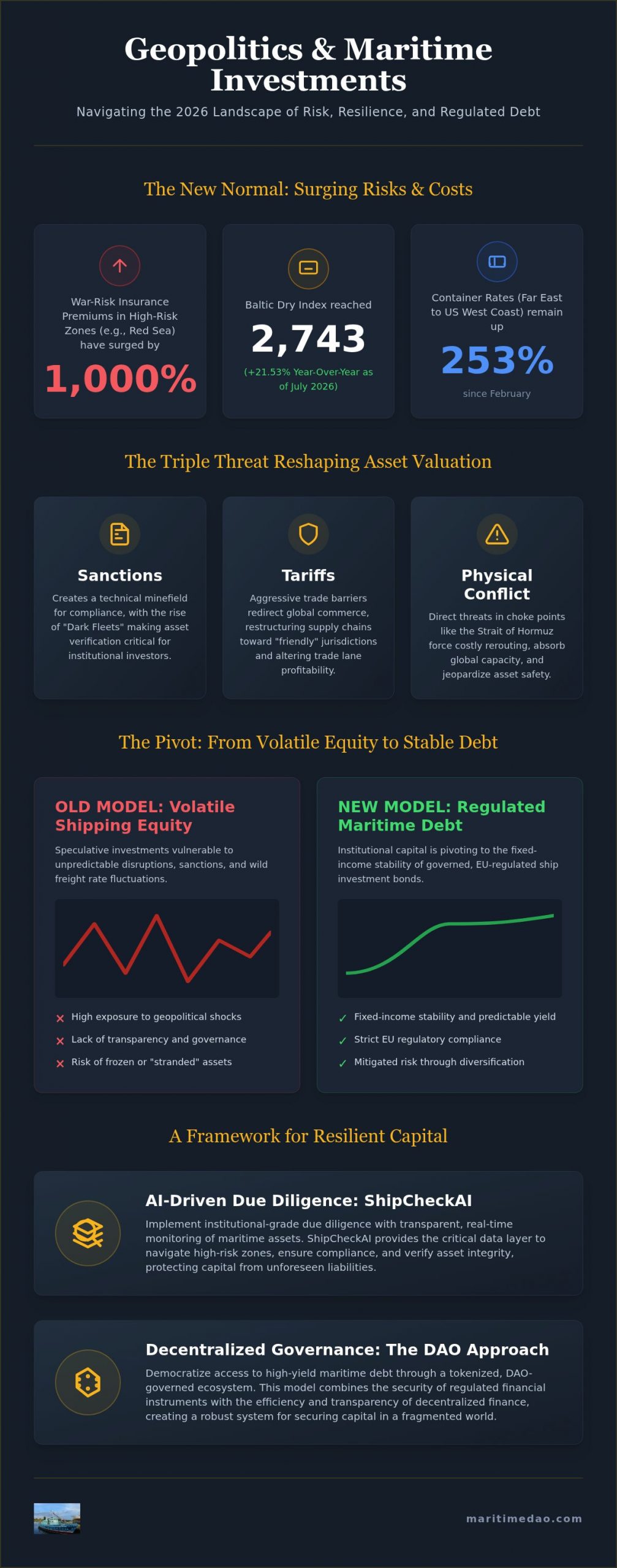
War-risk insurance premiums for voyages through the Red Sea and the Strait of Hormuz have surged by as much as 1,000 percent as of July 2026, fundamentally altering the calculus of maritime finance. You’ve likely watched with growing concern as unpredictable trade route disruptions and the constant threat of sanctions-related asset freezing erode the value of traditional shipping equity. It’s clear that old models of speculative investment can’t withstand a world where the Baltic Dry Index sits at 2,743 and container rates fluctuate wildly. This guide helps you analyze the impact of geopolitics on shipping investments to identify resilient opportunities in a landscape where volatility is the new baseline.
We’ll provide a rigorous framework for evaluating geopolitical risk while exploring a tripartite strategy of risk mitigation, regulatory compliance, and the shift from volatile equity to regulated maritime debt. You’ll learn how to leverage ShipCheckAI to achieve the asset transparency required for institutional-grade due diligence in 2026. By moving from speculative hype to a governed ecosystem of maritime bonds, you can protect your capital and capture yield in a fragmented global market.
Key Takeaways
- Analyze how the structural shift toward regionalized trade lanes and shifting ton-mile demand redefine the impact of geopolitics on shipping investments in 2026.
- Identify why institutional capital is pivoting from volatile shipping equity toward the fixed-income stability of EU-regulated ship investment bonds.
- Learn to implement AI-driven due diligence using ShipCheckAI to ensure transparent, real-time monitoring of maritime assets in high-risk zones.
- Discover how decentralized governance and tokenized finance are democratizing access to high-stakes maritime opportunities while maintaining strict regulatory compliance.
Navigating the 2026 Geopolitical Landscape in Global Shipping
Geopolitical Risk (GPR) in the maritime sector is a multifaceted architecture of physical threats, regulatory hurdles, and economic shifts. In 2026, the impact of geopolitics on shipping investments has transitioned from a peripheral concern to the central driver of asset valuation. This “new normal” is defined by the erosion of globalized trade lanes in favor of regionalized corridors. The Red Sea Effect persists, forcing vessels to maintain higher speeds and consume more bunker fuel to bypass choke points, which effectively tightens global capacity. Investors can’t afford a reactive stance. The current environment demands a proactive strategy that anticipates friction before it manifests as a loss. This requires a shift toward governed systems that provide structural integrity in an increasingly fragmented world.
The Triple Threat: Sanctions, Tariffs, and Physical Conflict
The return of aggressive tariff structures has acted as a primary catalyst for supply chain restructuring. These trade barriers don’t just increase costs. They redirect the flow of global commerce toward “friendly” jurisdictions. Simultaneously, the rise of “Dark Fleets” has made sanctions compliance a technical minefield for institutional investors. Asset managers must now navigate a landscape where maritime security issues escalate in the Strait of Hormuz and the Malacca Strait. A unified approach to risk must account for three critical pillars: asset safety, legal integrity, and economic viability. This governance is essential for protecting equity in a high-stakes environment where traditional insurance premiums have surged by as much as 1,000 percent in specific high-risk zones.
Sector-Specific Volatility: LNG vs. Dry Bulk
Market performance in 2026 remains highly fragmented across different vessel classes. LNG shipping has emerged as a sophisticated safe haven, underpinned by long-term energy security mandates and rigid infrastructure requirements. It offers a degree of insulation from the immediate shocks of trade wars. Conversely, the dry bulk sector remains tethered to the shifting tides of Chinese industrial policy. With the Baltic Dry Index reaching 2,743 in July 2026, a 21.53 percent year-over-year increase, the sensitivity of this sector to geopolitical posturing is undeniable. Container shipping faces its own unique challenges. Rates for a 40ft container have settled near $4,374, yet spot rates from the Far East to the US West Coast remain up 253 percent since February. Navigating this “bullwhip effect” requires a transparent understanding of how frontloaded imports collide with capacity constraints.
How Geopolitical Tensions Reshape Maritime Asset Valuation
The relationship between trade disruption and vessel “ton-mile” demand has become the primary driver of maritime asset valuation in 2026. When vessels are forced to reroute around the Cape of Good Hope to avoid conflict zones, the distance of a standard voyage increases significantly, effectively absorbing global capacity. This creates a supply-side squeeze that keeps newbuilding prices high even as interest rates and regional risks fluctuate. The impact of geopolitics on shipping investments is no longer just about freight rates; it’s about the widening gap between an asset’s book value and its replacement cost. Protectionist premiums now influence every transaction, as investors prioritize vessels that can navigate restricted corridors without triggering “stranded asset” status in sanctioned jurisdictions.
Valuing Assets in a Fragmented Global Market
Asset managers must now distinguish between a “Geopolitical Discount” and a “Scarcity Premium.” Ships operating in high-risk zones often face depressed valuations due to limited secondary market liquidity, yet compliant, high-spec vessels command record prices because they are essential for maintaining stable trade flows. In 2026, global tonnage growth has effectively decoupled from traditional GDP metrics as vessel demand is now dictated by the necessity of longer, circuitous routes rather than raw consumer consumption. This fragmentation creates pockets of extreme profitability for those who can identify resilient assets. Understanding the nuanced Global supply chain risks is critical for accurately modeling the terminal value of a maritime portfolio.
Compliance Costs and Their Impact on Net Yields
The rising cost of maritime investment compliance represents a significant drain on net returns in the current fiscal year. New 2026 regulations, such as the mandatory reporting of lost containers and the prohibition of PFOS in firefighting foams, add layers of operational expense that did not exist two years ago. Insurance premiums in high-risk zones have stabilized at elevated levels, often reaching 1 percent of a vessel’s value for a single transit through the Red Sea. These hurdles complicate cross-border capital deployment and require a unified approach to asset management. To navigate these complexities, many institutional players are exploring the structural stability offered by EU-regulated ship investment bonds, which provide a governed alternative to volatile equity positions.
The Paradox of Risk: Volatility as a Catalyst for Maritime Debt
The 2026 maritime market presents a unique paradox. While extreme volatility often deters capital, it simultaneously acts as a catalyst for more sophisticated financial structures. As geopolitical tensions in the shipping industry remain the primary concern for shipowners and financiers alike, we’re witnessing a profound shift in capital allocation. Institutional investors are increasingly rotating out of direct vessel equity, which bears the brunt of operational disruptions and asset freezing, and moving toward the security of EU regulated ship investment bonds. This flight to quality isn’t just a defensive maneuver. It’s a strategic recognition that in a high-tension environment, fixed-income instruments backed by physical assets provide a necessary buffer against the shocks of regional instability.
Equity vs. Debt: Where to Allocate in 2026?
Traditional ship ownership offers significant upside but leaves investors vulnerable to the total erosion of equity value during trade wars or sudden sanctions. In 2026, the risk-return profile has shifted. Maritime debt instruments sit higher in the capital stack, ensuring that bondholders receive priority during periods of market stress. This structural seniority, combined with the “regulated innovation” of an EU-governed framework, transforms shipping from a speculative bet into a predictable asset class. By utilizing asset-backed securities, investors can insulate themselves from the impact of geopolitics on shipping investments, focusing on yield rather than the volatility of a vessel’s spot-market valuation.
Yield Resilience in High-Tension Environments
Shipping bonds are uniquely positioned to capture the upside of increased ton-mile demand without the operational downside of direct ownership. When conflict forces rerouting, freight rates often surge. While an equity owner might see these gains offset by a 1,000 percent increase in war-risk insurance, a bondholder benefits from the underlying asset’s essential role in global trade. Securing capital in this fragmented world requires transparency. Forward-thinking firms are now utilizing Maritime DAO investment structures to provide real-time governance and asset clarity. This unified approach ensures that capital remains protected even when interest rate cycles and geopolitical shifts threaten traditional portfolios. Yield resilience is no longer an accident; it’s the result of a methodical transition to regulated, debt-focused ecosystems.
Mitigating Geopolitical Exposure through AI-Driven Due Diligence
The impact of geopolitics on shipping investments in 2026 has rendered traditional, manual due diligence obsolete. In a landscape where trade routes are rerouted overnight and sanctions lists are updated weekly, information asymmetry represents a systemic risk to capital. The shift toward AI in maritime due diligence allows investors to move beyond reactive snapshots and toward a continuous, data-driven understanding of asset condition. By automating the verification of vessel history and sanctions compliance, we replace subjective guesswork with institutional-grade certainty. This technological pillar ensures that every asset within a governed ecosystem remains transparent, compliant, and structurally sound.
ShipCheckAI: The New Standard for Vessel Assessment
ShipCheckAI has emerged as the definitive standard for vessel assessment in an era where manual surveys are often hindered by regional instability. By utilizing multi-point inspections that operate without human bias, this technology provides a transparent audit trail for every asset in a bond portfolio. High-accuracy data sets are no longer a luxury; they’re the foundation of maritime bond credit ratings, ensuring that capital is only deployed toward vessels that meet strict 2026 standards, including the latest SOLAS requirements for lifting appliances and MARPOL amendments on container reporting. AI ship inspection tools eliminate the physical risks associated with manual on-site visits in high-tension regions while providing instantaneous, verifiable data sets.
Real-Time Monitoring in High-Risk Trade Lanes
Persistent uncertainty in the Red Sea and the Strait of Hormuz requires 24/7 asset oversight that legacy systems simply cannot provide. Our ecosystem integrates satellite telemetry with automated intelligence to monitor vessel route deviations and detect “dark” activity, such as the unauthorized disabling of AIS transponders often associated with shadow fleets. This level of transparency builds essential trust for both retail and institutional investors, as it provides an immediate alert system for geopolitical friction. It’s a methodical approach to risk that protects yield from the unpredictable impact of geopolitics on shipping investments. If you’re ready to transition from speculative risk to a governed, tech-driven investment model, you can begin your journey through the Maritime DAO ecosystem today.
Securing Capital in a Fragmented World: The Maritime DAO Approach
Securing capital in a fragmented world requires a departure from legacy systems that are no longer equipped to handle rapid regional shifts. The traditional barriers to maritime finance are dissolving as the sector adopts a unified, digital-first architecture. This transition is essential because the impact of geopolitics on shipping investments has made legacy financing models too rigid to adapt to the “new normal” of 2026. By integrating the physical world of global trade with the digital world of blockchain, we’ve created a bridge that respects institutional requirements while embracing the efficiency of decentralized governance. This is not about speculative digital assets; it’s about a regulated innovation that uses code and law to protect global capital.
Governance within a DAO structure offers a level of asset clarity that traditional brokerage services cannot match. In our framework, investor interests are protected by a dual-layer system of EU financial law and immutable on-chain code. This decentralized approach ensures that every vessel in the portfolio is subject to the same rigorous standards of transparency, from its initial ShipCheckAI inspection to its ongoing operational compliance. It positions the DAO as a visionary architect of a new maritime fintech landscape that is resilient to the shocks of 2026. Understanding how to invest in maritime assets now involves moving away from opaque private deals toward a governed ecosystem.
The Power of Regulated Tokenized Bonds
Tokenization significantly lowers the barrier to entry for high-yield maritime assets, allowing a broader spectrum of investors to participate in a market once reserved for the ultra-wealthy. These EU-regulated ship investment bonds provide secondary market liquidity in a 24/7 trading environment, a stark contrast to the slow-moving secondary markets of traditional vessel ownership. Compliance isn’t a manual afterthought. It’s built directly into automated smart contracts that govern every transaction across multiple jurisdictions. This ensures that the impact of geopolitics on shipping investments is mitigated by real-time regulatory enforcement, providing a transparent and unified ecosystem for all participants. By utilizing tokenized debt, investors can maintain agility without sacrificing the security of institutional-grade finance.
Building a Resilient Maritime Portfolio for 2026
Strategic diversification across vessel types and trade routes is vital for absorbing the shocks of regionalization. A resilient portfolio in 2026 must balance high-demand LNG carriers with the cyclical opportunities found in dry bulk and container shipping. Maritime DAO acts as a reliable gatekeeper, ensuring that only institutional-grade assets enter the ecosystem after undergoing multi-point AI inspections. This methodical approach to portfolio construction focuses on three pillars: asset integrity, regulatory compliance, and yield stability. To begin your journey in regulated maritime finance, it’s essential to evaluate how these structural changes protect your capital from the volatility of traditional shipping equity. By embracing this unified framework, you secure your position in the future of global maritime trade.
Strategizing for a Resilient Maritime Future
The 2026 maritime landscape requires a fundamental pivot from speculative equity to the structural security of regulated debt. You’ve seen how regionalized trade and capacity constraints redefine asset valuation, making traditional investment models increasingly fragile. By integrating automated intelligence for asset assessment and embracing a governed financial ecosystem, investors can finally decouple their capital from the volatility of global friction. The impact of geopolitics on shipping investments is no longer a threat to be feared but a variable to be managed through transparency and institutional-grade due diligence.
It’s time to transition from reactive risk management to a proactive, tech-driven strategy that prioritizes order and security. You can secure your maritime capital with EU-regulated ship investment bonds at Maritime DAO, leveraging our unique EU-regulated framework and ShipCheckAI technology for unmatched asset clarity. This is a first-of-its-kind bridge between physical global trade and digital financial integrity. We invite you to join a community of visionary investors who value the democratization of complex shipping finance within a methodical, secure environment.
Frequently Asked Questions
How do 2026 tariffs specifically impact ship investment returns?
Tariffs act as a structural barrier that forces the regionalization of global supply chains. This shift increases ton-mile demand because goods often travel circuitous routes to reach neutral processing hubs before final delivery. While this can elevate freight rates, it simultaneously raises bunker fuel consumption and operational complexity, creating a fragmented environment where returns are dictated by a vessel’s ability to navigate these new trade barriers.
Is maritime debt safer than shipping equity in a trade war?
Maritime debt provides a significant layer of protection that equity cannot offer during periods of intense geopolitical instability. Because debt holders have a senior claim on the physical vessel, their capital is shielded from the total value erosion that often hits equity when specific trade routes are sanctioned. This seniority ensures that bondholders are prioritized in the capital stack, providing a predictable income stream even when market sentiment is volatile.
What role does AI play in assessing geopolitical risk for vessels?
AI quantifies risk by processing massive datasets that human analysts cannot monitor in real time. It utilizes satellite telemetry and AIS tracking to identify dark fleet patterns or unauthorized route deviations that might signal a sanctions breach. This automated oversight is crucial for understanding the impact of geopolitics on shipping investments, as it provides an early warning system that protects the portfolio’s legal and structural integrity.
Are EU-regulated ship investment bonds accessible to retail investors?
Tokenized EU-regulated ship investment bonds have democratized access to an industry that was once the exclusive domain of institutional giants. By utilizing a decentralized framework, investors can participate in maritime finance with significantly lower capital requirements than traditional vessel ownership. This inclusivity doesn’t sacrifice security; every bond remains governed by strict European financial frameworks and robust legal protections.
How does a Maritime DAO handle sanctions compliance?
Sanctions compliance is managed through a unified architecture of automated smart contracts and real-time data feeds. The system cross-references every transaction and vessel movement against global watchlists, effectively acting as a digital gatekeeper. This ensures the ecosystem’s assets aren’t compromised by illicit trade activity, maintaining a transparent and compliant environment for all global participants.
Can geopolitical conflict actually increase shipping bond yields?
Geopolitical conflict can paradoxically increase yields by creating artificial tonnage scarcity. When vessels are forced to avoid major choke points, the time required to complete a voyage increases, which effectively reduces the available global supply of ships. This supply-demand imbalance supports higher freight rates, which in turn provides more robust coverage for interest payments on maritime bonds and enhances the yield for the bondholder.
What is the difference between physical ship inspection and AI-driven assessment?
Physical inspections are manual, periodic, and often restricted by the same conflicts that drive market risk. In contrast, AI-driven assessments like ShipCheckAI offer a multi-point, objective analysis of a vessel’s condition through continuous data monitoring. This replaces subjective human reports with a transparent, verifiable audit trail that remains accessible to bondholders regardless of regional access restrictions.
How does the Red Sea disruption affect long-term maritime asset valuation?
The Red Sea disruption has fundamentally altered the impact of geopolitics on shipping investments by making operational resilience a primary valuation metric. Vessels that are technically equipped for long-haul circumnavigation now command a premium over ships designed solely for Suez-dependent routes. This shift prioritizes fuel efficiency and technical endurance as the long-term drivers of an asset’s market value in a permanently disrupted world.