
The traditional reliance on subjective broker sentiment and opaque private handshakes has reached its inevitable conclusion. For many, understanding ship valuation for investors remains a daunting hurdle, complicated by the inherent volatility of global freight rates and the logistical friction of assessing physical vessel integrity from a remote boardroom. You’ve likely felt the weight of these information asymmetries when attempting to gauge the true value of a maritime asset in a market that rarely offers total transparency.
This guide provides the strategic clarity you require, empowering you to master the complex methodologies and modern technological drivers that define vessel pricing in 2026. We’ll examine a tripartite framework that integrates real-time market data, AI-powered physical assessments through ShipCheckAI, and the structural security of EU-regulated maritime bonds. By bridging the gap between physical heavy industry and sophisticated financial governance, you’ll gain the confidence to navigate this high-stakes ecosystem with precision and institutional-grade insight. We move from the foundational mechanics of asset depreciation to the cutting-edge systems that govern modern maritime liquidity.
Key Takeaways
- Master the tripartite science of asset appraisal by integrating market-based comparisons, income projections, and AI-verified physical assessments.
- Gain a competitive edge in understanding ship valuation for investors by accounting for the critical impact of IMO 2026 green regulations and carbon intensity ratings.
- Reduce due diligence friction through digital twins and automated intelligence, utilizing ShipCheckAI to remove human subjectivity from vessel inspections.
- Identify why technical condition and maintenance history can often outweigh a vessel’s age in determining its true economic worth.
- Explore how EU-regulated ship investment bonds provide a transparent, institutional-grade gateway into the traditionally exclusive maritime asset class.
The Fundamentals of Maritime Asset Valuation for Investors
Ship valuation is the professional estimation of a vessel’s economic worth at a specific point in time. It represents a precise intersection of historical data, current market sentiment, and future earning potential. For those focused on shipping investments, this process differs fundamentally from other asset classes. Real estate offers the security of a fixed location but lacks the global mobility of a vessel; equities represent ownership in an entity where physical maintenance is often abstracted from the investor. In contrast, a ship is a mobile, depreciating factory that requires constant capital expenditure to remain seaworthy and compliant. Understanding ship valuation for investors requires a firm grasp of these unique physical and operational risks.
The cornerstone of this process is Fair Market Value (FMV). This concept defines the price at which an asset would change hands between a willing buyer and a willing seller, provided both parties have reasonable knowledge of relevant facts and neither is under compulsion. We’re now entering an era of regulated innovation where this legacy definition is being augmented by automated intelligence. This evolution ensures that valuation remains grounded in institutional reliability while adopting the speed and efficiency of modern data systems. It creates a unified framework where physical condition and market data are no longer siloed.
Why Ship Valuation is the “Black Box” of Finance
The maritime industry has long operated through private transactions and confidential handshakes. Unlike the residential housing market, no centralized database exists to track every sale in real time. This lack of transparency created a systemic information asymmetry, where established shipowners held a significant advantage over institutional outsiders. Mastering how to invest in maritime assets starts with breaking down these barriers. By digitizing valuation data, the industry moves away from “black box” pricing toward a transparent ecosystem that invites broader participation and reduces entry friction.
The Purpose of Valuation in the 2026 Investment Lifecycle
In the current financial landscape, valuations serve multiple strategic functions beyond simple divestment. They are the bedrock for bond issuance, secondary market trading, and secure lending. Accurate appraisals are also vital for maintaining maritime investment compliance, ensuring that asset-to-debt ratios remain within regulated limits. The industry is rapidly shifting from static, annual appraisals to real-time monitoring. Continuous data streams now allow investors to track how freight rate volatility and operational wear impact their holdings daily, replacing the traditional snapshot with a live, governed view of asset health.
The Three Pillars of Ship Valuation Methodology
Professional asset appraisal in the maritime sector relies on a tripartite framework to ensure accuracy and mitigate risk. To move beyond the limitations of subjective broker opinions, analysts utilize three distinct methodologies: the Market Approach, the Income Approach, and the Cost Approach. While the Cost Approach focuses on the replacement value of a vessel minus physical depreciation, it often serves as a theoretical ceiling rather than a reflection of current trade utility. Understanding ship valuation for investors requires recognizing how these three pillars interact to form a unified, data-driven perspective on an asset’s true worth. Relying on a single method in isolation often leads to skewed results, particularly during periods of high market volatility.
Market Comparison: The Power of “Sister Ship” Data
The Market Approach is the most common valuation tool, functioning similarly to real estate comparables. It relies on “last done” deals involving sister ships, which are vessels built to the same design specifications, often at the same shipyard. Several variables dictate the premium or discount applied to these comparisons. The shipyard of origin is a critical factor; for instance, Japanese-built vessels often command higher prices than those from smaller, unproven yards due to perceived build quality and longevity. Flag state and classification society records also play a role, as they indicate the regulatory standards the vessel has maintained. However, this approach has significant limitations during low-liquidity cycles when few transactions occur. In such cases, the lack of recent data can make it difficult to establish a reliable price floor without looking toward alternative methodologies.
Income-Based Valuation: Freight Rates and Time Charters
The Income Approach shifts the focus from historical sales to future earning potential. This method is particularly vital for institutional investors who view a ship as a cash-flow-generating instrument. The Baltic Dry Index (BDI) and other sector-specific benchmarks act as barometers for this valuation, as they dictate the daily hire rates a vessel can command. When a ship is secured under a long-term time charter, the contract acts as a guarantee, providing a layer of valuation stability that “spot market” vessels lack. To quantify this, analysts use a novel approach to ship valuation prediction that integrates historical rate cycles with forward-looking freight agreements.
At the heart of this pillar is the calculation of Net Present Value (NPV). In a maritime context, NPV represents the current worth of all projected future charter hire payments and the eventual scrap or resale value, discounted to account for the time value of money and specific maritime risk premiums. This calculation allows investors to determine if the current asking price aligns with the vessel’s ability to service debt and generate yield over its remaining operational life. It transforms a physical asset into a transparent financial projection.
A unified ecosystem triangulates these three pillars to eliminate the “black box” of traditional pricing. By combining market comparables with rigorous income modeling, investors can identify discrepancies between a ship’s price and its intrinsic value. To see how these methodologies are applied within a governed financial framework, you can explore the structure of regulated maritime investment bonds. This integrated approach ensures that every valuation is grounded in both physical reality and financial logic, providing the transparency necessary for significant capital commitments.
Key Variables Shaping Vessel Value in 2026
The landscape of maritime asset appraisal is shifting from simple age-based depreciation to a more nuanced assessment of technical utility and regulatory compliance. In 2026, understanding ship valuation for investors requires looking beyond the year of build to evaluate how a vessel fits into a decarbonizing global economy. We’re seeing a market where a well-maintained 10-year-old ship can actually command a higher premium than an 8-year-old vessel that lacks modern engine efficiencies or a robust maintenance history. This reality challenges legacy assumptions and demands a more sophisticated, data-driven approach to due diligence. It’s no longer enough to look at the hull; you must look at the data ecosystem surrounding it.
Several technical specifications now dictate the asset’s secondary market appeal. Engine efficiency, cargo capacity, and fuel flexibility, such as dual-fuel or LNG-ready systems, are no longer optional upgrades; they’re fundamental drivers of value. Global trade route shifts and supply chain disruptions also play a role, as certain vessel sizes or types become more or less relevant to emerging maritime corridors. Certified vessel valuation services are increasingly incorporating these micro-factors to provide a more accurate picture of an asset’s long-term viability. This granular approach ensures that capital is allocated to assets with the highest operational resilience.
The “Green Premium” and Stranded Asset Risk
The introduction of IMO 2026 and stringent EEXI/CII ratings has created a sharp divide in the market. Older, high-emission vessels are facing significant valuation “haircuts” as they become less competitive for charterers who must report their own carbon footprints. This has led to the rise of the “green premium,” where future-proof assets that meet or exceed environmental standards retain their value far better than their peers. For those looking to mitigate stranded asset risk, EU regulated ship investment bonds offer a strategic gateway, as these instruments typically favor green assets that align with European sustainability frameworks. Investing in vessels that fail these ratings today is a gamble on tomorrow’s obsolescence.
Micro-Factors: Maintenance Records and Survey Status
Beyond macro-trends, the specific maintenance lifecycle of a vessel is paramount. The Special Survey cycle, occurring every five years, represents a massive capital expenditure that can drastically swing a ship’s worth overnight. A vessel that has just passed its 15-year survey is often more valuable than one approaching its 20-year survey due to the immediate reduction in near-term dry-docking costs. “Class” status from reputable societies acts as the baseline for this transparency. ShipCheckAI now automates the verification of these maintenance milestones, ensuring that understanding ship valuation for investors is grounded in verified, multi-layered data rather than just self-reported logs. This level of granular verification is essential for maintaining the integrity of a regulated maritime portfolio and protecting institutional capital.
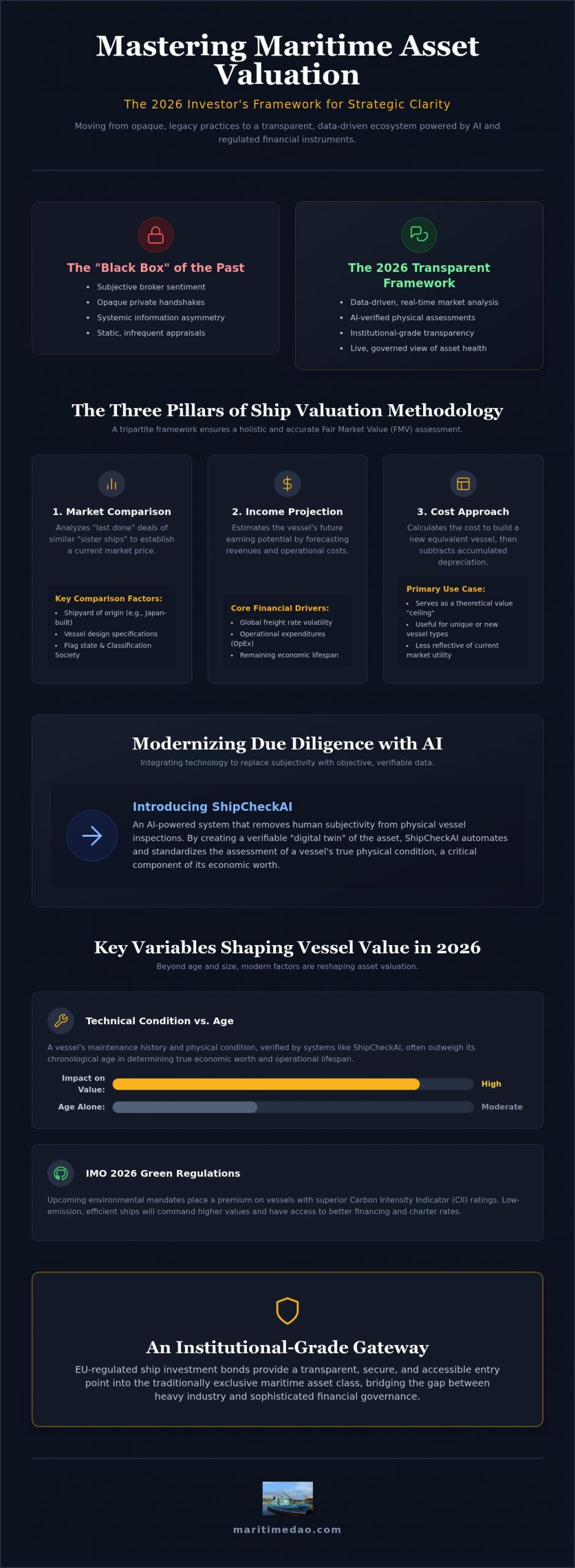
Modernizing Due Diligence: The Role of AI and Digital Twins
The transition from manual, checklist-based surveys to automated intelligence marks a paradigm shift in how we approach understanding ship valuation for investors. Traditional inspections often suffer from human subjectivity and geographical constraints, leading to inconsistent reports that can obscure an asset’s true condition. AI-driven platforms solve this by providing a standardized, multi-layered assessment that identifies structural fatigue and corrosion patterns invisible to the naked eye. This technology acts as the ultimate trust layer, bridging the gap between physical heavy industry and the precision required for institutional finance.
We’re moving away from static “snapshot” surveys toward the use of Digital Twins. These virtual replicas are fed by continuous data streams, reflecting the vessel’s real-time operational health rather than a single point in time. By analyzing thousands of data points across the hull and machinery, automated systems can predict maintenance failures before they occur. This foresight directly impacts an asset’s liquidity and resale value, ensuring that the valuation remains a living document rather than an outdated estimate. It allows for a more dynamic and accurate risk assessment that legacy systems simply cannot match.
ShipCheckAI: Transforming Inspection into Valuation Data
The deployment of an AI ship inspection tool like ShipCheckAI creates an immutable, verifiable audit trail for every asset in a portfolio. This system integrates various inspection protocols, including pre-purchase, annual, and damage assessments, into a unified data structure. The primary advantage is speed; where traditional inspections might take weeks to coordinate and finalize, AI-enhanced assessments can be completed in days. This rapid turnaround is essential for secondary market trading, where price volatility requires timely and accurate data to execute transactions. By digitizing the physical state of the ship, we turn subjective observations into actionable financial data.
Reducing Investor Risk through Transparent Governance
Implementing AI in maritime due diligence serves as a critical safeguard against overvaluation fraud and reporting errors. Within a DAO-governed ecosystem, these inspection records are stored on a transparent ledger, preventing any retroactive tampering with maintenance history or survey status. This level of governance ensures that all stakeholders have access to the same high-fidelity information. Crucially, AI-verified condition reports directly impact bond yield calculations by providing a clear risk profile of the underlying collateral. For those seeking to participate in this modernized market, you can explore how ShipCheckAI secures our asset-backed bonds to see this technology in action.
Navigating Regulated Ship Investments with Maritime DAO
Maritime DAO has engineered a solution that bridges the gap between physical maritime assets and institutional capital markets. By unifying valuation, inspection, and investment into a single, governed environment, we’ve eliminated the systemic inefficiencies that once plagued this sector. Understanding ship valuation for investors is no longer a matter of interpreting vague broker reports or navigating opaque private deals. Instead, it’s a process of engaging with a transparent, data-rich ecosystem where every asset is verified by automated intelligence. This approach transforms a traditionally exclusive industry into a first-of-its-kind marketplace for regulated innovation, where order and security are the primary pillars of every transaction.
The structure of EU-regulated ship investment bonds represents the logical conclusion of accurate, AI-driven valuation. These instruments provide the legal and financial framework necessary to offer fractionalized, asset-backed debt to a global audience, removing the high barriers to entry that previously restricted ship ownership. By anchoring digital governance in the physical reality of maritime trade, we’ve created a unified system that prioritizes structural integrity and regulatory compliance. Transparency in maritime DAO investment has become the new benchmark, ensuring that institutional and private investors alike operate with the same high-fidelity data. This is the democratization of heavy industry finance through the lens of institutional reliability.
From Valuation to Capital Allocation
The transition from a physical vessel to a financial instrument follows a methodical pipeline. It begins with a multi-layered ShipCheckAI assessment, which creates a digital twin of the vessel’s condition and operational history. This assessment is then integrated directly into a bond prospectus, providing an immutable record of the asset’s worth at the time of issuance. EU regulation provides the secure framework required for these digital assets, offering investors a level of protection that unregulated markets cannot match. You don’t have to rely on trust when you have a verifiable audit trail. Real-time monitoring allows you to track the ongoing health of your investment, ensuring the underlying collateral remains seaworthy and profitable throughout the bond’s lifecycle.
Next Steps for the 2026 Maritime Investor
Entering this market requires a commitment to data-driven decision-making. You can begin by reviewing the active bond offerings currently available on the platform, each backed by physical tonnage in high-demand sectors. Every offering is accompanied by detailed ShipCheckAI reports, giving you the tools to perform independent due diligence with institutional-grade precision. This level of transparency is designed to foster confidence and long-term participation in the maritime economy. Explore the Maritime DAO ecosystem to start your regulated investment journey and secure your position in the future of global trade finance.
Mastering the Future of Maritime Finance
The maritime industry is shedding its legacy of opacity in favor of a unified, data-driven ecosystem. Mastering the tripartite approach to valuation ensures that capital is no longer a gamble on sentiment but a commitment to verified physical and operational health. By integrating ShipCheckAI diagnostics with real-time market analytics, understanding ship valuation for investors becomes a precise science rather than a black-box art. We’ve explored how physical condition, green compliance ratings, and automated intelligence now dictate the secondary market appeal of every vessel. This shift from static appraisals to continuous data streams provides the structural integrity required for significant institutional commitments.
The future of global trade finance belongs to those who prioritize transparency and regulatory order. You don’t have to navigate these complexities alone. Secure your position in the maritime industry with EU-regulated ship investment bonds. Our platform is governed by European financial frameworks and powered by ShipCheckAI diagnostic precision, ensuring transparent DAO governance for all stakeholders. The horizon of global trade is open to those ready to lead with institutional-grade clarity.
Frequently Asked Questions
How often should a ship valuation be updated for an investment portfolio?
Ship valuations should be updated on a quarterly basis to account for the inherent volatility of freight markets and shifting global trade corridors. While traditional portfolios once relied on annual snapshots, the transition toward digital twins and automated data streams now allows for continuous monitoring of asset health. This frequency ensures that understanding ship valuation for investors remains accurate and reflects current market sentiment rather than outdated historical data.
What is the difference between Scrap Value and Market Value in shipping?
Scrap Value represents the price of the vessel’s lightweight tonnage if it were sold for recycling, whereas Market Value reflects its worth as a functional, trading asset. Market Value is typically much higher but fluctuates significantly based on charter rates and supply-demand cycles. During severe market downturns, the Market Value of an older vessel may converge with its Scrap Value, effectively setting a definitive price floor for the asset.
Can AI really replace a physical human ship surveyor for valuations?
AI doesn’t replace the human surveyor but instead augments the process by removing subjectivity and providing a standardized trust layer. Tools like ShipCheckAI utilize computer vision and sensor data to identify structural fatigue that might be missed by the naked eye. This hybrid approach ensures that valuations are grounded in multi-layered, verifiable, and transparent data points, creating a more reliable audit trail for institutional capital and regulatory compliance.
How do EU regulations protect investors in ship-backed bonds?
EU regulations protect investors by enforcing strict transparency requirements, standardized reporting, and rigorous governance frameworks for bond issuance. These legal structures ensure that the underlying assets are accurately appraised and that the investment vehicle operates within a governed financial ecosystem. By providing clear legal recourse and standardized risk disclosures, European frameworks reduce the systemic risks often associated with private maritime deals and unregulated digital assets.
Why do freight rates have such a high impact on vessel valuation?
Freight rates directly dictate a vessel’s earning potential, which is the primary driver of its Net Present Value calculation. When rates are high, the demand for tonnage increases, driving up secondary market prices for immediate delivery. Conversely, a drop in the Baltic Dry Index or other benchmarks can lead to a rapid contraction in asset values as the projected cash flow from future charters diminishes.
What is a “sister ship” and why is it vital for market-based valuation?
A sister ship is a vessel built to the same design specifications, often by the same shipyard, which serves as a critical benchmark for market-based appraisals. By analyzing last done sales of these identical assets, investors can triangulate a fair price floor based on recent transactions. This comparative methodology reduces the black box nature of ship pricing, provided that differences in maintenance history, technical upgrades, and survey status are properly accounted for.
How does the age of a vessel affect its depreciation curve in 2026?
In 2026, the depreciation curve is no longer a simple linear decline because technical utility and regulatory compliance now carry more weight than chronological age. A younger ship with inefficient engines may depreciate faster than an older vessel that has been retrofitted with dual-fuel systems or energy-saving devices. Understanding ship valuation for investors now requires evaluating the asset’s future-proof status rather than just its year of build to avoid stranded asset risk.
What happens to a ship’s value if it fails its environmental CII rating?
If a vessel fails its Carbon Intensity Indicator rating, it typically faces a steep valuation haircut due to its limited attractiveness to top-tier charterers. These assets become increasingly difficult to trade in regulated waters, often forcing owners to accept lower hire rates or invest in costly retrofits. This regulatory failure signals a high risk of technical obsolescence, potentially accelerating the vessel’s path toward its scrap value floor.