
The traditional era of opaque maritime reporting has officially ended; in 2026, a vessel’s physical integrity has become its most reliable financial ledger. You likely recognize the frustration of navigating a market where asset health is often obscured by legacy reporting and complex EU environmental mandates. It’s difficult to link a ship’s actual condition to its long-term financial risk when the data remains siloed and subjective.
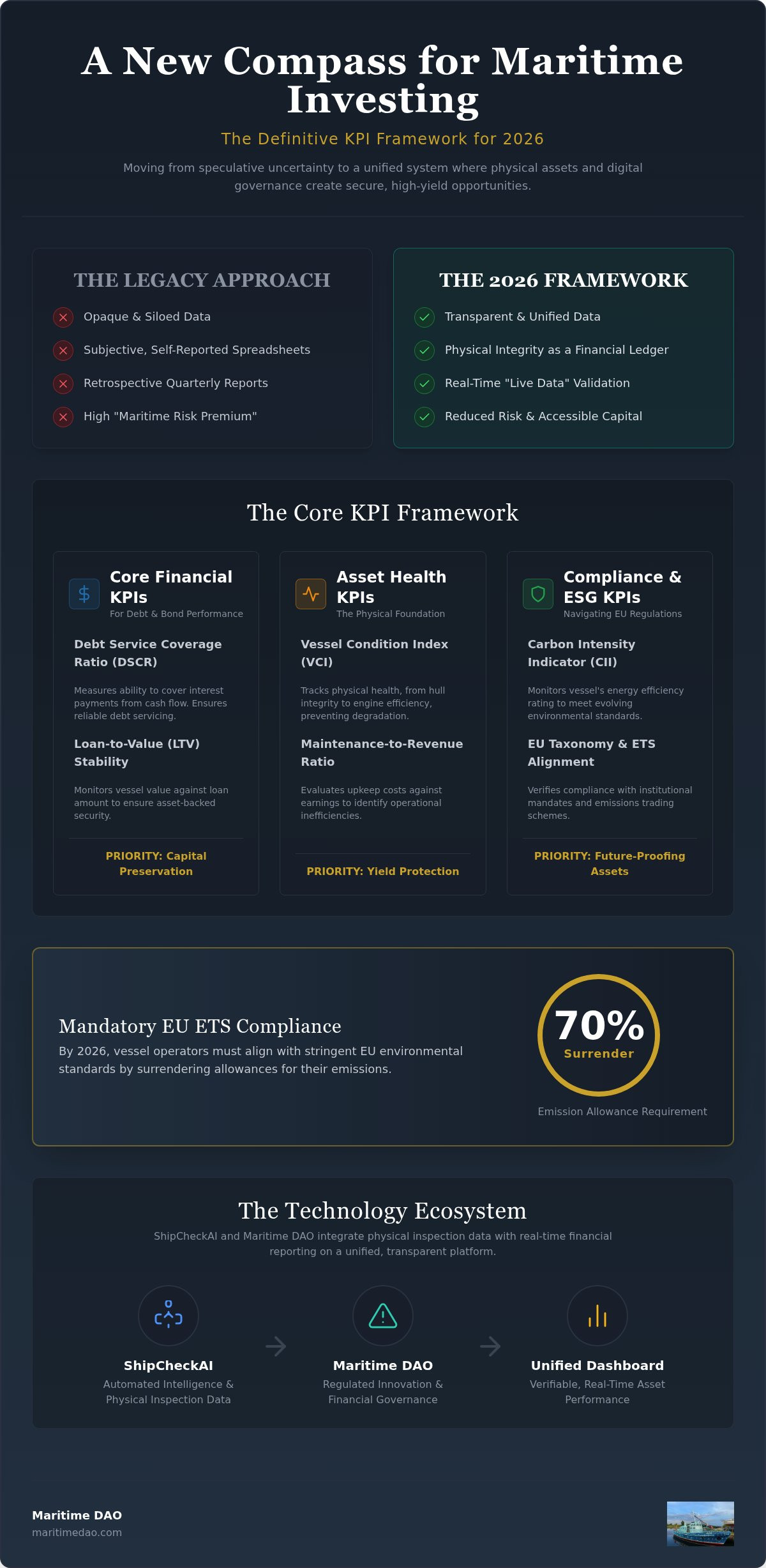
This article provides the definitive framework for key performance indicators for maritime investments, designed to help you mitigate risk and optimize yields within a governed digital ecosystem. You’ll master a comprehensive checklist of metrics to monitor bond performance, understand how ShipCheckAI utilizes automated intelligence to ensure transparency, and learn to align your assets with the 70% EU ETS emission surrender requirements. We’re moving from speculative uncertainty toward a unified system where physical assets and digital governance unite to create secure, high-stakes opportunities for the global investor.
Key Takeaways
- Distinguish between macro-market shifts and micro-asset metrics to construct a sophisticated maritime investment strategy grounded in operational reality.
- Master the essential key performance indicators for maritime investments, focusing on Debt Service Coverage Ratio (DSCR) and Loan-to-Value (LTV) stability to ensure reliable debt servicing.
- Evaluate asset health through the Vessel Condition Index (VCI) and maintenance-to-revenue ratios to prevent physical degradation from compromising financial yields.
- Align your portfolio with 2026 EU environmental standards by monitoring Carbon Intensity Indicators (CII) and verifying EU Taxonomy compliance for institutional mandates.
- Leverage ShipCheckAI and the Maritime DAO ecosystem to integrate physical inspection data with real-time financial reporting on a unified, transparent dashboard.
Defining Key Performance Indicators for Maritime Investments in 2026
A Key Performance Indicator (KPI) in the modern shipping sector is a quantifiable measure used to evaluate the financial health and operational viability of specific shipping assets. It’s no longer enough to rely on vague industry sentiment or self-reported spreadsheets. In 2026, key performance indicators for maritime investments serve as the essential bridge between physical vessel performance and institutional financial security. This framework allows investors to look past the historical “fog of the sea” to see exactly how their capital is being utilized and protected within a regulated ecosystem.
We categorize these metrics into two distinct layers. Macro indicators track market-wide trends, such as global trade volumes, port congestion levels, or broader freight rate indices. Micro indicators, however, are strictly asset-specific. They focus on an individual vessel’s engine efficiency, hull integrity, and regulatory compliance status. While macro trends might suggest the optimal time to enter a specific trade route, micro indicators determine which specific assets will actually deliver the promised yields and which ones represent a hidden liability.
The 2026 investment landscape requires a fundamental shift toward “Live Data” over retrospective quarterly reports. Waiting three months to discover an operational inefficiency or a maintenance lapse is a luxury the modern market doesn’t afford. Through a framework of “Regulated Innovation,” technology now validates financial claims in real-time. This ensures that every data point is verifiable, transparent, and compliant with the highest standards of institutional finance, moving the industry away from speculative estimates toward grounded, empirical truth.
The Shift from Operational to Financial KPIs
Investors must now look beyond traditional operational metrics like “Vessel Turnaround” to focus on “Net Yield” and “Asset Volatility.” While a fast port exit is a sign of good management, it’s the net yield after accounting for bunker fuel costs and EU carbon taxes that determines investment success. Transparency is the primary tool for reducing the “Maritime Risk Premium” that has historically kept institutional capital at a distance. When data is clear, the risk is lower, and capital becomes more accessible. The Maritime DAO ecosystem facilitates this data flow, connecting physical sensors and AI-driven inspections directly to financial dashboards to provide a unified view of asset performance.
Categorizing Metrics for Bondholders vs. Equity Owners
Bondholders and equity owners have different priorities, and their KPI dashboards should reflect that. Debt instruments require a relentless focus on capital preservation and interest coverage. Investors in EU regulated ship investment bonds prioritize asset-backed security. They need to know that the vessel’s value remains stable and that its cash flow can cover interest payments even in volatile markets. This focus on stability and downside protection ensures that maritime debt remains a reliable, high-integrity component of a diversified institutional portfolio.
Core Financial KPIs for Maritime Debt and Bond Performance
While equity investors often prioritize speculative upside, bondholders in the 2026 maritime market require a more disciplined focus on capital preservation and predictable cash flow. The primary key performance indicators for maritime investments in the debt sector revolve around a vessel’s ability to service its obligations without compromising its long-term operational integrity. This requires a shift from viewing a ship as a mere transport vehicle to treating it as a governed financial asset that must consistently produce measurable results within a transparent ecosystem.
To achieve this level of clarity, institutional investors rely on a synthesis of market data and asset-specific performance. Utilizing Maritime Administration performance data allows for a benchmark comparison between individual vessel performance and broader fleet statistics. This grounded approach ensures that financial claims are not just projections but are backed by the reality of global trade flows and port efficiency metrics. By integrating these data points, the Maritime DAO platform unites operational truth with financial governance, opening up secure pathways for significant capital deployment.
Monitoring Debt Service Coverage (DSCR)
The Debt Service Coverage Ratio remains the most critical metric for assessing a vessel’s solvency. In the context of shipping finance, DSCR is the ratio of operating income to total debt service. For 2026, the optimal DSCR range for maritime assets typically sits between 1.2x and 1.5x, providing a sufficient buffer against the inherent volatility of freight rates. Maritime DAO eliminates traditional reporting delays by using automated revenue tracking. This system ensures that bondholders see real-time income data, allowing for immediate intervention if the ratio dips below acceptable thresholds.
Asset Value and LTV Management
Loan-to-Value (LTV) stability is the second pillar of maritime debt security. Because vessel prices in the secondary market can fluctuate based on scrap steel values or environmental regulations, monitoring the underlying asset value against the bond issuance is vital. Rather than relying on generic market averages, our framework utilizes ShipCheckAI to provide a “Condition-Adjusted Value.” This metric accounts for the physical state of the ship, ensuring the LTV reflects the actual security of the investment. Understanding how these values fluctuate is essential for anyone learning how to invest in maritime assets with a focus on risk mitigation. Those interested in high-integrity debt instruments can explore regulated maritime opportunities to see how these KPIs function in a live environment.
- Charter Party Reliability: This KPI assesses the counterparty risk by evaluating the creditworthiness and historical performance of the vessel’s hirer.
- Yield-on-Cost: This measures the actual net return relative to the initial capital deployment, accounting for all operational overhead and regulatory fees.
- Cash-Flow-to-Debt: A broader measure of the vessel’s liquidity profile over a multi-year horizon, ensuring long-term sustainability.
Operational and Asset Health KPIs: The Physical Foundation
While financial ratios provide the necessary structure for an investment, the physical condition of the vessel provides its ultimate foundation. In 2026, the most sophisticated key performance indicators for maritime investments are those that bridge the gap between digital reporting and mechanical reality. Relying solely on fleet age is a legacy mistake that ignores operational nuances; a well-maintained twenty-year-old tanker often outperforms a neglected five-year-old vessel in both safety and yield. Investors must prioritize data points that reflect the actual state of the steel, the engine, and the safety systems to ensure capital protection.
This physical foundation is monitored through a tripartite focus on integrity, efficiency, and readiness. By integrating real-time sensor data with objective inspections, the Maritime DAO ecosystem transforms a ship from a distant, opaque machine into a transparent financial instrument. This visibility ensures that the relationship between physical assets and digital governance is clearly understood, allowing investors to move with confidence in a high-stakes environment where asset health is the primary driver of long-term value.
The Vessel Condition Index (VCI)
The industry has moved beyond binary “passed or failed” inspection reports. The Vessel Condition Index (VCI) provides a nuanced, composite health score that aggregates data from hull integrity, engine performance, and safety compliance. Because physical degradation almost always precedes financial distress, the VCI serves as a critical early warning system for bondholders. High-integrity data for this index is generated through AI in maritime due diligence, which utilizes automated intelligence to eliminate human bias and provide a verifiable baseline for asset health.
Minimizing Off-hire Risk
“Off-hire” refers to any period when a vessel is not earning revenue due to mechanical failure, unscheduled maintenance, or legal detention. For bondholders, every off-hire day translates directly into lost revenue potential and introduces immediate risk to interest distributions. By utilizing predictive maintenance protocols and real-time monitoring, operators can address minor technical issues before they escalate into catastrophic downtime. This proactive approach stabilizes cash flow and ensures that the asset remains a productive, yield-generating component of the investor’s portfolio.
Beyond downtime, institutional investors track two additional metrics to ensure long-term viability:
- Maintenance-to-Revenue Ratio: This KPI ensures the operator isn’t “running the asset into the ground” to artificially inflate short-term yields. A dangerously low ratio suggests that future CAPEX requirements will be severe.
- Technical Readiness Score: This metric predicts upcoming dry-docking costs and necessary equipment upgrades. It allows for precise financial planning and ensures the vessel is prepared for the rigorous demands of global trade routes.
By mastering these key performance indicators for maritime investments, you can look past the surface-level metrics and understand the true operational risk profile of your shipping assets.
Compliance and ESG KPIs: Navigating EU Regulations
The transition from physical asset health to regulatory standing is where many traditional investors lose visibility. In 2026, key performance indicators for maritime investments must include a rigorous assessment of environmental compliance, as a vessel’s license to operate is now inextricably linked to its carbon footprint. Regulatory pressure isn’t just a legal hurdle; it’s a direct driver of operational costs and asset liquidity. We’ve entered an era where a ship’s environmental rating is as critical to its valuation as its deadweight tonnage.
This regulatory landscape is governed by a complex interplay of international and regional mandates. By integrating compliance data directly into the investment framework, the Maritime DAO ecosystem ensures that every asset remains aligned with the latest standards. This transparency protects investors from the sudden “valuation shocks” that occur when vessels fall behind the curve of decarbonization. It’s about moving from reactive compliance to proactive asset management, where environmental efficiency is viewed as a primary financial asset.
Environmental Performance as a Financial Metric
The Carbon Intensity Indicator (CII) has evolved into a high-stakes financial metric. In 2026, the EU ETS phase-in requires shipping companies to surrender allowances for 70% of their reported 2025 emissions, with carbon prices currently trading near €83.29 per tonne. A vessel with a poor CII rating, specifically those falling into the ‘D’ or ‘E’ categories, faces more than just reputational damage. These assets risk becoming “stranded” as they incur higher ETS costs and face potential bans from EU ports. Conversely, vessels maintaining ‘A’ or ‘B’ ratings command higher charter rates, as charterers seek to minimize their own Scope 3 emissions and carbon tax liabilities.
Maintaining EU Regulatory Integrity
For risk-averse institutional players, maritime investment compliance represents the most critical KPI in the current landscape. Non-compliance results in a cascade of failures: heavy financial penalties, port detentions, and the immediate loss of “Green Bond” status, which can trigger debt covenants. The Maritime DAO governance model addresses this by automating compliance reporting, ensuring that every voyage is logged against EU Taxonomy and FuelEU Maritime standards. This creates a transparent, immutable record that satisfies both regulators and institutional auditors.
To maintain a robust portfolio, investors should monitor these specific compliance indicators:
- Regulatory Compliance Score: A unified metric tracking adherence to IMO 2026 GHG strategies and the 2% greenhouse gas intensity reduction mandated by FuelEU Maritime.
- Port State Control (PSC) Performance: Monitoring a vessel’s history of “clean” inspections to mitigate the risk of detention or safety-related delays.
- EU Taxonomy Alignment: Verifying that the asset meets the “Do No Significant Harm” criteria required for institutional ESG mandates.
By synthesizing these key performance indicators for maritime investments, the modern investor ensures that their capital is not just profitable, but also protected from the shifting tides of international law. To see these metrics in action, you can explore our regulated investment framework and discover how we bridge the gap between heavy industry and high finance.
Implementing KPI Tracking with ShipCheckAI and Maritime DAO
The transition from identifying key performance indicators for maritime investments to actively monitoring them requires a robust technological infrastructure. In 2026, the reliance on manual surveys and delayed financial statements has been replaced by a “Unified Dashboard” approach. This system merges real-time operational data with institutional financial reporting, ensuring that every stakeholder has a clear, unobstructed view of asset performance. By uniting physical truth with digital governance, we’ve created a framework where data is no longer a retrospective luxury but a live operational requirement.
This level of transparency is achieved through the strategic integration of automated intelligence and blockchain technology. While traditional maritime funds often leave investors in the dark for months, the Maritime DAO ecosystem provides immediate visibility into the underlying health of the fleet. This ensures that the relationship between a vessel’s physical condition and its financial yield is always transparent, governed by immutable records that cannot be altered or obscured. It’s a first-of-its-kind approach that brings the reliability of institutional finance to the high-growth potential of the maritime sector.
AI-Powered Asset Assessment
The core of this data integrity lies in the AI ship inspection tool known as ShipCheckAI. This platform transforms subjective physical inspections into objective, verifiable KPIs by utilizing advanced computer vision and digital checklists. By analyzing high-resolution visual data, the AI identifies specific corrosion patterns and structural anomalies to accurately predict future repair costs and maintenance cycles. This process drastically reduces human error and bias, providing investors with a precise “Vessel Condition Index” that serves as a reliable leading indicator for financial performance. As of July 2026, these assessments are live and operational, providing the empirical foundation for every bond issued within our ecosystem.
The Future of Regulated Maritime Finance
Tokenized bonds represent a paradigm shift in how we approach maritime debt. Unlike traditional private equity structures, tokenized instruments provide real-time KPI visibility that legacy funds simply cannot match. This democratization of institutional-grade due diligence means that all investors, regardless of their capital commitment, have access to the same high-integrity data. With the tokenized real-world asset (RWA) market reaching $185 billion in 2026, the demand for this level of transparency has never been higher. You can now use these key performance indicators for maritime investments to select assets with surgical precision, ensuring your portfolio is built on a foundation of regulated innovation. To begin your journey into transparent shipping finance, explore the Maritime DAO ecosystem and discover how we’re redefining the intersection of global trade and digital governance.
Navigating the Future of Maritime Capital
The 2026 maritime landscape demands a rigorous synthesis of physical truth and financial governance. Success is no longer found in speculative projections; it’s earned through the methodical monitoring of key performance indicators for maritime investments. By integrating debt service coverage ratios with real-time asset health scores and strict EU regulatory alignment, investors can finally bridge the gap between traditional shipping and modern digital finance.
Our ecosystem provides the structural integrity required to manage high-stakes capital in this new frontier. Through AI-driven transparency via ShipCheckAI, an EU-regulated financial framework, and real-time performance dashboards, we’ve unified the essential pillars of security, efficiency, and growth. You now have the professional tools to move from opaque reporting toward a future of governed innovation. Secure your capital with EU-regulated Ship Investment Bonds and position your portfolio at the intersection of global trade and institutional-grade technology. We’re ready to help you navigate this high-integrity investment landscape with total confidence.
Frequently Asked Questions
What are the most important KPIs for a first-time maritime investor?
First-time investors should prioritize a tripartite focus on the Debt Service Coverage Ratio (DSCR), Loan-to-Value (LTV) stability, and the Vessel Condition Index (VCI). These key performance indicators for maritime investments provide a balanced view of a vessel’s income potential, capital protection, and physical integrity. By monitoring these specific metrics, you can ensure that the asset is generating sufficient cash flow to service debt while maintaining its underlying market value.
How does the Carbon Intensity Indicator (CII) affect my bond yield?
The CII rating directly impacts a vessel’s net income by determining its liability under the EU Emissions Trading System (ETS). Vessels with poor ratings face higher carbon costs, currently trading near €83.29 per tonne, which reduces the capital available for bondholder distributions. This regulatory friction also introduces ‘stranded asset’ risk, as underperforming ships face potential bans from EU ports and lower demand from environmentally conscious charterers.
Can ShipCheckAI predict when a vessel will need major repairs?
ShipCheckAI utilizes automated intelligence to identify corrosion patterns and structural anomalies that often escape the human eye. By analyzing these physical indicators against historical maintenance data, the platform provides a Technical Readiness Score that forecasts upcoming CAPEX requirements. This proactive approach allows operators to schedule maintenance during planned downtime, effectively minimizing the risk of expensive, unscheduled off-hire periods that could disrupt investor yields.
Why is the Debt Service Coverage Ratio (DSCR) different for shipping than for real estate?
Shipping DSCR requirements are typically higher, ranging from 1.2x to 1.5x, to account for the extreme volatility of global freight rates and bunker fuel prices. Unlike real estate, where long-term leases provide predictable income, maritime assets operate in a high-stakes environment where market shifts can occur rapidly. This higher buffer ensures that the vessel remains solvent even during temporary market downturns or unexpected operational delays.
What happens to maritime bonds if a vessel’s condition KPI drops significantly?
A significant drop in the Vessel Condition Index (VCI) usually triggers a mandatory technical audit and may constitute a breach of debt covenants. This governance mechanism protects bondholders by forcing the operator to address maintenance lapses before they compromise the asset’s secondary market value. Maintaining a high-integrity condition score is essential for preserving the “Green” status of the bond and ensuring continued alignment with institutional mandates.
How often should maritime investment KPIs be reviewed by the investor?
While formal institutional audits occur quarterly, the 2026 framework allows for the real-time review of key performance indicators for maritime investments via unified digital dashboards. Continuous monitoring is essential in the modern market to identify operational inefficiencies or regulatory shifts as they happen. This shift toward live data transparency ensures that investors can make informed decisions based on the current reality of the asset rather than retrospective reports.
Is LTV (Loan-to-Value) the best measure of security in a maritime bond?
LTV is a critical pillar of security, but it’s most effective when used as a “Condition-Adjusted” metric. A standard LTV based on market averages can be misleading if the specific vessel has hidden technical defects or poor environmental ratings. By using ShipCheckAI to verify the actual physical state of the ship, we ensure that the LTV reflects the true security of the investment within a transparent, governed ecosystem.
How does Maritime DAO ensure the data in its KPI dashboard is accurate?
The Maritime DAO ecosystem ensures data accuracy by merging immutable blockchain records with objective, AI-driven inspection data from ShipCheckAI. This unified approach eliminates human bias and reporting delays, providing a “single source of truth” for all stakeholders. Every data point, from revenue logs to hull thickness measurements, is verifiable and transparent, ensuring that the relationship between physical assets and digital governance remains secure.