
The era of the “black box” maritime asset is officially over. For decades, the shipping industry remained a walled garden for institutional giants, guarded by opaque vessel reports and prohibitive capital requirements that left many searching for regulated shipping investment vehicles in vain. You’ve likely felt the frustration of wanting exposure to the backbone of global trade but fearing the lack of transparency or the complexity of maritime debt. It’s a valid concern, as the barrier to entry for high-yield maritime assets has historically been as deep and treacherous as the oceans themselves.
This guide demonstrates how the 2026 landscape has matured into a unified ecosystem of asset-backed security and institutional-grade transparency. By reading on, you’ll discover how the EU regulatory framework for shipping bonds provides a legal anchor for your capital, how AI-driven due diligence through platforms like ShipCheckAI automates the inspection process, and how new standards like the 2026 Rules for Intelligent Ships are transforming physical vessels into governed digital securities. We’ll break down the mechanics of these first-of-their-kind instruments, moving from the technicalities of the EU Emissions Trading System to the practicalities of identifying secure, high-yield opportunities in a modernized maritime market.
Key Takeaways
- Learn how the transition from private syndicates to public-facing regulated shipping investment vehicles is democratizing access to high-yield maritime debt while maintaining institutional-grade oversight.
- Identify the structural security of EU-regulated Ship Investment Bonds and how they provide a transparent, asset-backed alternative to traditional maritime financing.
- Understand the role of the EU Prospectus Regulation and MiFID II in creating a unified, governed framework for modern maritime capital markets.
- Discover how ShipCheckAI utilizes automated, multi-type vessel assessments to bridge the data gap and ensure the physical integrity of maritime assets.
- Learn the methodical steps for accessing this ecosystem through Maritime DAO, including institutional-grade onboarding and the review of AI-driven condition reports.
What are Regulated Shipping Investment Vehicles?
Regulated shipping investment vehicles are sophisticated financial instruments governed by national or international regulatory bodies, such as the European Securities and Markets Authority (ESMA). These structures facilitate the flow of capital into maritime assets while maintaining the same rigorous oversight found in traditional capital markets. By utilizing an Alternative investment framework, these vehicles transform what was once a “black box” industry into a standardized, transparent, and liquid asset class. They represent a fundamental shift in how global trade is financed, moving away from closed-door deals toward a unified ecosystem of regulated innovation.
For decades, maritime finance relied on private syndicates and opaque bank debt. This legacy system created high barriers to entry and left investors exposed to significant information gaps. Today, the industry’s evolution toward regulated shipping investment vehicles ensures that investor protection and standardized reporting are no longer optional. These vehicles provide the structural integrity required for institutional-grade participation, offering a clear path for capital to support the modernization of the global fleet. Within this landscape, Maritime DAO acts as a visionary architect, providing the unified governance and digital infrastructure necessary to manage these complex instruments with total precision.
The Evolution of Maritime Capital Markets
The transition from private placements to standardized debt securities has fundamentally altered the maritime risk profile. In the past, the “maritime risk premium” was often inflated by a lack of verifiable data and inconsistent legal protections. Regulatory oversight now compresses this premium by mandating strict disclosure requirements under frameworks like the EU Prospectus Regulation. This shift was accelerated in March 2026, when the first tokenized bonds received formal approval in Latvia, proving that decentralized technology can operate within a legally sound, regulated environment. Regulated shipping investment vehicles act as the definitive bridge between the heavy industrial requirements of global trade and the sophisticated governance of modern institutional finance.
Core Components of a Compliant Vehicle
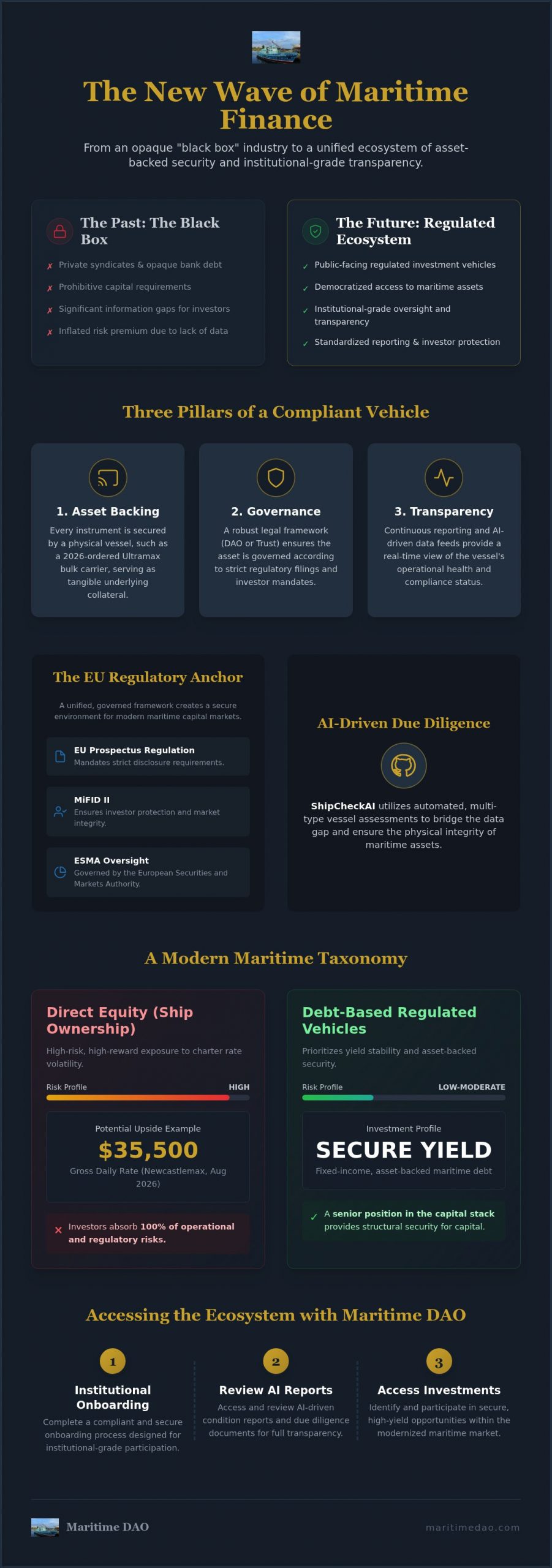
A compliant maritime vehicle isn’t merely a digital wrapper; it’s a multi-layered ecosystem designed to protect capital. These structures unite physical security, legal governance, and real-time transparency. To function effectively, a vehicle must integrate three specific pillars:
- Asset Backing: Every instrument is secured by a physical vessel, such as a 2026-ordered Ultramax bulk carrier, which serves as the underlying collateral.
- Governance: A robust legal framework, often managed through a DAO or Trust, ensures that the asset is governed according to strict regulatory filings and investor mandates.
- Transparency: Continuous reporting and AI-driven data feeds replace the outdated annual report, providing a transparent view of the vessel’s operational health and compliance status.
This tripartite approach ensures that the relationship between physical assets and digital governance is clearly understood. It’s a methodical system that replaces speculation with structural certainty.
Taxonomy of Modern Maritime Financial Instruments
The maritime financial landscape has bifurcated into two primary paths: the volatility of direct equity and the structured reliability of debt. While direct ship ownership offers the potential for significant upside during charter rate spikes, such as the $35,500 per day gross rate seen for Newcastlemax vessels in August 2026, it forces investors to absorb 100% of the operational and regulatory risks. Conversely, debt-based regulated shipping investment vehicles provide a senior position in the capital stack, prioritizing yield stability and asset-backed security over speculative gain. This taxonomy reflects a broader shift toward institutional-grade instruments that prioritize legal governance over traditional maritime “handshake” deals.
EU-Regulated Ship Investment Bonds
Fixed-income maritime debt has emerged as the gold standard for portfolios seeking uncorrelated returns. These bonds typically offer yield profiles linked to benchmarks like SOFR plus a spread, mirroring the SOFR + 1.40% rates seen in recent institutional loan agreements. For an instrument to be considered institutional-grade, it must be a prospectus-compliant offering that adheres to the EU Regulated Ship Investment Bonds: A Complete Guide. This regulatory alignment ensures that every bond is backed by a specific vessel or fleet, providing a transparent recovery path that legacy private placements simply cannot match.
Asset-Backed Securities (ABS) in Shipping
Securitization allows investors to diversify risk across multiple hulls rather than a single vessel. By pooling the charter hire cash flows from a fleet, ABS structures create a predictable income stream that is insulated from the operational failure of any individual ship. These vehicles rely on a robust EU Regulatory Framework for Maritime Finance to govern the flow of funds and ensure that credit enhancements, such as over-collateralization, remain intact. It’s a methodical approach to risk management that transforms the unpredictable nature of global trade into a steady financial product.
The Rise of Regulated Tokenized Assets
The most significant innovation in 2026 is the emergence of regulated tokenized debt, which utilizes blockchain as a governance layer rather than a speculative tool. Unlike unregulated digital assets, a Maritime DAO investment is grounded in legal compliance, using smart contracts to automate regulatory filings and distribution. By integrating blockchain with regulated shipping investment vehicles, we’ve created a unified system where transparency and efficiency coexist. These platforms enable fractional participation in high-value bonds, while 24/7 secondary markets provide the liquidity that traditional shipping funds lacked. If you’re ready to explore these modern instruments, you can review active bond offerings within our governed ecosystem.
The EU Regulatory Framework for Maritime Finance
The European Union has established the most robust legal foundation for regulated shipping investment vehicles, ensuring that maritime debt is no longer an outlier in global finance. Under the watchful eye of the European Securities and Markets Authority (ESMA), the industry has transitioned toward a unified standard of transparency that rivals traditional bond markets. This framework doesn’t merely suggest best practices; it mandates them through the Prospectus Regulation and MiFID II, creating a sanctuary for institutional capital that was previously deterred by the industry’s opaque nature. By requiring standardized reporting and rigorous investor protection, the EU has effectively demystified the “black box” of vessel ownership.
Central to this transformation is the integration of Anti-Money Laundering (AML) and Know Your Customer (KYC) requirements within digital ecosystems. While legacy shipping finance often struggled with the complexities of global jurisdictions, modern vehicles utilize automated protocols to ensure every participant is verified against international sanctions lists. This methodical approach to compliance allows for the democratization of maritime assets without sacrificing the security protocols required by major financial institutions. It is a system built on order, where the excitement of a new frontier is tempered by the sober reliability of institutional finance.
Standardized Disclosures and Investor Protection
A compliant maritime bond must offer more than a promise of yield; it requires a detailed prospectus that outlines vessel valuations, charterer creditworthiness, and environmental compliance scores. This is where maritime investment compliance becomes the bedrock of the vehicle’s stability. By requiring independent auditors and maritime experts to validate asset values, the EU ensures that bondholders have a transparent view of their collateral. These disclosures now include critical data on emissions under the EU Emissions Trading System (ETS), providing a comprehensive risk profile that accounts for both financial and regulatory headwinds.
Governance and the DAO Structure
Maritime DAO operates as a visionary architect, positioning the DAO structure as a regulated governance layer that fits precisely within the boundaries of EU law. Instead of relying on the discretionary decisions of a few individuals, the ecosystem utilizes smart contracts as a tool for automated regulatory enforcement. This shift from discretionary management to rule-based governance ensures that the terms of the bond are executed with mathematical precision. By baking compliance into the code, regulated shipping investment vehicles can manage complex distributions and secondary market trades 24/7, all while remaining fully aligned with the reporting mandates of MiFID II. It is a unified, transparent ecosystem that respects legacy legal systems while utilizing the efficiency of decentralized technology.
AI-Driven Due Diligence: Securing the Physical Asset
The “Information Gap” has historically been the primary friction point in maritime finance. Manual surveys are subjective and infrequent, leaving bondholders exposed to hidden structural decays or operational neglect. In the context of regulated shipping investment vehicles, where the physical hull serves as the primary collateral, this opacity is no longer acceptable. The industry is moving toward a model where the physical asset is continuously verified through AI in maritime due diligence, creating a high-fidelity “digital twin” that mirrors the vessel’s actual condition. This technological pillar ensures that the excitement of maritime yields is grounded in the sober reality of verified asset health.
Automated Vessel Assessment with ShipCheckAI
ShipCheckAI represents a paradigm shift in asset assessment, utilizing multi-type inspection protocols to analyze hull integrity, engine performance, and safety compliance with mathematical precision. This AI ship inspection tool eliminates the human error inherent in traditional surveys, providing a unified data set that informs both insurance premiums and bond ratings. By aligning with the “RULES FOR INTELLIGENT SHIPS 2026,” the platform ensures that every data point is standardized and actionable for institutional investors. High-accuracy data doesn’t just improve transparency; it compresses the maritime risk premium by proving the asset’s seaworthiness through objective, real-time metrics.
Mitigating Bondholder Risk
The new standard for 2026 replaces annual surveys with continuous condition monitoring, allowing for a proactive approach to risk management that protects the underlying capital. This transition ensures that minor mechanical faults are identified before they escalate into catastrophic failures that could devalue the collateral. By integrating real-time telemetry with historical performance benchmarks, AI transforms physical risk into quantifiable financial data. This methodical oversight provides a level of security that legacy private syndicates could never offer, turning a depreciating industrial machine into a stable, high-yield financial vehicle. You can access real-time condition reports for our active offerings to see this technology in action.
By uniting physical engineering with automated intelligence, we’ve built a gatekeeper that never sleeps. The result is a transparent ecosystem where the relationship between a physical vessel and its digital governance is perfectly synchronized, offering a level of structural integrity appropriate for significant capital investments.
How to Invest in Regulated Shipping Assets with Maritime DAO
Maritime DAO serves as the visionary architect and reliable gatekeeper for this modernized asset class. It’s not just a platform; it’s a unified gateway to regulated shipping investment vehicles. The process begins with institutional-grade onboarding, where global investors complete rigorous KYC and AML protocols within a secure portal. This isn’t a speculative digital asset exchange. It’s a methodical financial environment designed for significant capital deployment. By integrating legacy legal compliance with decentralized efficiency, we’ve built a bridge that allows capital to flow securely into the backbone of global trade.
The Investor Journey for 2026
Once verified, the investor journey transitions into active asset selection. You’ll gain access to a curated marketplace of EU-regulated instruments, ranging from traditional dry bulk carriers to next-generation green hydrogen tankers. Understanding how to invest in maritime assets in 2026 requires a focus on both yield and maturity. Investors can filter offerings based on vessel type, bond duration, and specific risk profiles, ensuring that every allocation aligns with their broader portfolio strategy. This structured approach replaces the “black box” of private syndicates with a clear, step-by-step guide to institutional maritime participation.
Transparency and Reporting
The hallmark of this ecosystem is the relationship between physical asset health and financial performance. As a bondholder, you don’t rely on quarterly summaries or vague emails. You access real-time inspection data from ShipCheckAI directly through your transparent dashboard. This high-frequency monitoring allows you to see the actual condition of the hull and engine room, providing a level of transparency that was previously impossible. Yield distributions are managed with mathematical precision via smart contracts, ensuring that payments are automated and governed by the strict terms of the prospectus. It’s a unified system where physical risk is transformed into quantifiable financial data.
This is the democratization of high-finance maritime debt. By bridging the gap between heavy industry and decentralized technology, we’ve created a system that values order, security, and institutional reliability. It’s time to move beyond the limitations of legacy ship brokerage and opaque private placements. Join the Maritime DAO to access regulated shipping investment vehicles today and secure your position in the future of global trade.
Navigating the Future of Maritime Capital
The transformation of maritime finance is no longer a distant vision; it’s a functioning reality governed by strict legal frameworks and automated intelligence. We’ve moved from the era of opaque private syndicates to a unified ecosystem where regulated shipping investment vehicles provide institutional-grade security for global capital. By aligning the EU-Regulated Compliance Framework with AI-powered due diligence via ShipCheckAI, the industry has successfully bridged the gap between physical assets and digital governance.
Transparent DAO governance ensures that every bond is managed with mathematical precision, protecting investor interests while democratizing access to high-yield maritime debt. This methodical integration of technology and law creates a stable foundation for the next generation of global trade finance. You’re invited to Explore EU-Regulated Ship Investment Bonds on Maritime DAO and see how structured transparency is redefining the capital markets. The horizon for maritime investment has never been clearer, and the tools for secure participation are finally within reach.
Frequently Asked Questions
What makes a shipping investment vehicle ‘regulated’ in the EU?
A shipping investment vehicle is considered regulated in the EU when it adheres to the Prospectus Regulation and MiFID II reporting standards under the oversight of the European Securities and Markets Authority (ESMA). These regulated shipping investment vehicles must provide standardized legal disclosures that detail asset valuations, risk profiles, and governance structures. This framework ensures that instruments are governed by a unified legal structure; it provides a layer of institutional-grade security for global capital.
How do EU-regulated ship investment bonds differ from traditional shipping stocks?
EU-regulated ship investment bonds represent a debt position with senior claims on a physical vessel, whereas traditional shipping stocks are equity investments in a company’s total performance. While stocks are subject to market volatility and corporate management decisions, bonds offer a structured yield profile secured by specific maritime assets. This debt-first approach provides a more predictable recovery path for investors compared to the speculative nature of the public equity markets.
Can retail investors access regulated maritime debt vehicles in 2026?
Retail investors can access these instruments in 2026 through fractional ownership platforms and tokenized bond offerings that have received formal regulatory approval. While traditional maritime finance was restricted to institutional syndicates, new digital gateways allow for lower entry points, sometimes as low as $10,000. These platforms utilize institutional-grade KYC and AML protocols to ensure that all participants operate within a compliant and governed ecosystem that values order and security.
What is the role of ShipCheckAI in securing my investment?
ShipCheckAI secures your investment by providing continuous, AI-driven vessel assessments that replace the outdated model of infrequent manual surveys. The platform utilizes multi-type inspections to monitor hull integrity and engine performance in real-time, creating a high-fidelity digital twin of the physical asset. This automated intelligence ensures that any mechanical or structural risks are identified early; it preserves the value of the collateral backing your bond through objective, data-driven oversight.
Is a Maritime DAO investment considered a safe-haven asset?
A Maritime DAO investment is primarily classified as an asset-backed debt instrument rather than a traditional safe-haven asset like gold or government treasuries. While it offers returns that are often uncorrelated with broader financial markets, it remains subject to maritime industry risks and global trade fluctuations. The structured nature of these regulated shipping investment vehicles aims to mitigate these risks through transparent governance, physical collateral, and the sober reliability of institutional finance.
How does tokenization impact the liquidity of shipping bonds?
Tokenization significantly enhances liquidity by enabling 24/7 secondary market trading on regulated digital asset exchanges. In the past, maritime debt was often locked in for the duration of the bond term, making it difficult for investors to exit their positions. By fractionalizing the bond into digital units, tokenization allows for more efficient price discovery; it provides a streamlined mechanism for investors to rebalance their portfolios without waiting for the instrument to reach maturity.
What are the typical yields for regulated maritime debt instruments?
Typical yields for these debt instruments are often structured as a spread over benchmarks like the Secured Overnight Financing Rate (SOFR). In mid-2026, institutional-grade maritime loans have been observed at rates such as SOFR plus 1.40% for five-year maturities. These yields reflect the senior position of the debt and the underlying security provided by the physical vessel, balancing competitive returns with the methodical risk management required by sophisticated global investors.
What happens to my investment if a vessel fails an inspection?
If a vessel fails an automated AI inspection, the governed ecosystem triggers an immediate alert for remedial action to be taken by the ship manager. Because the bond is governed by a transparent legal framework, failure to address critical faults can lead to a breach of covenant, allowing bondholders to exercise their rights over the collateral. The continuous monitoring provided by ShipCheckAI ensures that such issues are managed proactively before they impact the financial stability of the vehicle.