
In 2026, the era of the “black box” maritime asset is officially over. You’ve likely experienced the frustration of slow due diligence cycles that delay acquisitions and the lack of transparency in a vessel’s condition history that clouds true asset valuation. The industry has long accepted these inconsistencies as the cost of doing business, yet the margin for error has vanished under the weight of new 2026 regulatory mandates. Institutional investors now require more than just a surveyor’s opinion; they demand a verifiable, data-driven foundation for every capital deployment.
Integrating high-precision pre-purchase vessel inspection software is the essential bridge between physical maritime assets and regulated capital markets. This guide explores how AI-driven data verification transforms due diligence into a governed, high-fidelity financial asset. We’ll examine how ShipCheckAI and EU-regulated frameworks unify inspection, compliance, and financing into a single, transparent ecosystem. You’ll discover how to reduce investment risk through AI-verified data, navigate the 11% carbon intensity reduction factor requirements, and ensure a seamless transition from the initial survey to bond-backed acquisition.
Key Takeaways
- Understand the paradigm shift from subjective PDF reports to high-fidelity digital condition assessments as the new requirement for maritime asset management.
- Learn how to leverage institutional-grade pre-purchase vessel inspection software to eliminate human error and secure a unified data record for rigorous due diligence.
- Identify critical selection criteria for global asset managers, including API compatibility and the capacity to manage diverse ship inspection types across a unified platform.
- Discover how AI-driven verification through ShipCheckAI acts as the primary data validator for EU-regulated ship investment bonds within a transparent DAO ecosystem.
- Master the transition from fragmented manual surveys to a standardized, regulated financial asset framework to significantly reduce investment risk.
The Evolution of Pre-purchase Vessel Inspection Software in 2026
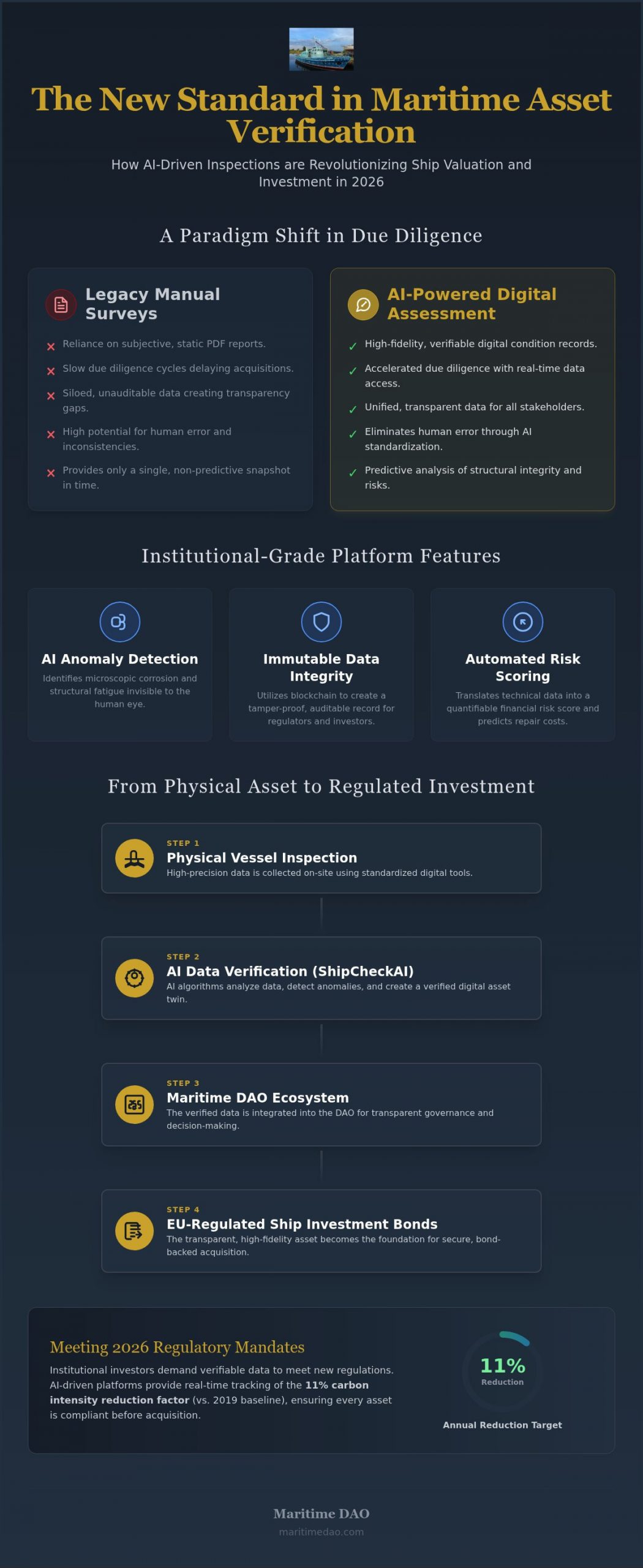
The maritime industry is undergoing a structural transformation. Legacy inspection methods, once reliant on the subjective eye of a single surveyor, are being replaced by high-fidelity digital ecosystems. In 2026, the reliance on static PDF reports has become a liability for institutional asset managers. These documents are siloed, difficult to audit, and fail to provide the real-time connectivity required for modern high-stakes acquisition cycles. Modern pre-purchase vessel inspection software serves as a unified gateway, bridging the gap between physical condition and financial valuation.
From Manual Checklists to Automated Intelligence
Legacy methods often fail to identify long-term structural fatigue hidden beneath surface coatings. Traditional Vessel safety surveys provided a snapshot in time, yet they lacked the predictive power of 2026 technology. Today, AI-assisted image recognition analyzes thousands of hull photos to detect microscopic corrosion patterns and coating degradation with superhuman precision. This evolution ensures that data inputs are standardized across global surveyor networks, creating a consistent reporting framework that eliminates the variances inherent in manual checklists. By automating the identification of structural anomalies, the software provides a layer of structural integrity that manual surveys simply cannot replicate.
Why Institutional Investors Demand Software Integration
The speed of global trade requires a corresponding acceleration in due diligence. Institutional investors use pre-purchase vessel inspection software to reduce the “due diligence gap” that typically exists between the physical survey and the financial closing. Verifiable, high-fidelity data is no longer optional; it’s a structural requirement for EU-regulated maritime debt instruments. This transparency is particularly critical within the Maritime DAO investment ecosystem, where decentralized governance relies on automated intelligence to validate asset integrity. Modern platforms now integrate real-time tracking of the 11% carbon intensity reduction factor, ensuring vessels meet the 2026 annual reduction targets relative to the 2019 baseline. This synergy between physical condition and digital governance ensures that every acquisition is backed by a transparent, immutable record of truth.
Core Features for Institutional-Grade Vessel Condition Assessment
Institutional-grade pre-purchase vessel inspection software must transcend basic data collection. It functions as a sophisticated gateway that satisfies the technical requirements of the surveyor while providing the financial clarity required by the financier. This synergy is achieved through cloud-based synchronization, advanced data encryption, and blockchain-backed integrity. These pillars allow stakeholders across global time zones to access live survey data during critical acquisition phases, ensuring that decisions are based on the most current information available. While U.S. Coast Guard vessel inspection regulations provide the legal baseline for physical safety, institutional software adds a layer of financial accountability that legacy systems lack. Multi-user permissioning further governs this environment, allowing owners, prospective buyers, and regulatory bodies to interact with the data without compromising the record’s structural integrity.
AI-Powered Anomaly Detection and Risk Scoring
Machine learning models now compare current vessel status against a global knowledge graph of fleet-wide benchmarks. This allows for the automated identification of “red flag” maintenance issues by cross-referencing historical data with real-time findings. Predictive cost-to-repair modeling provides an immediate financial impact assessment, turning raw technical data into actionable investment intelligence. By quantifying risk through automated scoring, the software eliminates the ambiguity that often plagues manual reports. This capability is a significant advancement over standard maintenance logs, providing a methodical approach to asset valuation that honors both physical reality and financial logic.
Standardized Reporting and ESG Compliance
The software streamlines the generation of vessel assessment for financing documents, ensuring that every report aligns with the stringent requirements of P&I clubs and bondholders. Environmental compliance is no longer a secondary consideration. Platforms now track Carbon Intensity Indicator (CII) and EEXI metrics directly during the pre-purchase audit. For vessels aiming to satisfy the 2026 11% reduction factor, this data is vital for securing competitive financing. Investors seeking a unified approach to these complex requirements often look to the Maritime DAO ecosystem to bridge the gap between technical reality and digital governance.
AI vs. Manual Surveys: Enhancing Accuracy in Maritime Due Diligence
Traditional vessel surveys rely on the finite capacity of human observation, a methodology prone to fatigue and inconsistent data capture. In the high-stakes environment of 2026 maritime finance, this subjectivity represents an unhedged risk. The transition to digital frameworks resolves the “lost data” problem by ensuring every observation is recorded in a unified environment. By utilizing geo-tagged photographic evidence, each finding is anchored to a specific physical coordinate and timestamp, creating a high-fidelity audit trail that manual reports cannot replicate. While manual report drafting historically averages 4.25 hours, AI-first tools reduce this requirement to approximately 15 minutes of review. This acceleration allows asset managers to move from inspection to financial closing with unprecedented speed, ensuring that acquisition windows aren’t missed due to administrative lag.
The Role of Computer Vision in Hull and Machinery Audits
Computer vision algorithms now process ultrasonic thickness measurements and structural data with mathematical precision. These systems identify structural thinning and coating failures that are often invisible to the naked eye, particularly in ballast tanks and high-stress machinery spaces. By cross-referencing current findings with historical fleet data, the software flags anomalies that a human surveyor might overlook during a standard walkthrough. Integrating automated pattern recognition into pre-purchase vessel inspection software increases ship inspection accuracy by 30% through the systematic identification of anomalies across vast technical datasets.
Data Integrity and the Blockchain Bridge
Accuracy is only as valuable as the integrity of the record. To prevent post-inspection tampering or the modification of survey findings, modern platforms utilize a blockchain bridge to secure data at the point of capture. This creates an immutable record that is essential for secondary market bond trading, where the underlying asset’s condition must be verified by a neutral, digital gatekeeper. Maritime DAO utilizes this decentralized governance model to ensure that every vessel assessment is governed by transparent, verifiable protocols. By anchoring physical condition data to a digital ledger, the ecosystem provides institutional investors with the structural certainty required for large-scale capital deployment in a regulated environment.
A Selection Framework for Global Maritime Asset Managers
Selecting pre-purchase vessel inspection software isn’t merely a technical choice; it’s a strategic alignment with institutional risk management. Asset managers must prioritize platforms that offer deep API compatibility with existing maritime fintech systems to ensure a unified data stream. This connectivity allows for the immediate translation of technical survey findings into financial risk models, ensuring that capital is deployed only on assets that meet specific yield and safety profiles. The platform must also demonstrate the versatility to handle multiple ship inspection types, ranging from standard condition assessments to specialized audits required for the September 30, 2026, EU ETS allowance deadlines.
High-quality automated reporting is the final pillar of this framework. For a vessel to qualify for EU-regulated ship investment bonds, the software must generate reports that meet the rigorous standards of institutional financiers. These outputs should synthesize complex technical data into concise executive summaries that highlight asset valuation, maintenance liabilities, and regulatory status. A robust system will unify data capture, govern user access, and secure the final record to provide a comprehensive view of the asset’s investment potential.
Assessing Regulatory and Compliance Alignment
Compliance is the bedrock of institutional maritime finance. Software must adhere to maritime investment compliance protocols, particularly regarding the issuance of regulated debt instruments. This includes the integration of KYC and AML verification for all stakeholders interacting with the survey data. Comprehensive audit trails are mandatory; the system must record every inspection step and data modification to satisfy future regulatory reviews or secondary market due diligence. In 2026, verifying the 11% carbon intensity reduction factor is a critical compliance check that must be integrated into the software’s core audit logic.
Scalability for Global Fleet Acquisitions
Managing a global acquisition pipeline requires a platform that scales across time zones and vessel classes. Offline-first mobile applications are essential for surveyors working in remote shipyards or deep-hull environments where connectivity is non-existent. These tools ensure data capture is never interrupted, while centralized dashboards provide C-suite visibility into the status of every active acquisition. By unifying these operational pillars, managers can effectively govern large-scale fleet expansions with precision. To begin standardizing your fleet due diligence, explore the ShipCheckAI ecosystem at Maritime DAO.
Integrating ShipCheckAI into the Maritime DAO Ecosystem
ShipCheckAI functions as the primary data validator within the Maritime DAO ecosystem, transforming raw technical findings into the structured data required for institutional-grade finance. While traditional software stops at the generation of a report, this platform continues into the investment phase by serving as the prerequisite for asset-backed security issuance. By using high-precision pre-purchase vessel inspection software, the ecosystem ensures that every vessel entering the pool meets specific structural and regulatory criteria. This synergy between AI-driven surveys and EU-regulated financial instruments creates a unified pipeline where technical truth directly informs capital allocation. The result is a seamless transition from physical inspection to the issuance of debt instruments, governed by transparency and structural integrity.
ShipCheckAI: The Gateway to Regulated Ship Investment Bonds
Standardizing pre-purchase data is essential to meet the rigorous transparency demands of institutional debt markets. ShipCheckAI provides this standardization by converting disparate survey inputs into a verifiable knowledge graph that financiers can trust. Bondholders benefit from this structural integrity through real-time access to vessel condition updates, ensuring that the underlying collateral remains within the agreed-upon safety and efficiency parameters. This level of continuous, AI-monitored oversight positions EU regulated ship investment bonds as the most secure maritime asset class available in 2026. By removing the informational asymmetry between the ship operator and the financier, the platform governs the asset’s lifecycle with unprecedented clarity and legal certainty.
The Future of Decentralized Maritime Finance
The next decade will see the rapid growth of AI-governed fleets where every operational decision is backed by immutable data. Maritime DAO is at the forefront of this shift, identifying systemic inefficiencies and building the technological gateways to fix them. This approach democratizes access to high-value shipping assets, allowing a global audience to participate in an industry that was once the exclusive domain of a few private entities. By integrating ShipCheckAI into the core of its governance structure, the DAO ensures that every investment is protected by automated intelligence and robust legal frameworks. To participate in this new frontier, investors can initiate their first vessel assessment through the ShipCheckAI portal, setting the stage for a data-driven acquisition strategy that respects both legacy systems and digital innovation. This methodical path ensures that long-term asset value is preserved through continuous, high-fidelity monitoring.
The Future of Maritime Asset Governance
The transition to a data-driven maritime economy is no longer a speculative future; it’s a present-day institutional requirement. Investors who utilize advanced pre-purchase vessel inspection software gain a decisive advantage by replacing subjective manual reports with high-fidelity, verifiable intelligence. By anchoring physical condition data to an immutable blockchain data trail, asset managers ensure that their due diligence is both transparent and legally defensible. This methodical approach identifies systemic inefficiencies and provides the technological gateways necessary for high-stakes capital deployment.
This evolution provides a unified path toward securing capital through an EU-regulated financial framework. ShipCheckAI bridges the gap between technical reality and financial valuation, offering AI-powered accuracy benchmarks that satisfy the most rigorous institutional standards. As the industry moves toward decentralized governance and automated intelligence, the ability to validate vessel integrity in real-time becomes the ultimate differentiator for global fleet managers. The relationship between physical assets and digital governance is now the bedrock of sustainable growth in a regulated environment.
Take the first step toward a more secure and transparent acquisition pipeline. Secure your maritime assets with ShipCheckAI today and lead the transformation of global ship finance.
Frequently Asked Questions
What is pre-purchase vessel inspection software?
It’s a digital platform designed to standardize the assessment of a ship’s physical and technical condition before an acquisition. This software replaces traditional manual surveys with a unified data environment that integrates AI analysis, high-resolution imagery, and historical records. By providing a transparent record of truth, it enables asset managers to conduct rigorous due diligence that aligns with institutional financing requirements.
How does AI improve the accuracy of pre-purchase ship surveys?
AI enhances accuracy by utilizing computer vision and machine learning to detect structural anomalies that are often invisible to the human eye. It cross-references current findings with fleet-wide benchmarks to identify red flag issues such as microscopic corrosion or coating failures. This systematic approach reduces human error and increases assessment precision by 30% through automated pattern recognition and data verification.
Is pre-purchase software compatible with EU maritime regulations?
Modern platforms are built to align with the stringent regulatory environment of 2026, including the EU ETS and Carbon Intensity Indicator (CII) mandates. The software tracks the 11% annual carbon intensity reduction factor required for 2026 compliance. This ensures that every vessel assessment provides the verifiable data necessary to meet the standards of EU-regulated ship investment bonds and other institutional debt instruments.
Can ShipCheckAI handle different types of vessel inspections?
ShipCheckAI is a versatile tool designed to support multiple inspection types across diverse vessel classes. It manages everything from standard pre-purchase condition assessments to specialized regulatory audits and annual safety surveys. This flexibility allows global asset managers to use a single, unified gateway for all technical due diligence, ensuring consistency across a multi-vessel acquisition pipeline.
Does the software work offline during remote ship inspections?
ShipCheckAI utilizes an offline-first mobile architecture specifically for inspections in remote shipyards or deep-hull environments. Surveyors can capture high-fidelity data, images, and measurements without an active internet connection. Once the device returns to a network area, the system automatically synchronizes the data to the cloud, ensuring stakeholders have immediate access to the verified findings.
How does inspection data affect the yield of ship investment bonds?
High-fidelity inspection data directly informs the risk profile of the underlying asset, which in turn influences bond pricing and yield. By providing a transparent, AI-verified record of a vessel’s condition, the software reduces the uncertainty premium often associated with maritime debt. This structural certainty allows for more precise valuation and ensures that the asset-backed securities remain attractive to institutional investors within a regulated financial framework.
What are the security protocols for storing vessel condition data?
The software employs advanced encryption and a blockchain-backed bridge to secure all survey findings at the point of capture. This creates an immutable data trail that prevents post-inspection tampering or unauthorized modifications. These protocols ensure that the digital record remains a single source of truth for secondary market trading and regulatory audits, maintaining the long-term integrity of the maritime asset ecosystem.
Can institutional investors access inspection reports in real-time?
Institutional investors can access live survey data through centralized dashboards as soon as it’s synchronized by the surveyor. This real-time visibility eliminates the administrative lag common in legacy reporting cycles. By providing immediate stakeholder access, the pre-purchase vessel inspection software enables faster decision-making and allows for a seamless transition from the initial audit to the final financial closing.