
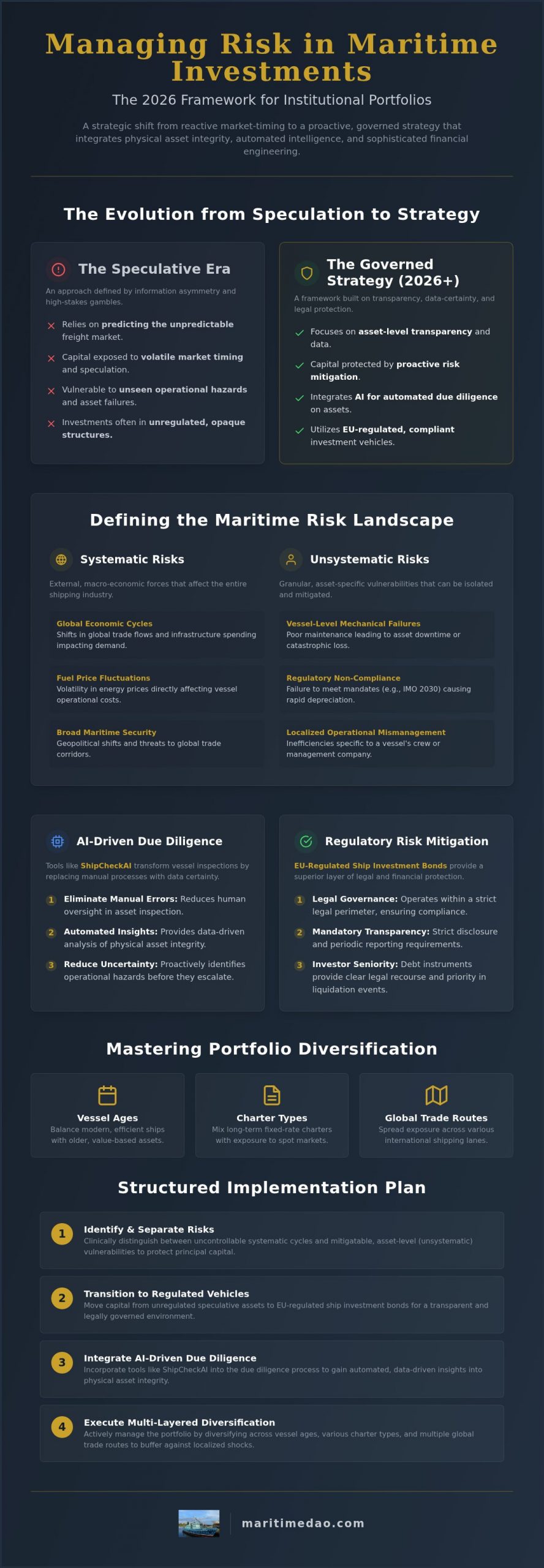
The era of speculative maritime investment, defined by information asymmetry and volatile freight rates, has reached its expiration date. You understand that protecting capital in global shipping requires more than just a historical perspective; it demands a unified approach to asset-level transparency and regulatory oversight. Managing risk in a maritime investment portfolio in 2026 is no longer about predicting the unpredictable. It’s about shifting from reactive market-timing to a proactive, governed strategy that integrates physical asset integrity, automated intelligence, and sophisticated financial engineering.
You’ll master the strategies required to mitigate volatility and secure capital within this modern asset class. This framework details how AI-driven due diligence through tools like ShipCheckAI reduces operational uncertainty while EU-regulated ship investment bonds provide a transparent, compliant vehicle for institutional yield. We’ll examine the integration of real-time data, the mechanics of regulated innovation, and the specific diversification tactics that transform maritime exposure from a high-stakes gamble into a structured, resilient component of a professional portfolio.
Key Takeaways
- Identify the critical distinction between systematic market cycles and unsystematic asset-level vulnerabilities to protect principal capital.
- Transition from unregulated speculative assets to EU-regulated ship investment bonds for a transparent and legally governed investment environment.
- Integrate ShipCheckAI into your due diligence process to eliminate manual errors and gain automated, data-driven insights into physical asset integrity.
- Master the technical nuances of managing risk in a maritime investment portfolio by diversifying across vessel ages, charter types, and global trade routes.
- Execute a structured implementation plan that aligns institutional yield requirements with a multi-layered risk mitigation framework.
Defining the Maritime Risk Landscape: Systematic vs. Unsystematic Factors
Maritime risk isn’t a singular metric; it’s a composite ecosystem built on global trade flows, geopolitical shifts, and physical asset integrity. For an institutional investor, managing risk in a maritime investment portfolio requires a clinical separation between systematic and unsystematic factors. Systematic risks represent the external forces that affect the entire industry, such as global economic cycles, fuel price fluctuations, and the broader maritime security landscape. These are the macro-economic tides that lift or sink all ships simultaneously. Conversely, unsystematic risks are granular and asset-specific, ranging from vessel-level mechanical failures to regulatory non-compliance and localized operational mismanagement.
The 2026 shift in maritime finance marks a transition from broad market-wide assumptions to asset-specific data certainty. Investors no longer rely on average fleet performance. Instead, they utilize unified intelligence to isolate and mitigate the specific vulnerabilities of individual vessels within a governed framework. This shift ensures that capital is protected by transparency rather than speculative hope.
Freight Rate Volatility and Market Timing
Volatility in shipping is often driven by supply-demand imbalances within specific vessel segments. Dry bulk carriers respond to infrastructure spending and grain harvests, while tankers react to energy policy and refinery output. The Baltic Dry Index remains a vital indicator for assessing the health of a dry bulk portfolio, signaling when freight rates are likely to contract or expand. Market timing risk in 2026 global trade corridors represents the potential for capital erosion resulting from entering or exiting vessel segments without accounting for real-time shifts in regional port congestion and localized demand surges.
Physical Asset Depreciation and Operational Hazards
Environmental regulations, specifically the IMO 2020 and 2030 mandates, have fundamentally altered asset longevity. Vessels that fail to meet carbon intensity standards face rapid depreciation or exclusion from major trade routes. Poor maintenance schedules introduce significant tail risk events, where a single mechanical failure leads to catastrophic loss of yield or total asset downtime. This creates a clear divide: older, non-AI-monitored vessels face technological obsolescence as they cannot provide the transparency required by modern institutional standards. Managing risk in a maritime investment portfolio effectively means prioritizing assets that integrate automated monitoring systems to ensure operational hazards are identified before they escalate into financial liabilities.
Regulatory Frameworks as Risk Mitigants in 2026
Compliance has evolved from a bureaucratic hurdle into a primary instrument for capital preservation. In the high-stakes environment of global shipping, the difference between a secure yield and a total loss often rests on the strength of the legal framework surrounding the asset. Managing risk in a maritime investment portfolio now prioritizes adherence to established financial standards over the high-risk allure of unregulated ventures. By utilizing a structured approach to maritime investment compliance, investors gain a level of transparency that was previously impossible in the traditionally opaque shipping industry.
The 2026 landscape features a stark divide between institutional-grade assets and the speculative ‘wild west’ of unregulated maritime tokens. While digital assets promised democratization, many lacked the structural integrity required to withstand market volatility. Regulated innovation solves this by embedding technological efficiency within a strict legal perimeter. Bond structures, in particular, offer a superior layer of protection. Unlike traditional equity, where investors are the last to be paid in a liquidation event, debt instruments provide seniority and clear legal recourse.
The Protection of EU-Regulated Ship Investment Bonds
The implementation of EU regulated ship investment bonds has redefined how debt is issued and managed in the maritime sector. These instruments are governed by strict disclosure requirements and periodic reporting, ensuring that investors have constant visibility into asset performance. Because these are structured as asset-backed securities (ABS), they create a definitive floor for investor recovery. In the event of operational distress, the underlying physical vessel serves as collateral, providing a tangible safety net that speculative ‘crypto-shipping’ projects simply cannot replicate. This legal certainty is the cornerstone of managing risk in a maritime investment portfolio for the risk-averse institutional player.
Governance in a Maritime DAO Environment
Decentralized autonomous organizations (DAOs) act as the visionary architects of this new financial ecosystem. A regulated DAO functions as a reliable gatekeeper, utilizing smart contracts to provide transparent, immutable records of every governance decision and financial transaction. This system eliminates the ‘black box’ of traditional ship management. By vetting every opportunity through a unified, governed process, the DAO ensures that only high-integrity projects reach the market. Understanding this shift is essential for those looking toward the future of ship finance, where ecosystem stability is maintained through automated oversight and collective accountability. For those seeking a secure entry point, exploring these regulated bond structures offers a path to institutional-grade maritime exposure.
AI-Driven Due Diligence: Transforming Vessel Inspections
Due diligence serves as the frontline of risk management; however, traditional methods often fall short in the face of modern complexity. In the past, investors relied on subjective, manual surveys that captured only a single moment in time. Today, AI is the most potent weapon in a professional’s arsenal for managing risk in a maritime investment portfolio. By transitioning to automated, data-driven assessments, the industry is effectively closing the information asymmetry gap that has long favored ship owners over capital providers. Real-time data feeds allow for predictive maintenance modeling, transforming how we perceive asset longevity. Instead of waiting for a mechanical breakdown to occur, AI identifies micro-patterns in performance data that signal impending issues. This shift ensures that every investment decision is grounded in empirical evidence rather than historical averages or optimistic projections.
ShipCheckAI and the New Standard of Inspection
ShipCheckAI represents the pinnacle of this technological evolution by performing multiple inspection types simultaneously to uncover hidden structural vulnerabilities. It identifies corrosion patterns and engine fatigue with an accuracy multiplier that human inspectors simply cannot match. This granularity is essential for the precise risk-pricing of maritime bonds. When an asset’s physical condition is quantified through AI ship inspection tools, the resulting data directly influences the coupon rates and security structures of the associated financial instruments. It’s a methodical process that replaces intuition with hard, verifiable data.
Quantifying Asset Condition for Portfolio Safety
The implementation of AI in maritime due diligence allows for the creation of a standardized Risk Score for every vessel in a fleet. This score isn’t static. Unlike one-off pre-purchase inspections that become obsolete the moment the ship leaves the dock, continuous monitoring provides a living record of asset health. It’s a sophisticated approach to managing risk in a maritime investment portfolio that prioritizes structural integrity over speculative market trends. By utilizing these automated systems, investors significantly reduce the probability of catastrophic asset failure. This ensures the underlying collateral for ship investment bonds remains robust throughout the lifecycle of the debt, acting as a reliable gatekeeper for institutional capital.
Diversification Strategies for the Global Shipping Sector
Managing risk in a maritime investment portfolio requires a clinical approach to asset allocation that transcends simple market participation. True diversification in 2026 is built on three distinct pillars: vessel category, asset age, and charter duration. By spreading capital across these variables, investors insulate their principal from localized downturns and sector-specific volatility. Fractional ownership has emerged as a critical gateway, allowing for high-granularity portfolio construction that was previously reserved for the industry’s largest shipowners. This model enables an investor to hold positions in a diversified fleet of dry bulk carriers and tankers, effectively reducing the tail risk associated with a single trade route or commodity cycle.
Geographic diversification serves as a necessary hedge against regional trade disruptions and port congestion. A unified portfolio strategy ensures that capital isn’t overly exposed to a single geopolitical corridor. Instead, it leverages the global nature of trade to maintain yield stability even when specific maritime arteries face temporary closures or regulatory shifts. This methodical spread ensures that the portfolio remains resilient, governed, and productive regardless of localized economic friction.
Sector-Specific Allocation Frameworks
Institutional investors must weigh the risk-return profiles of various tanker segments to optimize their exposure. VLCC vessels offer significant economies of scale but carry higher volatility compared to the more versatile Suezmax and Aframax classes. In the 2026 market, ‘green ships’-those powered by LNG or dual-fuel systems-represent a superior risk-adjusted choice because they carry significantly lower regulatory risk under tightening carbon mandates. For those seeking long-term stability, understanding how to invest in maritime assets through this diversified lens is essential. This selection process ensures that every vessel in the portfolio contributes to structural integrity rather than becoming a stranded liability.
Hedging Against Macro-Economic Shocks
Maritime bonds function as a sophisticated hedge against global inflation and currency fluctuations. Unlike equity, which remains highly sensitive to market sentiment, these regulated debt instruments are anchored by the physical utility of the global fleet. When ‘black swan’ events occur, such as the sudden closure of major transit canals, a diversified fleet survives by rerouting and capturing the resulting increase in ton-mile demand. One must also consider the liquidity advantage of tokenized bond instruments. While physical ships are notoriously illiquid assets that require months to divest, regulated bonds offer a streamlined exit path. This provides the flexibility needed for managing risk in a maritime investment portfolio during periods of high market stress. To begin building your diversified exposure, explore our EU-regulated ship investment bonds today.
Step-by-Step: Implementing a Risk-Managed Maritime Strategy
Implementing a resilient framework requires a methodical transition from high-level theory to operational execution. You must first define your internal risk tolerance and yield requirements before selecting any specific maritime instruments. Managing risk in a maritime investment portfolio isn’t a passive endeavor; it’s an active process of selection, verification, and ongoing oversight. By aligning your capital with regulated vehicles that offer structural protection, you move beyond the volatility of the spot market and into the stability of institutional-grade debt. This transition ensures that your exposure is governed by transparency rather than market sentiment.
Vetting the Issuer and the Asset
A rigorous audit of the issuer’s governance structure is the first step in any due diligence process. When evaluating a Maritime DAO, you should request a comprehensive record of compliance history, regulatory filings, and smart contract audits. This ensures the ecosystem is governed by immutable code rather than opaque human decisions. Interpreting a ShipCheckAI assessment report is equally critical. You are looking for specific indicators of structural health, maintenance consistency, and future emissions compliance. Finally, verify that the underlying vessel is legally ring-fenced within a Special Purpose Vehicle (SPV). This tripartite verification-governance integrity, asset health, and legal ring-fencing-creates a robust shield for your principal capital against counterparty risk and operational distress.
Optimizing for 2026 Market Conditions
The 2026 maritime market rewards those who embrace the ‘Smart Shipping’ era. Your portfolio should not only be diversified but also technologically integrated. This involves setting automated triggers for risk alerts based on real-time vessel performance data. If a vessel’s operational efficiency drops below a defined threshold or if it enters a high-risk geopolitical zone, your management system should provide immediate notification. This level of responsiveness is what defines managing risk in a maritime investment portfolio in the modern age. It’s about moving from quarterly reports to real-time awareness. By finalizing the transition from speculative equity to institutional-grade bonds, you secure a yield that’s grounded in the physical reality of global trade while benefiting from the efficiency of digital governance. Periodic rebalancing based on these real-time metrics ensures that your allocation remains optimized as global trade corridors and regulatory requirements evolve.
Securing the Future of Maritime Capital
The 2026 institutional framework transforms maritime investment from a speculative venture into a governed, data-driven asset class. You’ve seen how the convergence of AI-powered due diligence and strict legal oversight creates a resilient foundation for long-term yield. Managing risk in a maritime investment portfolio effectively requires a commitment to transparency, where every vessel’s structural integrity is quantified and every financial instrument is legally ring-fenced. By moving beyond the opacity of legacy ship finance, you can now access a unified ecosystem that prioritizes capital protection and operational excellence.
Success in this new era depends on your ability to integrate institutional-grade maritime asset assessments into your broader strategy. This shift ensures that your capital is anchored by physical reality and protected by a fully compliant EU financial framework. We’re ready to act as your reliable gatekeeper, providing the technological and legal infrastructure needed to thrive in global trade. Secure your portfolio with EU-regulated ship investment bonds at Maritime DAO and leverage AI-driven vessel transparency via ShipCheckAI to build a more resilient future. The opportunity to democratize and secure maritime finance is here; it’s time to take the next step.
Frequently Asked Questions
Is maritime investment riskier than real estate?
Maritime assets offer a distinct risk-return profile that prioritizes global trade utility over local geographic stability. While real estate is often illiquid and sensitive to regional policy, maritime assets provide exposure to international demand cycles. Managing risk in a maritime investment portfolio requires understanding that while freight rates are more volatile than rent, the mobility of the asset allows it to capture yield wherever global demand is strongest.
How does ShipCheckAI reduce the risk for bondholders?
ShipCheckAI reduces risk by replacing subjective, manual surveys with automated, multi-type inspections. It identifies hidden structural issues such as corrosion or engine fatigue with institutional-grade precision. By providing a transparent record of asset health, it ensures that bondholders aren’t exposed to the tail risk of catastrophic mechanical failure. This data-driven approach allows for more accurate risk-pricing and ensures the vessel remains a robust form of collateral.
What are the specific risks of tokenized ship bonds?
Specific risks include smart contract vulnerabilities and the potential for regulatory fragmentation across different jurisdictions. While the underlying vessel provides physical security, the digital layer must be governed by a robust legal framework. Investors should also note that secondary market liquidity for specialized debt can fluctuate. Choosing EU-regulated instruments ensures these technological risks are mitigated by a transparent, legally binding ecosystem that protects institutional capital.
Can I lose my principal investment in a maritime bond?
Principal loss is a possibility if the issuer defaults and the asset’s liquidation value falls below the outstanding debt. However, EU-regulated ship investment bonds are structured as asset-backed securities. This means the physical vessel serves as collateral, giving bondholders senior claim status during liquidation. This structural seniority provides a recovery floor that distinguishes regulated debt from speculative maritime equity, where investors have no such tangible protection.
How does EU regulation protect international maritime investors?
EU regulation protects investors by enforcing a standardized legal perimeter that mandates transparency, disclosure, and periodic reporting. By operating under the EU Prospectus Regulation, issuers provide a level of data certainty that is essential for managing risk in a maritime investment portfolio. This governed framework ensures that every participant, regardless of their location, benefits from the same rigorous oversight and legal recourse that defines institutional-grade finance.
What happens to my investment if a ship is involved in an accident?
Investment protection is maintained through comprehensive maritime insurance, including Hull and Machinery (H&M) and Protection and Indemnity (P&I) coverage. These policies are designed to cover repair costs or total loss scenarios. In many bond structures, the insurance proceeds are pledged to bondholders as part of the security package. This ensures that physical operational accidents are mitigated by financial hedges, preserving the structural integrity of your investment capital.
How often should I rebalance a maritime investment portfolio?
Portfolio rebalancing should ideally occur semi-annually to account for the diverging cycles of dry bulk and tanker markets. Rapid shifts in trade routes or environmental regulations can quickly alter the risk profile of older vessels. By using real-time data from AI monitoring platforms, you can make informed adjustments to your allocation. This proactive approach ensures your exposure remains aligned with institutional yield requirements while avoiding over-concentration in underperforming maritime sub-sectors.
What is ‘tail risk’ in the shipping industry?
Tail risk in shipping involves rare, high-impact events such as major canal blockages, sudden geopolitical sanctions, or catastrophic environmental incidents. These events can paralyze specific trade corridors and cause sharp, unexpected drops in asset value. Mitigating this risk requires a diversified strategy that spreads capital across different vessel types and geographic operational zones. This ensures that a single disruption doesn’t compromise the stability of your entire maritime investment ecosystem.