
By 2026, a ship’s environmental rating has become its most critical financial asset. An ‘E’ rating is no longer just a compliance failure, it’s a total financial write-down. Investors rightfully fear the specter of stranded assets as low-rated vessels become uncharterable, yet the persistent lack of transparent data makes verifying shipowner claims nearly impossible. Navigating the carbon intensity indicator (CII) for investors requires a shift from speculative hope to regulated innovation, grounding capital in verified operational performance rather than vague promises.
You’ll learn exactly how these 11% reduction mandates directly impact maritime bond yields, ship valuation, and overall investment risk this year. This guide provides a clear framework for assessing CII-related risk, detailing how ShipCheckAI serves as a truth layer for vessel efficiency while exploring the structural integrity of EU-regulated Ship Investment Bonds. We’ll move from the broad regulatory landscape to the specific functional components that govern modern maritime finance, ensuring your portfolio remains resilient, transparent, and compliant in a rapidly decarbonizing world.
Key Takeaways
- Understand why the 2026 reduction mandate makes the carbon intensity indicator (CII) for investors the primary metric for identifying high-compliance maritime assets.
- Learn how to distinguish between the ‘Green Premium’ of efficient vessels and the ‘Brown Discount’ that leads to accelerated asset depreciation.
- Discover how ShipCheckAI provides an independent truth layer to verify vessel efficiency and bridge the data gap in traditional maritime reporting.
- Identify the specific risk profiles of A-E ratings to better secure your portfolio through EU-regulated Ship Investment Bonds.
- Establish a clear framework for assessing maritime environmental risk to ensure your capital is protected against the threat of stranded assets.
What is the Carbon Intensity Indicator (CII) for Investors?
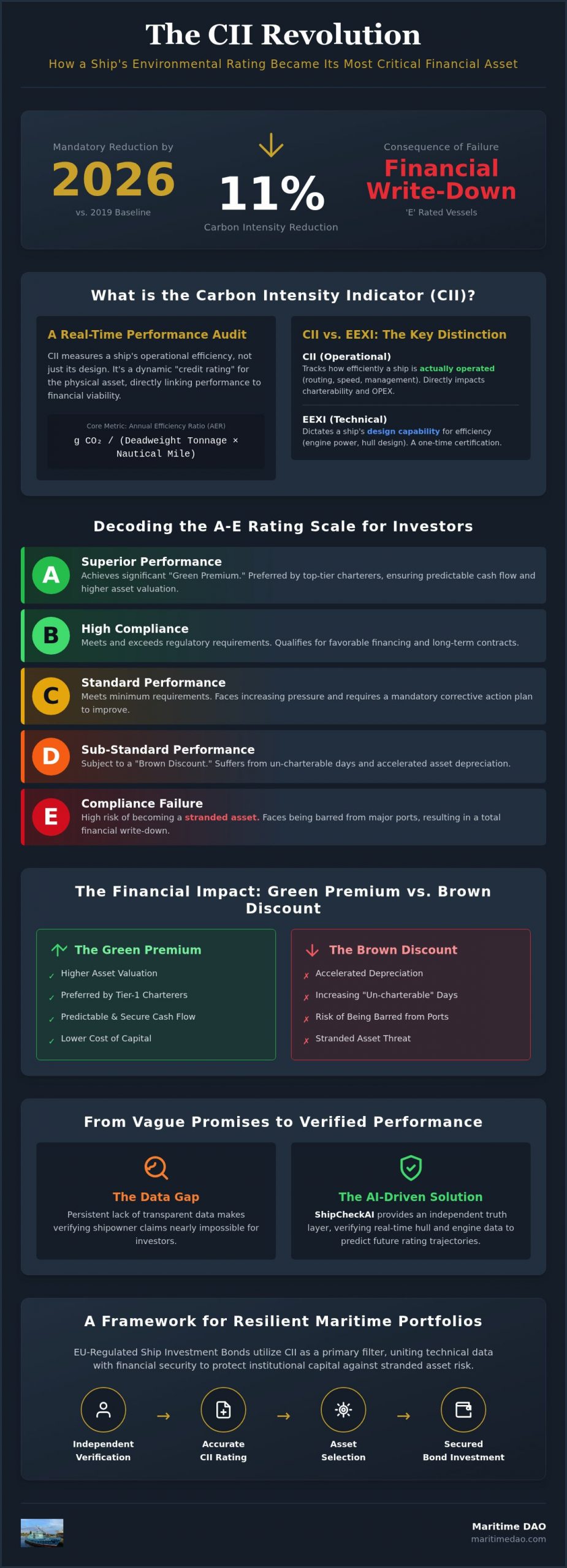
The carbon intensity indicator (CII) for investors represents a fundamental shift in how maritime assets are appraised, moving beyond static hull age to dynamic operational efficiency. Formally, CII measures the operational efficiency of a vessel in grams of CO2 per deadweight tonnage and nautical mile. It functions as a real-time performance audit, governed by the MARPOL 73/78 framework, which ensures that global trade aligns with urgent decarbonization targets. For the institutional lender, this is not a mere environmental check; it’s a credit rating for the physical asset itself.
By 2026, the regulatory pressure has intensified significantly. Shipowners must now achieve an 11% reduction in carbon intensity compared to the 2019 baseline. This annual tightening of requirements creates a clear distinction between high-performance fleets and those destined for obsolescence. While the Energy Efficiency Existing Ship Index (EEXI) dictates a vessel’s design capability, the CII tracks how that ship is actually operated. This distinction is vital for asset-backed securities because a technically efficient ship can still fail its CII rating through poor management or inefficient routing, directly impacting the security of the underlying investment.
The AER Formula and Investor Transparency
The Annual Efficiency Ratio (AER) serves as the core metric for vessel fuel productivity in 2026. This formula provides the transparency required to link physical operations to financial outcomes. By calculating the total CO2 emissions against the ship’s deadweight and distance traveled, investors gain a unified view of how effectively a vessel converts fuel into commercial activity. High fuel consumption doesn’t just damage the environment; it directly inflates operating expenses (OPEX), eroding the margins necessary to service debt and maintain liquidity in competitive charter markets.
Regulatory Deadlines: From 2023 Implementation to 2026 Reality
The 2026 review by the International Maritime Organization (IMO) marks a pivotal moment for the industry, potentially introducing even stricter enforcement mechanisms. Every vessel of 5,000 gross tonnage and above must carry a valid Statement of Compliance (SoC) to operate in regulated waters. Without this certification, a ship is effectively uncharterable, transforming a multimillion-dollar asset into a liability overnight. This regulatory reality is why sophisticated capital is moving toward EU regulated ship investment bonds, which utilize the carbon intensity indicator (CII) for investors as a primary filter for asset selection. These systems unite technical data, regulatory oversight, and financial security to protect institutional portfolios.
How CII Ratings Directly Influence Maritime Asset Valuation
The maritime market has undergone a fundamental bifurcation. We now see a distinct ‘Green Premium’ for A and B rated ships, where top-tier charterers pay significant premiums for operational efficiency, while a ‘Brown Discount’ plagues D and E rated vessels. A ship’s rating isn’t just a compliance grade; it’s a direct multiplier for its market value. If a vessel’s carbon intensity indicator (CII) for investors shows a downward trend, its depreciation schedule accelerates beyond traditional linear models. By 2027, ‘E’ rated ships face the very real threat of being barred from major international ports, effectively turning them into stranded assets. For bondholders, this means the underlying collateral is losing its liquidation value at an unprecedented rate, potentially compromising the security of the debt.
Charterability and Cash Flow Predictability
Tier-one charterers like Maersk and Shell now prioritize A and B rated vessels to meet their own corporate sustainability mandates. This preference creates a reliable and predictable stream of cash flow for compliant shipowners. In contrast, inefficient ships suffer from an increasing number of ‘un-charterable’ days. These are periods where a vessel sits idle because it fails to meet the environmental standards required for lucrative long-term contracts. Investors must look beyond current earnings and anticipate future viability. Using AI-driven tools like ShipCheckAI allows for the prediction of future rating trajectories based on real-time hull and engine data. This ensures the asset remains commercially attractive throughout the entire lifecycle of the investment.
CII and the Cost of Capital
The global financial ecosystem has integrated environmental metrics into its core lending logic. Under the Poseidon Principles, major institutional lenders now align their ship finance portfolios with IMO decarbonization targets. This means a poor CII rating directly increases interest rates and tightens credit availability for the owner. High-efficiency ships enjoy a unified advantage: they’re cheaper to operate and cheaper to finance. They typically benefit from lower insurance premiums and more favorable loan-to-value ratios. Investors looking to mitigate these risks should consider the structural integrity provided by EU-regulated Ship Investment Bonds, which prioritize assets with proven efficiency and transparent data governance. This approach ensures that capital is bridged to the physical world through a framework that values long-term asset resilience over short-term speculative gains.
Risk Assessment: Decoding the A-E Rating Scale for Bondholders
The A-E rating scale represents the definitive risk spectrum for modern maritime finance, providing a unified framework for assessing asset resilience. A and B ratings function as the ‘Safe Haven’ for long-term debt, signaling assets that exceed current efficiency mandates and possess superior commercial longevity. C ratings constitute the ‘Baseline’; these vessels meet immediate standards but exist on a precarious edge, necessitating rigorous operational oversight to prevent downward drift. Conversely, the D and E ratings comprise the ‘Red Zone’, where assets face immediate regulatory scrutiny and the looming threat of mandatory retrofitting or premature decommissioning. Sophisticated bondholders must scrutinize the Ship Energy Efficiency Management Plan (SEEMP Part III) to understand the shipowner’s strategy for maintaining compliance. This plan is the primary risk mitigation document, detailing how the vessel will navigate the 11% reduction requirements that define the carbon intensity indicator (CII) for investors in 2026. These systems unite vessel performance, market liquidity, and regulatory standing into a single risk profile.
The Financial Burden of Corrective Action Plans
Moving a vessel from a D to a C rating requires substantial capital expenditure (CAPEX) that can significantly erode bondholder returns. Mandatory retrofits, including advanced hull coatings, engine power limitation (EPL) systems, or rotor sails, demand immediate liquidity from the shipowner. These improvements aren’t optional enhancements; they’re essential survival mechanisms. A corrective action plan is a binding financial liability, not just a bureaucratic document. When a ship falls into the ‘Red Zone’, the cost of compliance often rivals the remaining book value of the asset, directly impacting the recovery rate for debt holders in the event of a restructuring.
Liquidity Risk in the Secondary Ship Market
Liquidating a D-rated vessel in a ‘green’ maritime economy is increasingly difficult, as the buyer pool shrinks to those few willing to absorb high-risk, low-efficiency tonnage. In the current 2026 landscape, an ‘E’ rating often triggers ‘event of default’ clauses in modern maritime bond agreements, potentially leading to forced liquidations at distressed prices. This creates a systemic liquidity risk where the asset’s technical failure becomes a financial catastrophe. To mitigate this, sophisticated stakeholders are using AI in maritime due diligence to identify subtle performance declines before they manifest as a rating downgrade. By monitoring hull integrity, engine performance, and routing efficiency, investors can spot rating drift early. This proactive oversight ensures that the carbon intensity indicator (CII) for investors remains a strategic tool for wealth preservation rather than a post-mortem diagnostic of a failing asset.
AI-Driven Due Diligence: Verifying CII Data for Ship Investments
Traditional maritime due diligence relies on historical logbooks; these records are often subjective, incomplete, and insufficient for the 2026 regulatory environment. Investors can’t rely on self-reported data when the financial stakes of a rating downgrade are so high. The carbon intensity indicator (CII) for investors demands a more rigorous, data-driven approach that bypasses manual reporting. This is where AI-driven oversight creates a unified truth layer, bridging the gap between physical operations and financial governance. By moving toward real-time monitoring, capital providers can ensure that the ships backing their debt maintain the efficiency levels required for long-term profitability.
ShipCheckAI provides this necessary transparency by conducting independent vessel assessments that go far beyond standard class reports. It identifies mechanical issues, such as hull fouling or engine wear patterns, that degrade a ship’s efficiency over time. By automating the detection of ‘CII gaming’—where operators might manipulate speed or routing to artificially boost a rating—the system ensures that the reported data reflects actual operational reality. This continuous oversight is essential for maintaining bond compliance and protecting the asset’s market value in a volatile regulatory climate.
Step 1: Independent Technical Assessment
ShipCheckAI evaluates hull condition and engine performance to validate the reported Annual Efficiency Ratio (AER). Mechanical failures caused 1,505 shipping incidents in 2025; these are precisely the risks that AI identifies before they manifest as operational downtime. By comparing ShipCheckAI results against the official Statement of Compliance, investors can verify if a vessel is truly as efficient as claimed. This process ensures that the carbon intensity indicator (CII) for investors is based on physical truth rather than administrative optimism, uniting technical diagnostics, maintenance logs, and performance data into a single, transparent view.
Step 2: Predictive Modeling for Multi-Year Bonds
Securing capital for a multi-year bond term requires projecting a vessel’s performance against the IMO’s increasing stringency. This ‘ratchet mechanism’ means a ship that is currently a ‘C’ might easily slip into ‘D’ or ‘E’ territory within twenty-four months without proactive management. Predictive modeling accounts for these regulatory shifts, ensuring the investment remains aligned with EU compliant maritime bonds throughout its entire lifecycle. This forward-looking governance is the hallmark of regulated innovation, providing the structural integrity needed for significant capital commitments while protecting against the threat of stranded assets. To secure your portfolio against rating drift, explore how ShipCheckAI automates technical due diligence for institutional investors.
Investing in Compliant Maritime Debt: The Maritime DAO Advantage
Maritime DAO operates as a visionary architect at the intersection of heavy industry and high finance, identifying systemic inefficiencies and building high-tech solutions to address them. By integrating the carbon intensity indicator (CII) for investors into its core risk framework, the platform ensures that every bond issuance is backed by high-compliance assets. This methodical filtering process excludes vessels in the ‘Red Zone’, prioritizing ships that exceed the 11% reduction mandate required in 2026. The result is a unified ecosystem where technical performance and financial security are inextricably linked, protecting capital from the volatility of the traditional shipping boom-bust cycle.
The synergy between ShipCheckAI and EU-regulated Ship Investment Bonds creates a first-of-its-kind truth layer for maritime debt. While traditional finance often relies on stagnant, self-reported data, this ecosystem utilizes automated intelligence to govern asset quality. Real-time assessment allows tokenized bondholders to monitor vessel efficiency and maintenance logs with unprecedented transparency. In a year where shipping companies must surrender EU Emissions Trading System (ETS) allowances for 70% of their 2025 emissions by September 30, 2026, this level of oversight is essential. Maritime debt has evolved into a core ESG asset, providing senior-secured exposure to the physical world of global trade through a digital governance framework.
The Security of Regulated Financial Instruments
EU regulation serves as the gold standard for maritime asset-backed securities, providing a sober and reliable framework for significant capital investments. The DAO structure ensures that governance remains transparent and methodical, bridging the gap between the physical reality of a ship and the digital rights of the investor. By utilizing the AI ship inspection tool as a permanent audit layer, Maritime DAO maintains a continuous record of hull integrity and engine performance. This system unites legal compliance, technical verification, and financial stability into a single, high-stakes investment vehicle that respects legacy systems while embracing innovation.
Next Steps for Institutional and Retail Investors
Accessing the Maritime DAO platform allows investors to view granular vessel efficiency data and carbon intensity indicator (CII) for investors metrics before committing capital. The process of diversifying into regulated shipping finance is now inclusive and transparent, allowing for a steady, educational approach to portfolio construction. Investors can move away from the opacity of traditional ship finance and toward a model of AI-verified, regulated debt. By choosing assets that are governed by strict environmental and financial standards, you ensure your portfolio remains resilient in a decarbonizing global economy. Explore the available bond offerings today to secure your position in the future of maritime trade.
The Future of Transparent Maritime Finance
By 2026, the maritime industry has reached a definitive point of no return. We’ve seen how technical efficiency translates directly into financial resilience, where a ship’s environmental rating dictates its market value, charterability, and long-term liquidity. The carbon intensity indicator (CII) for investors is no longer a secondary metric; it’s the fundamental baseline for capital preservation in a decarbonizing world. Success in this high-stakes landscape requires moving beyond historical logbooks toward a system that unites real-time technical verification with institutional financial standards. This shift ensures that physical assets are governed by the same transparency expected in modern capital markets.
You can now navigate this transition with confidence by utilizing a platform built for transparency and legal integrity. Maritime DAO provides direct access to high-efficiency assets, governed by an EU-regulated compliance framework and verified through AI-powered ShipCheckAI audits. This unified approach ensures that your capital supports only the most resilient vessels in the global fleet, protecting you from the risk of stranded assets. Secure your portfolio with EU-regulated Ship Investment Bonds at Maritime DAO and lead the shift toward a more sustainable, data-driven maritime economy. The era of speculative ship finance is over; the era of verified, regulated debt has arrived.
Frequently Asked Questions
How does a poor CII rating affect a ship’s resale value?
Resale value drops as the pool of eligible buyers shrinks to those willing to accept high-risk tonnage. A poor carbon intensity indicator (CII) for investors signals a high probability of future un-charterability. By 2026, vessels rated D or E are valued at a “Brown Discount” because they require immediate CAPEX for retrofitting. This accelerated depreciation directly impacts the liquidation value of the ship, which serves as the primary collateral for maritime debt.
What is the difference between EEXI and CII for a bond investor?
EEXI measures the technical design efficiency of a vessel, while CII tracks its actual operational performance. For a bond investor, EEXI is a one-time baseline, but CII is a dynamic risk factor that changes every year. A ship with a perfect design can still fail its CII rating through poor management or inefficient routing. This makes CII the superior metric for assessing the ongoing cash flow stability of a maritime asset.
Can a shipowner ‘fix’ a D or E rating, and what does it cost?
Shipowners can improve a rating by implementing technical retrofits such as engine power limitations or advanced hull coatings. However, these corrective actions represent significant CAPEX liabilities that can erode bondholder returns. Moving a vessel from the “Red Zone” to a C rating is a binding requirement under the SEEMP Part III. Investors must treat these mandatory costs as a priority debt that precedes other financial distributions within the ship’s operating budget.
How often are CII ratings updated and verified?
Ratings are updated annually based on the vessel’s performance data from the previous calendar year. The official Statement of Compliance is typically issued by May 31 each year, following the April 30 deadline for data submission. Because these ratings are retroactive, they can lag behind current operational reality. This is why using tools like ShipCheckAI is essential to identify performance drift in real-time before the official annual rating reflects a technical decline.
Are EU-regulated maritime bonds safer than traditional shipping equity?
EU-regulated Ship Investment Bonds provide a more stable risk profile by offering senior-secured exposure to the asset. Unlike equity, which is subject to the volatile “boom-bust” cycles of charter rates, these bonds prioritize investor repayment. The regulated framework ensures that the underlying assets meet strict efficiency standards, reducing the likelihood of default. This structure bridges the gap between the physical world of trade and the digital security of a governed financial ecosystem.
Does ShipCheckAI provide real-time carbon intensity data?
ShipCheckAI acts as an independent truth layer that verifies the technical foundations of carbon intensity data. It evaluates hull integrity and engine performance to validate the reported Annual Efficiency Ratio (AER). While the official carbon intensity indicator (CII) for investors is an annual administrative grade, ShipCheckAI provides the technical evidence needed to ensure that data isn’t being manipulated. This continuous oversight allows bondholders to monitor the physical health of their collateral throughout the investment lifecycle.
What happens if the IMO changes CII requirements mid-bond term?
The IMO utilizes a “ratchet mechanism” where reduction requirements automatically become more stringent every year. If the regulatory body introduces even steeper targets mid-term, ships on the edge of compliance may face sudden “event of default” risks. Maritime DAO mitigates this through predictive modeling that accounts for these shifts. By filtering for high-performance assets from the outset, the platform ensures that the debt remains resilient even if the regulatory landscape becomes more aggressive.
Why is 2026 a critical year for Carbon Intensity Indicator enforcement?
2026 marks a pivotal enforcement milestone because it requires an 11% reduction in carbon intensity compared to the 2019 baseline. It’s the year when the IMO conducts its first comprehensive review of the CII framework, potentially introducing stricter penalties for non-compliance. Additionally, shipping companies must surrender EU ETS allowances for 70% of their 2025 emissions by September 30, 2026. This convergence of environmental and financial deadlines makes 2026 the definitive year for maritime asset revaluation.