
Did you know that by late 2026, the marine transport industry reached an AI adoption rate of 56% for risk management, outperforming almost every other global sector? This surge confirms that digital transformation in maritime finance is no longer a speculative future but a functional requirement for institutional stability. You’ve likely felt the frustration of opaque vessel data leading to mispriced risk, or struggled with the high administrative costs of legacy cross-border shipping finance. It’s a common pain point in an industry where the physical state of an asset often remains disconnected from its financial valuation.
This guide empowers you to bridge that gap by mastering the intersection of AI-driven due diligence and regulated digital capital. We’ll detail how to implement ShipCheckAI to secure your capital through verifiable asset integrity and how to access EU-regulated ship investment bonds within a unified, transparent ecosystem. By the end of this strategic guide, you’ll understand how to leverage a governed digital framework to reduce administrative friction, verify asset-backed security integrity in real-time, and navigate the modernized landscape of maritime investment with absolute precision.
Key Takeaways
- Identify the structural shifts driving digital transformation in maritime finance as automated ecosystems replace opaque legacy models to close the industry’s liquidity gap.
- Leverage ShipCheckAI to implement a continuous vessel assessment protocol, ensuring that the physical state of an asset remains unified with its financial valuation.
- Master a methodical two-step strategy for evaluating the digital maturity of maritime assets and transitioning from traditional equity to regulated digital instruments.
- Examine the Maritime DAO framework to understand how EU-regulated ship investment bonds provide a secure, transparent architecture for institutional-grade capital.
- Reduce administrative friction and eliminate mispriced risk by integrating AI-driven due diligence into the lifecycle of asset-backed digital securities.
The Evolution of Maritime Finance: From Paper Trails to Digital Ecosystems
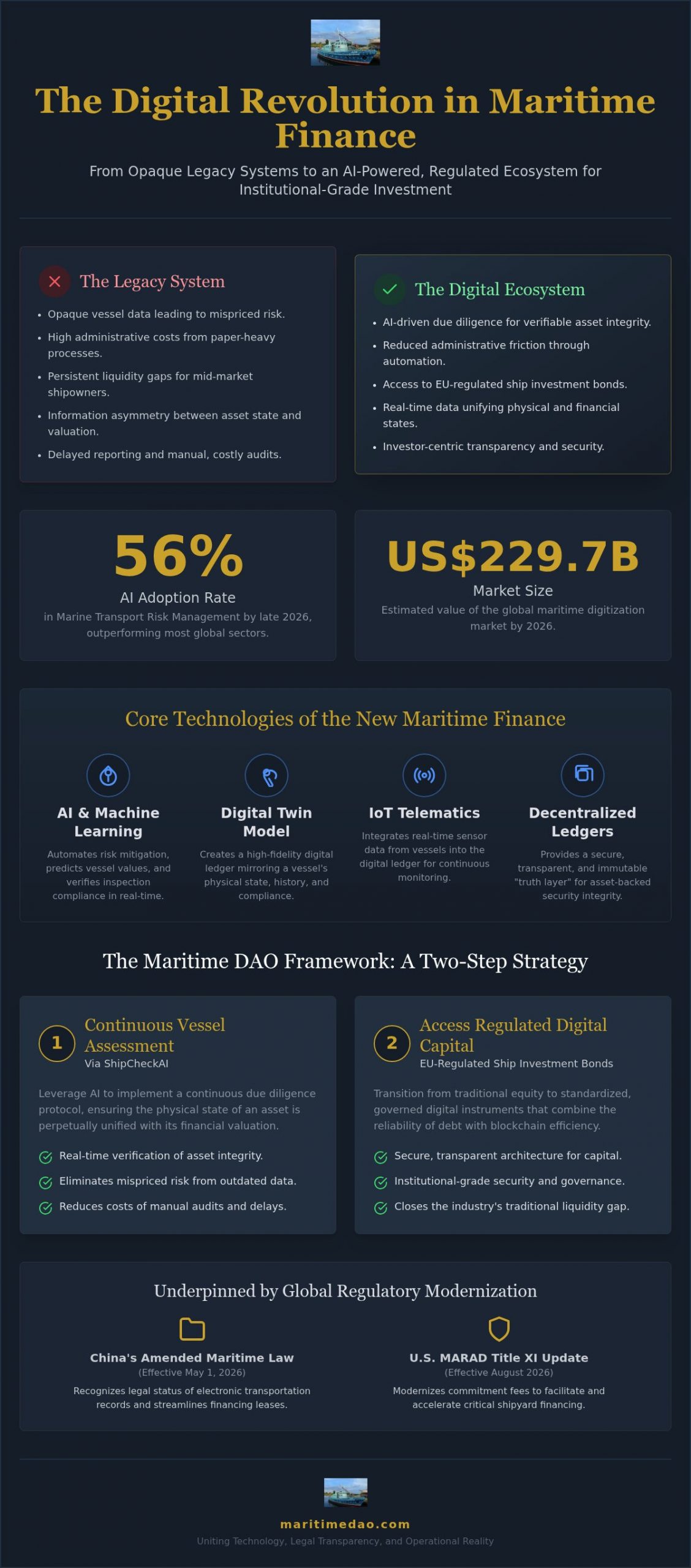
The mid-2020s signaled a definitive end to the era of opaque, manual maritime financing. For decades, the industry operated within a “black box” where paper-heavy documentation and delayed reporting created a persistent liquidity gap. This gap effectively barred mid-market shipowners from efficient capital while leaving investors exposed to unquantified risks. By 2026, the global maritime digitization market reached an estimated US$229.7 billion, proving that the adoption of digital transformation in maritime finance has accelerated into a core institutional requirement. This evolution replaces ship-centric data silos with investor-centric transparency, fundamentally altering how capital flows through global trade routes.
Regulatory frameworks have matured to support this transition with remarkable precision. For instance, China’s amended Maritime Law, effective May 1, 2026, now recognizes the legal status of electronic transportation records and streamlines the registration of financing leases. Similarly, the United States Maritime Administration (MARAD) implemented an interim final rule for the Title XI program in August 2026, modernizing commitment fees to facilitate shipyard financing. These shifts provide the legal structural integrity necessary for a unified digital ecosystem to thrive, bridging the gap between physical shipping and high finance.
Overcoming Legacy Inefficiencies in Shipping Capital
Administrative friction has long functioned as a silent tax on maritime debt. Traditional ship brokerage models, while historically significant, often lack the speed and data granularity required for modern asset-backed securities. Digital platforms now augment these legacy systems by providing real-time data streams that verify asset performance. This shift reduces the “information asymmetry” that previously led to mispriced risk. Modern investors utilize these platforms to monitor keels laid after January 1, 2026, ensuring compliance with updated SOLAS safety regulations and electronic inclinometer requirements. By automating the verification of physical asset states, the industry reduces the high costs associated with manual audits and cross-border administrative delays.
The Institutional Shift Toward Regulated Innovation
Institutional capital is moving away from speculative digital experiments toward standardized, governed instruments. Modern investors demand “truth layers” that connect physical vessel condition directly to financial performance. Integral to the digital transformation in maritime finance is the move toward EU regulated ship investment bonds. These instruments represent a new asset class that combines the reliability of traditional debt with the efficiency of blockchain-based governance. This tripartite approach, which unites technological ambition, legal transparency, and operational reality, allows for the democratization of complex financial structures while maintaining the high-stakes security required by institutional gatekeepers.
Core Technologies Driving Financial Modernization in 2026
The 2026 maritime financial landscape is defined by a sophisticated technological stack that replaces intuition with verifiable, real-time data. As the marine transport industry maintains an AI adoption rate of 56% for risk management, the core of digital transformation in maritime finance has shifted toward the “Digital Twin” model. This framework creates a high-fidelity digital ledger that mirrors the physical state, operational history, and regulatory compliance of a vessel. By integrating IoT telematics with decentralized ledgers, investors no longer rely on fragmented, periodic reports but instead access a unified truth layer that governs asset-backed security integrity.
AI and Machine Learning in Risk Mitigation
Predictive analytics have fundamentally altered capital allocation by forecasting vessel residual values and market volatility with institutional precision. AI systems now automate the verification of maritime inspection compliance, cross-referencing real-time sensor data against the 2026 SOLAS requirements for electronic inclinometers and enhanced fire safety measures. This transition from manual surveys to continuous, automated assessment ensures that financial models remain solvent and transparent. Maritime AI is the automated synthesis of operational data for financial risk assessment.
Utilizing tools like ShipCheckAI allows for multi-type vessel assessments that feed directly into these predictive models, significantly reducing the likelihood of mispriced risk. This systematic approach ensures that the relationship between the physical asset and its financial valuation is governed by logic rather than speculation. It provides a reliable gatekeeper for investors who require high-stakes security for their capital commitments.
Blockchain: The Governance Layer for 2026 Capital Markets
Blockchain technology provides the structural integrity required for trustless governance in maritime investment. Smart contracts now handle the heavy lifting of automated yield distribution and bond maturation, executing payments only when specific, IoT-verified conditions are met. This removes the administrative friction that once plagued cross-border shipping finance. Decentralized Autonomous Organizations (DAOs) have emerged as robust legal entities, providing a framework for ship ownership that is inclusive yet deeply serious about regulatory compliance. Through immutable transaction logs, maritime DAO investment offers a level of transparency previously impossible in traditional private equity. This ecosystem unites technological ambition, legal frameworks, and operational data to create a first-of-its-kind gateway for global maritime capital.
The Role of AI-Driven Due Diligence in Capital Allocation
In the modernized landscape of 2026, the cornerstone of digital transformation in maritime finance is the absolute verification of physical asset integrity. Capital allocation no longer rests on the subjective, static reports of periodic surveys. Instead, it relies on a continuous stream of high-accuracy data that eliminates the “information asymmetry” traditionally favoring shipowners over global investors. This fundamental shift ensures that the bond issuance lifecycle is governed by a verifiable truth layer, directly influencing insurance premiums and bond yields. When the physical state of a vessel is transparently linked to its financial valuation, the entire ecosystem gains structural integrity.
The impact of this high-fidelity data is most visible in the pricing of risk. By 2026, the market for artificial intelligence in maritime transport reached US$6.67 billion, reflecting a massive shift toward automated risk mitigation. Institutional investors now utilize these data streams to verify that assets meet the latest safety standards, such as the enhanced fire safety measures for ro-ro spaces implemented in early 2026. This level of precision allows for the reduction of administrative friction, as real-time condition reporting replaces the costly and slow manual audit processes of the past.
Standardizing Vessel Assessment for Financing
The 2026 standard for pre-purchase and periodic inspections has moved beyond manual checklists to embrace automated intelligence. Modern AI ship inspection tools provide a standardized framework that eliminates human bias in condition reporting. This creates a tripartite link between physical inspection, regulatory compliance, and capital flow. When an AI identifies structural integrity issues or maintenance lapses, the risk is immediately reflected in the financial model, allowing bondholders to protect their capital with mathematical precision. This standardization is essential for maintaining the liquidity of asset-backed digital securities.
ShipCheckAI: The Verifiable Truth Layer
ShipCheckAI serves as the architect of this new transparency within the Maritime DAO ecosystem. By utilizing multi-type vessel assessments, it identifies structural risks that traditional methods might overlook, providing a comprehensive diagnostic for every hull in the fleet. This capability is essential for securing AI in maritime due diligence, particularly when backing institutional-grade digital bonds. Real-time reporting ensures that bondholders have instant visibility into the asset’s condition, acting as a reliable gatekeeper for global capital. This transparent architecture ensures that the relationship between physical shipping and digital finance remains unified, governed, and secure.
Implementing a Digital Transformation Strategy for Maritime Investors
Execution of a successful digital transformation in maritime finance requires a methodical, five-step transition from manual oversight to automated governance. It’s not merely about adopting new software; it’s about shifting capital into a framework where every dollar is backed by verifiable, real-time data. Investors must move beyond the “black box” of traditional ship management and enter a unified ecosystem that prioritizes transparency and regulatory compliance. This systematic approach ensures that portfolios remain resilient against the volatility of global trade while minimizing administrative friction.
Evaluating Digital Maturity in Shipping Assets
Before capital is committed, investors must assess the digital maturity of their targets. An “investment-ready” vessel in 2026 is defined by its ability to generate high-fidelity data streams that feed directly into a digital ledger. This includes integrated sensor arrays that track fuel consumption, structural integrity, and compliance with the latest 2026 ISO standards for maritime technology. Identifying “Digital Gaps”, such as a ship management company’s inability to provide continuous, automated reporting, is essential for mitigating risk. If the physical asset cannot communicate with the financial model in real-time, it represents a significant liability in a modernized market.
Transitioning to Regulated Digital Bonds
The move from legacy equity to regulated digital instruments is the most critical phase of the strategy. Traditional maritime debt is often hindered by high administrative costs and opaque reporting cycles. In contrast, understanding how to invest in maritime assets through digital frameworks allows for the use of smart contracts to automate yield distribution. This transition is underpinned by EU-regulated frameworks that provide the structural integrity required for institutional-grade security. By selecting these governed instruments, investors can scale their portfolios through fractional tokenized ownership, allowing for broader diversification across global fleets.
To implement this transformation effectively, investors should follow a strict operational mandate:
- Step 1: Assess the digital readiness of the vessel and its management team to ensure data-readiness.
- Step 2: Allocate capital into EU-regulated digital instruments over traditional, illiquid equity.
- Step 3: Embed AI-powered due diligence into the investment lifecycle to ensure continuous compliance.
- Step 4: Monitor asset performance through a unified digital platform that mirrors the physical state of the ship.
- Step 5: Scale the portfolio by leveraging the liquidity and inclusivity of tokenized debt markets.
This methodical progression allows capital to flow into the most efficient assets while maintaining the safety of a regulated environment. Investors ready to begin this transition can access EU-regulated ship investment bonds to secure their position in the modernized maritime economy.
The Future of Regulated Maritime Investment: The Maritime DAO Model
The Maritime DAO model represents the structural culmination of digital transformation in maritime finance. It functions as a unified ecosystem where the physical world of shipping and the digital world of capital markets finally converge with institutional-grade reliability. This architecture doesn’t just digitize old processes; it builds a first-of-its-kind gateway that governs, secures, and opens up maritime assets to a global audience. By 2026, the vision of a transparent, AI-verified capital market has moved from a conceptual pilot to a functional reality, providing a bridge between legacy heavy industry and high-tech finance.
This model prioritizes structural integrity over speculative growth. It creates a rhythm of expansion and contraction, opening with a broad vision of global trade inclusivity before grounding that vision in practical, systematic details. By 2026, the industry’s shift toward the Poseidon Principles and ESG-aligned financing has made the DAO’s role as a visionary architect even more essential. It acts as both a bold innovator and a reliable gatekeeper, ensuring that the democratization of complex financial structures never comes at the expense of security or order.
Compliance as a Competitive Advantage
In a digital-first world, navigating maritime investment compliance is no longer a secondary concern but a primary competitive advantage. The Maritime DAO utilizes EU-regulated frameworks as the gold standard for bond issuance, ensuring that every instrument meets the rigorous legal requirements necessary for long-term capital security. This governed innovation allows the DAO to act as a reliable gatekeeper, maintaining decentralized but strictly compliant governance. It’s a methodical approach that respects the sobriety of institutional finance while embracing the efficiency of decentralized technology. This regulatory alignment provides the “truth layer” that institutional investors demand before committing significant capital.
The Logic of Unified Maritime Finance
The efficiency of the 2026 maritime market depends on the absolute unification of data and capital. This is why ShipCheckAI and bond issuance must exist on the same platform to ensure a seamless flow of information. When the “truth layer” of AI-powered vessel assessment is directly integrated with the “capital layer” of bond distribution, the cost of capital decreases significantly. This reduction is driven by superior data integrity, as investors no longer pay a premium for the uncertainty of opaque vessel conditions. By democratizing access through fractionalized bonds, the Maritime DAO allows for a more inclusive yet deeply serious investment environment where the relationship between physical assets and digital governance is clearly understood.
This ecosystem unites technological ambition with regulatory precision to create a transparent future for global trade. It’s a system designed to empower investors by removing the systemic inefficiencies that plagued the industry for decades. As the digital transformation in maritime finance continues to evolve, the integration of physical asset integrity and digital governance remains the only path forward for secure capital allocation. Secure your position in the modernized maritime economy by leveraging the structural integrity of the Maritime DAO today.
Navigating the New Horizon of Maritime Capital
The shift toward a digital-first maritime economy is no longer a strategic choice but a fundamental necessity for institutional stability. By embracing the digital transformation in maritime finance, investors can finally eliminate the opaque risks of the past and replace them with a unified, transparent ecosystem. You’ve seen how AI-powered due diligence through ShipCheckAI provides the essential truth layer for bondholders, and how the Maritime DAO model integrates these insights into a governed, institutional-grade framework. This intersection of physical asset integrity and regulated digital capital ensures that shipping remains a resilient, accessible asset class for the global market.
Now is the time to secure your position in this modernized landscape. Explore the Future of Regulated Maritime Investment with Maritime DAO and leverage our EU-regulated Ship Investment Bonds, AI-Powered ShipCheckAI Technology, and Institutional-grade Governance Framework to build a more secure portfolio. It’s a first-of-its-kind opportunity to participate in the growth of global trade with absolute confidence. The future of maritime finance is here; it’s time to lead the way.
Frequently Asked Questions
What is digital transformation in maritime finance?
Digital transformation in maritime finance is the systematic integration of automated intelligence, decentralized ledgers, and real-time telematics into the capital allocation process. It replaces manual, opaque paper trails with a unified digital ecosystem that ensures absolute transparency between physical assets and financial valuations. This evolution allows the industry to close the traditional liquidity gap by providing institutional investors with verifiable data and streamlined, cross-border administrative frameworks.
How does AI improve maritime investment due diligence?
Artificial intelligence transforms due diligence by shifting the industry from static, periodic surveys to continuous, predictive asset assessment. By synthesizing vast streams of operational data, AI identifies structural risks and maintenance lapses before they impact vessel residual value. This automated synthesis allows for a more accurate pricing of risk, ensuring that bondholders aren’t exposed to the information asymmetry that historically plagued traditional maritime private equity and debt markets.
Are tokenized ship bonds regulated in the EU?
Yes, ship investment bonds within the Maritime DAO ecosystem are issued under a strictly governed, EU-regulated framework to ensure long-term capital security. These instruments represent a first-of-its-kind asset class that combines the efficiency of digital tokenization with the sober reliability of institutional finance. By adhering to European financial regulations, these bonds provide a compliant gateway for global investors to participate in the modernized landscape of maritime debt without the speculative risks found in unregulated markets.
What role does a DAO play in maritime asset management?
A Decentralized Autonomous Organization (DAO) acts as the visionary architect and reliable gatekeeper for maritime asset management. It establishes a trustless governance layer where smart contracts automate yield distribution, bond maturation, and operational compliance. This structure democratizes access to shipping capital while maintaining a serious, high-stakes emotional register appropriate for significant investments. The DAO unifies technology, legal frameworks, and physical assets into a single, transparent, and methodical ecosystem.
How does ShipCheckAI reduce risk for maritime bondholders?
ShipCheckAI reduces risk by functioning as the verifiable truth layer for every vessel within a bond portfolio. It utilizes multi-type vessel assessments to identify structural vulnerabilities and regulatory non-compliance in real-time, providing bondholders with instant visibility into asset integrity. By integrating these high-fidelity diagnostics directly into the financial ecosystem, the tool eliminates mispriced risk and ensures that the physical state of the ship remains perfectly aligned with its financial valuation.
Can retail investors participate in digital maritime finance in 2026?
In 2026, the democratization of maritime capital allows for broader participation through fractionalized, tokenized investment bonds. While the industry was traditionally exclusive to institutional players, digital transformation has opened up shipping debt to a global audience within a regulated environment. Investors can now access high-value maritime assets with lower capital entry points, benefiting from the same AI-driven due diligence and EU-compliant security frameworks that protect large-scale institutional portfolios.
What are the primary risks of digital transformation in shipping finance?
The primary risks include cybersecurity vulnerabilities in operational technology and the challenge of maintaining global data standardization across fragmented fleets. As the industry becomes more interconnected, the threat of disruptive cyberattacks on vessel communication systems requires robust, institutional-grade security protocols. Additionally, investors must navigate evolving regulatory landscapes to ensure that their digital instruments remain compliant with international maritime laws and the latest safety standards, such as the 2026 SOLAS amendments.
How do I start investing in regulated maritime debt instruments?
You can begin by accessing the Maritime DAO ecosystem to explore EU-regulated ship investment bonds. The process starts with a methodical assessment of your investment goals followed by the selection of digital instruments backed by AI-verified assets. By leveraging ShipCheckAI diagnostics and the platform’s transparent governance framework, you can allocate capital into the maritime sector with the assurance of structural integrity, legal compliance, and real-time performance monitoring.