
The most secure corporate balance sheet in the world is still more vulnerable than a single physical vessel governed by code and protected by institutional-grade legal frameworks. In a 2026 market where US high-grade corporate bond yields hover above 5.5 percent, the perceived safety of a high credit rating often masks the underlying volatility of corporate defaults. You’ve likely felt the pressure of low traditional yields and the frustration of trying to verify the quality of collateral in a shifting global economy. When weighing corporate bonds vs asset-backed bonds, the fundamental choice isn’t just about interest rates; it’s about whether you trust a company’s future earnings or a tangible, income-producing asset.
We recognize that assessing collateral has traditionally been an opaque process reserved for specialist firms. This guide provides a clear framework to optimize your fixed-income strategy within the global maritime sector. We’ll explore how EU regulations now protect bondholders through standardized frameworks and how AI-driven tools like ShipCheckAI eliminate the transparency gap in physical collateral. You’ll discover how these systems unite, govern, and open up institutional-grade opportunities that were once the exclusive domain of legacy finance, providing the structural integrity your capital requires.
Key Takeaways
- Contrast the fundamental structural differences between corporate bonds vs asset-backed bonds to identify which model better preserves capital in a volatile 2026 economy.
- Learn how the securitization of global shipping vessels transforms physical maritime assets into regulated, income-producing debt instruments ring-fenced from general credit risk.
- Gain a clear framework for analyzing “waterfall” payment structures and EU financial regulations to ensure your interests are prioritized during capital repayment.
- Discover how ShipCheckAI provides unprecedented asset transparency, allowing you to verify collateral quality through multi-layered automated inspections before committing capital.
- Explore the integration of DAO governance to achieve a unified, transparent ecosystem for managing institutional-grade maritime debt with real-time bondholder voting.
The Structural Divide: Creditworthiness vs. Tangible Collateral
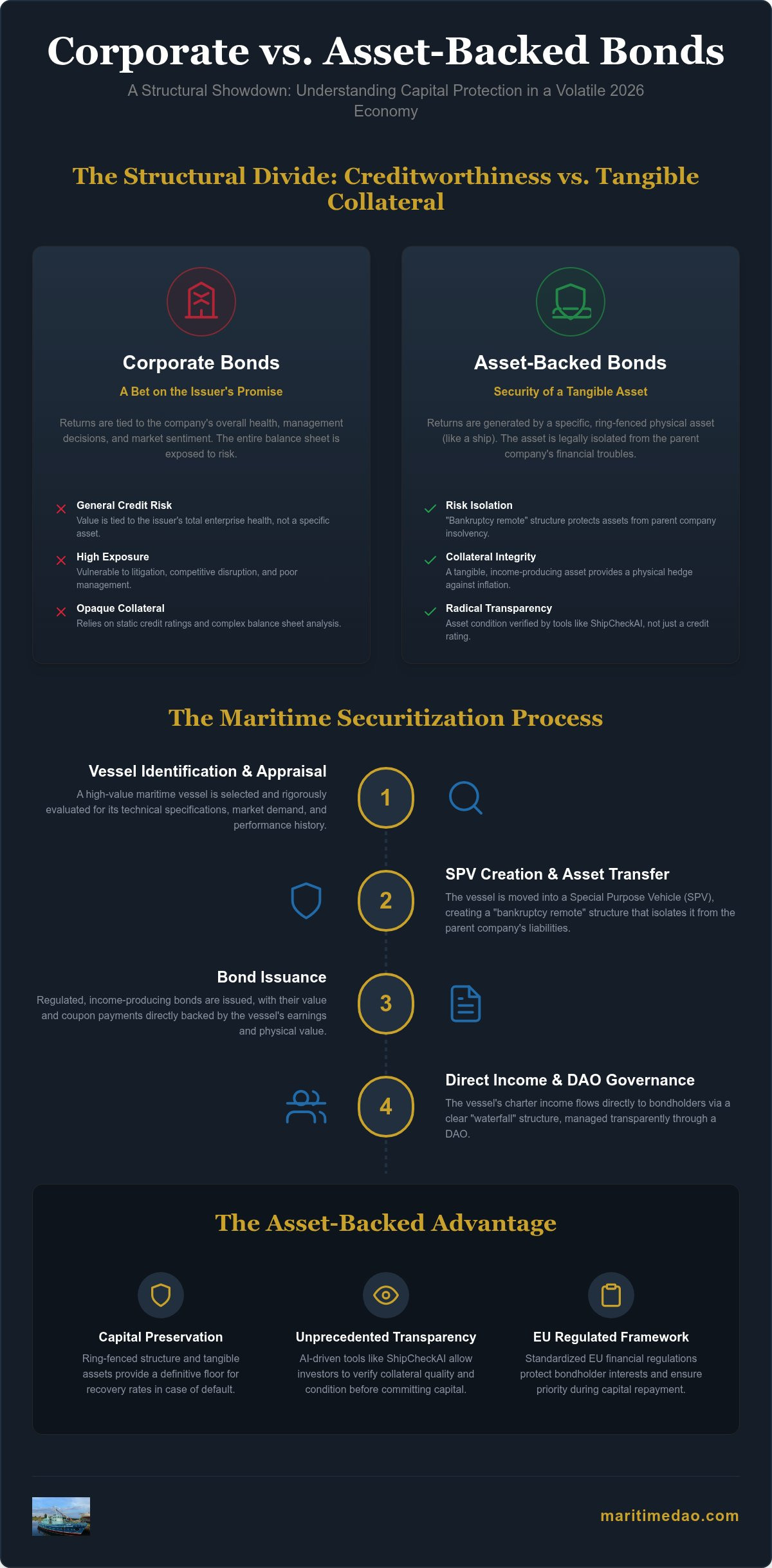
The core distinction in the 2026 financial landscape lies in what actually pays the coupon. When evaluating corporate bonds vs asset-backed bonds, investors must choose between the general creditworthiness of a large entity and the specific performance of a ring-fenced asset. One relies on a boardroom’s strategy; the other relies on a physical machine’s ability to generate yield. This choice dictates how your capital is protected during market volatility and defines the ultimate recovery rate in the event of a default.
Corporate Bonds: The Promise of the Issuer
Corporate debt represents a claim against the total enterprise. Whether structured as senior secured or unsecured debt, the investor’s return is intrinsically tied to the company’s overall health, management decisions, and shifting market sentiment. If the issuer’s primary business line falters, the bond’s value erodes regardless of how well a specific subsidiary performs. Corporate bonds are essentially a bet on the operational future of a specific firm. This model forces investors to monitor macro-economic cycles and internal corporate governance, as the entire balance sheet remains exposed to litigation, debt maturity walls, and competitive disruption.
Asset-Backed Bonds: The Security of the Underlying
An Asset-backed security (ABS) operates on a fundamentally different logic of isolation. In this ecosystem, specific high-value assets, such as a global shipping vessel, are transferred into a Special Purpose Vehicle (SPV). This creates a “bankruptcy remote” structure. If the parent company faces insolvency, the assets within the SPV remain protected and governed by their own legal framework, ensuring that the ship’s earnings continue to flow to bondholders without interference from the parent’s creditors.
The shift from general credit to asset performance metrics provides a definitive floor for recovery rates. Investors no longer analyze the CEO’s vision; they analyze the vessel’s charter rates, age, and maintenance history. In the 2026 maritime market, these bonds represent a unified bridge between heavy industry and institutional finance. Several factors contribute to this structural integrity:
- Collateral Integrity: Tangible assets provide a physical hedge against inflation and corporate mismanagement.
- Risk Isolation: The SPV structure ensures that liabilities from the issuer’s other business units don’t bleed into the bondholder’s pool.
- Transparency: Modern tools like ShipCheckAI identify, verify, and secure the asset’s condition, moving beyond the static credit ratings used in corporate bonds vs asset-backed bonds comparisons.
This structural divide defines the risk-reward profile of the modern portfolio. While corporate debt offers familiarity, the asset-backed model provides a transparent, governed alternative where the physical world dictates financial security.
The Mechanics of Asset-Backed Bonds in Modern Maritime Finance
Maritime finance in 2026 relies on a unified ecosystem that converts heavy industrial assets into transparent financial products. The process of securitization isolates a ship’s value from the operator’s balance sheet, creating a framework where systems unite, govern, and open up institutional-grade opportunities. Unlike traditional debt, this transformation allows Maritime DAO to offer institutional-grade safety by grounding digital governance in physical realities. When comparing corporate bonds vs asset-backed bonds, the critical mechanic is how the underlying asset’s productivity directly dictates investor returns.
Vessel Securitization: From Steel to Securities
The transition from steel to securities begins with a rigorous appraisal and debt structuring phase. Every vessel is evaluated based on its technical specifications, market demand, and historical performance. This data informs the Loan-to-Value (LTV) ratio, which serves as a primary risk buffer for bondholders. For a comprehensive breakdown of these procedural details, you can review our guide on how to invest in maritime assets. By maintaining conservative LTV ratios, the bond remains resilient even during temporary market corrections, ensuring capital preservation through structural discipline.
Interest payments aren’t dependent on a corporation’s quarterly earnings across multiple business lines. Instead, they’re fueled by charter rates, which are the contractual fees paid by shipping companies to use the vessel. This direct link provides empirical data on bond risk and returns that shows lower volatility compared to corporate counterparts. The cash flow is governed by the charter agreement, creating a predictable stream of income that is unified with the asset’s operational life.
ShipCheckAI: Solving the Transparency Gap
The 2026 market has moved beyond the limitations of annual paper audits. Through the AI ship inspection tool known as ShipCheckAI, Maritime DAO conducts multiple, real-time inspection types. This automated intelligence monitors hull integrity, engine performance, and regulatory compliance. This level of granular visibility solves the transparency gap that often plagues corporate bonds vs asset-backed bonds discussions. While corporate debt holders rely on management’s self-reported data, asset-backed bondholders utilize independent, AI-verified condition monitoring to confirm the collateral’s value every day. This real-time oversight significantly reduces the risk profile, positioning these instruments as a superior choice for risk-averse institutional capital.
You can explore current EU-regulated ship investment bonds to see these mechanics in action and understand how asset-backed structures provide a safer harbor for your capital.
Risk-Adjusted Returns: Comparing Corporate and Asset-Backed Yields
Investors evaluating corporate bonds vs asset-backed bonds in 2026 prioritize risk-adjusted returns over nominal yields. While US high-grade corporate bond yields sit above 5.5 percent with spreads hovering below 0.8 percentage points, maritime asset-backed instruments provide a structural premium. This delta is a “complexity premium” that rewards those who look beyond general corporate credit to the specific productivity of a vessel. These bonds represent a unified hedge against traditional volatility because global trade flows often decouple from domestic equity cycles, providing a diversified income stream that corporate balance sheets cannot replicate.
The impact of inflation further distinguishes these two asset classes. Tangible assets provide a robust defense against currency devaluation. As the replacement cost of a vessel rises with inflation, the underlying collateral value increases, whereas corporate cash flows are often eroded by rising labor and raw material expenses. This physical floor ensures that the bond’s security remains transparent and governed by real-world industrial value rather than speculative market sentiment.
Default Risk and Recovery Scenarios
The recovery landscape in 2026 highlights a significant divide in creditor protection. Asset-backed bonds allow for the physical sale of collateral to satisfy creditors. In a worst-case scenario, corporate bondholders are forced to navigate lengthy bankruptcy proceedings to claim a share of remaining enterprise value, which often results in deep haircuts. Conversely, the secondary vessel market is highly liquid and transparent. If an operator fails, the vessel can be rapidly re-chartered or sold to recover principal. This physical certainty ensures that recovery rates for collateralized maritime debt remain significantly higher than those of unsecured corporate obligations.
Yield vs. Liquidity: The 2026 Perspective
Tokenization has transformed the liquidity profile of traditionally opaque shipping debt. By fractionalizing vessel-backed debt within a regulated framework, the market now offers the high yields of industrial assets with the entry and exit flexibility of digital instruments. This evolution bridges the gap between the high-yield potential of heavy industry and the liquidity requirements of institutional portfolios. You can review the specific yield benchmarks and security protocols within our guide to EU regulated ship investment bonds. This transition ensures that the relationship between physical assets and digital governance is clearly understood, providing a methodical path toward portfolio diversification and capital preservation.
Due Diligence Framework: Evaluating Regulated Bond Structures
The 2026 regulatory environment has introduced a new era of custody and transparency. While corporate debt remains subject to standard SEC and ESMA filings, asset-backed maritime bonds operate within a more specialized, asset-specific legal ecosystem. The due diligence process for corporate bonds vs asset-backed bonds requires a deep understanding of the “waterfall” structure. This hierarchy defines who gets paid first, protecting senior bondholders by prioritizing their claims on the vessel’s charter income. Without a clearly defined waterfall, the structural safety of the bond is compromised, regardless of the asset’s physical quality.
Regulatory Compliance and EU Standards
EU-regulated bond structures offer a higher degree of investor protection than many traditional alternatives. The role of the Prospectus Regulation is central here, as it mandates standardized disclosure and independent verification of the asset’s value. This aligns with global trends like the SEC’s 2026 agenda to modernize custody rules for fund assets, reflecting a broader movement toward institutional-grade digital governance. Our reference guide on maritime investment compliance provides the necessary checklists to ensure your portfolio meets these standards. These regulations ensure that every issuance is governed, transparent, and unified under a legally recognized framework, bridging the gap between heavy industry and modern finance.
AI-Powered Due Diligence
Automated intelligence has replaced the slow, annual audit cycles of the past. By integrating AI in maritime due diligence, investors can access real-time condition monitoring that identifies structural risks before they escalate. This shift toward continuous assessment provides a level of granular visibility that corporate bonds, which rely on quarterly self-reporting, cannot match. This AI-driven oversight identifies, verifies, and secures the collateral, ensuring that the bond’s value is always grounded in the physical condition of the vessel. In the 2026 market, the ability to monitor asset health daily is the primary differentiator when comparing corporate bonds vs asset-backed bonds.
You can evaluate our latest EU-regulated ship investment bonds to see how we apply this rigorous due diligence framework to every asset in our ecosystem.
Regulated Innovation: The Maritime DAO Approach to Asset-Backed Debt
Maritime DAO operates as the visionary architect of a new credit paradigm. While the comparison of corporate bonds vs asset-backed bonds typically focuses on the recovery of principal, our approach emphasizes the continuous, automated governance of the asset itself. We’ve built a bridge between the physical world of global trade and the digital world of blockchain, ensuring that every bond is grounded in legally recognized frameworks. EU compliance serves as our cornerstone, providing the sober reliability that institutional capital demands in a volatile 2026 economy. This commitment to transparency ensures that investors don’t just hold a debt instrument; they hold a stake in a verified, income-producing ecosystem.
Unified Governance and Transparency
The Maritime DAO ecosystem provides a unified platform where systems unite, govern, and open up opportunities for a global audience. Smart contracts handle the operational pillars of the bond, automating coupon payments and ensuring strict adherence to the waterfall payment hierarchy. This decentralized governance model removes the opacity associated with traditional corporate management. Instead, bondholders enjoy a transparent view of vessel performance and direct participation in key decisions through secure voting mechanisms. It’s a methodical transition from legacy finance to a high-tech ecosystem that prioritizes order and security, utilizing automated intelligence to maintain the asset’s structural integrity over its entire lifecycle.
Accessing the Maritime Bond Market
Accessing high-grade maritime debt shouldn’t be limited to the world’s largest banks. We’ve identified a systemic inefficiency and built a solution that democratizes complex financial structures for institutional and sophisticated investors alike. By utilizing a regulated environment for fractionalized debt, we’ve lowered the barriers to entry while maintaining the security of a tangible, vessel-backed instrument. This shift provides a clear framework for those comparing corporate bonds vs asset-backed bonds, offering the yield of heavy industry with the liquidity of a digital asset. This innovation aligns with the 2026 SEC focus on modernizing custody and the EU’s MiCA framework, creating a first-of-its-kind gateway for capital. You can begin your participation in this evolving market by reviewing our latest EU-regulated ship investment bonds today.
Navigating the Future of Fixed-Income Strategy
The 2026 financial landscape demands a move beyond traditional credit metrics toward the structural certainty of tangible collateral. Choosing between corporate bonds vs asset-backed bonds is no longer just a calculation of yield; it’s a strategic decision to prioritize bankruptcy-remote security and real-world industrial value. By isolating high-value vessels within a governed ecosystem, investors can finally decouple their portfolios from the volatility of general corporate defaults. This transition ensures your capital is protected by the physical reality of global trade rather than shifting boardroom sentiment.
This evolution is defined by a robust EU-regulated framework, AI-driven vessel assessment via ShipCheckAI, and 100% transparent DAO governance. These systems unite to identify, verify, and secure your capital in ways legacy finance cannot match. As global trade continues to drive the modern economy, the ability to access institutional-grade maritime debt through a unified digital gateway provides a reliable path toward wealth preservation. Secure your portfolio with EU-regulated maritime bonds at Maritime DAO and participate in a first-of-its-kind ecosystem built for serious capital. Your investments deserve the structural integrity of regulated maritime innovation.
Frequently Asked Questions
What is the primary difference between corporate and asset-backed bonds?
Corporate bonds rely on the issuer’s general creditworthiness and total balance sheet, whereas asset-backed bonds are secured by specific, ring-fenced collateral. In the comparison of corporate bonds vs asset-backed bonds, the latter provides a direct claim on a tangible asset, such as a vessel, which is isolated from the issuer’s other liabilities. This structural divide ensures that bondholders are protected even if the parent company faces financial distress or insolvency.
Are asset-backed bonds safer than corporate bonds during a recession?
Asset-backed bonds typically offer higher recovery rates during economic downturns because they’re secured by physical collateral with intrinsic value. While corporate bonds depend on a company’s ability to generate cash flow in a stagnant market, asset-backed securities provide a floor for recovery through the potential sale or re-chartering of the underlying asset. This makes them a more resilient choice for investors who prioritize capital preservation during periods of high default risk.
How do EU regulations protect investors in maritime asset-backed bonds?
EU regulations, including the Prospectus Regulation and MiCA, mandate strict transparency and standardized disclosure for maritime debt instruments. These frameworks ensure that every issuance is governed by legally recognized standards, requiring independent verification of asset values and clear waterfall payment structures. By operating within a regulated digital ecosystem, investors gain institutional-grade protection and legal recourse that’s often lacking in unregulated or speculative digital asset markets.
Can individual investors buy asset-backed bonds in the shipping industry?
Modern platforms have democratized access to institutional-grade maritime debt through fractionalization and regulated digital gateways. Previously, the shipping bond market was restricted to large banks and sovereign funds due to high entry costs. Today, EU-regulated ship investment bonds allow individual and sophisticated investors to participate in this asset class with significantly lower capital requirements, providing a unified path to global trade yields without traditional barriers.
What role does AI play in securing the value of asset-backed bonds?
AI provides real-time, continuous monitoring of the underlying collateral to identify structural risks before they impact bond value. Tools like ShipCheckAI perform multi-layered inspections, analyzing hull integrity and engine performance data that traditional paper audits miss. This automated intelligence identifies, verifies, and secures the asset’s condition. It ensures that the transparency gap often associated with corporate bonds vs asset-backed bonds is effectively closed, providing investors with institutional-grade data.
How does the recovery rate of maritime bonds compare to corporate debt?
Maritime bonds generally offer superior recovery rates because the underlying vessels can be sold in a liquid secondary market. In a default scenario, corporate bondholders often wait years for bankruptcy proceedings to conclude, frequently receiving pennies on the dollar. Conversely, a vessel-backed bond allows for the physical seizure and sale of the asset, providing a methodical and predictable route to principal recovery that unsecured corporate debt can’t replicate.
What is an SPV and why is it used in asset-backed bond issuance?
A Special Purpose Vehicle (SPV) is a separate legal entity created to hold a specific asset, such as a ship, and isolate it from the parent company’s financial risks. This bankruptcy remote structure ensures that the asset’s cash flow remains dedicated to bondholders. By using an SPV, the bond’s security is tied exclusively to the vessel’s performance, preventing other corporate creditors from claiming the collateral in the event of an issuer’s insolvency.
Why should I choose a DAO-governed bond over a traditional bank-issued bond?
DAO governance provides a level of real-time transparency and direct investor participation that traditional banks don’t offer. Through smart contracts and on-chain voting, bondholders can monitor cash flows and influence key decisions without relying on opaque middle-men. This model combines the reliability of institutional finance with the efficiency of decentralized technology, creating a unified ecosystem where governance is automated, transparent, and strictly governed by code and law.