
The global shipping fleet comprises over 116,000 vessels, yet the pricing of the debt that powers this trade remains remarkably fragmented. You’ve likely found that the typical coupon rate for ship bonds fluctuates significantly between sectors, making it difficult to benchmark maritime private credit against standard corporate bonds. This opacity is often compounded by uncertainty regarding how a vessel’s physical condition impacts its overall risk profile. In 2026, the maritime finance market has matured into a sophisticated ecosystem where yields are no longer determined by simple interest margins alone.
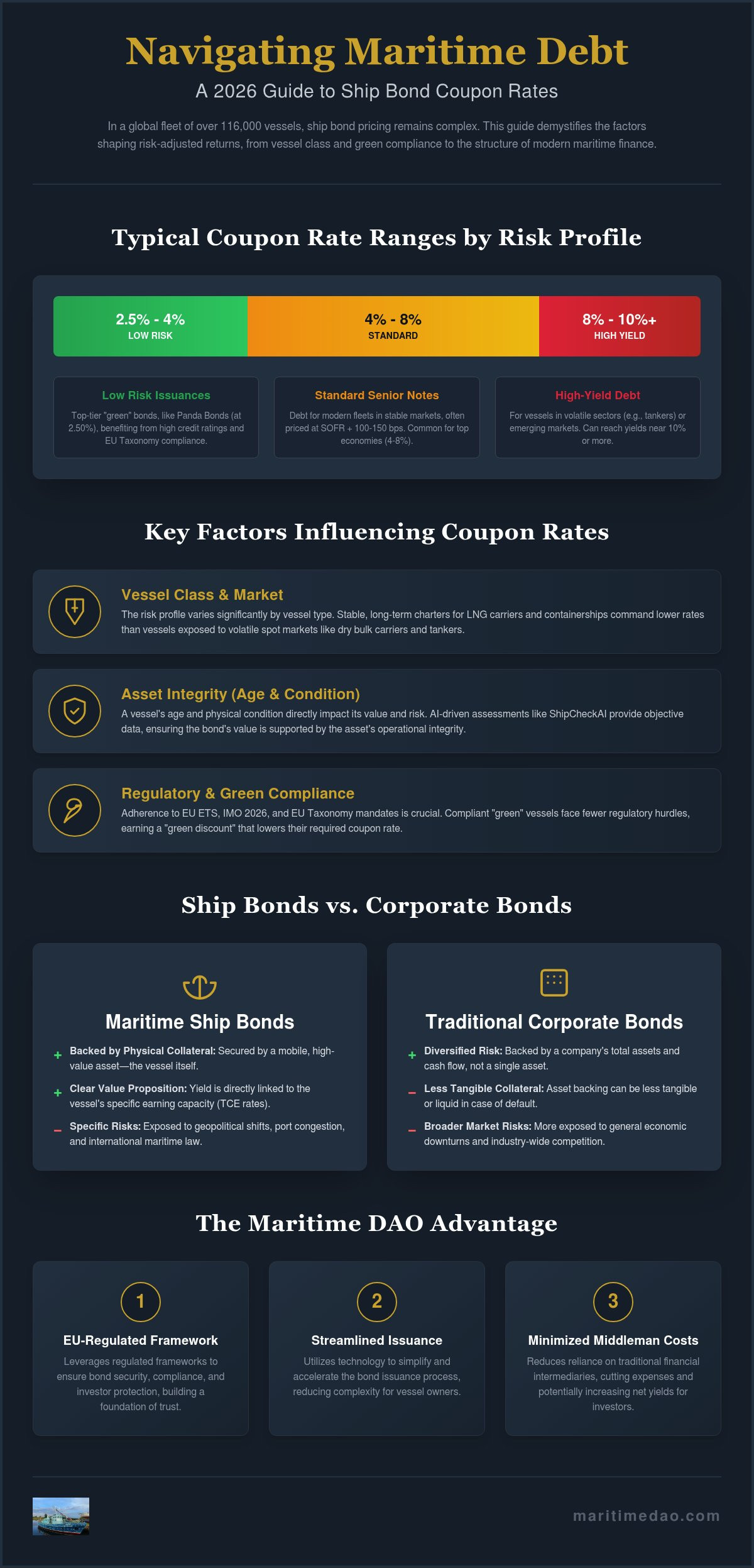
This guide clarifies current market standards, offering a comprehensive framework to evaluate risk-adjusted returns in a regulated innovation landscape. You’ll learn why top-tier issuances, such as recent Panda Bonds, sit at 2.50% while other senior notes reach yields above 7%. We examine how the full implementation of the EU Emissions Trading System (ETS) and AI-driven assessments via ShipCheckAI now dictate bond stability. By the end of this analysis, you’ll understand the specific factors that define typical coupon rates in the 2026 maritime sector, from technical operational integrity to the governance of EU-regulated ship investment bonds.
Key Takeaways
- Analyze how specific vessel classes, such as LNG carriers or container ships, dictate the risk profile and yield benchmarks for maritime debt.
- Discover the typical coupon rate for ship bonds by examining the 2026 spreads over SOFR and the pricing advantages of EU Taxonomy compliance.
- Evaluate the correlation between a vessel’s age and its required coupon, utilizing ShipCheckAI assessments to verify the operational integrity of the underlying asset.
- Contrast maritime asset-backed securities against traditional high-yield corporate bonds to understand the stability offered by physical collateral.
- Explore how the Maritime DAO ecosystem leverages EU-regulated frameworks to streamline bond issuance and minimize traditional middleman expenses.
What Defines a Typical Coupon Rate for Ship Bonds?
In its most fundamental form, the coupon rate represents the fixed annual interest payment a vessel owner commits to paying bondholders. While the general structure of a Bond (finance) remains consistent across industries, maritime debt is unique because it’s anchored to a mobile, depreciating physical asset subject to global geopolitical shifts. Unlike a standard corporate bond issued by a diversified retailer, a ship bond’s yield is inextricably linked to the vessel’s specific earning capacity and its compliance with international maritime law.
The 2026 market has witnessed a structural shift in how these yields are calculated. We’ve moved into a borrower’s market where high loan volumes and competitive interest margins are the norm. However, the typical coupon rate for ship bonds isn’t a static figure; it’s a dynamic reflection of the issuer’s creditworthiness, the vessel’s age, and its “green” status under the EU Taxonomy. For instance, top-tier Asian shipowners currently see credit margins in the 100 to 150 basis points range over the SOFR reference rate, while high-yield senior notes in the tanker sector can reach yields near 10%.
The Mechanics of Maritime Debt Yields
Maritime debt pricing begins with a base reference rate, typically the Secured Overnight Financing Rate (SOFR) or EURIBOR, to which an industry-specific spread is added. This spread accounts for the liquidity of the specific vessel class and the issuer’s operational history. Payment frequency also plays a critical role in defining the effective yield. Most EU-regulated ship investment bonds utilize semiannual or quarterly distributions, which affects the issuer’s cash flow management and the investor’s compounding potential.
A crucial distinction in this sector is the relationship between vessel appraisal and bond par value. As a ship ages, its market value fluctuates based on scrap prices and charter demand. To maintain the integrity of the typical coupon rate for ship bonds, issuers often use ShipCheckAI to provide objective, real-time data on the asset’s condition. This ensures that the bond’s par value remains supported by the physical reality of the vessel’s operational life.
Shipping Risk Premium Explained
The shipping risk premium is the additional yield required to compensate for maritime-specific operational hazards. This premium quantifies the volatility inherent in global trade routes, where sudden shifts in port congestion or canal accessibility can disrupt revenue. Solvency is often measured through Time Charter Equivalent (TCE) rates, a standard industry metric that calculates the average daily revenue performance of a vessel.
Investors demand a higher premium when TCE rates are volatile or when a vessel operates in oversupplied segments, such as large container ships. Conversely, modern vessels that meet IMO 2026 mandates or EU Emissions Trading System (ETS) requirements often command a lower risk premium. This “green discount” reflects the market’s belief that compliant vessels face fewer regulatory hurdles and maintain higher long-term value in a decarbonizing global economy.
Typical Coupon Rate Ranges by Vessel Asset Class
Asset classification is the primary determinant of risk distribution within maritime finance. Because different vessel types operate under distinct chartering cycles and supply-demand pressures, the typical coupon rate for ship bonds varies significantly across the 2026 landscape. Investors must distinguish between the steady, utility-like cash flows of long-term containership charters and the spot-market volatility inherent in dry bulk operations. These instruments unite asset security, regulatory oversight, and technological transparency to provide a structured yield profile tailored to specific maritime risks.
A recent Observer Research Foundation analysis indicates that while top economies often secure maritime debt at rates between 4% and 8%, emerging markets or specialized sectors may face coupons as high as 10%. This spread reflects the market’s assessment of liquidity and operational longevity. In the current 2026 environment, the typical coupon rate for ship bonds is increasingly influenced by the duration of the underlying charter, which acts as a stabilizer for the bond’s interest coverage ratio.
Tankers and Dry Bulk Carriers
The energy transport sector remains a high-yield frontier. For instance, Euronav Lux S.A. senior notes due in late 2026 have recently carried a coupon of 6.25%, though secondary market yields reached 9.94% in June 2026. This reflects the premium required for tanker operations amidst shifting global energy routes. In the dry bulk segment, Diana Shipping Inc. issued senior notes due in 2029 with an 8.75% coupon, demonstrating the higher returns demanded to offset the sector’s historical price fluctuations.
Risk profiles differ even within sub-classes. Capesize vessel bonds generally command higher coupons than Panamax counterparts due to their limited port flexibility and greater sensitivity to specific commodity trades like iron ore. If you are looking to benchmark these yields against institutional standards, you might explore how EU-regulated ship investment bonds provide a transparent framework for these asset classes.
Containerships and Specialized Tonnage
Containerships often provide the baseline for stability in maritime debt. Benchmarks from 2026 show a range from the highly competitive 2.50% coupon for Seaspan Panda Bonds to the 7.375% offered by MPC Container Ships AS. This variation is typically driven by the age of the fleet and the creditworthiness of the charterers. LNG carriers represent a more specialized niche; Golar LNG Ltd bonds due in 2029 and 2030 carry coupons between 7.5% and 7.75%, reflecting the technical complexity and high capital expenditure required for gas transport.
Specialized tonnage, including ‘green’ ammonia tankers and offshore wind support vessels, is increasingly priced with a focus on long-term regulatory viability. As the EU ETS mandates 100% allowance surrender in 2026, these modern, compliant vessels are securing more favorable terms than older, carbon-intensive ships. This shift rewards operational integrity and ensures that capital is directed toward the most sustainable segments of the global fleet.
Factors Influencing Maritime Coupon Rates in 2026
The pricing architecture of maritime debt has transitioned from traditional relationship-based lending to a data-driven model governed by specific risk variables. In 2026, the typical coupon rate for ship bonds is no longer a static reflection of the base interest rate plus a generic industry margin. Instead, it’s a granular calculation that accounts for environmental compliance, asset longevity, and the precision of maintenance records. Geopolitical factors also exert significant pressure; bonds tied to vessels operating in volatile trade lanes often require an additional premium to account for increased insurance costs and potential transit delays. The 2026 market demands a tripartite focus on technical condition, regulatory status, and charterer creditworthiness.
Regulatory Compliance and EU Taxonomy
Environmental mandates have created a bifurcated capital market where the “Green Premium” significantly lowers borrowing costs for compliant owners. Understanding how maritime investment compliance impacts bond pricing is essential for institutional investors seeking stable, long-term returns. According to 2026 trends in ship finance, the influence of the Nordic bond market and direct lenders has accelerated the adoption of sustainability-linked pricing models.
The cost difference between “brown” debt, issued for older, less efficient tonnage, and green maritime bonds can exceed 200 basis points. This gap is driven by the 2026 EU Emissions Trading System requirements, which mandate 100% allowance surrender for voyages within the European economic area. EU-regulated ship investment bonds often achieve tighter spreads due to increased institutional transparency and alignment with the EU Green Bond Standard. This regulatory alignment ensures that capital flows toward assets that are resilient to future carbon-pricing mechanisms.
Operational Integrity and Maintenance Records
Vessel age remains a primary factor in risk assessment, showing a direct correlation to higher required coupons. As a ship moves toward its third or fourth special survey, the probability of structural failure or regulatory detention increases. To mitigate this, the industry has turned toward automated systems to verify asset-backed security. The integration of AI in maritime due diligence allows for a more precise quantification of risk than was possible with traditional manual reporting.
Investors increasingly demand higher coupons for vessels with opaque maintenance histories or intermittent inspection records. By using ShipCheckAI for frequent, verified inspections, issuers can reduce the “uncertainty discount” that often plagues private maritime credit. This technological transparency ensures that the typical coupon rate for ship bonds accurately reflects the physical reality of the asset. It provides a unified standard for governed finance, allowing investors to move beyond speculative estimates into a domain of objective, real-time asset assessment.
Comparing Ship Bonds to Traditional Fixed Income
Maritime debt occupies a distinctive position between traditional fixed income and alternative private credit. While standard high-yield corporate bonds often rely on the unsecured cash flows of a parent company, the typical coupon rate for ship bonds is anchored by the intrinsic value of a physical asset. This structural difference provides a risk profile that is fundamentally different from retail or technology sector debt. In 2026, with the ship finance market exceeding $400 billion in outstanding debt, institutional investors are increasingly utilizing these instruments to diversify away from tech-heavy indices that are sensitive to interest rate sentiment rather than physical trade volume.
Vessel-Backed Security vs. Unsecured Corporate Debt
The primary advantage of maritime finance lies in the recovery value of the underlying asset. In a default scenario, a vessel can be arrested, appraised, and sold on the global secondary market, providing a “floor” for investor protection that unsecured corporate debt lacks. These ship asset backed securities ensure that the bond’s par value is supported by physical collateral, regulatory oversight, and predictable cash flow. Historically, default rates in the maritime sector have shown resilience compared to the retail or commercial real estate markets, particularly when debt is issued against modern, compliant tonnage.
Unlike traditional corporate entities that may face total insolvency, a ship maintains a residual scrap value even in the most severe market downturns. This provides a unique safety net for bondholders. When evaluating the typical coupon rate for ship bonds, investors must consider this “hard asset” backing as a critical component of the risk-adjusted return calculation. The 2026 market has seen a surge in liquidity for these bonds, with secondary markets becoming more robust as specialized platforms provide unified standards for asset assessment and governance.
Inflation Hedging in Maritime Finance
Shipping debt serves as a natural hedge against inflation because the underlying value of the asset and the revenue it generates are tied to the cost of global trade. As inflation drives up the price of commodities and finished goods, charter rates often follow suit, protecting the issuer’s ability to service debt. In the current inflationary 2026 environment, the choice between fixed and floating maritime coupons has become a strategic priority for portfolio managers. Floating rate notes, often priced at a spread over the SOFR reference rate, allow investors to maintain yield parity as central bank policies shift.
Strategic allocation into ship bonds offers a way to capture yield from heavy industry while benefiting from the structural integrity of regulated capital markets. These bonds provide a bridge between the physical world of global trade and the digital world of transparent finance. If you are ready to diversify your fixed income strategy with institutional-grade maritime debt, you can explore the current offerings for EU-regulated ship investment bonds to secure yield backed by global trade assets.
Optimizing Yield through the Maritime DAO Ecosystem
Maritime DAO serves as a visionary architect in a capital market traditionally defined by fragmented intermediaries and opaque pricing. By replacing legacy brokerage silos with a unified, governed ecosystem, the platform significantly reduces the administrative friction that historically suppressed net returns for bondholders. This structural efficiency allows for the issuance of EU-regulated ship investment bonds with optimized yield profiles. When the middleman tax is removed, the typical coupon rate for ship bonds reflects a more direct relationship between the vessel’s earning power and the investor’s distribution, creating a more inclusive frontier for institutional capital that values order and transparency.
Transparency through ShipCheckAI
Operational integrity is no longer a matter of faith but a product of automated intelligence. Through the AI ship inspection tool, known as ShipCheckAI, bondholders receive continuous data feeds that monitor the physical condition of the underlying asset. This level of real-time transparency eliminates the uncertainty discount that often drives up risk premiums in maritime private credit. These data-driven insights ensure that bond covenants are maintained with precision, providing a layer of security that traditional manual inspections cannot match. By quantifying technical risk through objective vessel assessments, the ecosystem lowers the overall risk premium for DAO-governed debt instruments.
Accessing EU-Regulated Maritime Debt
Entering the world of Maritime DAO investment empowers participants to engage with assets that were once the exclusive domain of global banks. The process is methodical and transparent, guided by a framework that prioritizes legal compliance within the European Union. Investors aren’t just passive observers; they participate in a system designed to unify physical assets, digital governance, and institutional compliance. Prospective bondholders should carefully evaluate current offerings on a global maritime investment platform to verify the alignment between yield and asset quality. Ultimately, the most successful strategies in 2026 balance a competitive typical coupon rate for ship bonds with the sober reliability of a governed, asset-backed ecosystem.
The Evolution of Regulated Maritime Capital
The maritime finance sector has entered a period of regulated innovation where data transparency and legal frameworks replace the opaque traditions of the past. As we’ve analyzed, the typical coupon rate for ship bonds in 2026 is fundamentally driven by the tripartite relationship between vessel class, environmental compliance, and technical operational integrity. By leveraging institutional-grade assessments and adhering to the EU Taxonomy, the industry has created a stable bridge between physical global trade and transparent debt markets. This shift ensures that capital is no longer allocated based on speculation, but on objective, real-time asset performance.
You’re now equipped to evaluate maritime yields with the same precision as traditional corporate debt. To begin your journey into this modernized asset class, Explore EU-Regulated Ship Investment Bonds at Maritime DAO. Through our EU-regulated framework and AI-driven transparency via ShipCheckAI, we provide unprecedented global maritime asset access for the sophisticated investor. It’s time to secure your position in the future of global trade finance with confidence and clarity.
Frequently Asked Questions
What is a typical coupon rate for a ship bond in 2026?
The typical coupon rate for ship bonds in 2026 generally ranges from 2.5% for top-tier issuers to nearly 10% for high-yield senior notes. These rates are often calculated as a spread over the SOFR reference rate, with premier Asian shipowners securing margins between 100 and 150 basis points. Market benchmarks show that specialized vessels like LNG carriers often command coupons around 7.5%, reflecting their technical complexity and capital intensive nature.
How does vessel age affect the bond’s coupon rate?
Vessel age has a direct, positive correlation with the required coupon rate. As ships approach their third or fourth special survey, the probability of technical failure or regulatory detention increases. To compensate for this elevated risk, investors demand a higher yield. Modern vessels with higher operational integrity often secure more favorable terms, as they are better positioned to comply with evolving environmental mandates and maintain long-term asset value.
Are maritime bonds considered high-yield or investment-grade?
Maritime bonds span the entire credit spectrum from investment-grade to high-yield instruments. Top-tier container ship operators often issue debt with yields comparable to investment-grade corporate bonds. Conversely, smaller owners with older tanker or dry bulk fleets typically operate in the high-yield space, where coupons exceed 8%. The designation depends on the issuer’s creditworthiness, the vessel’s age, and the stability of its underlying charter agreements.
Can the coupon rate of a ship bond change after issuance?
While most traditional bonds feature a fixed coupon rate established at issuance, the 2026 market frequently utilizes floating-rate structures. These instruments are often linked to a base rate like SOFR plus a fixed margin, meaning the actual payment fluctuates with broader interest rate movements. This structure provides a hedge against inflation and ensures that the bond’s yield remains competitive within the shifting global financial landscape.
What happens to the coupon payments if the vessel is not earning freight?
Coupon payments are mandatory debt obligations that must be met regardless of the vessel’s current freight earnings. If a ship is off-hire due to maintenance or market downturns, the issuer must utilize cash reserves or corporate liquidity to fulfill interest payments. Failure to meet these distributions typically triggers a default event, allowing bondholders to exercise their rights over the underlying physical asset as collateral.
How do EU regulations affect the interest rates on shipping bonds?
EU regulations act as a stabilizing force that often results in tighter interest rate spreads for compliant vessels. The implementation of the EU Taxonomy and the Emissions Trading System (ETS) has created a Green Premium, where sustainable vessels secure lower borrowing costs. EU-regulated ship investment bonds benefit from a unified standard of transparency and governance, which reduces the perceived risk for institutional investors and institutionalizes the maritime capital markets.
Is a higher coupon rate always better for a maritime investor?
A higher coupon rate is not inherently superior; it’s a reflection of the asset’s risk profile. While a 9% yield is attractive, it often signals an older vessel, volatile spot-market exposure, or lower operational integrity. Investors should focus on risk-adjusted returns, evaluating how factors like EU-regulated frameworks and AI-driven inspections mitigate the hazards associated with higher-yielding maritime debt instruments.
How does ShipCheckAI help in determining the coupon rate?
ShipCheckAI provides the objective, real-time data required to quantify a vessel’s operational integrity and maintenance history. By delivering precise assessments of the asset’s physical condition, it allows issuers to reduce the uncertainty discount that typically inflates risk premiums. This technological transparency ensures that the typical coupon rate for ship bonds is based on verifiable data rather than speculative estimates, creating a more efficient and governed financing ecosystem.