
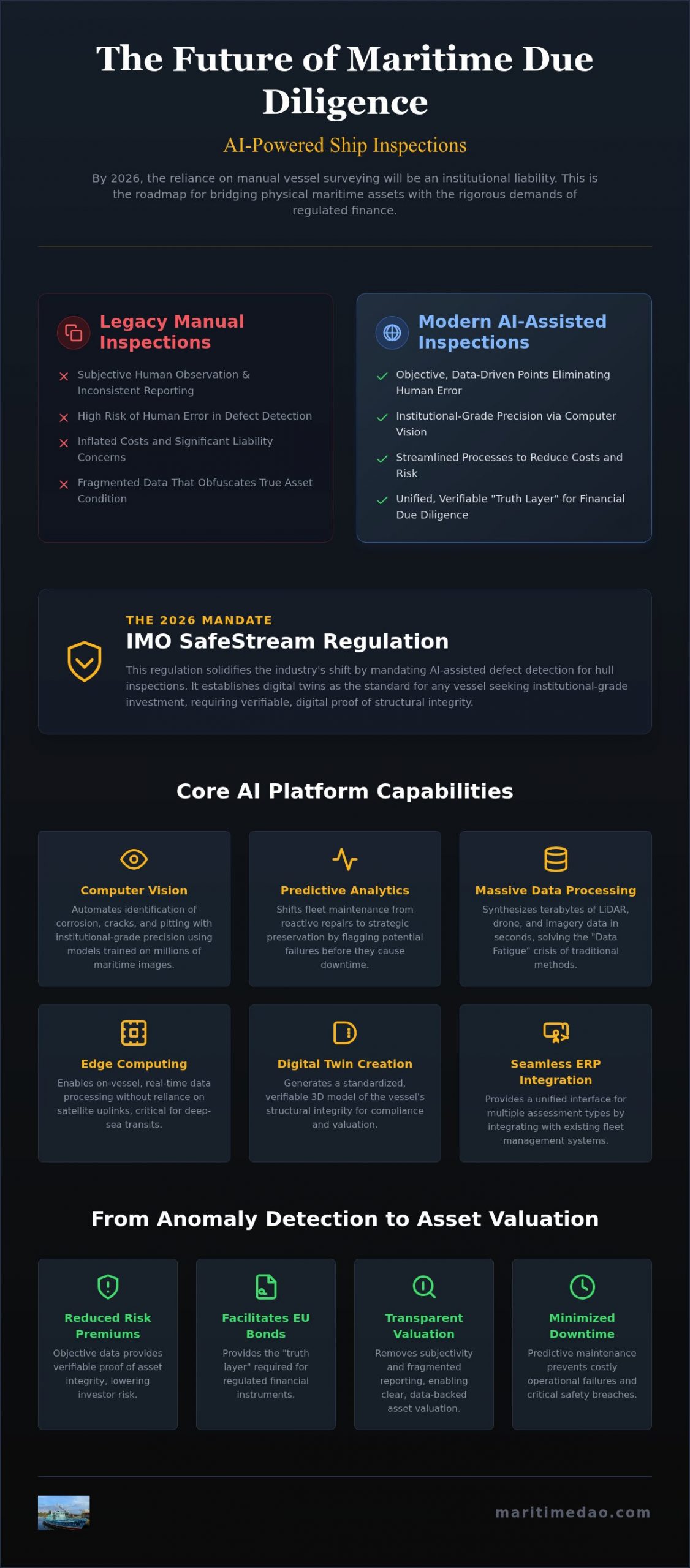
By the close of 2026, the reliance on manual vessel surveying will be viewed as an institutional liability rather than an industry standard. As the global maritime sector transitions toward a model of proactive compliance, the traditional clipboard and flashlight approach simply cannot provide the granular data required for modern asset management. You’ve likely experienced the friction of high manual survey costs and the persistent risk of human error in detecting critical structural defects like corrosion, pitting, or hairline cracks.
This guide demonstrates how AI ship inspection software is transforming these operational burdens into a streamlined foundation for institutional-grade due diligence. You’ll learn how intelligent systems process massive drone and LiDAR datasets to deliver precise, verifiable assessments of a vessel’s structural integrity. We will detail the shift toward automated intelligence, the implications of the IMO’s SafeStream regulation, and the role of ShipCheckAI in securing the transparency needed for EU-regulated investment bonds. This is the roadmap for bridging the gap between physical maritime assets and the rigorous demands of regulated finance.
Key Takeaways
- Transition from subjective manual checklists to objective, AI-driven data points to eliminate human error and address the challenges of massive dataset processing.
- Understand how modern AI ship inspection software utilizes computer vision to automate the detection of structural anomalies like corrosion and cracks with institutional-grade precision.
- Discover the role of high-fidelity inspection data as a “truth layer” that reduces risk premiums and facilitates the issuance of EU-regulated ship investment bonds.
- Align fleet operations with the 2026 IMO SafeStream regulations by implementing verifiable, digital proof of structural integrity and continuous compliance.
- Evaluate inspection platforms based on their ability to integrate seamlessly with existing ERP systems and provide a unified interface for multiple assessment types.
The Evolution of Maritime Surveys: Why AI is Mandatory in 2026
Maritime due diligence has reached a critical inflection point. The industry’s historic reliance on subjective human observation is dissolving, replaced by a sophisticated framework of objective, automated intelligence. By late 2026, the adoption of AI ship inspection software has become a regulatory and financial mandate rather than a technological choice. This transition directly solves the “Data Fatigue” crisis. While traditional methods struggled to process terabytes of LiDAR point clouds and high-resolution imagery, modern AI synthesizes this information in seconds. It creates a unified truth layer that governs asset valuation, ensures structural safety, and secures institutional capital.
The implementation of the International Maritime Organization’s SafeStream regulation in October 2026 has solidified this shift by mandating AI-assisted defect detection for hull inspections. This makes digital twins the expected standard for any vessel seeking institutional-grade investment. Traditional ship brokerage, while useful for transaction facilitation, lacks the technical depth required for modern due diligence. Institutional investors now demand verifiable, standardized data that only an automated ecosystem can provide to mitigate the risks inherent in heavy industry assets.
Limitations of Legacy Inspection Methods
Legacy surveys are restricted by human biology and fragmented reporting. Manual inspectors face extreme risks in confined ballast tanks and high-altitude structural zones, leading to inflated costs and significant liability concerns. Subjectivity remains the greatest threat to institutional confidence; two different surveyors may interpret the same corrosion pattern with varying levels of severity. These inconsistencies create fragmented data sets that delay capital deployment and obfuscate the true condition of a maritime asset, making it difficult to achieve a transparent valuation.
The Rise of Autonomous and Remote Surveys
Autonomous drones and ROVs now serve as the primary eyes of the industry, feeding raw data into cloud-based processing engines. These systems function similarly to AI-powered collision avoidance systems by utilizing computer vision to identify anomalies with surgical precision. This technology allows for real-time defect detection during live vessel walk-throughs, ensuring that reports are standardized across global fleets. By unifying physical inspections, digital governance, and financial transparency, these tools provide the data foundation required to secure EU-regulated ship investment bonds.
Core Capabilities of AI Vessel Inspection Platforms
Modern AI ship inspection software is an integrated diagnostic ecosystem that utilizes machine learning to automate defect identification and facilitate predictive maintenance protocols. It’s more than a digital reporting tool; it’s a sophisticated engine that identifies, localizes, and prioritizes structural risks. By converting raw visual data into actionable intelligence, these platforms provide the truth layer required for high-stakes asset management. This technology ensures that every assessment is rooted in objective data, removing the inconsistencies that historically plagued manual surveying methods.
Predictive analytics represent a fundamental shift from reactive repairs to strategic preservation. By analyzing historical wear patterns, the software flags potential failures before they result in costly operational downtime or safety breaches. For deep-sea transits where connectivity is limited, edge computing is a non-negotiable requirement. High-performance software must run locally on vessel hardware, allowing for real-time data processing without relying on satellite uplinks. This ensures that the crew can identify and address anomalies immediately, maintaining the vessel’s structural integrity throughout the voyage.
Computer Vision and Defect Detection
The efficacy of computer vision depends on the depth of its training. Leading platforms utilize models trained on millions of maritime-specific images to achieve institutional-grade accuracy. This allows the system to distinguish between superficial surface rust and critical structural corrosion that threatens the hull’s stability. By localizing these anomalies within a 3D digital model of the vessel, the software provides a spatial context that traditional flat-image reporting cannot replicate. This precise mapping allows technical managers to visualize the exact progression of wear across the entire fleet, ensuring that maintenance capital is deployed where it’s most needed.
Dynamic Checklist Generation
Unlike static legacy forms, intelligent platforms utilize dynamic checklists that adapt to the specific vessel type, age, and operational history. This ensures that a 20-year-old bulk carrier receives a fundamentally different assessment protocol than a newly commissioned LNG tanker. Integrating AI in maritime due diligence into standard workflows allows operators to automate compliance with the IMO guidelines issued on January 22, 2026. Unlike single-use tools, advanced AI ship inspection software like ShipCheckAI performs multiple inspection types in a single, unified interface. This level of transparency is foundational to the governance structures within the Maritime DAO ecosystem, providing the verifiable proof of seaworthiness required by institutional investors.
From Anomaly Detection to Asset Valuation: The Financial Impact
High-fidelity data derived from AI ship inspection software transforms the risk profile of maritime assets from an opaque liability into a transparent financial instrument. By replacing subjective estimates with objective metrics, this technology significantly reduces the risk premium associated with maritime debt. Institutional lenders require precision to justify capital allocation, and automated intelligence provides the necessary evidentiary support to satisfy these mandates. ShipCheckAI acts as the definitive “Truth Layer” for EU regulated ship investment bonds, ensuring that the physical condition of a vessel is perfectly mirrored in its digital financial representation. This alignment between technical status and fiscal valuation accelerates bond issuance by providing a standardized audit trail that satisfies rigorous regulatory frameworks.
The correlation between automated surveys and maritime insurance underwriting accuracy is equally profound. When underwriters have access to granular, AI-verified structural data, they can price risk with unprecedented accuracy, often leading to more favorable terms for well-maintained fleets. This creates a virtuous cycle where transparency leads to lower capital costs, which in turn incentivizes higher standards of maintenance and safety across the global maritime ecosystem.
Securitization and Technical Due Diligence
AI-generated reports satisfy the growing demand for transparency among institutional investors who require more than periodic, snapshot-based surveys. These stakeholders now expect continuous monitoring of asset health to protect their long-term interests. ShipCheckAI facilitates this by providing a persistent stream of structural data, allowing bondholders to track the integrity of their underlying collateral in real time. This proactive approach mitigates “Black Swan” risks, such as sudden hull failures or undetected structural fatigue, by utilizing predictive structural health monitoring. It creates a governed environment where risk is not just managed but systematically reduced through automated, verifiable oversight.
Improving Maritime Bond Yields through Efficiency
Operational efficiency is the primary driver of investor yield in the shipping sector. By utilizing AI ship inspection software to optimize maintenance planning, operators can drastically reduce vessel off-hire time and unplanned repair costs. Every day a ship remains in active service rather than in an unscheduled dry dock directly translates to higher revenue and more secure debt servicing. Modern strategies regarding how to invest in maritime assets now rely heavily on this AI-verified data to project reliable long-term returns. Creating a unified, transparent record of asset value from the initial build to the final scrap yard ensures that the vessel maintains its peak valuation throughout its operational lifecycle, providing a stable foundation for the entire Maritime DAO ecosystem.
Selection Framework: Evaluating AI Inspection Tools for Global Fleets
Selecting AI ship inspection software requires a departure from superficial feature comparisons toward a rigorous evaluation of institutional reliability. The primary technical metric is the accuracy of computer vision models, specifically the ratio of false positives to false negatives. While a high false positive rate creates operational noise, a false negative in structural defect detection represents a systemic risk to vessel integrity. Operators must prioritize platforms that demonstrate a proven track record in identifying critical anomalies across diverse environmental conditions, ensuring that structural assessments are both precise and actionable.
Integration capabilities define the software’s long-term utility within a global fleet. A standalone tool that exists in a vacuum creates data silos, whereas a unified platform integrates seamlessly with existing ERP and maintenance systems to trigger automated work orders. This connectivity ensures that structural data informs every aspect of fleet management, from procurement to decommissioning. Additionally, the software must support multiple inspection types, including pre-purchase, annual, and damage assessments, to provide a comprehensive view of asset health throughout its entire operational lifecycle.
Technical Integration and Scalability
Modern assessment tools must possess the computational power to process high-bandwidth data streams, including LiDAR point clouds and 4K video. Managing this data requires a sophisticated approach to storage sovereignty. While cloud-based processing offers scalability, on-premise edge computing is essential for maintaining data security and operational continuity during deep-sea transits. User interface design must also be prioritized; if the software isn’t intuitive for crew members in the field, the quality of the raw data collected will invariably suffer, undermining the entire assessment ecosystem. Scalable systems allow for the simultaneous monitoring of hundreds of vessels, providing a unified dashboard for technical managers.
Governance and Audit Trails
For institutional investors, the integrity of the data is as important as the data itself. A robust selection framework must include an evaluation of the software’s governance architecture, ensuring that all inspection logs are immutable and transparent. This prevents tampering or fraudulent reporting, which is a critical requirement for maritime investment compliance. Providers must demonstrate a deep understanding of both maritime technology and institutional finance, acting as a reliable gatekeeper for global trade. To secure your fleet with an integrated, finance-ready assessment solution, explore the offerings at Maritime DAO.
ShipCheckAI: Unifying Inspection Technology with Regulated Finance
ShipCheckAI serves as the specialized technical pillar within the Maritime DAO ecosystem, providing the empirical foundation for high-stakes asset-backed security. While general-purpose platforms often focus on isolated diagnostics, this AI ship inspection tool unifies multiple assessment types, ranging from structural hull surveys to machinery health audits, into a single, governed interface. It’s the architecture that allows the physical reality of a vessel to be translated into the digital certainty required by modern capital markets. By providing real-time access to vessel health data within a regulated DAO structure, the platform empowers institutional investors to monitor their collateral with unprecedented transparency and confidence.
This integration of AI ship inspection software into the financial lifecycle of a vessel ensures that technical due diligence is no longer a static, one-time event. Instead, it becomes a continuous stream of verifiable data that protects the interests of all stakeholders. The platform acts as a bridge, connecting the heavy industry of global shipping with the sophisticated requirements of decentralized finance and institutional asset management.
The ShipCheckAI Advantage
This platform is engineered specifically for the rigor of EU-regulated financial instruments, ensuring that every data point satisfies the compliance standards of institutional bondholders. Automated reporting modules are tailored to the distinct needs of shipowners, insurers, and investors, creating a unified language of risk across the entire ecosystem. The software doesn’t remain static; it benefits from continuous feature updates driven by the Maritime DAO governance community. This ensures that the technology evolves alongside shifting regulatory and operational demands, maintaining its position as a leader in regulated innovation.
Future-Proofing Maritime Assets
As the industry enters a decade defined by decarbonization and stricter structural monitoring, ShipCheckAI provides the necessary tools for long-term asset preservation. The integration of AI ship inspection software into the broader Future of Ship Finance allows for the monitoring of carbon intensity and structural wear in a single, auditable record. For fleet owners, the next step is the transition from reactive maintenance to a data-governed operational model. For institutional investors, it’s the adoption of a framework where capital is secured by verifiable, real-time intelligence. By unifying these distinct worlds, ShipCheckAI ensures that maritime assets remain viable, compliant, and profitable in an increasingly transparent global market.
Securing the Future of Maritime Asset Integrity
The transition from subjective manual surveys to objective, automated intelligence marks a permanent shift in maritime operations. By late 2026, the adoption of AI ship inspection software has become the primary mechanism for securing institutional-grade investments and ensuring structural integrity across global fleets. You’ve seen how high-fidelity data reduces risk premiums and facilitates the issuance of EU-regulated ship investment bonds, providing a transparent foundation for the entire maritime ecosystem.
ShipCheckAI stands at the intersection of heavy industry and high finance, offering a unified interface that supports multiple inspection types while adhering to a strict EU-regulated compliance framework. This integration with the Maritime DAO investment ecosystem ensures that your assets aren’t just maintained; they’re governed by a methodical, visionary architecture designed for long-term stability. As the industry moves toward a more transparent and inclusive future, the tools you choose today will define your operational resilience for the next decade. It’s time to align your fleet with the highest standards of digital governance.
Explore ShipCheckAI and Modernize Your Vessel Assessments to lead the next era of maritime innovation.
Frequently Asked Questions
Is AI ship inspection software reliable enough to replace human surveyors?
AI ship inspection software serves as a high-precision augmentative layer rather than a total replacement for human expertise. While it eliminates the subjectivity and fatigue associated with manual surveys, the final legal certification often requires human oversight. However, the software identifies structural anomalies like hairline cracks and micro-corrosion with a level of accuracy that exceeds human biological limits, providing the objective data foundation necessary for institutional-grade asset valuation.
How does computer vision detect corrosion in low-light ballast tanks?
Computer vision systems utilize high-intensity LED arrays mounted on drones or ROVs to illuminate confined spaces like ballast tanks. The underlying machine learning models are trained specifically on low-contrast, noisy imagery to distinguish between shadows and actual structural defects. By normalizing the visual data through specialized algorithms, the software can identify pitting and deformation in environments where human visibility is severely compromised, ensuring a comprehensive assessment of the hull’s internal integrity.
Can AI ship inspection software work without an internet connection?
Modern AI ship inspection software is designed to function via edge computing, allowing it to operate without an active internet connection during deep-sea transits. Localized hardware on the vessel processes raw LiDAR and image data in real time, enabling the crew to identify immediate risks. Once the vessel enters a zone with satellite or port connectivity, the system synchronizes the processed reports with the centralized DAO ecosystem to update the asset’s digital financial record.
What are the primary types of ship inspections supported by ShipCheckAI?
ShipCheckAI supports a comprehensive range of assessment protocols, including pre-purchase surveys, annual structural inspections, and damage assessments. It provides a unified interface for multiple inspection types, allowing technical managers to maintain a continuous record of a vessel’s condition. This multi-faceted approach ensures that all operational and financial stakeholders have access to a single version of the truth, whether they’re evaluating a potential acquisition or monitoring a long-term maritime debt instrument.
How does AI inspection data influence the pricing of maritime investment bonds?
High-fidelity inspection data directly influences maritime bond pricing by reducing the risk premium associated with opaque asset conditions. When investors have access to verifiable, AI-driven structural reports, they can allocate capital with greater confidence. This transparency allows for more precise collateral valuation, which often leads to lower interest rates for issuers and more secure yields for bondholders within the EU-regulated maritime investment ecosystem, ensuring a stable environment for institutional finance.
Is ShipCheckAI compliant with EU financial regulations?
ShipCheckAI is built within an ecosystem founded on EU-regulated compliance, ensuring it meets the rigorous standards required for institutional finance. The software’s governance architecture provides an immutable audit trail of all vessel assessments, which is essential for satisfying the transparency mandates of European financial authorities. This alignment allows the platform to serve as the technical “truth layer” for the issuance and management of regulated ship investment bonds, bridging the gap between heavy industry and capital markets.
What hardware is required to run modern AI vessel inspection software?
Running sophisticated AI ship inspection software requires a combination of high-resolution data capture devices and localized processing power. This typically includes 4K-capable drones or ROVs, LiDAR scanners for 3D modeling, and edge-computing servers equipped with GPU acceleration. These hardware components work in tandem to capture and analyze massive datasets, ensuring that structural defects are identified with surgical precision before the data is transmitted to the broader governance network for institutional review.
How long does it take to process a full vessel inspection using AI?
Processing times have been drastically reduced through automated intelligence, allowing terabytes of LiDAR and visual data to be synthesized in minutes. While a traditional manual survey might take days to generate a preliminary report, AI-driven systems can produce a comprehensive, standardized assessment in a fraction of that time. This rapid turnaround allows for immediate decision-making, reducing vessel off-hire periods and accelerating the technical due diligence process for high-stakes financial transactions and operational planning.