
In 2026, the true measure of a vessel’s worth isn’t found in its steel or its age, but in the verified integrity of its digital data. For too long, the maritime industry has accepted that heavy maintenance and regulatory compliance must come at the cost of operational momentum. You likely recognize the frustration of seeing a high-value asset sit idle while manual rope access teams and fragmented class surveys drive up costs and delay schedules. Ship inspection efficiency is no longer just a technical goal; it’s the primary bridge between physical operations and institutional capital.
We’ll show you how AI-driven automation and regulated frameworks are finally eliminating vessel downtime while securing the asset transparency that modern investors demand. By integrating real-time compliance with advanced data platforms, the industry is moving toward a model where technical health and financial valuation are inextricably linked. This guide examines how the transition to unified ecosystems like ShipCheckAI allows stakeholders to navigate the 11% CII reduction mandates and EU ETS requirements with precision, turning mandatory due diligence into a strategic advantage for global trade.
Key Takeaways
- Redefine ship inspection efficiency as a strategic metric that balances high-fidelity data accuracy with the minimization of costly vessel downtime.
- Deploy AI-powered computer vision and IoT sensor networks to transition from reactive maintenance to preemptive condition assessments.
- Align operational technicalities with financial outcomes by using transparent data reports to secure and enhance the yield of EU-regulated Ship Investment Bonds.
- Follow a structured five-step roadmap to audit legacy reporting systems and integrate automated, multi-type inspection tools into your fleet management.
- Connect physical asset integrity to the digital economy through unified platforms like ShipCheckAI, bridging the gap between heavy industry and institutional finance.
The Evolution of Ship Inspection Efficiency in 2026
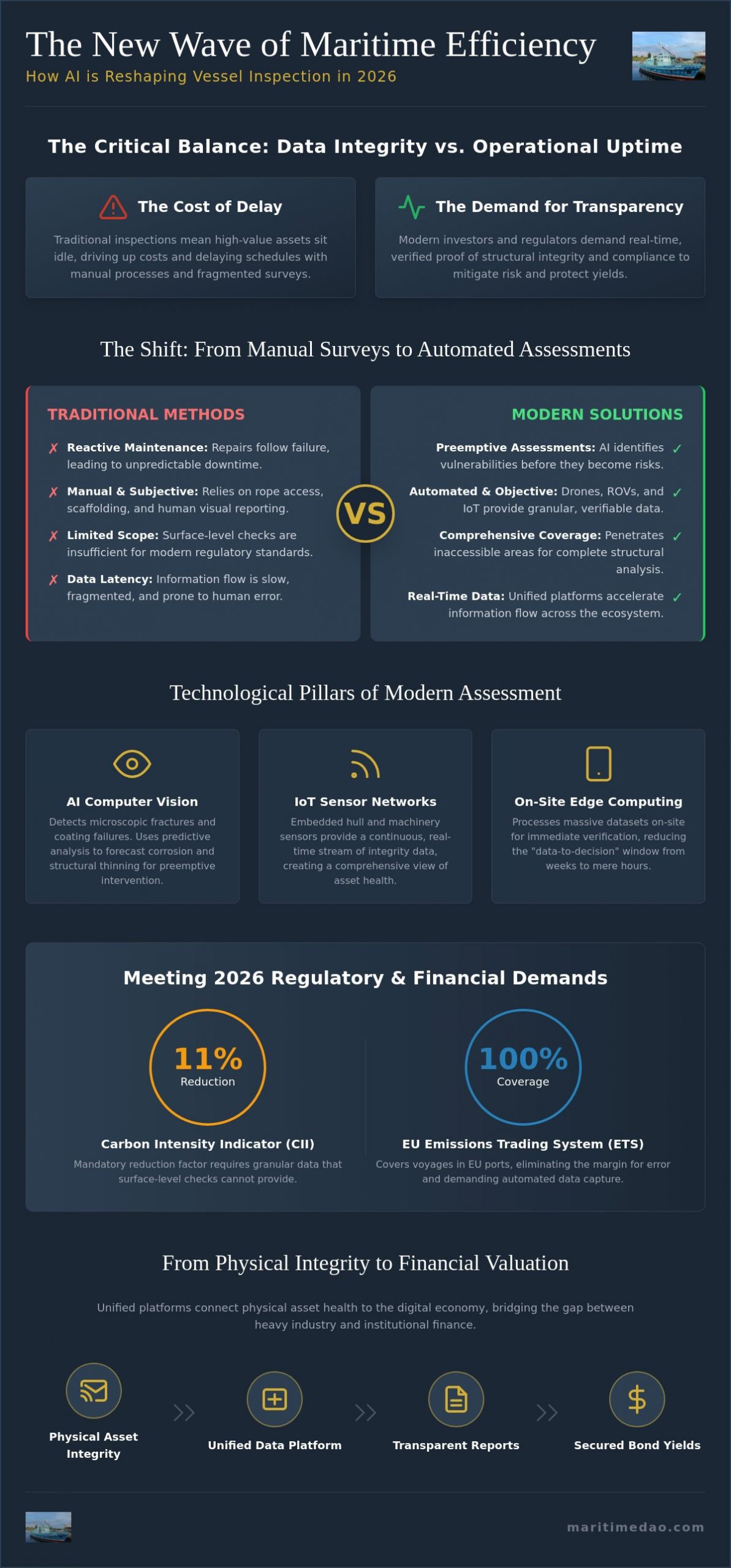
In the current maritime landscape, ship inspection efficiency represents the critical equilibrium between high-fidelity data acquisition and the minimization of operational latency. It’s no longer measured simply by the hours spent on board, but by the mathematical ratio of data accuracy to vessel downtime. As we move through 2026, the industry has undergone a fundamental shift from reactive maintenance, where repairs follow failure, to AI-preempted condition assessments that identify structural vulnerabilities before they manifest as operational risks. This transition unifies, validates, and accelerates the flow of information across the entire maritime ecosystem.
The New Inspection Regime (NIR), a cornerstone of the modern Port State Control (PSC) regime, has standardized the minimum expectations for safety and environmental compliance. However, commercial excellence now demands more than just meeting these baselines. High-stakes institutional capital, particularly within the realm of ship investment bonds, requires faster and more transparent vessel data to mitigate risk. Investors don’t just want to know a ship is seaworthy; they demand real-time proof of its structural integrity and regulatory standing to protect their yields.
From Manual Surveys to Automated Assessments
Traditional methods involving rope access and extensive scaffolding have become obsolete in an era where every hour of downtime carries a heavy financial penalty. These manual processes are inherently limited by human physical constraints and the subjective nature of visual reporting. Surface-level checks aren’t enough to satisfy 2026 regulatory standards, such as the mandatory 11% Carbon Intensity Indicator (CII) reduction factor. Understanding the nuances of various ship inspection types is now vital for maintaining high fleet availability. Automated systems can penetrate areas once considered inaccessible, providing a level of granular detail that manual surveys simply can’t match.
Key Drivers of Efficiency in the Current Decade
The standardization of digital twin reporting across global registries has created a unified language for asset management. These digital replicas allow for continuous monitoring, integrating IMO pollution prevention efforts directly into technical surveys. With the EU ETS now covering 100% of emissions for voyages involving EU ports, the margin for error has vanished. Automated data capture significantly reduces the human error factor, ensuring that reports are grounded in objective reality rather than estimated approximations. This systematic approach governs how data is collected, processed, and presented, opening up new opportunities for optimized asset valuation and streamlined compliance.
Technological Pillars of Modern Vessel Assessment
In 2026, ship inspection efficiency is no longer defined by the hardware alone but by the intelligent ecosystem that governs its data. AI-powered computer vision serves as the central nervous system of automated defect detection, identifying microscopic fractures and coating failures that often escape the human eye. This software doesn’t operate in isolation. It integrates with IoT sensors embedded in the hull and machinery to provide a continuous stream of real-time integrity data. This tripartite approach of vision, sensing, and analysis creates a comprehensive view of asset health that was previously impossible to achieve through manual means.
To eliminate reporting latency, edge computing processes these massive datasets on-site. This allows for immediate verification before the vessel leaves the berth, reducing the “data-to-decision” window from weeks to hours. We see a decisive move toward hardware-agnostic software platforms that unify fragmented inspection tools. By consolidating data from drones, ROVs, and handheld scanners into a single governed environment, these platforms ensure that every stakeholder has access to a transparent source of truth regarding the vessel’s condition.
The Role of AI in Improving Inspection Accuracy
Modern AI models have moved beyond simple visual recognition to perform predictive corrosion and structural analysis. By analyzing historical datasets, these systems forecast where structural thinning is likely to occur, allowing for preemptive intervention. Operators can significantly improve ship inspection accuracy by training algorithms on thousands of verified class survey reports. These systems automatically cross-reference findings against international maritime codes, ensuring that every assessment is compliant with the highest standards. This methodical approach mirrors the rigor of the U.S. Coast Guard Streamlined Inspection Program, where structured plans replace ad-hoc visual assessments to maintain fleet readiness.
Robotics and Drones: Accelerating Physical Access
Physical access, once the primary bottleneck of inspection, has been revolutionized by specialized robotics. Elios-class drones now navigate internal ballast tanks without the need for time-consuming gas clearing or dangerous human entry. Similarly, submersible ROVs conduct hull inspections during active port operations, eliminating the need for dry-docking to verify biofouling or weld integrity. While the hardware is impressive, the real value lies in the data pipeline. Many fleet managers are shifting to subscription-based models to ensure they always have access to the latest sensor technology without the burden of asset depreciation. For those looking to capitalize on this data-driven transparency, exploring institutional maritime investment structures offers a path toward securing returns backed by verified physical assets.
Operational vs. Financial Efficiency: A Strategic Comparison
In the high-stakes environment of 2026, a fundamental distinction has emerged between simple technical seaworthiness and investment-ready data. While a vessel may be physically capable of navigation, its financial utility is governed by the transparency and verifiability of its condition reports. Ship inspection efficiency has evolved into a primary financial metric, directly impacting the risk pricing and eventual yield of maritime debt instruments. When data is fragmented or subjective, institutional investors demand higher risk premiums. Conversely, unified and AI-verified reporting reduces information asymmetry, allowing ship owners to present their vessels as transparent, low-risk assets to global capital markets.
This systematic alignment of technical health and financial reporting is essential for the issuance of EU regulated ship investment bonds. In this regulated ecosystem, the speed of data deployment dictates the speed of capital deployment. By utilizing automated intelligence to secure asset transparency, operators can bridge the traditional gap between heavy industry operations and the stringent requirements of institutional finance. This ensures that every structural assessment serves a dual purpose: maintaining the physical asset and upholding its status as a governed financial security.
Quantifying the Cost of Downtime
The revenue loss associated with traditional surveys is no longer an acceptable cost of doing business. When a vessel is pulled from a charter for 18 days to accommodate manual scaffolding and human surveyors, the financial impact extends beyond the inspection fee to include lost hire, port dues, and disrupted logistics chains. Modern ship inspection efficiency leverages ‘inspections in transit’ and automated drone assessments to maintain strict operational schedules. Opportunity cost in this context is the definitive margin between an asset generating active charter revenue and one incurring stagnant berthing fees during an 18-day manual survey versus a 1-day automated assessment.
Data Integrity as a Financial Asset
Objective data has replaced subjective surveyor opinions as the gold standard for maritime due diligence. For a vessel to meet the rigorous standards of maritime investment compliance, its data must be standardized, immutable, and easily auditable by third-party stakeholders. High-efficiency inspections provide this level of structural integrity, which in turn lowers insurance premiums and reduces the cost of financing. By moving away from anecdotal reporting and toward AI-verified datasets, the industry creates a more inclusive and reliable investment landscape where asset valuation is grounded in granular, real-time evidence rather than historical approximations.
Implementing an Efficient Inspection Framework
Transitioning to a high-performance operational model in 2026 requires a methodical departure from legacy reporting structures. To achieve true ship inspection efficiency, owners must move beyond the ad-hoc adoption of drones and instead build a foundation of governed data. This process begins with a rigorous audit of technical debt, identifying the fragmented silos and manual reporting gaps that currently obscure asset transparency. By replacing these outdated systems with a unified digital infrastructure, operators can ensure that every inspection serves both technical maintenance and financial due diligence requirements.
A successful transition follows a five-step roadmap: auditing existing reporting systems, establishing unified data protocols, selecting software that aligns with financial governance, integrating automated capture tools, and training superintendents to interpret AI-driven analytics. This systematic approach ensures that technology doesn’t just automate old inefficiencies but instead creates a new standard for asset management. This framework allows operators to unify, govern, and validate their data streams with institutional precision. To begin this transformation, you can access our regulated maritime investment framework to align your fleet’s technical data with institutional capital requirements.
The 2026 Asset Assessment Checklist
Every modern inspection must be measured against the latest standards for AI in maritime due diligence. This involves more than just visual evidence. It requires verifying data encryption and blockchain-based timestamping to create immutable audit trails that satisfy both regulators and bondholders. Integrating these technical findings directly into a vessel’s digital logbook ensures that the condition report is a living document rather than a static snapshot. This level of precision secures the asset’s valuation and simplifies future refinancing or sale processes, ensuring that ship inspection efficiency remains a constant operational priority. For acquisitions specifically, deploying dedicated pre-purchase ship inspection software ensures that hidden defects and compliance gaps are identified before capital is committed.
Scaling Efficiency Across Global Fleets
For global operators, scaling efficiency means centralizing data from various Port State Control Memoranda of Understanding (MoUs). Fleet-wide analytics allow managers to identify systemic maintenance patterns across different vessel classes, moving the organization toward a ‘Continuous Compliance’ model. Instead of preparing for annual peak survey periods, this model ensures the vessel is always in a state of verified readiness. This proactive stance reduces the risk of unexpected detentions and maintains the steady yields expected by institutional investors within the maritime ecosystem. By adopting these fleet-wide standards, owners can transform their technical departments into centers of financial reliability.
ShipCheckAI: The Unified Gateway to Efficient Maritime Due Diligence
As the maritime industry converges with institutional finance, the need for a single point of truth has never been more acute. ShipCheckAI emerges as the premier AI ship inspection tool, specifically engineered to navigate the complexities of multi-type vessel assessments in a decentralized economy. It serves as the functional bridge between the physical reality of a ship’s condition and the digital requirements of modern due diligence. By centralizing disparate data streams into a single governed environment, the platform transforms raw technical findings into actionable financial intelligence. This integration is what ultimately drives ship inspection efficiency to its logical conclusion, ensuring that no asset remains obscured by fragmented reporting or subjective analysis.
The role of ShipCheckAI within the broader Maritime DAO ecosystem is to provide the structural integrity required for high-stakes capital deployment. It unifies technical precision, regulatory compliance, and capital market accessibility, allowing stakeholders to verify, govern, and trust the underlying value of their maritime holdings. This transparency is vital for the issuance and management of asset-backed securities, where the speed of verification directly correlates with the liquidity of the investment. In an era where data is the new currency of global trade, having a unified gateway ensures that every vessel remains a transparent and productive component of the global supply chain.
Unified Inspections for Unified Finance
ShipCheckAI is designed to serve a dual audience, providing the granular detail required by the technical superintendent while delivering the high-level assurance demanded by the bondholder. The platform’s governance model ensures that all assessments are conducted with absolute transparency, eliminating the risk of data tampering or biased reporting. By utilizing automated data synthesis and real-time cloud synchronization, ShipCheckAI reduces the total reporting lifecycle by over 70% compared to conventional manual survey methods. This dramatic reduction in time-to-report allows owners to secure financing and clear regulatory hurdles with unprecedented speed, turning a traditionally slow process into a competitive operational advantage.
Securing the Future of Maritime Assets
In 2026, efficiency is the ultimate risk mitigation strategy. A vessel that can prove its compliance and structural health instantly is a vessel that carries less risk for insurers, lenders, and investors alike. We invite you to explore the broader Maritime DAO investment ecosystem to see how these technological pillars are reshaping the world of ship finance. By prioritizing data-driven transparency, you aren’t just maintaining a ship; you’re securing a financial asset for the next decade of global trade. It’s time to move beyond the limitations of legacy systems and optimise your vessel assessments with ShipCheckAI to stay ahead of the regulatory curve.
Securing the Future of Maritime Asset Integrity
The maritime industry’s transition toward a digital, data-first economy is no longer a distant vision but a mandatory reality for competitive operators. The evidence demonstrates how the integration of AI-powered computer vision and IoT sensors has fundamentally redefined ship inspection efficiency, shifting the focus from manual labor to high-fidelity data deployment. By bridging the gap between technical seaworthiness and financial transparency, owners can now unlock institutional capital that was previously inaccessible. This systematic approach ensures that every vessel remains a liquid, compliant, and productive asset within the global supply chain.
Achieving this level of operational excellence requires a commitment to regulated innovation and unified governance. ShipCheckAI provides the necessary gateway to this future, offering institutional-grade maritime asset assessments through a regulated framework for data transparency. It’s time to move beyond fragmented reporting and embrace a model where technical health and financial yield are perfectly aligned. You can Streamline Your Vessel Assessments with ShipCheckAI and secure your fleet’s position in the high-stakes maritime landscape of tomorrow. The opportunity to lead through transparency is yours to take.
Frequently Asked Questions
What is the primary factor in improving ship inspection efficiency?
The primary factor is the transition from subjective human observation to automated, high-fidelity data capture. This shift allows for continuous monitoring and creates a transparent audit trail that satisfies both technical superintendents and institutional investors. By leveraging AI-driven systems, the industry eliminates the inconsistencies inherent in manual reporting.
How much time can AI-driven drone inspections save compared to traditional methods?
Industry data indicates that AI-driven drones can reduce the inspection window from an 18-day manual process to a 1-day automated assessment. This gain in ship inspection efficiency is largely due to the removal of requirements for scaffolding and the extensive gas clearing typically needed for human entry into ballast tanks. These time savings directly translate into increased vessel availability for active chartering.
Are automated ship inspections accepted by major classification societies in 2026?
Major classification societies now fully recognize and accept automated assessments as part of their standard survey procedures. These organizations utilize AI-verified findings to supplement or replace traditional visual inspections, provided the data is captured within a governed and transparent framework. This regulatory acceptance has paved the way for more streamlined class renewals across the global fleet.
How does inspection efficiency affect the value of ship investment bonds?
High levels of efficiency provide the granular, real-time data necessary to reduce risk premiums for institutional investors. This transparency ensures that the physical asset’s health is accurately reflected in its financial valuation. It directly supports the structural integrity of EU-regulated Ship Investment Bonds by providing a verifiable link between technical performance and financial yield.
Can ShipCheckAI handle multiple types of maritime inspections simultaneously?
ShipCheckAI is a specialized tool designed to consolidate various inspection types into a single, unified gateway. It processes hull integrity, machinery condition, and environmental compliance data simultaneously. This ensures that all technical pillars are governed under one institutional-grade assessment model, reducing the administrative burden on fleet managers.
What are the safety benefits of switching to automated vessel assessments?
Automated assessments significantly improve safety by eliminating the need for crew or surveyors to enter high-risk zones. Drones and ROVs handle the physical navigation of confined spaces and external hulls, removing the danger of falls or exposure to hazardous atmospheres. This methodical approach protects human life while maintaining a high standard of technical due diligence.
How do I integrate AI inspection data into my existing fleet management system?
Integration is achieved through secure, API-driven software architectures that link automated capture tools to your central database. This creates a living digital twin of the vessel, where inspection findings automatically update the technical history and maintenance schedules in real-time. It’s a seamless process that replaces fragmented spreadsheets with a unified data ecosystem.
What is the cost-benefit ratio of implementing AI ship inspection software?
The cost-benefit ratio is heavily weighted toward long-term operational savings and risk mitigation. While there’s an initial commitment to software integration, the recovery of lost charter revenue through reduced downtime far outweighs the technology costs. By cutting inspection cycles from weeks to days, operators ensure their assets remain productive and financially transparent. Buyers evaluating new tonnage can further protect their capital by consulting a dedicated guide to pre-purchase ship inspection software to understand how AI-driven platforms identify hidden defects before acquisition.