
A single reporting oversight in 2026 no longer results in a mere administrative warning; it triggers immediate financial penalties of €2,400 per tonne under FuelEU Maritime and threatens the fundamental liquidity of the vessel. The maritime industry has reached a critical inflection point where the sheer volume of data required for EU ETS, SIRE 2.0, and UK ETS compliance has outpaced the capacity of manual back-office teams. You’re likely managing a growing pile-up of regulatory demands that increase operational costs while heightening the risk of vessel detention. This guide explores how automated maritime compliance checks are replacing these fragmented manual processes with a unified intelligence layer designed to secure assets and ensure institutional-grade transparency.
We recognize that the transition from legacy systems to digital governance feels daunting, yet it’s the only path to maintaining a competitive edge in a regulated market. You’ll discover how automated intelligence secures maritime bonds, reduces back-office friction, and provides real-time visibility into your fleet’s standing. We will detail the integration of ShipCheckAI within a broader financial ecosystem, demonstrating how methodical data verification transforms compliance from a cost center into a strategic driver of asset value, security, and governed growth.
Key Takeaways
- Understand why the shift from simple digitization to automated maritime compliance checks is essential for meeting the stringent 100% emission surrender requirements of the 2026 EU ETS.
- Navigate the complexity of the “Regulatory Pile-Up” by replacing fragmented manual audits with a unified, AI-driven intelligence framework.
- Identify the critical limitations of point-in-time marine surveys and how continuous vessel assessments provide the real-time visibility required for high-stakes capital investments.
- Learn how to implement a compliance-first due diligence process that bridges the gap between physical maritime operations and institutional financial structures.
- Discover how ShipCheckAI and Maritime DAO integrate technical oversight with regulated bond issuance to create a transparent and governed investment ecosystem.
The Evolution of Maritime Compliance: From Digitization to Automation
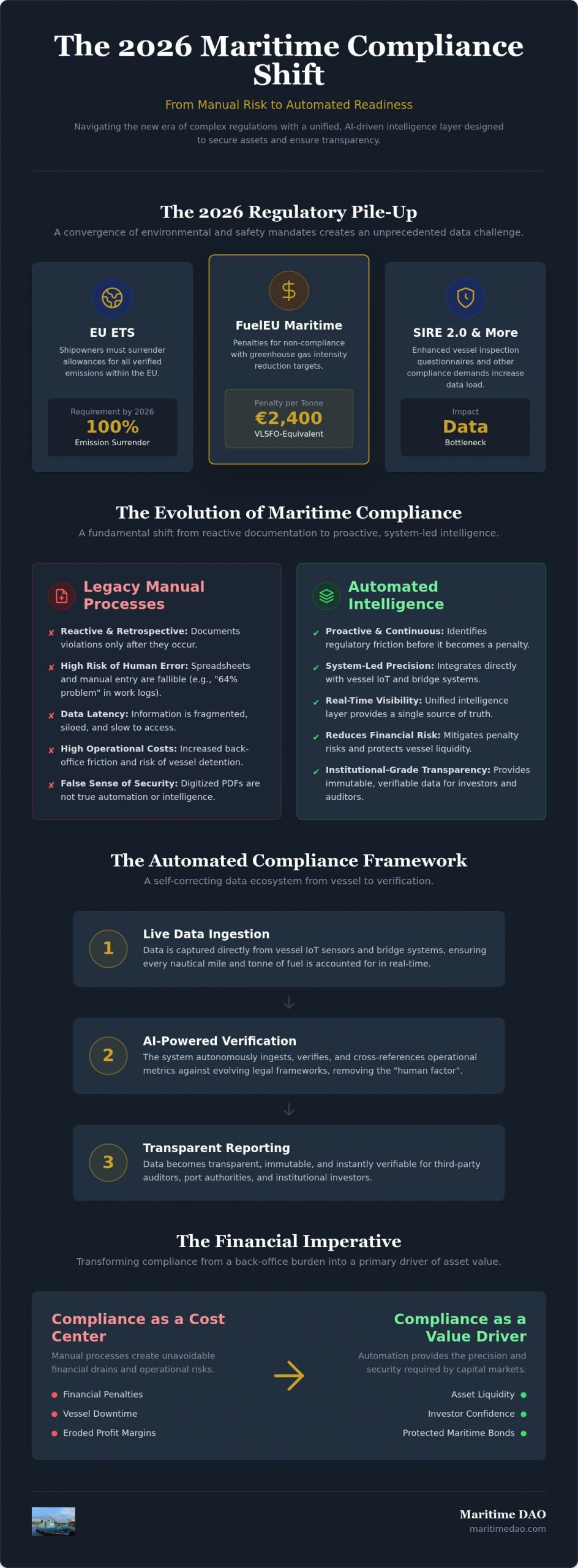
Maritime compliance has transitioned through three distinct eras: manual, digitized, and now, automated. While the digitization wave of the last decade replaced filing cabinets with PDFs and spreadsheets, it failed to resolve the underlying issue of data latency. In 2026, automated maritime compliance checks represent a shift from static records to dynamic, system-led intelligence. This proactive approach identifies regulatory friction before it manifests as a financial penalty or a vessel detention. By moving away from reactive auditing, operators can now maintain a state of “continuous readiness” that aligns with the high-velocity requirements of modern global trade.
The reliance on manual data entry for EU ETS or FuelEU reporting is a high-stakes gamble. These legacy methods are inherently retrospective, documenting a violation only after it has occurred. True automation utilizes live data feeds to ensure every nautical mile and metric tonne of fuel is accounted for against current regulatory thresholds. This transition drastically reduces vessel operational downtime. When a system is inherently compliant, the need for exhaustive, manual pre-port audits evaporates, allowing the crew to focus on core operational safety rather than administrative survival.
Digitization vs. Automated Intelligence
Digital record-keeping often provides a false sense of security because it still relies on fallible human entry. A spreadsheet is only as accurate as the person typing the figures. Automated intelligence removes this “human factor” by integrating directly with vessel IoT sensors and bridge systems. This technological shift mirrors the broader industry move toward Maritime Autonomous Surface Ships (MASS), where system-led decision-making ensures precision. Automated compliance is a self-correcting data ecosystem that autonomously ingests, verifies, and reports operational metrics against evolving legal frameworks. This ecosystem ensures that data remains transparent, immutable, and instantly verifiable by third-party auditors.
The Financial Imperative for Automation
The cost of non-compliance has reached institutional proportions. With FuelEU Maritime penalties set at approximately €2,400 per tonne of VLSFO-equivalent, a single reporting error can erode the profit margins of an entire voyage. Automated maritime compliance checks mitigate this risk by providing real-time visibility into a vessel’s regulatory standing. This level of precision significantly improves the risk profile for maritime debt. Investors seeking stable returns through EU Regulated Ship Investment Bonds rely on these automated frameworks to protect their capital. By uniting technical oversight, financial transparency, and legal rigor, automation transforms compliance from a back-office burden into a primary driver of asset liquidity and investor confidence.
Navigating the 2026 Regulatory Pile-Up: EU ETS, FuelEU, and SIRE 2.0
The maritime industry has entered an era of unprecedented oversight, characterized by a convergence of environmental, safety, and operational mandates. By August 2026, the “Regulatory Pile-Up” is no longer a future projection but a daily operational reality. Shipowners must now surrender EU ETS allowances for 100% of verified emissions, while simultaneously navigating the first active penalty cycle of the FuelEU Maritime regulation. This density of requirements creates a data bottleneck that traditional back-office structures cannot resolve. Implementing automated maritime compliance checks is the only viable method to synthesize these diverse data streams into a single, actionable intelligence layer that protects the vessel’s commercial liberty.
Automation also addresses systemic integrity issues, such as the “64 percent problem” regarding work and rest hour documentation. Historical data suggests that over 60% of manual records contain inconsistencies or non-compliant overlaps that trigger port state control deficiencies. Automated systems eliminate these human errors by cross-referencing bridge logs with biometric or digital punch-in data, ensuring absolute alignment with STCW and MLC standards. Similarly, the transition to electronic record books for MARPOL requirements ensures that oil, garbage, and ballast water entries are immutable and timestamped, removing the risk of retrospective “logbook doctoring” that often leads to criminal liabilities.
Environmental Mandates: EU ETS and FuelEU Maritime
The shift from annual retrospective reporting to real-time verification is the defining characteristic of 2026 environmental compliance. Automated systems now ingest fuel consumption and bunker delivery note data to calculate greenhouse gas intensity in real-time, allowing operators to adjust speeds or fuel blends before exceeding FuelEU intensity limits. These systems ensure accurate carbon credit allocation by linking specific voyage data directly to the Union Registry. By verifying Carbon Intensity Indicator (CII) calculations through automated sensor data rather than manual midday reports, owners provide the high-fidelity proof required for maritime asset transparency and institutional-grade reporting.
Safety and Vetting: SIRE 2.0 and TMSA
Safety inspections have evolved from static checklists to the risk-based, digitized framework of SIRE 2.0. Under this regime, inspectors utilize tablets to upload evidence in real-time, focusing heavily on human factors and crew competency. Automation prepares crews for these unpredictable, algorithm-generated questionnaires by providing them with instant access to vessel performance history and maintenance records. This standardized approach to vessel assessment is critical for institutional finance. When a ship’s safety data is governed by a unified, automated system, it creates the reliable due diligence trail necessary for securing capital in a market that increasingly demands transparent, data-backed proof of operational excellence.
AI-Driven Vessel Assessments vs. Traditional Marine Surveys
Traditional marine surveys are inherently limited by their “point-in-time” nature. A physical inspector boards a vessel, conducts a visual audit, and produces a report that is effectively obsolete the moment the ship leaves the berth. This static approach fails to account for the dynamic operational shifts that define modern shipping. In contrast, automated maritime compliance checks utilize AI-powered software to create a “continuous survey” environment. This persistent oversight monitors structural health, operational efficiency, and regulatory alignment every hour of every day. For large fleet operators, the transition to AI-driven assessments isn’t just a technological upgrade; it’s a financial necessity. By reducing survey turnaround from several days to just a few hours, these systems minimize off-hire time and maximize asset utilization across the entire lifecycle.
The speed of AI-driven assessments doesn’t come at the expense of accuracy. In fact, the precision of machine learning models often surpasses human observation in detecting micro-trends in vessel performance. Automated systems can analyze vast datasets from engine sensors, hull vibrations, and fuel flow meters simultaneously. This allows owners to identify potential failures or compliance breaches long before they manifest as physical damage. By shifting from a reactive “find and fix” model to a predictive “monitor and maintain” strategy, fleet managers can secure their assets against the unpredictable nature of global maritime operations.
ShipCheckAI: A Multidimensional Inspection Tool
ShipCheckAI represents the pinnacle of this technological shift by performing multiple inspection types simultaneously. Instead of requiring separate audits for safety, environmental standards, and structural integrity, the system utilizes high-resolution computer vision to identify corrosion, weld fatigue, and coating degradation in a single pass. These findings are then integrated into a vessel condition report platform. This unified data stream allows ship managers to implement maritime decarbonisation solutions with surgical precision. The result is a comprehensive ecosystem where technical improvements, regulatory compliance, and carbon credit savings are tracked within a single, transparent interface.
Accuracy and Data Integrity
One of the most significant advantages of AI-driven assessments is the elimination of subjective bias. Traditional reports are often colored by an individual surveyor’s experience or perspective, leading to inconsistencies across a fleet. AI systems provide an objective, data-driven baseline for every vessel. To ensure absolute accuracy, the AI cross-references AIS data with physical logs to detect anomalies in fuel consumption or positional reporting. This methodical verification is further secured by blockchain technology. By anchoring inspection data to a decentralized ledger, we ensure that every record is immutable and transparent, protecting the integrity of the asset’s history against any form of tampering or unauthorized alteration.
Implementing Automated Compliance Frameworks for Institutional Investors
Institutional capital mandates a level of oversight that exceeds the capabilities of traditional maritime management. For bond issuers and asset managers, the shift toward automated maritime compliance checks is a prerequisite for participating in the modernized global trade economy. Designing a compliance-first due diligence process requires more than a checklist; it demands an integrated system where regulatory intelligence is embedded directly into the asset management lifecycle. This approach ensures that every vessel within a portfolio remains a “bankable” asset, free from the encumbrances of unforeseen legal liabilities or operational halts. By adopting Compliance-as-a-Service models, issuers can provide a unified, transparent, and governed gateway for capital that respects both legacy maritime law and modern financial standards.
Managing global sanctions has become an increasingly complex facet of maritime governance. Automated screening against OFAC, UN, and EU hitlists is no longer optional for those operating at an institutional scale. These systems autonomously cross-reference vessel movements, ownership structures, and counterparty data to detect potential breaches in real-time. This level of automated vigilance protects the integrity of the entire financial ecosystem, ensuring that maritime assets are never compromised by proximity to prohibited jurisdictions or entities. It transforms compliance from a defensive posture into a proactive shield for investor interests.
Due Diligence for Tokenized Maritime Assets
Fractional ship ownership relies heavily on the radical transparency provided by automated intelligence. When multiple stakeholders hold interests in a single vessel, the need for an immutable record of compliance becomes paramount. Automated KYC and AML protocols ensure that every participant in the ecosystem is verified, maintaining the structural integrity of the investment vehicle. By linking maritime investment compliance to digital asset governance, we create a framework where physical operations and financial reporting are perfectly synchronized. This synergy allows for a more inclusive and efficient market, where institutional-grade due diligence is accessible to a broader range of global investors.
Risk Mitigation and Transparency
Transparency is the primary driver of maritime bond yields. Investors reward clarity and penalize uncertainty; therefore, providing real-time dashboarding for bondholders to monitor asset health is a strategic advantage. Automated alerts serve as an early warning system, identifying potential regulatory breaches or technical failures before they escalate into costly detentions. This proactive risk mitigation strategy stabilizes cash flows and enhances the creditworthiness of the underlying asset. When transparency is treated as a core operational pillar, the relationship between asset performance and investor confidence is solidified, creating a more resilient and predictable investment environment.
To see how these frameworks are applied to real-world assets, you can explore our current ship investment opportunities and the automated systems that govern them.
Securing Assets with Maritime DAO: ShipCheckAI and Regulated Bond Issuance
Maritime DAO represents a fundamental shift in how heavy industry and high finance interact. It’s a unified ecosystem where technical oversight, financial transparency, and legal rigor converge to create a new standard for asset management. By integrating automated maritime compliance checks directly into the capital issuance process, the platform ensures that every vessel is vetted against the highest global standards before it ever reaches an investor. This synergy between AI-driven intelligence and regulated financial instruments provides a secure pathway for institutional capital to enter the maritime sector. It effectively bridges the gap between the physical reality of a vessel at sea and the digital requirements of modern debt instruments.
The future of maritime governance lies in this transition to automated, system-led oversight. As regulatory requirements like the UK ETS and the expanded EU ETS mandates continue to evolve, the ability to scale compliance across global fleets becomes a competitive necessity. Maritime DAO provides the structural integrity required to manage these complexities without the overhead of massive back-office teams. By utilizing a decentralized yet highly governed framework, we empower investors and shipowners alike to participate in a transparent market where risk is quantified by data rather than intuition. This is the cornerstone of a resilient maritime economy that values order, security, and the democratization of complex financial structures.
ShipCheckAI in the Investment Lifecycle
ShipCheckAI serves as the primary technical gatekeeper for the Maritime DAO ecosystem. Before a vessel is considered for bond listing, it must undergo an exhaustive AI-driven assessment that evaluates its structural integrity, historical performance, and current regulatory alignment. This pre-purchase audit ensures that only high-quality assets enter the portfolio, protecting the ecosystem from sub-standard collateral. Once a vessel is active, the system provides persistent monitoring to protect the interests of bondholders. Any deviation from the required compliance standards triggers immediate alerts, ensuring that the asset’s “bankable” status is never compromised. For a comprehensive look at these assessment protocols, see our AI Ship Inspection Tool guide.
A New Era of Regulated Innovation
The issuance of EU-regulated ship investment bonds within this framework introduces a level of reliability that traditional digital asset circles often lack. These bonds are anchored by physical assets and governed by established legal frameworks, offering a sober and grounded alternative to speculative investments. The scalability of automated maritime compliance checks allows for the rapid expansion of these bond offerings across diverse vessel classes and jurisdictions. This methodical approach to innovation respects legacy systems while building a high-tech bridge to the future of global trade. We invite you to explore the Maritime DAO ecosystem and secure your maritime investments today.
The Future of Governed Maritime Capital
The transition to 2026 standards requires a definitive departure from the fragmented, manual processes of the past. By adopting automated maritime compliance checks, shipowners and investors secure a unified intelligence layer that effectively mitigates the high-stakes risks of the current regulatory pile-up. This technological shift, anchored by ShipCheckAI proprietary technology, replaces subjective surveys with real-time vessel assessment capability and persistent structural transparency. It ensures that every asset remains bankable, compliant, and operationally efficient in an increasingly complex legal landscape.
Within the Maritime DAO ecosystem, these technical pillars serve as the essential foundation for an EU-regulated financial framework that values order, security, and institutional-grade due diligence. We invite you to bridge the gap between heavy industry and modern finance by exploring how our ecosystem protects your capital while democratizing access to global trade. It’s time to move beyond the limitations of legacy auditing and embrace a system where compliance is a strategic driver of asset value. Secure your maritime portfolio with EU-regulated bonds and participate in the next era of transparent, governed innovation.
Frequently Asked Questions
What is automated maritime compliance software?
Automated maritime compliance software is a system-led intelligence layer that captures, verifies, and reports operational data against global regulatory standards. Unlike traditional manual record-keeping, it utilizes live data feeds from vessel sensors to ensure continuous alignment with mandates like MARPOL and the EU ETS. This technology provides a unified ecosystem where technical performance and legal governance are perfectly synchronized, reducing the administrative burden on back-office personnel.
How does AI improve the accuracy of ship inspections?
AI improves inspection accuracy by utilizing computer vision and machine learning to identify structural issues that the human eye might overlook. Systems like ShipCheckAI analyze high-resolution imagery to detect corrosion, weld fatigue, and coating degradation with objective precision. By removing the “human factor,” these tools provide a consistent, data-driven baseline for vessel health that is essential for institutional-grade due diligence and long-term asset management.
What are the main 2026 maritime regulations I should be aware of?
In 2026, the regulatory landscape is dominated by the full implementation of the EU Emissions Trading System (ETS) and the first active penalty cycle of FuelEU Maritime. Owners must surrender allowances for 100% of verified emissions, while vessels must also comply with the new UK ETS maritime expansion. These simultaneous mandates create a regulatory pile-up that requires sophisticated, automated systems to manage complex reporting deadlines and greenhouse gas intensity limits effectively.
Can automated compliance checks replace traditional marine surveys?
While physical inspections remain necessary for certain technical repairs, automated maritime compliance checks transform the traditional survey model into a “continuous survey” environment. AI-driven monitoring provides persistent oversight that a point-in-time physical survey cannot match. This shift allows for real-time asset valuation and ensures that a vessel remains in a state of constant readiness for port state control and institutional vetting.
How does ShipCheckAI support EU-regulated ship investment bonds?
ShipCheckAI acts as the fundamental technical foundation for the issuance of EU-regulated ship investment bonds within the Maritime DAO ecosystem. By performing multidimensional vessel assessments, the software ensures that every ship meets strict structural and regulatory criteria before being listed. This persistent monitoring provides bondholders with real-time visibility into the health of their collateral, ensuring that the investment remains secure, transparent, and governed by institutional standards.
What are the risks of not using automated compliance software in 2026?
Operating without automated maritime compliance checks in 2026 exposes shipowners to severe financial and operational liabilities. Non-compliance with FuelEU Maritime can trigger penalties of approximately €2,400 per tonne of VLSFO-equivalent, while errors in EU ETS reporting may lead to vessel detentions. Manual systems are prone to human error and data latency, which can compromise the commercial viability of a vessel and erode investor confidence in the underlying maritime assets.
Is automated compliance suitable for small maritime fleets?
Automation is highly suitable for small fleets because it democratizes access to institutional-grade oversight without the need for extensive back-office teams. Small operators can utilize scalable software to manage complex environmental mandates and safety vetting with the same precision as global conglomerates. This levels the playing field, allowing smaller fleets to maintain the transparency and structural integrity required to attract regulated investment capital.
How does blockchain technology ensure the integrity of maritime compliance data?
Blockchain technology ensures data integrity by creating an immutable, decentralized ledger that anchors every compliance record and inspection finding. Once data is recorded, it cannot be tampered with or retroactively altered, providing a transparent and verifiable history of the vessel’s operational life. This cryptographic security builds trust between shipowners, regulators, and bondholders, ensuring that the maritime ecosystem operates with absolute order, security, and structural integrity.