
The era of maritime investment as an opaque, high-stakes gamble for the global elite is over. You’ve likely found that navigating complex jurisdictional laws and opaque vessel reporting makes securing maritime debt feel like an impossible task for all but the largest institutions. It’s a valid concern, especially when the fear of capital loss in unregulated digital tokens continues to cast a shadow over the industry. This is why the benefits of regulated ship investment have become the cornerstone of a new, transparent financial era, providing a bridge between legacy trade and modern capital protection.
This article demonstrates how these advantages are now accessible through a unified ecosystem of legal compliance and automated intelligence. You’ll learn how EU-regulated frameworks and ShipCheckAI due diligence are transforming maritime finance into a secure, transparent, and institutional-grade asset class. We will explore the mechanics of asset-backed securities, the precision of AI-driven inspections, and the structural integrity of European financial standards that protect your capital in 2026. By bridging the gap between physical assets and digital governance, we’re entering a period where predictable yields and verified vessel conditions are the new standard for global trade finance.
Key Takeaways
- Understand how the transition from opaque private equity to transparent, structured instruments defines the modern maritime era.
- Explore the core benefits of regulated ship investment, including enhanced security through EU-compliant legal frameworks and institutional-grade custody.
- Learn why physical due diligence is no longer a weak link when integrating ShipCheckAI’s multi-layered vessel assessment data into financial reporting.
- Compare the risk-reward spectrum of fixed-income bonds against traditional shipping equity to secure predictable yields and priority claims.
- Discover how the Maritime DAO ecosystem unites decentralized governance with rigorous financial regulation to ensure total transparency in capital deployment.
Defining Regulated Ship Investment in the Modern Maritime Era
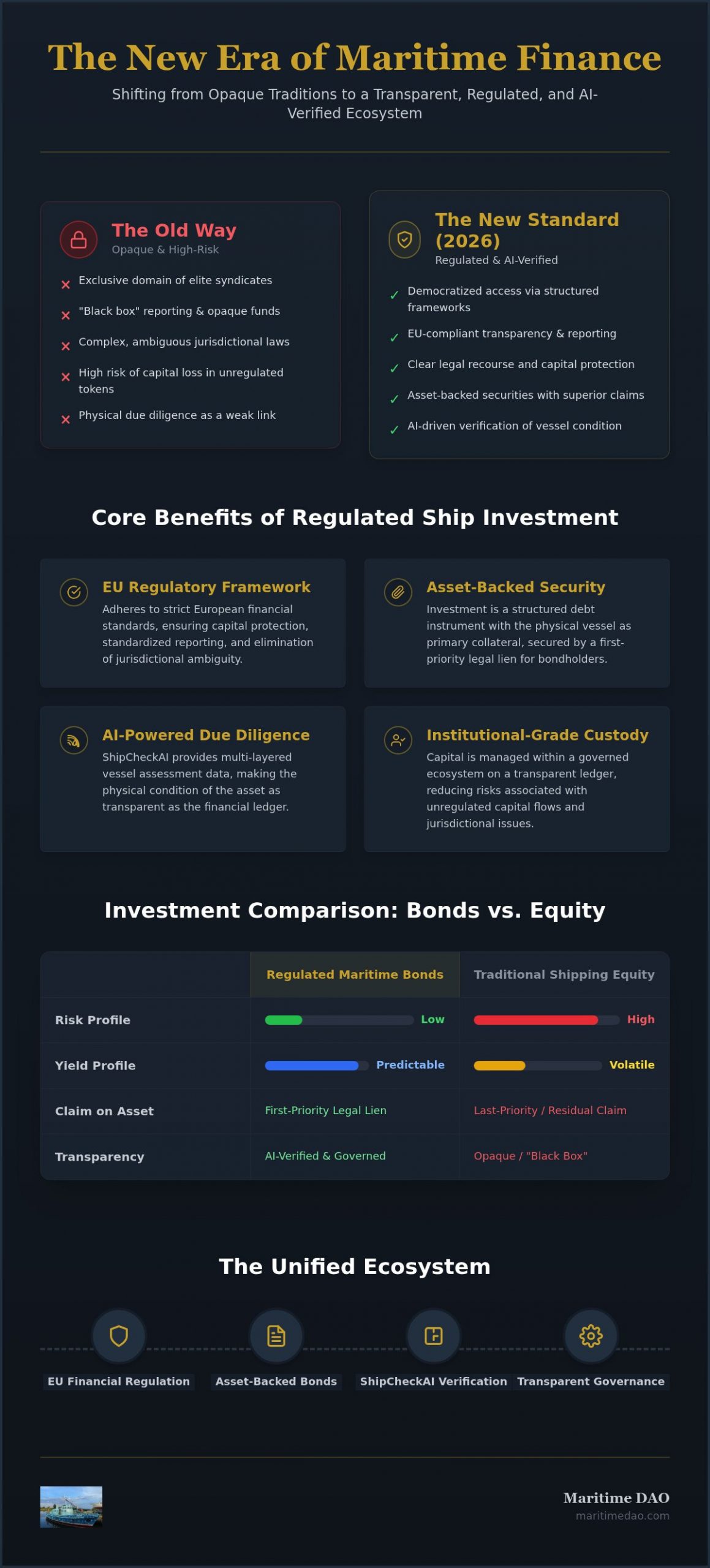
The year 2026 represents a definitive shift in how global trade is financed. Historically, maritime debt was the exclusive domain of massive banking syndicates and opaque private equity firms. Today, the benefits of regulated ship investment are realized through structured frameworks that democratize access while enforcing institutional-grade rigor. We’re moving away from speculative maritime tokens, which often lacked legal recourse, toward compliant securities that provide a clear bridge between digital governance and physical steel. This evolution ensures that capital deployment is no longer a matter of trust, but a matter of verified, governed systems.
The transition from opaque private holdings to transparent, EU-regulated ship investment bonds has solved a systemic inefficiency. Investors are no longer forced to accept the “black box” reporting typical of traditional shipping funds. Instead, they participate in an ecosystem where every vessel’s operational status and financial standing are documented with surgical precision. This shift marks 2026 as the turning point where maritime capital markets finally integrated with the broader world of regulated digital finance, creating a unified standard for asset management.
The Role of EU Financial Regulation in Maritime Debt
European financial standards provide the bedrock for this new asset class. EU-regulated ship investment bonds must adhere to strict transparency requirements, ensuring that every unit of capital is accounted for within a governed ecosystem. This oversight eliminates the jurisdictional ambiguity that once plagued international shipping. By 2026, standardized reporting has become the industry benchmark. It allows investors to verify compliance and financial health through unified digital gateways. This level of scrutiny protects capital from the volatility often found in unregulated markets. The benefits of regulated ship investment are most apparent here, as the framework provides a predictable environment for institutional and private capital alike.
Asset-Backed Security: The Core of the Investment
At its heart, this model relies on the Asset-backed security structure, which creates a direct legal link between the investor’s bond and the physical vessel. Unlike traditional equity, where returns are tethered to the fluctuating profits of a chartering company, these bonds function as high-integrity alternative assets. The integration of the AI ship inspection tool ensures that the physical condition of the vessel is as transparent as the financial ledger. A maritime asset-backed security is a structured debt instrument where the underlying vessel serves as primary collateral, secured by a first-priority legal lien that grants bondholders a superior claim over the asset’s residual value. This tripartite connection between physical condition, legal lien, and financial yield defines the modern maritime investment landscape.
Primary Benefits of Regulated Investment Platforms for Global Shipping
Regulated platforms don’t just offer compliance; they provide a structural foundation for capital preservation in a historically volatile sector. One of the primary benefits of regulated ship investment is the elimination of the “black box” operational style that once defined the industry. By moving maritime debt into a governed ecosystem, investors gain access to institutional-grade custody and legal frameworks that protect their interests. This shift ensures that every transaction is recorded on a transparent ledger, reducing the risks associated with jurisdictional ambiguity and unregulated capital flows.
There’s a significant difference between the unpredictable nature of traditional shipping equity and the stable yield profiles of regulated bonds. While equity holders are often the last to be paid during market downturns, bondholders benefit from fixed-income structures and priority claims on the underlying assets. As highlighted in the UN Trade and Development Review of Maritime Transport 2023, the industry’s shift toward digital verification and green compliance is essential for long-term viability. Regulated platforms capitalize on this trend, using tokenization to provide liquidity for assets that were previously locked in multi-year “club deals.”
Institutional-Grade Security and Risk Mitigation
Security in 2026 is defined by the integration of physical verification and legal oversight. Utilizing a comprehensive maritime investment compliance framework significantly reduces counterparty risk. This system relies on third-party audits and mandatory regulatory filings to ensure bondholders are never left in the dark about their holdings. By removing the “black box” effect, regulated platforms transform maritime operations into a transparent data stream, allowing for real-time risk assessment and proactive capital management.
Democratization and Accessibility
The transition toward open, regulated platforms has effectively lowered the barriers to entry for accredited investors. In the past, high-quality maritime debt was reserved for a small circle of insiders. Now, the maritime DAO investment model enables global participation through fractional ownership. This democratization doesn’t sacrifice security; rather, it enhances it by distributing governance across a wider, more transparent network. If you’re looking to diversify into asset-backed securities, exploring the Maritime DAO ecosystem provides a clear path to institutional-grade maritime exposure without the historical complexity of traditional brokerage.
By 2026, the benefits of regulated ship investment have become undeniable for those seeking predictable returns. The synergy between decentralized systems and EU financial standards creates a unified gateway for capital. This architecture ensures that as global trade grows, the mechanisms for funding it remain secure, inclusive, and fundamentally transparent.
Regulated Maritime Bonds vs. Traditional Shipping Equity
Choosing between variable equity and fixed-income debt is a fundamental decision that defines an investor’s risk profile in the maritime sector. While traditional shipping equity offers uncapped upside during market peaks, it exposes the holder to the full volatility of the industry’s boom-and-bust cycles. In contrast, regulated maritime bonds provide a structured risk-reward spectrum where the return is defined from the outset. One of the primary benefits of regulated ship investment is the priority of claims. In any liquidation scenario, bondholders hold a first-priority legal lien on the vessel, ensuring they’re repaid before any equity partners receive a cent. This hierarchy provides a layer of capital protection that equity simply cannot match.
The level of management involvement also marks a sharp divide between these two instruments. Equity partners are often active participants, frequently entangled in operational decisions, technical management, and the high-stakes world of chartering. Bondholders occupy a more sophisticated, passive role. They provide the capital and receive predictable yields without the operational liability or the “hands-on” risks of ship ownership. This separation of capital and operations is essential for institutional portfolios that require exposure to global trade without the administrative burden of fleet management.
Stability in a Volatile Global Market
Market cycles in shipping are famously aggressive, but regulated debt offers a necessary buffer. By utilizing EU regulated ship investment bonds, investors can secure yields that remain insulated from the daily fluctuations of freight rates. While equity returns might vanish during a downturn, bondholders are protected by the physical value of the vessel itself. According to a recent legal perspective on private equity in shipping, the 2026 landscape requires a careful alignment of investment timelines with environmental regulations. Fixed-interest debt structures provide the stability needed to navigate these transitions without the constant threat of equity dilution.
Liquidity and Exit Strategies
Traditional shipping funds often require lock-up periods of five to ten years, making them highly illiquid alternative assets. The rise of tokenized bonds on regulated platforms has fundamentally changed this dynamic. By understanding how to invest in maritime assets through digital exchange listings, investors gain access to secondary markets that didn’t exist a decade ago. These platforms allow for the trading of fractional bond interests, providing exit strategies that are far more flexible than the cumbersome process of selling physical vessel shares. This liquidity, combined with the security of an EU-regulated framework, makes maritime debt a superior choice for modern capital allocation.
The Role of AI in Asset Verification and Due Diligence
One of the most critical benefits of regulated ship investment is the integration of automated intelligence into the due diligence process. Historically, investors were forced to rely on subjective, human-led surveys that often missed structural nuances or operational inefficiencies. By 2026, the use of an AI ship inspection tool has replaced these “point-in-time” reports with real-time, objective data streams. This shift eliminates the human bias and error that previously clouded asset valuation, ensuring that the financial bond is anchored to the actual physical state of the vessel. It’s a system where physical condition, operational data, and financial reporting converge into a single source of truth.
Traditional maritime finance often suffered from the “weak link” of physical due diligence, where a vessel’s condition could deteriorate between annual inspections without the lender’s knowledge. Today, continuous monitoring has replaced sporadic checks. This creates a dynamic valuation model where the asset’s health is constantly verified, providing a level of security that paper-based certificates simply cannot offer. This transition is a core component of the “regulated innovation” that defines the modern maritime era.
ShipCheckAI: A Technical Gatekeeper for Investors
ShipCheckAI functions as a sophisticated filter, performing multi-layered vessel assessments that scrutinize everything from hull integrity to engine performance. By leveraging AI in maritime due diligence, we create a transparent “digital twin” of the asset that persists throughout the investment lifecycle. Modern regulated bonds now require these real-time data feeds to maintain their status, providing a level of physical oversight that was previously impossible. This technical gatekeeping ensures that capital is only deployed into assets that meet rigorous, automated standards of quality, directly linking the vessel’s physical health to the financial reporting seen by bondholders. With the global maritime AI market projected to grow at a compound annual rate of 23% through 2029, these tools are no longer optional extras; they’re the standard for institutional-grade debt.
Reducing Information Asymmetry
AI-driven data fundamentally empowers investors by closing the knowledge gap between capital providers and shipowners. In the past, shipowners held all the technical cards, leaving bondholders with significant information asymmetry. Today, technical transparency directly influences bond pricing and yield calculations, as the “unknown risks” are systematically identified and mitigated. Automated AI inspections drastically reduce the risk premium required for maritime debt by replacing speculative assumptions with verifiable, high-fidelity data. This shift allows for more precise capital allocation and ensures that yields are reflective of the asset’s true operational health. To see how these technical assessments protect your capital, you can explore the ShipCheckAI integration within the Maritime DAO ecosystem.
Navigating the Maritime DAO Ecosystem: The Future of Compliance
The Maritime DAO ecosystem represents the final pillar of this tripartite structure, where technology, finance, and heavy industry converge. It’s not merely a digital platform; it’s a governed financial architecture that bridges the gap between decentralized efficiency and institutional rigor. By 2026, the synergy between decentralized governance and EU financial regulation has created a stable environment for capital growth. One of the primary benefits of regulated ship investment within this framework is the absolute transparency of capital deployment, ensuring that every Euro is tracked from the point of acquisition to its final allocation in vessel debt.
Moving from due diligence to bond acquisition is now a unified process. Once ShipCheckAI verifies the physical integrity of a vessel, the data is integrated into the DAO’s governance layer. This allows for a seamless transition into the issuance of EU-regulated ship investment bonds. As we look beyond 2026, the scaling of this innovation will likely define the future of maritime capital markets, offering a template for how other heavy industries can modernize their debt structures through compliant, digital gateways.
Governance and Transparency
Smart contracts serve as the ecosystem’s automated gatekeepers, handling the distribution of yields and the enforcement of compliance standards without human interference. This automation removes the administrative delays typical of traditional shipping finance. Bondholders don’t just hold debt; they participate in a transparent audit trail where every operational milestone and financial transaction is recorded on an immutable blockchain. This level of accountability ensures that the interests of the shipowner and the investor remain perfectly aligned, governed by a code that respects both the physical reality of the sea and the legal requirements of the European Union.
Next Steps for the Strategic Investor
For the institutional or accredited investor, the transition to tokenized maritime debt requires a shift in infrastructure. Selecting a regulated platform is the first priority; you must ensure the provider maintains a clear legal lien on the physical asset and adheres to established EU directives. Setting up the necessary digital custody for tokenized bond management is the final step in securing your position. If you’re ready to move beyond speculative assets and toward a governed, high-yield alternative, explore the Maritime DAO homepage to begin your journey into regulated shipping finance. The future of maritime investment is transparent, methodical, and deeply serious about capital protection.
The Future of Maritime Capital Preservation
The convergence of European financial standards and automated intelligence has fundamentally redefined the maritime asset class. By 2026, the benefits of regulated ship investment are no longer theoretical; they’re realized through a unified ecosystem that prioritizes capital protection and asset transparency. We’ve moved beyond the era of opaque reporting and speculative risks, establishing a new benchmark where physical vessel condition is verified by ShipCheckAI and legal liens are enforced by robust EU frameworks.
This transition empowers strategic investors to capture predictable yields from the world’s most essential industry without the historical barriers of traditional finance. The structural integrity of this model relies on a tripartite foundation of an EU-Regulated Compliance Framework, AI-Powered Vessel Inspection via ShipCheckAI, and Transparent Blockchain Governance. It’s a system designed for the modern era, where innovation and reliability are finally aligned. You can secure your maritime portfolio with EU-regulated ship investment bonds at Maritime DAO. The path to institutional-grade maritime exposure is now open, governed, and ready for your capital.
Frequently Asked Questions
What exactly are EU-regulated ship investment bonds?
EU-regulated ship investment bonds are structured debt instruments that comply with specific European financial directives. They facilitate capital allocation into maritime assets through a legal framework that ensures transparency and investor protection. Unlike speculative digital tokens, these bonds are asset-backed and governed by strict institutional standards. One of the core benefits of regulated ship investment is the legal certainty provided by these EU-compliant structures, which grant bondholders a first-priority lien on the vessel.
How does ShipCheckAI improve the security of my investment?
ShipCheckAI acts as a technical gatekeeper by performing multi-layered vessel assessments that scrutinize hull integrity and engine performance. It replaces static, human-led reports with objective, AI-driven data that persists throughout the bond’s lifecycle. This continuous monitoring ensures that the physical asset’s value remains consistent with the financial reporting. By eliminating information asymmetry, investors gain a transparent view of the vessel’s health, which significantly reduces the risk of unforeseen technical failures or maintenance oversights.
Can retail investors participate in regulated ship investments?
Participation depends on jurisdictional regulations and specific platform accreditation requirements. While maritime debt was once the exclusive domain of institutional syndicates, the transition to fractionalized, tokenized bonds has lowered entry barriers. Many platforms now allow accredited individuals to access high-quality maritime debt through secure digital gateways. This democratization is a vital component of the modern ecosystem, enabling a broader range of global stakeholders to secure asset-backed yields without the traditional complexity of legacy brokerage deals.
What are the main risks associated with regulated maritime debt?
Even within a regulated framework, maritime investment carries inherent risks such as global trade volatility, geopolitical disruptions, and physical asset depreciation. While the benefits of regulated ship investment include priority claims and legal liens, these don’t eliminate the risk of total market downturns. Investors must also consider liquidity risk, as secondary markets for tokenized bonds are still maturing. Proper due diligence via tools like ShipCheckAI is essential to mitigate these technical and operational exposures.
How does a Maritime DAO differ from a traditional shipping fund?
A Maritime DAO utilizes decentralized governance and blockchain technology to manage assets, whereas traditional funds rely on centralized management and manual administration. Smart contracts automate yield distribution and compliance enforcement, removing the “black box” reporting typical of legacy funds. This structure ensures that every transaction is recorded on an immutable ledger, providing bondholders with a level of transparency and direct governance participation that traditional private equity models simply cannot offer in today’s market.
How is the liquidity of tokenized maritime bonds managed?
Liquidity is facilitated through digital exchange listings and secondary market platforms that allow for the trading of fractional bond interests. Unlike traditional shipping investments that require multi-year lock-up periods, tokenized bonds provide more flexible exit strategies. The ecosystem supports liquidity by enabling a global pool of investors to buy and sell debt instruments in a regulated, transparent environment. This ensures that capital remains more accessible and mobile compared to the rigid structures of legacy private equity.
What happens if the underlying vessel in a ship bond is damaged?
If a vessel sustains damage, the impact on the bond depends on the severity and the insurance coverage in place. ShipCheckAI provides real-time alerts regarding the vessel’s operational status, allowing for immediate risk assessment. Because these bonds are asset-backed, the legal lien remains attached to the vessel regardless of its condition. In extreme cases leading to liquidation, bondholders maintain a first-priority claim on the insurance proceeds or the residual value of the physical asset.
Are these investments compliant with global AML and KYC standards?
Compliance with Anti-Money Laundering (AML) and Know Your Customer (KYC) standards is a mandatory requirement for EU-regulated platforms. Every participant must undergo a rigorous identity verification process before they can interact with the DAO or acquire bonds. This strict adherence to global financial standards ensures the ecosystem remains secure and reputable, protecting the community from illicit activity while maintaining the institutional-grade integrity required for significant capital investments in the 2026 maritime landscape.