
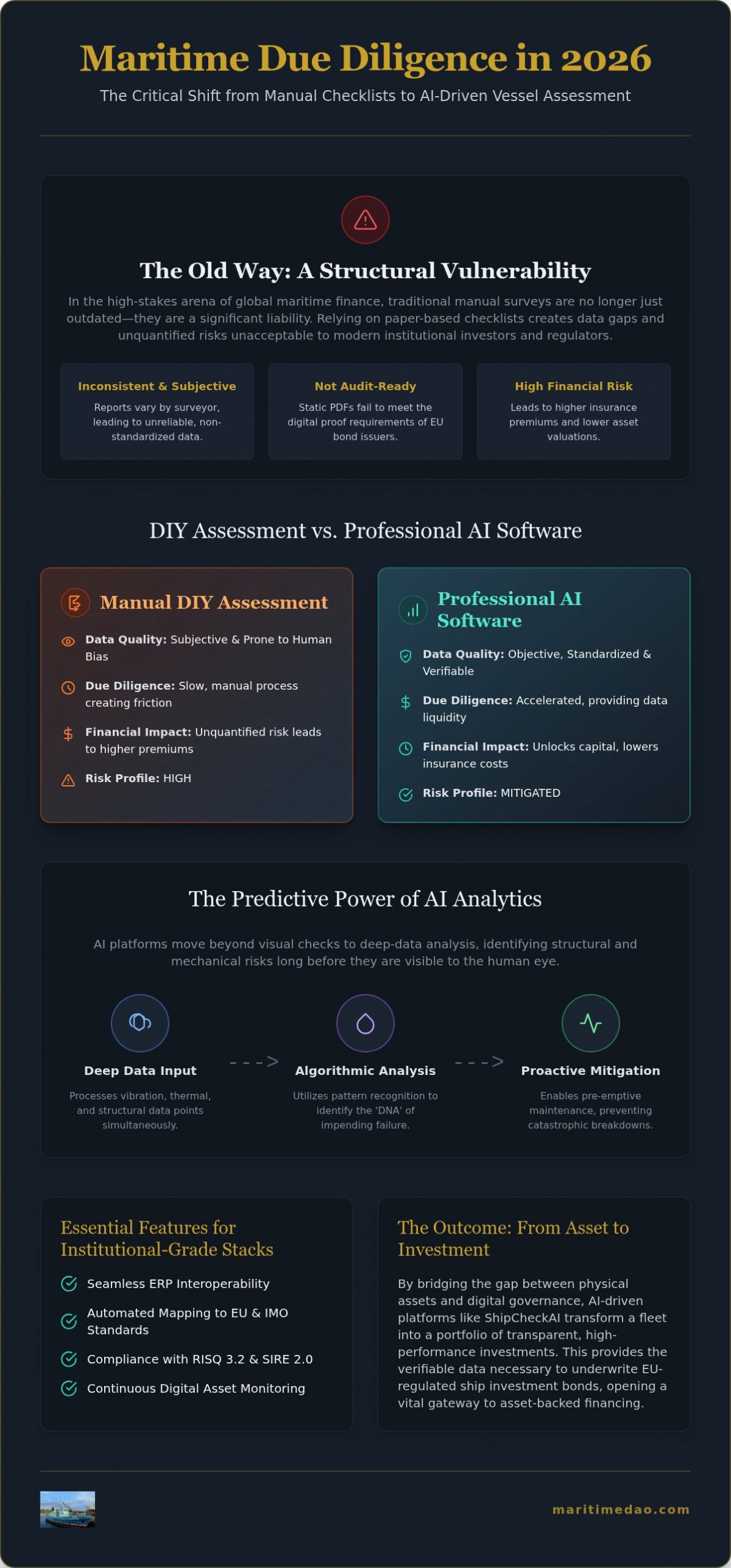
In the high-stakes arena of global maritime finance, a manual checklist is no longer a tool; it is a structural vulnerability. As we move through 2026, the traditional reliance on fragmented, paper-based surveys has become a significant liability for those seeking to secure institutional capital. The debate regarding DIY vessel assessment vs professional software is no longer about saving on surveyor fees, but about ensuring the liquidity of data required for modern compliance.
You recognize that inconsistent reports and the high cost of preliminary checks create friction in an industry that demands absolute precision. It’s increasingly difficult to prove asset condition to EU-regulated bond issuers when your data lacks a unified, verifiable framework. This guide demonstrates why AI-driven software is now the mandatory standard for maritime due diligence. We’ll detail how ShipCheckAI enables you to generate standardized, audit-ready reports, reduce due diligence timelines, and lower insurance premiums through governed data. By bridging the gap between physical assets and digital governance, you can transform your fleet into a portfolio of transparent, high-performance investments that meet the most rigorous institutional standards.
Key Takeaways
- Understand why manual, paper-based surveys have evolved into high-risk liabilities in the 2026 regulatory environment, necessitating a shift toward objective, data-driven condition reports.
- Explore the predictive power of AI-driven analytics that identify structural and mechanical risks, such as impending engine failure, long before they become visible to the human eye.
- Evaluate the financial implications of DIY vessel assessment vs professional software by comparing immediate survey costs against long-term asset value preservation and accelerated due diligence timelines.
- Identify the critical features required for institutional-grade inspection stacks, including seamless ERP interoperability and automated mapping to EU and IMO regulatory standards.
- Learn how ShipCheckAI serves as a vital gateway for asset-backed financing, providing the verifiable data necessary to underwrite EU-regulated ship investment bonds within a transparent ecosystem.
The Evolution of Vessel Assessment: Why Manual Checklists Fail in 2026
In the current maritime climate, a DIY vessel assessment refers to the practice of relying on internal checklists and manual surveys to evaluate commercial assets. While this was once standard, it’s now a high-risk liability. Institutional investors require more than a best effort report; they demand objective, verifiable data that can withstand the scrutiny of a bond issuer. The core tension in DIY vessel assessment vs professional software lies in the reliability of the output. As we move through 2026, the transition from subjective surveys to data-driven condition reports has become the baseline for participation in global trade finance.
Traditional vessel safety surveys have long relied on the human eye and individual expertise. However, the human bias problem is real. Even the most experienced surveyors often miss micro-fractures or systemic data patterns that precede mechanical failure. EU financial frameworks are now applying immense pressure on shipowners to provide standardized digital proof of asset quality. Manual checklists fail because they lack the structural integrity needed to survive a modern audit. They are snapshots of the past, whereas the industry now demands a vision of the future.
The Institutional Shift Toward Data Transparency
Investors no longer accept scanned PDF checklists as sufficient due diligence. These documents are static, easily manipulated, and impossible to aggregate for portfolio-level analysis. The adoption of a professional AI ship inspection tool creates a layer of trust that manual processes can’t replicate. This technology enables a fundamental shift from snapshots in time to continuous digital asset monitoring. By providing a unified view of condition, software allows stakeholders to unite their operational data, govern their risk exposure, and open up new opportunities for capital.
The Cost of Subjectivity in Maritime Finance
The financial stakes of subjective reporting are higher than ever. Inconsistent DIY reports frequently lead to higher insurance premiums and lower bond ratings because they represent an unquantified risk. If a defect remains undiscovered until after a bond issuance, the legal implications for asset-backed securities can be catastrophic for the issuer. Information asymmetry in maritime assets is the primary driver for professional software adoption, as it bridges the gap between what the owner knows and what the investor can verify. While the upfront cost of a DIY vessel assessment vs professional software might seem lower, the long-term value preservation of a software-backed asset far outweighs the temporary savings.
AI-Driven Accuracy: How Professional Software Decodes Vessel Condition
Professional software represents a fundamental shift from visual observation to deep-data analysis. While a manual surveyor relies on subjective experience, AI-driven platforms process vibration, thermal, and structural data points simultaneously to reveal the true state of a vessel. The choice between DIY vessel assessment vs professional software is ultimately a choice between human intuition and algorithmic precision. By utilizing pattern recognition, these systems identify the ‘DNA’ of impending engine failure long before it manifests as a physical breakdown, allowing for proactive risk mitigation that manual checklists simply cannot offer.
Standardization is the cornerstone of this technological leap. In a global fleet, human surveyors may vary in their rigor or interpretation of a vessel’s state. Professional software ensures every asset is measured against the exact same institutional benchmarks, such as the RISQ 3.2 standards or SIRE 2.0 protocols. This uniformity is essential for maritime debt issuers who require a consistent risk profile across their entire portfolio. When every vessel is assessed through a unified digital lens, the resulting data becomes a liquid asset in itself.
Machine Learning vs. The Human Eye
AI identifies corrosion patterns and structural fatigue that are often invisible to traditional ultrasonic testing. By analyzing historical data alongside real-time sensor inputs, machine learning models reduce the ‘noise’ in maritime telemetry to highlight genuine anomalies. Government frameworks, such as the Streamlined Inspection Program (SIP), demonstrate an increasing institutional openness to alternative compliance methods that prioritize operator responsibility. High levels of ship inspection accuracy are no longer optional; they are the primary defense against catastrophic asset loss and the resulting financial fallout.
ShipCheckAI: A Unified Technical Architecture
ShipCheckAI integrates hull inspections with machinery and cargo system assessments within a single ecosystem. This unified architecture allows stakeholders to move from raw data to ‘Audit-Ready’ reports in minutes. This speed is a critical advantage during high-pressure acquisition windows. Utilizing a sophisticated vessel condition report platform ensures multi-stakeholder transparency, providing a single source of truth for owners, investors, and insurers. If you are looking to professionalize your due diligence process, exploring the multi-inspection capabilities of ShipCheckAI is a logical next step toward institutional readiness.
DIY Assessment vs. Professional Software: A Comparative Risk Framework
The choice between DIY vessel assessment vs professional software is often framed as a simple cost-benefit analysis of labor hours. This perspective is dangerously narrow for institutional maritime investment. A comprehensive risk framework must evaluate the “Time-to-Truth,” which is the velocity at which an investor can move from raw observation to a final, capital-deploying decision. While manual processes often stall in a cycle of revisions and data entry, professional software provides an immediate, unified view of asset health. This speed is a competitive necessity in 2026.
Compliance remains the most significant hurdle for manual systems. Relying on internal checklists creates a “Compliance Gap” that fails to satisfy the rigorous maritime investment compliance standards required by modern debt markets. We are witnessing a transformative shift as Artificial Intelligence redefines how risk is quantified and governed across the sector. Scalability also becomes an insurmountable barrier for DIY approaches; a manual system that functions for a single vessel will inevitably collapse under the weight of a multi-asset portfolio, leading to fragmented reporting and unmanaged risk.
Quantifying the Hidden Costs of Manual Surveys
The upfront savings of a DIY approach are quickly eroded by the opportunity costs of surveyor travel and the labor-intensive nature of manual data entry. These delays don’t just affect operational schedules; they have a direct negative impact on maritime bond yields by increasing the uncertainty surrounding the underlying collateral. Professional software reduces the Risk Premium demanded by institutional lenders by replacing subjective estimates with verifiable, real-time condition data. By streamlining the inspection workflow, owners can preserve asset value and secure more favorable financing terms.
Data Integrity and Chain of Custody
Spreadsheet-based assessments are inherently fragile and lack the “financial-grade” integrity required for asset-backed securities. They are susceptible to manipulation and lack a clear chain of custody. Professional software solves this by utilizing cryptographic timestamps to verify every data point collected during an inspection. Implementing an AI powered vessel survey ensures an immutable asset history, creating a transparent record that protects both the issuer and the investor. This structural integrity is what allows maritime assets to be unified within a regulated financial ecosystem.
Choosing Your Inspection Stack: Essential Features for Institutional Due Diligence
Selecting a technology stack is a strategic decision that defines the transparency, security, and liquidity of a maritime portfolio. A professional inspection stack must serve as more than a digital clipboard; it must function as a comprehensive gateway that connects physical assets to institutional capital. The fundamental distinction in DIY vessel assessment vs professional software is the presence of an integrated, cloud-native architecture that supports multi-stakeholder transparency. To meet the rigorous standards of 2026, an inspection stack should prioritize four core pillars:
- Interoperability: The ability to ingest data from existing ERP systems and IoT sensors to create a unified view of vessel health.
- Regulatory Mapping: Automated intelligence that flags violations of EU or IMO standards, ensuring continuous compliance.
- Investor Dashboards: High-level health scores that translate complex technical data into actionable insights for non-technical bondholders.
- Cloud-Native Architecture: A secure environment that provides global stakeholders with real-time access to verifiable vessel condition data.
The Necessity of Multi-Inspection Versatility
Investors should avoid point solutions that only address isolated survey requirements. A fragmented approach creates data silos that obscure the true risk profile of a fleet. Utilizing a unified tool like ShipCheckAI allows operators to manage various ship inspection types within a single, governed ecosystem. This versatility ensures that pre-purchase, class, and condition surveys all adhere to the same structural benchmarks. When evaluating software, the user interface is critical; crew members must be able to capture high-fidelity data in the field without friction to ensure the integrity of the entire reporting chain.
Reporting and Export Capabilities
The final output of an inspection must be audit-ready and formatted for the specific needs of financial institutions. Automated generation of vessel assessment for financing reports significantly reduces the administrative burden on shipowners while increasing the confidence of lenders. Modern platforms allow for customized data views, ensuring that insurers, owners, and investors receive the specific granularity they require. This commitment to FAIR data principles—making data findable, accessible, interoperable, and reusable—is what separates institutional-grade tools from basic digital checklists. If you are ready to modernize your fleet’s due diligence, you can access ShipCheckAI to begin standardizing your asset assessments.
ShipCheckAI: Bridging the Gap Between Physical Surveys and Regulated Finance
The transition from a physical survey to a financial instrument requires a level of data integrity that manual methods cannot provide. ShipCheckAI serves as the critical mechanism for Maritime DAO to underwrite EU regulated ship investment bonds. By providing a transparent, AI-verified record of vessel condition, it allows for a seamless workflow from initial inspection to capital deployment within the maritime DAO investment ecosystem. This process effectively solves the primary dilemma of DIY vessel assessment vs professional software: the ability to turn technical data into a bankable asset that meets institutional standards.
Recent implementations have demonstrated that this digital-first approach can reduce due diligence timelines by 70% while simultaneously increasing data confidence among global stakeholders. As the maritime AI market reaches its projected USD 8.3 billion valuation in 2026, the industry is moving toward a future where every asset possesses a real-time ‘Digital Twin.’ This verified digital counterpart ensures that asset value is always governed by live operational data rather than outdated, point-in-time reports, providing a level of security that was previously impossible in maritime finance.
Unlocking Capital Through Data Confidence
Standardized AI reports represent a fundamental democratization of the industry, lowering the barrier to entry for retail investors in maritime. When asset condition is verifiable and transparent, capital flows more freely across borders. ShipCheckAI provides the underlying data layer for ship asset backed securities, ensuring that every bond is supported by a rigorous, algorithmic assessment of the vessel’s structural and mechanical health. This positions Maritime DAO as a leader in regulated innovation, acting as both a visionary architect and a reliable gatekeeper for the next generation of maritime debt.
Getting Started with ShipCheckAI
Integrating AI surveys into your current fleet management workflow is a methodical process designed to replace legacy inefficiencies with algorithmic precision. Transitioning from DIY vessel assessment vs professional software requires a shift in perspective, moving from reactive maintenance to proactive asset management. By adopting a professional digital stack, you can unite your operational data and secure the transparency required for modern finance. You can optimize your vessel due diligence with ShipCheckAI today to ensure your fleet is prepared for the institutional demands of the 2026 maritime market.
Navigating the Future of Maritime Asset Governance
The transition from subjective manual surveys to objective, AI-driven data is no longer a technological choice but a financial necessity. As we move through 2026, the contrast between DIY vessel assessment vs professional software has become the defining line between unmanaged risk and institutional readiness. By adopting a digital-first approach, you ensure that your fleet meets the rigorous transparency standards required by bondholders and global regulators. This shift ensures your operational data is no longer a static record but a dynamic, liquid financial asset that supports long-term value preservation.
Professional software serves as the critical gateway to the modern debt market. ShipCheckAI provides the multi-inspection capabilities and AI-driven transparency essential for underwriting EU-regulated ship investment bonds. This unified ecosystem allows you to unite your systems, govern your risk, and open up new gateways for capital deployment. It’s time to move beyond legacy checklists and transform your fleet into a transparent, high-performance portfolio. Secure your maritime assets with ShipCheckAI and Maritime DAO to lead the next era of regulated innovation.
Frequently Asked Questions
Is DIY vessel assessment ever acceptable for commercial ships?
DIY vessel assessment is increasingly viewed as a high-risk liability in the commercial sector. While internal checklists might suffice for minor operational maintenance, they lack the data integrity required for asset-backed financing or insurance underwriting. The debate between DIY vessel assessment vs professional software is settled by the need for objective, verifiable data. Institutional lenders and bond issuers require standardized reports that manual, subjective surveys simply can’t provide.
How does professional AI software improve ship inspection accuracy?
Professional software utilizes advanced machine learning to analyze vibration, thermal, and structural data points simultaneously. This multidimensional analysis identifies corrosion patterns and mechanical anomalies that are invisible to the human eye. By reducing the noise in maritime sensor data, AI-driven tools eliminate the subjectivity and bias inherent in manual surveys. This ensures that every component, from the hull to the propulsion systems, is assessed against precise, data-driven benchmarks for maximum accuracy.
What are the primary costs of switching from manual surveys to professional software?
The primary costs involve the initial integration of the software into your existing fleet management workflow and the training of crew members to use the digital interface. While there’s an operational shift from paper-based methods, the investment is offset by the reduction in surveyor travel expenses and manual data entry labor. This transition eliminates the risk premiums often charged by lenders when faced with the information asymmetry of inconsistent manual reports.
Can professional software reports be used for EU-regulated bond issuance?
Yes, professional software reports are a critical requirement for underwriting EU-regulated ship investment bonds. ShipCheckAI generates audit-ready reports that provide the transparency and cryptographic verification necessary for institutional debt markets. These digital documents serve as the primary proof of asset quality, allowing bond issuers to quantify risk with a high degree of precision. This data-driven framework is essential for maintaining the structural integrity of regulated maritime financial ecosystems.
How often should a professional AI vessel assessment be performed?
We recommend a shift from point-in-time inspections to continuous digital monitoring. While traditional surveys might occur annually, professional software enables quarterly or even real-time assessments of critical systems. This ongoing visibility allows owners to identify impending failures before they manifest physically, ensuring the asset’s value is governed by live data. Regular assessments ensure the vessel’s digital twin remains accurate, providing stakeholders with a transparent and up-to-date health score for the asset.
Does ShipCheckAI replace the need for physical human surveyors?
ShipCheckAI doesn’t replace human surveyors; it empowers them with high-fidelity data and automated analysis. The software acts as an authoritative gatekeeper that standardizes the inspection process, ensuring that the surveyor’s expertise is augmented by objective machine learning. This combination of human experience and algorithmic precision results in a more robust due diligence report. It allows surveyors to focus on complex decision-making while the AI handles the repetitive task of pattern recognition.
What technical infrastructure is required to run ShipCheckAI on a vessel?
ShipCheckAI is built on a cloud-native architecture that requires minimal on-board hardware beyond standard mobile devices or tablets for data capture. The system is designed for interoperability, allowing it to integrate seamlessly with existing IoT sensors and ERP systems already present on modern commercial vessels. This unified approach ensures that data can be uploaded and verified in real-time, providing global stakeholders with immediate access to the vessel’s condition through a secure digital gateway.
How does professional software handle compliance with IMO and EU standards?
Professional software utilizes automated regulatory mapping to flag potential violations of IMO treaties and EU financial frameworks in real-time. The system is updated continuously to reflect the latest amendments to international maritime law, such as SIRE 2.0 or RISQ 3.2 standards. By evaluating the DIY vessel assessment vs professional software choice, owners gain a tool that automatically aligns their fleet’s operational data with complex global compliance requirements, reducing the risk of detention.