
In 2026, the era of “voluntary” sustainability in shipping has officially ended, replaced by a rigorous regulatory ecosystem where capital preservation depends entirely on technical alignment. With the EU Emissions Trading System now covering 100% of eligible maritime emissions, the margin for error in asset selection has vanished. You’re likely struggling to navigate the updated Technical Screening Criteria or verify vessel data without falling into the trap of greenwashing. It’s a complex landscape where the distinction between transitional and enabling activities determines the viability of your portfolio. This guide empowers you to master the EU taxonomy for sustainable maritime finance, offering a precise framework to evaluate maritime debt with institutional-grade confidence.
You’ll discover how to identify genuine taxonomy-aligned investment opportunities and understand the stringent requirements of the EU Green Bond Standard. We’ll explore how automated intelligence and ShipCheckAI simplify ESG compliance, moving beyond manual reporting into a unified system of governed data. By the end of this analysis, you’ll have a clear roadmap for navigating the 2026 regulatory shifts, ensuring your ship investment bonds meet the highest standards of transparency, security, and legal integrity.
Key Takeaways
- Decode the 2026 classification system to ensure every asset in your portfolio meets the rigorous “Do No Significant Harm” requirements.
- Master the technical screening criteria, including specific energy efficiency benchmarks, to distinguish between high-performing vessels and stranded assets.
- Navigate the complexities of the EU taxonomy for sustainable maritime finance by correctly identifying transitional activities that support the industry’s path toward zero-emission operations.
- Leverage ShipCheckAI to automate the inspection and verification process, transforming raw vessel data into credible ESG reporting that satisfies institutional auditors.
- Evaluate how decentralized governance and EU-regulated ship investment bonds combine to provide a transparent, high-integrity vehicle for maritime capital allocation.
What is the EU Taxonomy for Sustainable Maritime Finance?
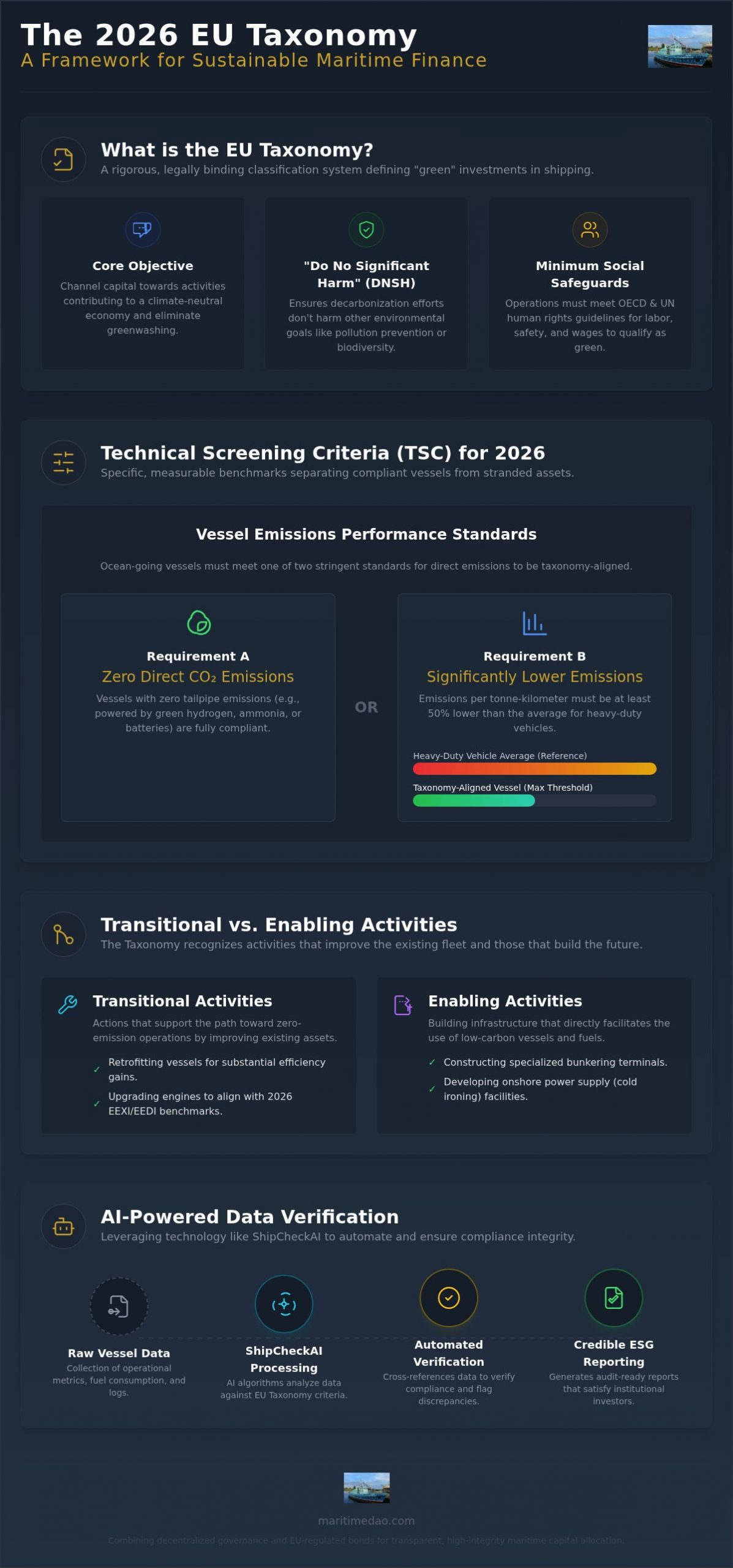
The EU taxonomy for sustainable maritime finance serves as the definitive classification system within the European Green Deal, designed to channel capital toward activities that contribute to a climate-neutral economy. It isn’t just a set of guidelines; it’s a rigorous, legally binding dictionary that defines what “green” actually means for the shipping sector. By 2026, this framework has become the primary filter for institutional investors, as the full implementation of the EU Emissions Trading System (ETS) now requires 100% coverage of maritime emissions. The system relies on the EU Taxonomy for sustainable activities to ensure that every investment contributes to climate change mitigation or adaptation without causing harm elsewhere.
The “Do No Significant Harm” (DNSH) principle is the cornerstone of this ecosystem. It mandates that a vessel’s contribution to decarbonization cannot come at the expense of other environmental goals, such as pollution prevention or the circular economy. For shipowners, this means a dual-fuel vessel must not only reduce CO2 but also manage waste and underwater noise according to strict thresholds. 2026 marks a critical juncture where Delegated Regulation (EU) 2026/73 has updated these criteria, making alignment a prerequisite for capital preservation.
The Core Objectives for the Shipping Industry
The primary ambition is a rapid transition to a low-carbon economy. This involves shifting the fleet toward zero-emission propulsion and protecting the biodiversity of European waters. By establishing clear technical benchmarks, the Taxonomy eliminates the ambiguity that previously allowed for greenwashing. It provides a transparent baseline that ensures capital flows only to vessels that meet or exceed the Energy Efficiency Existing Ship Index (EEXI) and Energy Efficiency Design Index (EEDI) requirements. This clarity is essential for the EU taxonomy for sustainable maritime finance to function as a trust-building mechanism between heavy industry and institutional finance.
Minimum Social Safeguards in Maritime Operations
Sustainability isn’t limited to carbon metrics. To qualify as taxonomy-aligned, maritime operations must adhere to minimum social safeguards, including the OECD and UN Guiding Principles on Business and Human Rights. These safeguards govern labor standards, crew safety protocols, and fair wages. If a vessel fails these social benchmarks, it’s disqualified from being “green,” regardless of its fuel type. This integrity is central to the structure of EU regulated ship investment bonds, where social and environmental compliance are unified to protect investor reputation and long-term yield.
Technical Screening Criteria for Sustainable Shipping
The Technical Screening Criteria (TSC) represent the granular engine of the EU taxonomy for sustainable maritime finance, translating broad environmental ambitions into specific engineering requirements. As of January 1, 2026, the regulatory landscape has shifted with the entry into force of Delegated Regulation (EU) 2026/73. This amendment tightens the thresholds for what qualifies as a sustainable activity, moving beyond simple carbon reduction into a more holistic assessment of vessel performance. For institutional investors, these criteria are the primary safeguards against asset obsolescence and regulatory non-compliance.
The official EU Taxonomy framework now requires ocean-going vessels to demonstrate either zero direct (tailpipe) CO2 emissions or emissions per tonne-kilometer that are 50% lower than the average reference value for heavy-duty vehicles. This standard creates a clear divide between legacy assets and the modern, efficient fleet. While retrofitting existing vessels remains a viable path for many operators, the taxonomy mandates that such upgrades must result in substantial efficiency gains that align with the 2026 benchmarks. Infrastructure supporting these low-carbon fuels, such as specialized bunkering terminals and onshore power supplies, is also classified as an enabling activity, provided it facilitates the transition of the broader maritime ecosystem.
Zero-Emission vs. Low-Emission Thresholds
The distinction between zero-emission and low-emission thresholds is more pronounced in 2026. The transitional pathway that permitted vessels using at least 25% zero-direct-emission fuels expired on December 31, 2025. Current standards favor vessels powered by green hydrogen or ammonia, while dual-fuel and LNG-powered ships face stricter scrutiny regarding methane slip and life-cycle GHG intensity. The taxonomy handles alternative fuels with a focus on their total environmental impact, ensuring that the “green” label is reserved for technologies that offer a genuine path to decarbonization without compromising marine biodiversity.
Operational Efficiency and EEDI/EEXI Alignment
The EU framework unifies with global standards by integrating the International Maritime Organization’s (IMO) Energy Efficiency Design Index (EEDI) and Energy Efficiency Existing Ship Index (EEXI). For a new ship to be taxonomy-aligned, its EEDI must be at least 10% lower than the EEDI requirements applicable on April 1, 2022. This integration ensures that sustainable finance is grounded in recognized international metrics rather than localized data. Verifying these complex operational efficiencies across a diverse fleet requires a methodical approach to data integrity. Investors seeking to capitalize on these high-standard assets can look toward EU regulated ship investment bonds, which provide a transparent vehicle for funding taxonomy-aligned maritime transport.
Enabling vs. Transitional Activities in Maritime Debt
The EU taxonomy for sustainable maritime finance distinguishes between two critical pathways for capital: transitional and enabling activities. This categorization isn’t merely academic; it dictates the risk profile and long-term eligibility of maritime debt. Transitional activities encompass economic sectors for which there are no technologically and economically feasible low-carbon alternatives yet. Since deep-sea shipping remains heavily reliant on liquid fuels in 2026, the majority of active vessels fall into this category. These assets are subject to “sunset clauses,” meaning their green status is temporary and contingent on maintaining best-in-class performance until zero-emission technologies become commercially viable for the entire fleet.
Enabling activities, by contrast, are those that directly facilitate the decarbonization of other sectors. In a maritime context, this includes the development of zero-emission port infrastructure, onshore power supplies, and the deployment of advanced digital governance systems. For investors, the risk profile of a transitional asset is inherently more complex. It requires continuous, granular monitoring to ensure the vessel doesn’t fall behind the tightening GHG intensity reduction targets. For instance, following the 2% reduction mandated by FuelEU Maritime in 2025, the industry is already looking toward the 6% threshold for 2030.
Transitional Assets: Investing in the Shift
Transitional assets currently dominate the maritime bond market because they represent the physical reality of global trade. To qualify under the taxonomy, a vessel must demonstrate performance that is significantly better than the industry average, often utilizing the Energy Efficiency Existing Ship Index (EEXI) as a baseline. This requires a methodical approach to maritime investment compliance, ensuring that the asset remains within the top tier of its peer group. Without this rigorous oversight, a transitional asset risks becoming a “stranded asset” as regulatory thresholds tighten in the coming years.
Enabling Technology: The Role of Inspection and Data
Enabling technologies provide the structural integrity required for a transparent financial ecosystem. Shore-side power installations and AI-driven inspection tools are prime examples of this category. These systems don’t just reduce emissions at the berth; they create the essential data layer necessary for verifying taxonomy alignment across the entire lifecycle of a ship investment. By using automated intelligence to audit vessel performance, investors can bridge the reporting gap that has historically allowed for greenwashing. This digital governance ensures that every claim of sustainability is backed by immutable data, transforming the physical ship into a transparent, governed financial asset.
Data Verification: The Role of AI in Taxonomy Compliance
The “Reporting Gap” represents the most significant operational hurdle in the 2026 regulatory environment. While the EU taxonomy for sustainable maritime finance provides the legal framework, manual vessel inspections often fail to meet the rigorous transparency requirements now mandated by the EU AI Act. Relying on paper-based logs or sporadic physical surveys creates a vulnerability for institutional investors who require high-fidelity data to justify their ESG disclosures. Automated intelligence bridges this gap by transforming vessel performance into an immutable stream of verified metrics, ensuring that every data point is audit-ready and legally defensible.
Automating the Technical Screening Criteria (TSC) audit process reduces the friction of compliance. Instead of waiting for quarterly reports, AI systems provide continuous monitoring of fuel consumption, GHG intensity, and operational efficiency. This shift significantly lowers the cost of compliance for shipowners while providing bond issuers with the “truth engine” needed to attract risk-averse institutional capital. It replaces subjective human judgment with objective, machine-verified proof of performance, creating a unified standard for the entire maritime ecosystem.
ShipCheckAI: The Truth Engine for Maritime Finance
Standardizing vessel assessment for financing is no longer an optional luxury. Through the use of advanced AI ship inspection tools, Maritime DAO ensures that every asset in a portfolio is scrutinized against current taxonomy benchmarks. ShipCheckAI performs multiple, layered inspections that verify both structural integrity and operational sustainability. This data isn’t just for internal review; it is integrated directly into regulated bond prospectuses, providing a level of granular detail that manual surveys simply cannot match. It ensures that the physical reality of the ship aligns perfectly with its digital twin in the financial ecosystem.
Ensuring Transparency for Institutional Bondholders
The primary enemy of sustainable finance is greenwashing, which often thrives in the absence of transparent data. By utilizing AI-verified data logs, issuers can eliminate the ambiguity that plagues traditional ESG reporting. These logs provide continuous monitoring of “Do No Significant Harm” compliance, ensuring that a vessel’s environmental performance doesn’t degrade over time. For bondholders, this means annual ESG reporting is no longer a manual burden but a systematic output of the asset’s governance layer. This level of transparency is essential for maintaining the integrity of EU-regulated ship investment bonds and protecting the long-term yield of the portfolio.
Investing in Taxonomy-Aligned Bonds via Maritime DAO
Maritime DAO functions as a visionary architect in the global trade ecosystem, providing a bridge between physical assets and digital governance. The platform utilizes a “regulated innovation” model that respects legacy financial systems while leveraging blockchain for transparency. By integrating the EU taxonomy for sustainable maritime finance into its core governance, the DAO ensures that all funded projects meet the highest regulatory standards. This unified approach provides institutional investors with a secure gateway to a sector that was previously opaque and difficult to navigate. It’s a system designed to unite capital with the most efficient vessels in the global fleet.
The structure of EU regulated ship investment bonds within this ecosystem is designed for capital preservation and long-term yield. These bonds are asset-backed, governed by smart contracts, and fully compliant with the European Green Bond Standard. This methodical alignment ensures that at least 85% of the capital raised is allocated to activities that satisfy the Technical Screening Criteria. Such rigor is essential in 2026, as the maritime sector faces increasing pressure to demonstrate tangible progress toward decarbonization.
The Regulatory Gateway to Maritime Assets
The importance of EU regulation for cross-border capital deployment cannot be overstated. A maritime DAO investment democratizes access to green shipping by allowing a global investor base to participate in high-stakes maritime debt. Unlike speculative digital assets, these instruments are grounded in the physical reality of global trade. The DAO acts as a reliable gatekeeper, utilizing asset-backed security mechanisms to protect bondholders in a digital-first environment. This ensures that the democratization of finance doesn’t come at the expense of security or structural integrity.
Next Steps for the 2026 Sustainable Investor
Successful investors must move beyond surface-level ESG claims and evaluate ship bonds based on specific taxonomy alignment scores. Understanding how to invest in maritime assets in 2026 requires a focus on data-driven due diligence. A final checklist for taxonomy-compliant maritime due diligence should include several critical pillars:
- Verification of the vessel’s EEDI/EEXI alignment with 2026 thresholds.
- Confirmation of “Do No Significant Harm” compliance via AI-verified logs.
- Assessment of the bond’s adherence to the EU Green Bond Standard (EuGB).
- Review of the DAO governance protocols for asset tracking and reporting.
This systematic approach ensures that your portfolio remains resilient against the evolving standards of the EU taxonomy for sustainable maritime finance. By focusing on asset-backed securities and transparent data, you can achieve a sophisticated balance between technological ambition and financial reliability.
Navigating the Future of Regulated Maritime Capital
The landscape of 2026 demands a shift from speculative assessment to data-driven certainty. Mastery of the EU taxonomy for sustainable maritime finance is no longer a niche expertise but a fundamental requirement for institutional capital preservation. By aligning technical screening criteria with automated verification, the industry has established a unified standard that eliminates greenwashing. This transition ensures that every vessel in a portfolio contributes meaningfully to the European Green Deal while maintaining the structural integrity required by high-finance frameworks.
Maritime DAO stands at the intersection of heavy industry and high finance, acting as a reliable gatekeeper for taxonomy-aligned assets. Through our transparent DAO governance model and proprietary AI-driven inspection technology, we provide a methodical path for investors to access EU-regulated financial instruments. The integration of ShipCheckAI ensures that every ship investment bond remains compliant with evolving standards, bridging the gap between physical assets and digital governance. Explore EU-Regulated Ship Investment Bonds on Maritime DAO today and secure your position in a new era of maritime prosperity.
Frequently Asked Questions
What are the 6 environmental objectives of the EU Taxonomy for shipping?
The taxonomy defines six core environmental pillars:
- Climate change mitigation
- Climate change adaptation
- Sustainable use and protection of water and marine resources
- Transition to a circular economy
- Pollution prevention and control
- Protection and restoration of biodiversity and ecosystems
For the shipping sector, mitigation and pollution control are the primary focuses. Every activity must substantially contribute to one objective while adhering to the Do No Significant Harm principle across the remaining five.
Can a vessel powered by LNG be considered EU Taxonomy-aligned in 2026?
LNG vessels can achieve alignment as transitional activities, provided they meet rigorous greenhouse gas intensity thresholds. In 2026, these assets must demonstrate significant emission reductions compared to heavy fuel oil alternatives. However, alignment is temporary and subject to sunset clauses. Investors must verify methane slip data and life-cycle emissions to ensure the vessel doesn’t lose its status as zero-emission technologies like green hydrogen become more prevalent in the market.
How does the EU Taxonomy impact the interest rates of maritime bonds?
Alignment with the EU taxonomy for sustainable maritime finance typically results in more favorable borrowing terms, often referred to as a greenium. Institutional investors prioritize taxonomy-aligned debt to meet their own ESG mandates, increasing demand and potentially lowering interest rates for issuers. Conversely, non-aligned assets may face higher capital costs or reduced liquidity as lenders pivot away from carbon-intensive maritime projects that carry higher regulatory risks in 2026.
What is the difference between ‘Taxonomy-eligible’ and ‘Taxonomy-aligned’?
Eligibility simply means that a maritime activity is included in the taxonomy’s classification system. Alignment is a much higher standard, requiring the activity to meet specific Technical Screening Criteria and Minimum Social Safeguards. While many shipping operations are taxonomy-eligible, only those that prove they don’t cause significant environmental harm and contribute to mitigation goals are considered truly aligned. This distinction is vital for investors seeking to fund genuine green shipping initiatives.
How do EU-regulated ship investment bonds verify their green claims?
Verification is achieved through a combination of external audits and the EU Green Bond Standard framework. Issuers must allocate at least 85% of capital to taxonomy-aligned activities and provide detailed impact reporting. Advanced platforms like Maritime DAO enhance this process by using automated intelligence to provide real-time, machine-verified proof of vessel performance. This systematic approach replaces self-reporting with immutable data logs, ensuring that every green claim is transparent, governed, and legally defensible for institutional bondholders.
Is the EU Taxonomy mandatory for all maritime companies by 2026?
Reporting is mandatory for large maritime entities falling under the Corporate Sustainability Reporting Directive. Even for smaller operators, the taxonomy has become a de facto requirement for accessing competitive finance. Banks and institutional bondholders increasingly demand taxonomy alignment as part of their due diligence. While not every private company is legally bound to report, those seeking institutional capital in 2026 find alignment essential for market participation and long-term financial viability.
What happens if a vessel in a bond portfolio loses its taxonomy-aligned status?
If a vessel fails to meet tightening technical thresholds, it may be reclassified as a non-aligned asset, potentially triggering a breach of green bond covenants. This can lead to mandatory divestment by ESG-focused funds or a revaluation of the bond’s risk profile. Continuous monitoring is vital to prevent assets from becoming stranded. Regulated frameworks ensure that such shifts are transparently reported to bondholders, maintaining the integrity and security of the broader maritime investment ecosystem.
How does ShipCheckAI assist in EU Taxonomy reporting?
ShipCheckAI automates the verification of Technical Screening Criteria by performing multi-layered vessel inspections. It provides the truth engine required for annual ESG reporting, capturing operational data that manual surveys often miss. By creating an immutable record of a vessel’s environmental performance, the tool simplifies the audit process for bond issuers. It ensures that the EU taxonomy for sustainable maritime finance is applied with mathematical precision across every asset in the portfolio.