
The global maritime industry stands at a critical juncture where the capital requirements for decarbonization have outpaced the risk appetite of traditional lending institutions. Financing the transition to sustainable shipping is no longer a distant policy ambition; it has evolved into a sophisticated, data-driven asset class underpinned by automated intelligence and regulated financial structures. You’re likely grappling with the opaque credit risks associated with aging conventional vessels and the formidable capital expenditure required for dual-fuel engine retrofits. The shifting landscape of EU taxonomy and IMO standards only adds layers of complexity to an already high-stakes investment environment.
This strategic guide demonstrates how innovative financial instruments and AI-driven data are closing the trillion-dollar gap to achieve net-zero maritime operations. We’ll identify bankable pathways for green shipping and examine the vital role of regulated debt instruments in securing the fleet of the future. You’ll also learn how ShipCheckAI utilizes multi-layered vessel assessments to improve asset accuracy, providing the transparency needed to transform maritime sustainability into a predictable, institutional-grade opportunity.
Key Takeaways
- Understand how innovative financial instruments are closing the trillion-dollar gap in financing the transition to sustainable shipping to meet IMO 2050 targets.
- Overcome traditional credit risk barriers by utilizing ShipCheckAI to automate vessel inspections. This provides a transparent, unified view of asset health for institutional investors.
- Identify bankable pathways for green maritime operations through the strategic use of EU-regulated ship investment bonds and asset-backed securities.
- Discover how a unified ecosystem of decentralized governance, institutional compliance, and automated intelligence works to govern sustainable maritime capital.
The Trillion-Dollar Challenge: Defining the Transition to Sustainable Shipping
Sustainable shipping finance represents the strategic mobilization of capital required to align global maritime operations with the International Maritime Organization (IMO) 2050 net-zero objectives. This transition isn’t merely a shift in fuel types; it’s a comprehensive industrial overhaul involving cleaner vessel construction, complex engine retrofits, and the development of global green fuel infrastructure. It’s a high-stakes evolution that demands a unified approach to risk assessment and asset management to ensure the longevity of maritime commerce.
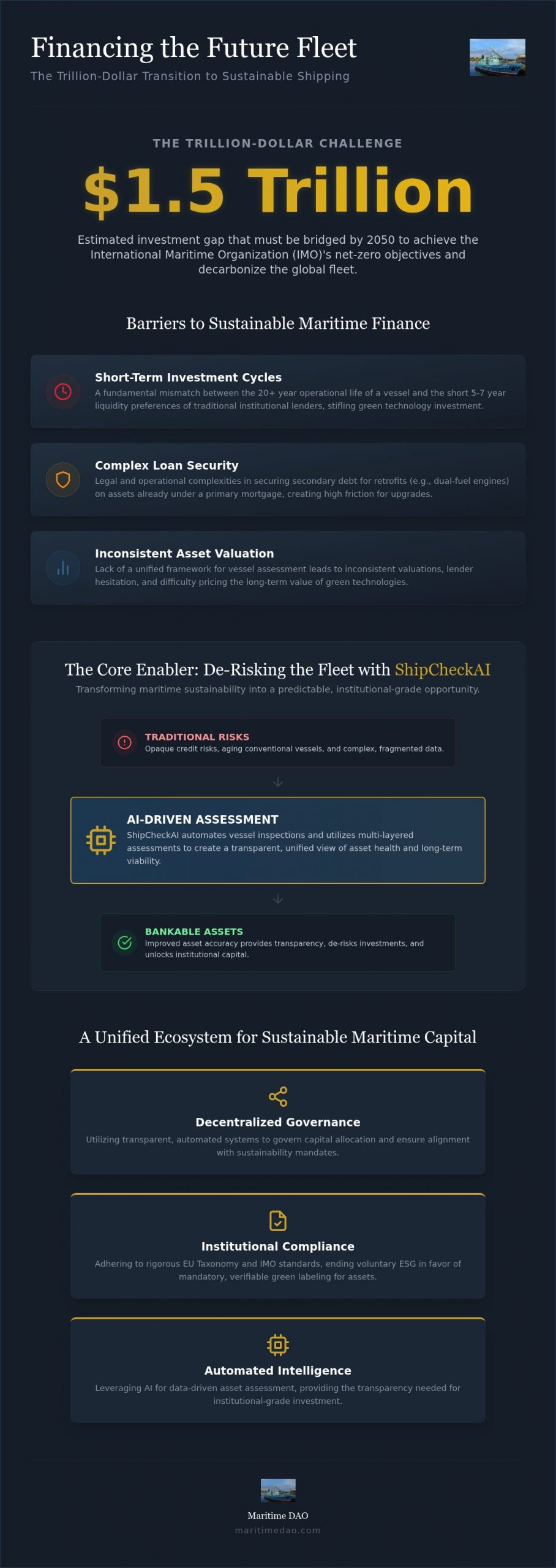
The Trillion-Dollar Challenge is underscored by an estimated $1.5 trillion investment gap that must be bridged by 2050 to achieve full decarbonization. Financing the transition to sustainable shipping requires moving beyond traditional, fragmented loan structures to embrace a unified ecosystem of regulated debt and automated asset intelligence. Without this coordinated influx of capital, the global fleet risks falling behind the accelerating pace of international climate mandates and losing access to primary trade routes.
A green vessel’s bankability is determined by its ability to maintain a verifiable low-emissions profile that ensures long-term regulatory compliance and protects against the premature stranding of the asset in a carbon-constrained economy.
The Role of the IMO and EU Taxonomy in 2026
By 2026, the International Maritime Organization’s net-zero objective has become the primary governor of global capital flow. EU financial regulations have established rigorous maritime standards for “green” labeling, effectively ending the era of voluntary ESG reporting. Institutional investors now require mandatory compliance, ensuring that every dollar deployed meets strict environmental thresholds defined by the EU Taxonomy. This shift creates a transparent marketplace where only those assets meeting high-integrity standards can access institutional-grade capital, effectively penalizing legacy vessels that fail to adapt.
Key Components of the Sustainable Fleet
Transitioning the global fleet demands a tripartite focus on dual-fuel capabilities, energy-saving technologies (ESTs), and infrastructure for ammonia and hydrogen. Retrofitting existing vessels with ESTs provides an immediate reduction in carbon intensity, while newbuilds prioritize modular designs capable of burning zero-emission fuels as they become available. Adhering to a robust maritime investment compliance framework has become an economic necessity for owners seeking to access competitive interest rates in 2026’s capital markets. This framework ensures that capital is directed toward assets with verified structural integrity and long-term operational viability.
Barriers to Capital: Why Sustainable Maritime Finance is Lagging
Traditional commercial banking frameworks often fail to align with the capital intensive requirements of the maritime sector’s decarbonization. The primary Barriers to Capital stem from a fundamental mismatch between the long term operational life of a vessel and the short term liquidity preferences of institutional lenders. While the industry requires a twenty year horizon for infrastructure deployment, many commercial banks remain anchored to five or seven year cycles. The industry requires a unified approach that integrates collateral security, operational transparency, and long-term valuation to overcome these hurdles. This “short-termism” creates a significant hurdle when financing the transition to sustainable shipping, as it leaves many operators without the necessary runway to realize returns on green technology investments.
Loan security challenges further complicate the landscape, particularly regarding retrofit technologies on encumbered assets. When a vessel is already under a primary mortgage, securing secondary debt for dual-fuel conversions or energy-saving retrofits becomes legally and operationally complex. Many lenders lack a unified framework for vessel assessment for financing, leading to inconsistent valuations and a general hesitation to fund upgrades on older hulls. This lack of standardization prevents the scaling of green retrofits across the global fleet, leaving many vessels exposed to unpriced climate risks that could diminish their long term value.
The Credit Risk Assessment Failure
Institutional models frequently struggle to assign accurate values to zero-emission vessels (ZEVs) due to the absence of a robust secondary market. This valuation gap creates a perceived credit risk that is often decoupled from the asset’s actual utility. Conversely, conventional shipping portfolios face the growing threat of “stranded assets” where unpriced climate risks, such as carbon taxes or port entry restrictions, are not yet fully reflected in book values. These assessments currently underestimate the financial threats of the transition, making financing the transition to sustainable shipping appear riskier than maintaining the status quo. To navigate these complexities, investors can explore EU-regulated ship investment bonds that bridge the gap between traditional finance and modern asset intelligence.
Technological Uncertainty and Infrastructure Gaps
The transition is currently hindered by a “chicken and egg” dilemma involving green fuel production and vessel adoption. Shipowners are hesitant to commit to ammonia or hydrogen ready designs without guaranteed bunkering infrastructure, while fuel producers won’t scale production without a confirmed order book of dual-fuel ships. This uncertainty often forces early adopters to run dual-fuel vessels on conventional fuels, undermining the environmental objectives of the investment. The high cost of capital for these early movers reflects the perceived risk of unproven maritime technologies, creating a financial penalty for those leading the decarbonization effort.
De-Risking the Fleet: The Role of AI and Asset Assessment
The fundamental challenge of financing the transition to sustainable shipping lies in the historically subjective nature of maritime asset valuation. AI-powered vessel inspection software eliminates this opacity. It provides a transparent, data-driven foundation for institutional maritime investment. By digitizing the physical condition of a ship, technology bridges the gap between traditional heavy industry and modern high finance. This transition ensures that capital is governed by empirical evidence rather than legacy assumptions. It transforms a physical vessel into a transparent, bankable data stream.
ShipCheckAI: Standardizing Due Diligence
Traditional survey methods don’t offer the granularity required for modern debt instruments. The ShipCheckAI vessel assessment provides a unified condition report for investors, synthesizing complex structural data into a single, actionable risk score. This shift from manual ship surveys to automated intelligence ensures that bondholders receive objective insights rather than anecdotal reports. An AI powered vessel survey significantly reduces the human error factor in ship inspection accuracy, allowing for more precise pre-purchase and annual audits. By unifying multiple inspection types, such as hull integrity, engine efficiency, and maintenance history, into a single digital asset report, the platform offers a holistic view of operational health. This methodical approach to due diligence creates a reliable gatekeeper for sustainable capital.
Transparency as a Financial Security
Transparency serves as a primary financial security in the 2026 maritime market. We link vessel performance data directly to bond yield calculations to create dynamic financial instruments. These instruments reward operational excellence and verified emissions reductions. Investors gain a “live” view of their ship asset-backed securities. They don’t have to rely on static quarterly reports to understand their portfolio’s “green” status. Blockchain technology establishes an immutable audit trail for sustainable shipping. It documents every engine retrofit, maintenance event, and fuel consumption metric with absolute precision. This unified system ensures that capital remains protected while actively financing the transition to sustainable shipping. It creates a robust ecosystem that unites physical assets, governs financial risk, and opens up new opportunities for institutional growth.
Strategic Pathways: Navigating Maritime Capital Markets in 2026
The landscape of global trade finance is undergoing a fundamental structural realignment. Modern maritime capital markets are increasingly pivoting toward debt-heavy instruments that prioritize asset-backed security over the volatility of speculative equity growth. Ship asset-backed securities (ABS) have emerged as the preferred vehicle for institutional capital, offering a direct link to income-generating hulls while insulating investors from broader industrial fluctuations. This shift is a necessary evolution for financing the transition to sustainable shipping, as it provides the stable, long-term foundation required for the massive capital expenditures of green retrofits and newbuilds. Mid-sized shipowners, who were previously sidelined by large commercial banks, are now finding new life through these alternative finance pathways that value asset transparency over legacy balance sheets.
Debt vs. Equity in Sustainable Shipping
Institutional investors in 2026 are moving away from traditional equity models that leave them exposed to the extreme peaks and troughs of charter rates. EU regulated ship investment bonds provide a more resilient alternative, offering superior downside protection through senior-secured debt structures. In an era of persistent inflation, these yield-bearing assets serve as a critical component of a diversified portfolio. They offer a predictable return profile governed by rigorous regulatory standards and automated asset intelligence. By positioning debt as the primary engine of the transition, the industry ensures that capital remains protected while actively funding the decarbonization of the global fleet.
Retail Access to Institutional Maritime Assets
The democratization of maritime finance represents a significant shift in how global trade is governed and funded. Historically, the barriers to maritime investment for retail investors were insurmountable, restricted by high entry costs and a lack of transparent data. Fractional ownership models have fundamentally changed this dynamic, allowing for a broader, more resilient capital base that speeds up the industry’s transition to net-zero. Robust regulatory safeguards now ensure that non-accredited participants are protected by the same transparency standards as institutional players. This unified approach not only democratizes wealth creation but also ensures that financing the transition to sustainable shipping is supported by a global, inclusive community of stakeholders.
To participate in this first-of-its-kind financial ecosystem and secure your role in the future of global trade, you can access EU-regulated ship investment bonds and begin diversifying your portfolio with sustainable maritime assets today.
The Future of Regulated Maritime Innovation: Maritime DAO
The convergence of automated intelligence and decentralized finance has created a first-of-its-kind ecosystem for global trade. It’s a paradigm shift that moves beyond the limitations of legacy banking. Maritime DAO investment represents a sophisticated synthesis of cutting-edge technology and institutional reliability. By creating a unified platform where physical assets are governed by digital transparency, we’ve established a scalable mechanism for financing the transition to sustainable shipping. This model ensures that every bond issued is backed by verifiable data from ShipCheckAI, creating a synergy that eliminates the information asymmetry traditionally found in maritime lending. It’s a methodical approach to scaling the global shipping transition through a unified investment gateway.
Regulated Innovation: The Maritime DAO Model
One of the most persistent hurdles in ship finance is the “encumbered asset” problem, where existing mortgages prevent the influx of fresh capital for green retrofits. Tokenized debt structures address this by allowing for more granular, secondary debt layers that don’t conflict with primary security interests. The platform ensures that all EU compliant maritime bonds meet the highest standards of legal and financial integrity. As we move through the 2026 ESG reporting cycle, ShipCheckAI will play a pivotal role in automating compliance, providing an immutable audit trail that satisfies both regulators and institutional stakeholders. This methodical approach transforms regulatory burden into a competitive advantage for forward-thinking shipowners.
Next Steps for Sustainable Shipping Investors
Evaluating a maritime bond now requires a shift from analyzing static balance sheets to interrogating real-time vessel assessment data. Investors should look for instruments where yield is explicitly linked to verified operational efficiency and emission profiles. Participating in the maritime fintech platform allows both retail and institutional players to access these high-quality assets with unprecedented ease. The long-term outlook for maritime asset yields remains strong, as the global economy increasingly rewards decarbonized supply chains. By financing the transition to sustainable shipping through a regulated, tech-driven ecosystem, you’re not just funding a vessel; you’re securing a stake in the infrastructure of future global trade. Explore the ecosystem of regulated maritime debt and join a unified community of investors committed to a transparent, carbon-neutral future.
Securing the Future of Global Maritime Trade
The path toward a net-zero maritime industry requires a fundamental shift from legacy banking models to a unified ecosystem of regulated innovation. We’ve explored how the integration of AI-powered ShipCheckAI transparency and institutional-grade asset-backed securities provides the structural integrity needed to de-risk the global fleet. By moving beyond subjective surveys and embracing automated intelligence, the industry can finally close the trillion-dollar investment gap. Financing the transition to sustainable shipping is no longer a speculative ambition; it’s a bankable reality governed by rigorous legal frameworks and real-time data.
Our EU-regulated compliance framework ensures that capital remains protected while actively modernizing the infrastructure of global trade. This methodology empowers a global community of stakeholders to participate in a high-stakes market that was once restricted to a select few. You’re invited to join this first-of-its-kind movement and secure your position in a carbon-neutral economy. Invest in the transition with EU-regulated Ship Investment Bonds and help build a more transparent, sustainable maritime future. The opportunities for growth are as vast as the oceans we serve.
Frequently Asked Questions
What is the “trillion-dollar gap” in sustainable shipping finance?
The “trillion-dollar gap” refers to the estimated $1.5 trillion in capital required by 2050 to achieve the International Maritime Organization’s net-zero objectives. This funding is essential for new vessel construction, global bunkering infrastructure, and complex engine retrofits. Traditional commercial banks currently lack the risk appetite to bridge this divide alone. It requires a unified approach that combines institutional debt with automated asset intelligence to ensure long-term operational viability.
How do EU-regulated ship investment bonds differ from traditional shipping debt?
EU-regulated bonds operate within a strict compliance framework that ensures transparency and investor protection. Unlike traditional bank loans, which are often opaque and short-term, these bonds leverage asset-backed security and automated intelligence. They provide institutional-grade debt instruments with senior-secured status. This structure offers superior downside protection and aligns with 2026 financial standards, making them a more resilient vehicle for financing the transition to sustainable shipping.
Can AI technology like ShipCheckAI really reduce investment risk?
Yes, by replacing subjective manual surveys with objective, data-driven assessments. ShipCheckAI synthesizes complex structural data into a single, actionable risk score for bondholders. It performs multiple inspection types to validate a vessel’s physical condition and emissions profile in real-time. This level of transparency reduces the human error factor and ensures that capital is governed by empirical evidence, significantly improving the accuracy of maritime asset valuations and credit risk assessments.
What are the main barriers to financing ship retrofits in 2026?
The primary hurdles include “short-termism” in commercial banking and the legal complexity of encumbered assets. Many vessels are already under primary mortgages, making it difficult to secure secondary debt for green upgrades. Additionally, the lack of standardized vessel assessment tools creates inconsistent valuations. These barriers prevent the scaling of energy-saving technologies across the global fleet, leaving many operators exposed to unpriced climate risks and potential asset stranding in a carbon-constrained economy.
Is sustainable shipping investment available to retail investors?
The democratization of maritime finance has opened these institutional-grade assets to a broader audience. Through fractional ownership and regulated digital platforms, retail investors can now participate in financing the transition to sustainable shipping. Robust regulatory safeguards ensure that non-accredited participants receive the same transparency and security as large institutions. This inclusive model strengthens the capital base required to meet global decarbonization targets while providing retail participants with access to yield-bearing maritime debt.
How does the EU Taxonomy affect maritime asset valuation?
The EU Taxonomy dictates strict environmental thresholds that define “green” maritime assets. Vessels that fail to meet these standards face lower valuations and higher borrowing costs due to perceived climate risks. Conversely, compliant ships gain access to preferential interest rates and institutional capital. This shift forces a move from voluntary reporting to mandatory compliance, ensuring that asset values are directly linked to their verifiable carbon intensity and long-term alignment with international climate mandates.
What role does a Maritime DAO play in global shipping governance?
A Maritime DAO acts as a visionary architect and reliable gatekeeper for decentralized maritime finance. It combines transparent governance with institutional compliance to oversee the issuance of regulated debt. By utilizing a unified platform, the DAO ensures that all stakeholders have access to immutable audit trails and real-time asset data. This model democratizes decision-making while maintaining the serious, high-stakes register appropriate for significant capital investments in the global trade ecosystem.
How are ship asset-backed securities (ABS) structured for green vessels?
These securities are structured as senior-secured debt instruments linked directly to income-generating maritime assets. They prioritize structural integrity by integrating yield-bearing components with automated asset intelligence. For green vessels, the ABS structure often includes performance-linked yields that reward verified emissions reductions. This provides a predictable return profile for investors while insulating them from the broader industrial volatility typically associated with traditional shipping equity markets, ensuring capital remains protected throughout the transition.