
With private credit now accounting for nearly 25% of all new maritime debt originations in 2026, the era of opaque ship finance is being replaced by a new standard of transparency and precision. You’ve likely found that traditional vessel condition reports lack the depth required for modern risk mitigation, while the regulatory friction of cross-border capital allocation remains a significant barrier. These structural hurdles often hinder the growth of institutional maritime investments, leaving high-yield opportunities to those willing to manage outdated, fragmented systems.
It’s time to shift from speculative uncertainty to a governed, unified framework that prioritizes structural integrity. You’ll discover how institutional investors are leveraging EU-regulated ship bonds and ShipCheckAI multi-inspection technology to secure maritime alternative assets with all-in yields that frequently exceed 10%. This guide details how our ecosystem unites rigorous compliance, automated intelligence, and digital governance to open up a new frontier in global trade finance.
Key Takeaways
- Understand the structural shift in 2026 as institutional maritime investments migrate toward transparent, EU-regulated debt instruments to capture high-yield premiums.
- Learn how to secure capital through asset-backed ship investment bonds that utilize senior debt structures and robust legal protections within the European financial framework.
- Master risk mitigation by leveraging ShipCheckAI to replace subjective, outdated vessel reports with real-time, multi-inspection data for independent asset verification.
- Evaluate the strategic role of maritime alternative assets in a diversified portfolio, focusing on their low correlation with traditional fixed income and inflation-linked return profiles.
- Navigate the compliant onboarding and governance protocols of a regulated maritime DAO designed to unify physical asset management with digital transparency.
The Institutional Shift Toward Maritime Alternative Assets in 2026
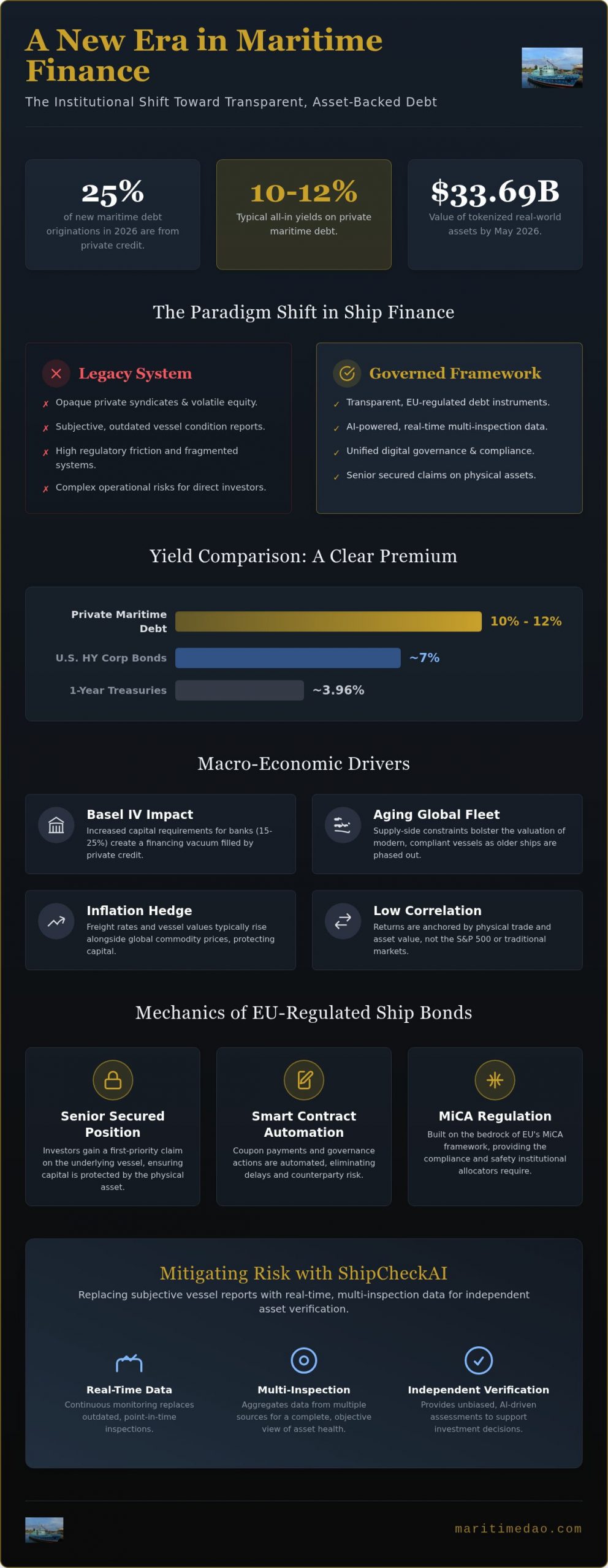
For decades, maritime capital was synonymous with volatile equity and opaque private syndicates. By July 2026, the paradigm has fundamentally shifted. Institutional maritime investments now prioritize structured debt over direct ownership, seeking the stability of asset-backed cash flows within a governed ecosystem. This transition marks the emergence of maritime debt as a sophisticated alternative to traditional fixed-income instruments. While 1-year Treasuries yield approximately 3.96% and the U.S. high-yield corporate bond market offers roughly 7%, private maritime debt provides a significant illiquidity premium. Current yields often range from 550 to 900 basis points over the Secured Overnight Financing Rate (SOFR), frequently resulting in all-in yields exceeding 10% to 12%.
The year 2026 represents a critical turning point for maritime asset-backed securities (ABS). Stricter Basel IV capital requirements have increased the cost of traditional ship loans for banks by 15% to 25%, creating a financing vacuum. Private credit has rapidly filled this void, now accounting for nearly 25% of all new maritime debt originations. This shift allows institutional allocators to capture returns that are largely uncorrelated with the S&P 500, anchored instead by the physical necessity of global trade and the intrinsic value of steel.
Macro-Economic Drivers for Maritime Capital
The global fleet is aging, and growth is expected to flatten after 2026. This supply-side constraint, combined with evolving environmental standards, bolsters the valuation of modern, compliant vessels. Shipping investments serve as a potent inflation hedge because freight rates and vessel values typically rise alongside global commodity prices. Investors aren’t chasing speculative equity upside anymore; they’re opting for regulated debt instruments that provide seniority in the capital stack and predictable, quarterly distributions.
Identifying Institutional Entry Points
Historically, high barriers to entry meant that only the largest sovereign wealth funds could participate in maritime finance. Today, the landscape is more inclusive yet remains deeply professional. While direct vessel ownership involves complex operational risks, structured bonds offer a cleaner exposure. Fractional maritime investment platforms have matured, allowing for precise capital allocation across diversified fleets. Among these options, EU regulated ship investment bonds have become the preferred vehicle for institutional capital. These instruments combine the legal certainty of European financial standards with the transparency of digital governance, ensuring that every asset is unified, transparent, and governed by clear covenant protections.
Mechanics of EU Regulated Ship Investment Bonds
EU-regulated ship investment bonds aren’t merely digital certificates; they’re sophisticated debt instruments built on the bedrock of European financial law. These bonds provide a structural bridge between the physical durability of cargo vessels and the efficiency of decentralized ledgers. By utilizing a senior secured position, investors gain a first-priority claim on the underlying asset, ensuring that capital remains protected even in volatile market cycles. While traditional options like the U.S. Maritime Administration financing programs offer paths for domestic development, the EU framework provides a globally accessible, digital-first alternative for institutional maritime investments.
The integration of smart contracts automates the most cumbersome aspects of bond management. Coupon payments are executed with algorithmic precision, which eliminates the delays associated with manual bank transfers and intermediary clearinghouses. This unified ecosystem ensures that governance is a hard-coded reality rather than an afterthought. As the on-chain value of tokenized real-world assets reached $33.69 billion in May 2026, the appetite for transparent, asset-backed liquidity is clearly at an all-time high. This technology allows for a level of structural integrity that legacy systems simply can’t match.
Compliance and Regulatory Standards
The backbone of these instruments is the Markets in Crypto-Assets (MiCA) regulation, which provides the safety net institutional allocators require. Every issuance adheres to strict EU-specific maritime finance directives, ensuring that digital debt isn’t synonymous with unregulated risk. Robust KYC and AML protocols are mandatory for all participants, creating a walled garden of verified capital. This level of oversight transforms the DAO from a speculative experiment into a reliable gatekeeper for significant capital flows, providing order, security, and transparency.
The Ship Bond Lifecycle
The journey begins with an exhaustive appraisal of the physical asset, followed by the structuring of the debt for institutional maritime investments on a maritime DAO investment platform. Once the bond is issued, tokenization facilitates secondary market liquidity, allowing holders to trade positions without the multi-week settlement periods typical of private debt. Exit strategies are clearly defined, with redemption protocols governed by smart contracts to ensure orderly capital return. If you’re looking to modernize your portfolio, you can explore our current bond offerings to see these mechanics in action.
Mitigating Risk with AI-Powered Vessel Assessments
Information asymmetry is the primary antagonist of efficient capital allocation in the shipping sector. Historically, institutional maritime investments have been hampered by a reliance on subjective, point-in-time surveys that are often months old by the time a transaction closes. These traditional reports fail to capture the dynamic operational realities of a vessel, leaving lenders exposed to hidden technical liabilities. By 2026, the industry has turned toward automated intelligence to bridge this gap, utilizing systems that reduce the manual document review burden by 40-60%. This shift provides a unified, transparent view of asset health across global maritime capital markets.
Standardizing inspection data is no longer a luxury; it’s a requirement for high-stakes debt structuring. When data is fragmented or biased, the risk premium rises, which often prices out legitimate capital. AI-powered platforms solve this by creating a governed data environment where every vessel’s technical history is verified against global benchmarks. This systematic approach ensures that asset-backed bonds remain structurally sound throughout their entire lifecycle, protecting the interests of bondholders through objective, real-time oversight.
ShipCheckAI: The New Standard for Due Diligence
ShipCheckAI represents a fundamental leap in technical oversight by automating multi-type inspections to ensure total asset integrity. It doesn’t just record current status; it leverages predictive analytics to forecast maintenance costs and residual value with a high degree of precision. By integrating this intelligence into the AI in maritime due diligence framework, the system allows bondholders to verify collateral quality without relying on the ship owner’s internal reporting. This tripartite approach—standardize, verify, and monitor—positions ShipCheckAI as a reliable gatekeeper for institutional capital.
Continuous Monitoring vs. Point-in-Time Surveys
Traditional annual surveys are insufficient for the rigorous risk mandates of 2026. Institutional capital requires real-time transparency into asset health to trigger bond covenants before a technical failure occurs. Scholarly research into AI in Marine Insurance Risk Assessment highlights how AI-verified data can significantly lower insurance premiums by providing a clearer risk profile. For example, predictive tools now achieve a 92% accuracy rate for diesel-engine fault detection. This continuous feed allows the ecosystem to govern, secure, and optimize physical assets with unprecedented accuracy, ensuring that institutional maritime investments are backed by more than just trust.
Portfolio Integration: Maritime Debt vs. Traditional Fixed Income
Institutional maritime investments act as a strategic stabilizer within a modern diversified portfolio. As of July 2026, the federal funds rate sits at 3.63%, yet maritime debt continues to offer a significant yield spread that’s largely uncorrelated with the S&P 500 or 10-year Treasuries. These assets provide a resilient hedge against inflation, as vessel valuations and freight rates are intrinsically tied to the physical movement of global commodities. By integrating these bonds, institutional allocators can’t ignore the unique risk premium that traditional fixed-income instruments simply fail to replicate in the current macroeconomic climate. This architecture is designed to validate asset health, enforce regulatory compliance, and distribute yield with algorithmic precision.
The risk-adjusted return profile, or Sharpe ratio, of maritime debt has become a focal point for credit committees seeking yield without excessive volatility. While U.S. high-yield corporate bonds offer approximately 7% in 2026, maritime debt provides all-in yields that often exceed 10% to 12%. This performance is underpinned by the physical collateral of the vessel, which maintains a residual value even in downturns. Tokenization has further transformed this asset class by increasing capital velocity. As the on-chain value of tokenized real-world assets reached $33.69 billion in May 2026, the perceived illiquidity of shipping is being replaced by a more fluid, transparent secondary market.
Maritime Debt in the Fixed Income Stack
In a “Core Plus” strategy, maritime bonds bridge the gap between investment-grade corporate credit and opportunistic private equity. They offer the cash-flow predictability of debt with the asset-backing of heavy industry. EU-regulated frameworks ensure cross-border investment efficiencies, which reduces the legal and tax friction that once plagued global shipping finance. This unified ecosystem allows for a methodical transition from legacy fixed income into high-yield alternative assets through a governed, first-of-its-kind financial structure.
The Role of the Maritime DAO in Governance
Decentralized governance provides a robust safety net for institutional minority bondholders. In a DAO structure, voting rights and capital deployment oversight are transparently governed by smart contracts, preventing the concentration of power often seen in traditional maritime syndicates. This system ensures that maritime investment compliance is automated and verifiable, providing a level of structural integrity that’s essential for significant capital investments. To begin optimizing your fixed-income allocation, you can review our current institutional debt offerings today and join a professional community of regulated innovators.
Navigating the Maritime DAO Ecosystem for Institutional Capital
The transition from legacy finance to a digital-first ecosystem requires a gateway that balances technological ambition with institutional reliability. For institutional maritime investments, the onboarding process is designed to meet the rigorous standards of global compliance while providing the agility of a decentralized structure. Accredited investors move through a methodical verification phase, ensuring that every participant in the DAO adheres to the same high-stakes regulatory frameworks that govern traditional capital markets. This isn’t a speculative leap; it’s a calculated entry into a unified, transparent environment where physical assets are managed with digital precision.
Independent verification remains the cornerstone of this ecosystem. Investors utilize ShipCheckAI to perform autonomous, multi-layer assessments of potential collateral before a single dollar is deployed. This synergy between physical vessel operations and digital bond governance ensures that the bond’s performance is always anchored in the technical reality of the hull and machinery. By the end of 2026, this model of “regulated innovation” has become the blueprint for how heavy industry interacts with global capital, providing a secure path for capital deployment in a complex global trade environment.
The Unified Investment Gateway
The Maritime DAO portal serves as a single interface for managing a diversified portfolio of global shipping assets. It replaces fragmented spreadsheets and delayed brokerage reports with a real-time auditing dashboard designed for institutional reporting requirements. You can track asset health, monitor coupon distributions, and participate in governance votes through a unified portal that provides total visibility into your allocation. This level of structural integrity allows for a steady, educational approach to portfolio scaling, ensuring that the relationship between your capital and the physical fleet is clear at every stage of the lifecycle.
Future-Proofing Maritime Portfolios
The roadmap for 2026 and beyond focuses on the integration of sustainability metrics directly into the bond lifecycle. As ESG compliance becomes a mandatory condition for European financing, ShipCheckAI has evolved to track environmental performance, such as fuel efficiency and carbon emissions, with a 92% accuracy rate for fault detection. This data-driven approach allows investors to future-proof their institutional maritime investments against evolving maritime regulations. If you’re ready to secure your position in this first-of-its-kind asset class, you can learn more about how to invest in maritime assets through our comprehensive 2026 guide and begin your deployment into the next generation of regulated shipping finance.
Securing the Next Era of Global Trade Finance
The convergence of EU-regulated financial frameworks, automated intelligence, and decentralized governance has fundamentally redefined the landscape for institutional maritime investments. You’ve explored how the industry is moving away from fragmented, legacy systems toward a unified ecosystem that prioritizes structural integrity and legal certainty. By combining senior secured debt positions with the real-time transparency of ShipCheckAI, investors can now manage risk with a level of precision that was previously unattainable. This tripartite approach ensures that every vessel is verified, every transaction is governed, and every yield is secured through a transparent, high-stakes framework.
As global trade volumes evolve and Basel IV requirements reshape traditional lending, the opportunity for alternative debt has never been more compelling. Our institutional-grade DAO provides the necessary gatekeeper functions to protect capital while fostering inclusive access to high-yield maritime assets. It’s time to transition from speculative uncertainty to a methodical, compliant allocation strategy. Secure your institutional maritime position with EU-regulated bonds at Maritime DAO and lead the evolution of sophisticated shipping finance.
Frequently Asked Questions
What are the primary risks associated with institutional maritime investments?
The primary risks involve freight rate volatility, asset depreciation, and unexpected technical failures. While market cycles influence charter rates, institutional maritime investments in structured debt mitigate these factors through senior secured positions and the physical collateral of the vessel. Continuous monitoring through automated intelligence further reduces operational risk by identifying maintenance needs before they escalate into costly technical liabilities or safety breaches.
How do EU-regulated ship investment bonds differ from traditional corporate bonds?
EU-regulated ship bonds are strictly asset-backed instruments that grant investors a first-priority lien on a specific physical vessel. Unlike traditional corporate bonds, which rely on the general creditworthiness of an issuing company, these maritime bonds tie capital to tangible, productive assets. They utilize smart contracts for automated governance and coupon distribution, ensuring that distributions are executed with algorithmic precision and total transparency within a regulated European framework.
Can institutional investors participate in the governance of Maritime DAO?
Institutional participants hold significant governance rights proportional to their bond holdings. This decentralized structure allows allocators to vote on critical capital deployment strategies, reserve fund management, and the selection of new vessel assets for the fleet. By participating in this governed ecosystem, institutions act as reliable gatekeepers, ensuring that the DAO operates with the transparency and structural integrity required for high-stakes capital allocation.
How does ShipCheckAI improve the accuracy of vessel valuations?
ShipCheckAI standardizes technical data across multiple inspection types to eliminate the information asymmetry typical of traditional surveys. By utilizing predictive analytics, the tool achieves a 92% accuracy rate in diesel-engine fault detection and forecasts maintenance costs with unprecedented precision. This real-time data feed ensures that vessel valuations reflect the actual physical condition of the asset rather than relying on outdated, subjective point-in-time reports.
What is the minimum capital requirement for institutional bond participation?
Participation is restricted to accredited and institutional investors who meet specific regulatory thresholds for alternative asset allocation. While specific entry levels vary based on the individual bond issuance and the underlying vessel’s valuation, the framework is designed to accommodate significant capital flows from family offices, pension funds, and private credit managers. Interested parties should verify their status through the compliant onboarding portal to access current debt offerings.
How does tokenization impact the liquidity of maritime debt?
Tokenization transforms historically illiquid private debt into a fluid digital asset class by facilitating secondary market trading. It reduces settlement periods from several weeks to mere seconds, allowing for greater capital velocity and more efficient portfolio rebalancing. As on-chain value for real-world assets continues to expand, tokenized maritime debt provides a transparent, audited pathway for institutions to enter and exit positions without traditional administrative friction.
Are maritime bonds compliant with ESG mandates?
Maritime bonds are increasingly structured to meet rigorous Environmental, Social, and Governance (ESG) standards, specifically adhering to the EU Taxonomy. ShipCheckAI tracks critical environmental metrics, such as carbon emissions and fuel efficiency, providing bondholders with verifiable data on the fleet’s sustainability profile. This automated reporting ensures that institutional maritime investments remain aligned with modern mandates while supporting the global transition to more efficient, low-emission shipping operations.
What happens in the event of a vessel default within the DAO framework?
In a default scenario, the DAO framework triggers an automated enforcement of the senior secured lien. Because the debt is asset-backed, the ecosystem governs the orderly liquidation or re-chartering of the vessel to recover bondholder capital. Smart contracts ensure that the priority of payments is strictly followed, protecting the seniority of institutional investors and maintaining the structural integrity of the investment vehicle throughout the recovery process.