
By the close of 2026, the traditional boundary between maritime due diligence and financial compliance has effectively vanished. Investors no longer just verify the person across the table; they must now verify the structural and operational integrity of the vessel itself. Implementing robust KYC/AML for maritime asset investors is no longer a secondary administrative task but the central pillar of institutional security. You likely recognize that the stakes have never been higher, especially as the EU Anti-Money Laundering Authority (AMLA) solidifies its oversight and sanctions evasion becomes increasingly sophisticated.
This article provides the definitive roadmap to mastering the 2026 compliance landscape, ensuring your capital remains protected within a legally sound, EU-regulated framework. We’ll explore how ShipCheckAI transforms physical asset verification into a streamlined digital process and how the new EU Digital Identity Wallet integrates with DAO governance. You’ll gain a clear understanding of the “Know Your Vessel” (KYV) standard and how automated intelligence accelerates onboarding without compromising on the sober reliability required for high-stakes shipping investments.
Key Takeaways
- Master the requirements of the EU regulatory framework to ensure your maritime investments remain compliant with the 2026 AMLA standards.
- Discover why effective KYC/AML for maritime asset investors must now integrate “Know Your Asset” protocols to verify both physical vessel integrity and investor identity.
- Learn how ShipCheckAI provides essential transparency by incorporating AI-driven vessel inspections directly into the institutional due diligence process.
- Acquire a structured roadmap for onboarding that leverages the EU Digital Identity Wallet and blockchain-based verification for secure capital deployment.
- Understand the governance model behind EU-regulated ship investment bonds and how they provide a unified gateway between decentralized finance and maritime law.
The Evolution of Maritime KYC/AML: Why Shipping Assets Require Specialized Compliance
Global shipping operates as the circulatory system of international trade, yet its inherent mobility makes it a primary target for illicit financial activity. For those managing capital, Know Your Customer (KYC) and Anti-Money Laundering (AML) protocols have transitioned from static checklists into dynamic, technology-driven ecosystems. In 2026, KYC/AML for maritime asset investors encompasses more than just identifying the beneficial owner. It requires a holistic verification of the physical asset’s history, its operational patterns, and its jurisdictional footprint to mitigate Trade-Based Money Laundering (TBML).
Shipping assets are uniquely vulnerable. The high capital value of vessels, combined with complex corporate structures and the ease of changing flags, provides a veil for bad actors. Legacy compliance models relied on periodic reviews that often missed “dark activity” occurring between audits. Today, the standard is perpetual KYC (pKYC), a model characterized by event-driven triggers and real-time data ingestion. This shift represents a move toward “regulated innovation,” where decentralized governance and institutional-grade security unite to protect legitimate commerce.
The High Stakes of Maritime Financial Crime
The risks aren’t theoretical. Between 2023 and 2025, the number of sanctioned vessel profiles more than doubled, reflecting a more aggressive global enforcement environment. “Ghost fleets” and deceptive shipping practices, such as GPS spoofing and false flag registration, have become sophisticated tools for sanctions evasion. In the first three quarters of 2025 alone, over 1,000 vessels were identified using false flags to bypass international law. Maritime AML serves as the definitive barrier between legitimate capital and sanctioned maritime operations, protecting investors from severe legal and financial repercussions.
Institutional Expectations for 2026
Institutional investors now demand transparency that matches the rigor of traditional bond markets. The liquidity of maritime assets depends on the market’s confidence that the underlying vessels are not tainted by illicit activity. Maritime DAO meets these expectations by providing a “Regulated Gateway” to the industry. By utilizing EU-regulated Ship Investment Bonds, the platform ensures that every dollar is governed by strict financial laws. This alignment provides a comprehensive ecosystem built on three pillars:
- Structural Integrity: Every investment vehicle is anchored in a transparent, governed ecosystem that respects legacy financial systems.
- Asset Transparency: Integration with tools like ShipCheckAI allows for rigorous, AI-driven vessel-side due diligence.
- Legal Certainty: Compliance with the EU single rulebook for AML/CFT eliminates regulatory arbitrage across member states.
This methodical approach ensures that the democratization of maritime finance doesn’t come at the cost of security. It bridges the gap between the physical world of global trade and the digital world of blockchain through a commitment to transparency and legal frameworks.
Navigating the 2026 Regulatory Landscape for EU-Regulated Ship Bonds
The regulatory environment for 2026 is defined by a sharp divergence between major global jurisdictions. While the U.S. FinCEN has delayed its comprehensive AML requirements for private fund managers until 2028; the European Union has accelerated its harmonized framework. For those managing institutional capital, the European Anti-Money Laundering Authority (AMLA) now dictates the technical standards for customer due diligence. This shift is particularly relevant for tokenized maritime debt, which falls under the clarity of the Markets in Crypto-Assets (MiCA) regulation. These frameworks ensure that EU-regulated ship bonds aren’t merely digital novelties but legally robust financial instruments that satisfy the highest global standards for cross-border capital allocation.
AMLD6 and the Maritime Investor
The latest European directives have fundamentally altered how beneficial ownership is recorded and verified. In 2026, transparency isn’t optional; it’s a structural requirement. Failure to identify the ultimate controllers of a vessel can lead to fines reaching €10 million or 10% of annual turnover. This environment makes a comprehensive understanding of maritime investment compliance essential for protecting bondholders. By acting as a shield, these regulations prevent legitimate investors from being inadvertently linked to “facilitators” of financial crime, a category that now faces much stricter criminal liability under the 2026 standards.
Global Sanctions and OFAC Compliance
Maintaining compliance in the shipping sector requires a dual focus on both the investor and the asset’s operational history. The number of sanctioned vessel profiles doubled between 2023 and 2025, making manual list-checking obsolete. Modern KYC/AML for maritime asset investors relies on automated, AI-driven screening that cross-references global databases in real time. Following the maritime shipping financial sanctions guidance is critical for any entity dealing with high-risk maritime trade. Unified dashboards now integrate OFAC, EU, and UK sanctions lists, providing a transparent view of risk at every stage of the investment lifecycle. To see how these standards are applied in practice, you might examine our EU-regulated ship investment bonds.
Beyond Identity: Integrating Vessel Due Diligence into Investor Onboarding
In the 2026 financial landscape, identity verification is merely the starting point. While traditional finance often treats the investor and the asset as separate risk silos, the institutional standard for KYC/AML for maritime asset investors dictates that financial vetting must occur in parallel with rigorous technical scrutiny. Knowing Your Customer is incomplete without Knowing Your Asset. Staying compliant with financial sanctions in this sector demands a granular understanding of the vessel’s physical state, operational history, and ownership trail. This integration ensures that capital isn’t just legitimate at the point of entry but remains secure throughout the investment lifecycle.
The synergy between AI in maritime due diligence and financial compliance creates a unified ecosystem where technical data and governance converge. By shifting technical due diligence into the onboarding phase, firms can identify risks that traditional KYC might overlook, such as structural anomalies or “dark” operational patterns that signal illicit activity.
ShipCheckAI: The Technical Pillar of Compliance
The implementation of ShipCheckAI provides the verifiable data trail that modern institutional investors require. This platform utilizes automated intelligence to analyze thousands of data points, creating a “Digital Twin” of the vessel that serves as a transparent record for bondholders. This technology does more than assess seaworthiness; it detects subtle physical changes or structural modifications that bad actors use to hide sanctioned cargo. By providing a governed, transparent, and unified view of the asset, ShipCheckAI acts as a reliable gatekeeper, ensuring that only vessels with a clean, verifiable history are permitted into the ecosystem.
Asset-Backed Security vs. Regulatory Risk
A clean vessel inspection report has become a prerequisite for AML clearance in 2026. This technical verification protects the underlying integrity of EU regulated ship investment bonds by ensuring the collateral is both physically sound and legally untainted. Beyond sanctions, this AI-driven approach mitigates “greenwashing” risk by providing objective data on fuel consumption and emissions compliance. This methodical process allows the platform to verify, monitor, and protect the value of the asset. Investors gain the confidence that their capital is anchored in a vehicle that meets both the cutting-edge requirements of digital finance and the sober reliability of maritime law.
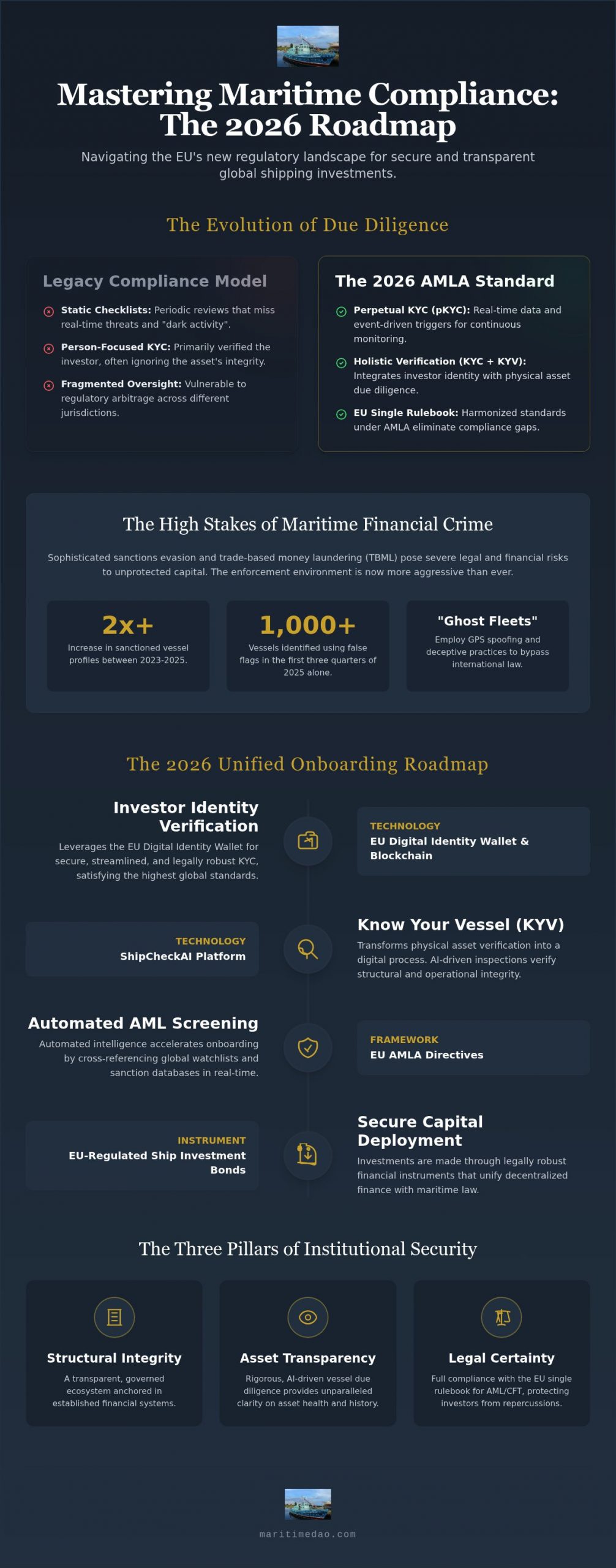
A Step-by-Step Guide to Maritime Investor Onboarding and AML Verification
Transitioning from asset-side transparency to investor-side verification requires a methodical, multi-stage approach. In 2026, KYC/AML for maritime asset investors is a friction-less yet rigorous process that leverages the EU Digital Identity Wallet and blockchain-based credentials. This system ensures that every participant in the ecosystem meets institutional standards before capital is deployed. By uniting identity verification with financial scrutiny, the onboarding process creates a secure, governed environment for global trade finance.
- Step 1: Digital Identity Verification (CIP). Onboarding begins with biometric and blockchain-anchored identity verification. By utilizing the eIDAS 2.0 framework, investors provide a secure, immutable record of identity that simplifies future cross-border transactions and reduces the risk of synthetic identity fraud.
- Step 2: Source of Wealth (SoW) and Source of Funds (SoF). Verification of maritime capital requires tracing the origin of wealth through often complex corporate structures. Investors must provide a clear audit trail that connects their capital to legitimate operational activities, ensuring that no illicit funds enter the ecosystem.
- Step 3: Enhanced Due Diligence (EDD). High-net-worth individuals and institutional entities undergo deeper scrutiny. This stage analyzes jurisdictional risks and political exposure to prevent any breach of international sanctions, particularly in high-stakes maritime corridors.
- Step 4: Continuous Monitoring and Automated Re-verification. Compliance is no longer a one-time event. The ecosystem utilizes event-driven triggers to ensure that investor risk profiles remain accurate and up-to-date in real time, a model known as perpetual KYC.
Documenting Maritime Capital
Corporate entities within the shipping sector face specific documentation requirements, particularly regarding beneficial ownership transparency. In 2026, the EU’s harmonized Anti-Money Laundering Regulation (AMLR) has eliminated the opacity once found in traditional “Safe Harbor” jurisdictions. Fractional ship investments require digital proof of funds that can be verified against banking records instantly. This methodical documentation protects the ecosystem’s structural integrity and ensures that all tokenized maritime debt instruments remain legally sound.
The Onboarding Experience in a DAO
Maritime DAO utilizes smart contracts to automate the verification flow, balancing user privacy with the “Regulated Innovation” mandate. While the technology is cutting-edge, the pace is steady and educational, leading the investor through each layer of the ecosystem. Institutional-grade compliance clearance typically occurs within 24 to 48 hours, providing a reliable gateway for global capital to enter the shipping market securely. To begin your verification process, you can explore our institutional onboarding portal.
Strategic Compliance: How Maritime DAO Secures Global Shipping Investments
Maritime DAO serves as both a visionary architect and a reliable gatekeeper, establishing a unified ecosystem where physical assets and digital governance exist in total harmony. This integration is essential for modern KYC/AML for maritime asset investors, as it replaces fragmented legacy systems with a transparent, governed framework. By bridging the divide between decentralized technology and physical maritime law, the platform ensures that every investment is anchored in legal certainty and structural integrity. The result is a “Regulated Gateway” that transforms a traditionally exclusive industry into a secure, accessible frontier for global capital.
The long-term benefits of this model extend beyond simple regulatory adherence. Investors who utilize an AI-enhanced platform benefit from reduced operational risk and enhanced asset transparency. This strategic approach allows you to invest in maritime assets with the confidence that your capital is protected by a sophisticated intersection of automated intelligence and institutional-grade finance. In an era of heightened geopolitical tension, this level of scrutiny is the only way to ensure that shipping investments remain resilient and untainted by illicit trade practices.
The Future of Regulated Maritime Finance
As we move toward the late 2020s, the maritime fintech sector is expected to converge entirely with institutional compliance standards. The Maritime DAO model provides the definitive blueprint for future asset-backed DAOs by demonstrating that decentralized structures can thrive within strict legal frameworks like AMLD6 and MiCA. This “Compliance-First” philosophy offers a significant competitive advantage. It ensures liquidity, fosters trust among institutional stakeholders, and protects the ecosystem from the volatility often associated with unregulated digital assets. The future of shipping finance is not just digital; it is governed, transparent, and methodical.
Getting Started with Maritime DAO
Prospective bondholders can begin their journey by following a structured onboarding protocol designed for maximum security. Before accessing the primary investment gateway, ensure you have prepared the following essentials:
- Digital Credentials: A valid EU Digital Identity Wallet or equivalent biometric identity record.
- Entity Transparency: Clear documentation of beneficial ownership, especially for corporate or fractional investment vehicles.
- Technical Review: Utilization of the ShipCheckAI platform to review the physical and operational history of the underlying vessel.
By completing these steps, you align your capital with a platform that values order and security. This methodical process ensures that the relationship between physical maritime assets and digital governance remains robust, providing a reliable foundation for your shipping portfolio in 2026 and beyond.
Securing Your Position in the 2026 Maritime Economy
The intersection of global trade and digital finance in 2026 demands a sophisticated, unified approach to security. Success in this new frontier requires a commitment to structural integrity, where physical asset transparency and digital identity verification exist within a single, governed ecosystem. By adopting a “Know Your Vessel” standard alongside traditional protocols, investors can navigate the complexities of international shipping with absolute clarity. Mastering KYC/AML for maritime asset investors is no longer just about meeting legal requirements; it’s about ensuring the long-term viability and liquidity of your shipping portfolio through institutional-grade compliance standards.
Maritime DAO provides the essential bridge between the physical world of global trade and the digital world of blockchain. Our platform offers a secure, EU-regulated financial framework backed by AI-driven vessel due diligence, ensuring that every investment bond is both legally sound and physically verified. You can now engage with this traditionally exclusive industry with the confidence that your capital is anchored in a transparent and methodical system. Access the Secure Maritime Investment Gateway and begin your journey into the future of regulated maritime finance today.
Frequently Asked Questions
What is the difference between KYC and AML for maritime investors?
KYC focuses on the initial verification of an investor’s identity and risk profile during the onboarding phase. In contrast, AML represents the comprehensive framework used to detect and prevent illicit financial flows throughout the investment lifecycle. For KYC/AML for maritime asset investors, this includes “Know Your Vessel” (KYV) protocols that scrutinize the ship’s operational history to prevent trade-based money laundering and sanctions evasion.
Are maritime DAOs legally compliant with EU financial regulations in 2026?
Compliance depends entirely on the organizational structure and the financial instruments used. Maritime DAO achieves compliance by utilizing EU-regulated ship investment bonds that align with the AMLD6 and MiCA frameworks. This model bridges the gap between decentralized governance and established maritime law. It ensures that the investment vehicle remains legally sound while providing the transparency and security expected by institutional stakeholders in 2026.
How does ShipCheckAI assist in the AML process for ship bonds?
ShipCheckAI provides essential asset-side due diligence by creating a verifiable data trail of a vessel’s physical and operational status. By detecting structural anomalies or irregular movement patterns, the tool identifies risks associated with deceptive shipping practices. This technical verification is a critical component of the AML process, ensuring that the collateral backing the EU-regulated ship investment bonds is untainted by sanctioned activity or illicit trade.
What documents are required for institutional KYC in the shipping industry?
Institutional entities must provide comprehensive documentation including certificates of incorporation, articles of association, and clear identification of Ultimate Beneficial Owners (UBOs). Additionally, 2026 standards require verified Source of Wealth (SoW) and Source of Funds (SoF) records. For maritime capital, this often involves tracing funds through complex corporate structures to ensure the capital originates from legitimate global trade operations rather than sanctioned sources.
Can retail investors pass the KYC process for regulated ship bonds?
Retail investors can successfully complete the verification process, as the platform is designed to democratize access to shipping finance. While the requirements remain rigorous, the use of biometric tools and the EU Digital Identity Wallet streamlines the experience. This inclusive approach ensures that all participants, regardless of their capital size, meet the high-stakes compliance standards required to maintain the structural integrity of the entire ecosystem.
How often is investor monitoring conducted on the Maritime DAO platform?
Monitoring is a continuous, automated process rather than a periodic review. The platform utilizes perpetual KYC (pKYC), which relies on event-driven triggers and real-time data ingestion to keep investor risk profiles updated. If an investor’s status or jurisdictional risk changes, the system identifies the shift immediately. This methodical oversight ensures that the KYC/AML for maritime asset investors remains robust and responsive to the evolving regulatory landscape.
What happens if a vessel in a bond portfolio is flagged for sanctions?
If a vessel is flagged, the platform’s automated sanctions screening system triggers an immediate compliance protocol. This involves cross-referencing global lists such as OFAC and EU sanctions databases to verify the nature of the risk. The governed ecosystem then implements pre-defined legal frameworks to protect bondholders. This rapid response preserves the integrity of the bond portfolio and ensures that the investment vehicle remains compliant with international maritime law.
Is my personal data secure during the KYC onboarding process?
Personal data is protected through advanced encryption and strict adherence to eIDAS 2.0 regulations. The platform balances the need for transparency with individual privacy by utilizing blockchain-based identity credentials that give investors control over their information. This “regulated innovation” approach ensures that while the DAO meets all legal mandates for identity verification, the underlying data remains secure against unauthorized access or institutional data breaches.