
The era of opaque vessel valuation and exclusive, back-room lending is reaching its inevitable conclusion. For too long, the maritime sector has operated within a fragmented ecosystem where high entry barriers and regulatory uncertainty in offshore jurisdictions sidelined institutional growth. You’ve likely experienced the frustration of navigating these legacy systems, where transparency is a luxury rather than a standard. This guide provides a comprehensive analysis of the modern types of maritime debt financing, bridging the gap between physical global trade and the sophisticated world of regulated digital securities.
We’ll explore the full spectrum of debt instruments, moving from traditional bank loans to the emerging frontier of EU-regulated ship investment bonds. You will learn how a unified framework of governance and automated intelligence can mitigate risk while expanding access to capital. By the end of this strategic guide, you’ll understand the precise hierarchy of maritime debt and how tools like ShipCheckAI are redefining due diligence through objective, tech-verified, and transparent vessel assessments.
Key Takeaways
- Recognize why the fixed-income nature of maritime debt is outperforming equity in terms of risk-adjusted returns for institutional portfolios in 2026.
- Analyze the core types of maritime debt financing, establishing a clear hierarchy between traditional senior secured loans and modern digital securities.
- Evaluate the advantages of EU-regulated ship investment bonds as a transparent, liquid, and compliant alternative to traditional private credit.
- Gain insights into how ShipCheckAI improves the accuracy of vessel valuations by replacing subjective manual inspections with objective, automated intelligence.
- Explore how decentralized governance frameworks provide a unified ecosystem for debt issuance, ensuring transparency and structural integrity across global trade.
What is Maritime Debt Financing and Why Does it Matter in 2026?
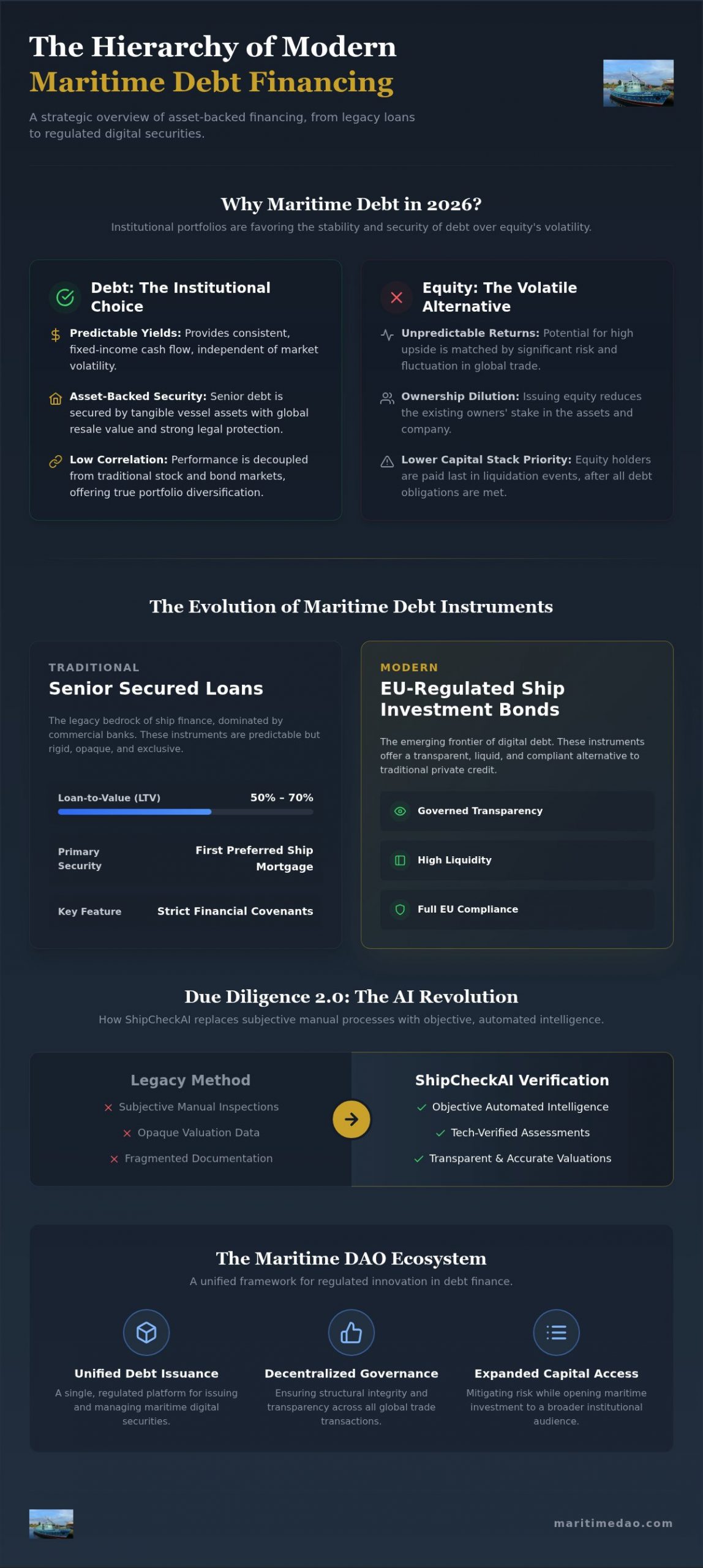
Maritime debt financing is the structural backbone of the global shipping industry. It functions as a mechanism where capital is lent to ship owners or operators, primarily secured by the underlying vessel assets or the revenue generated through charter contracts. As we move through 2026, the strategic importance of these instruments has intensified. Investors are increasingly pivoting toward fixed-income maritime bonds, valuing their reliability and governed transparency over the volatile swings common in equity markets. Understanding the various types of maritime debt financing is now essential for institutional players seeking to anchor their portfolios in tangible, high-stakes industry assets.
The current landscape is shaped by two primary forces: sustained high interest rates and the mandatory transition toward decarbonization. Retrofitting existing fleets with eco-friendly technology requires immense capital. Consequently, the demand for sophisticated types of maritime debt financing has surged. These instruments offer a clear path to funding “green” initiatives while maintaining the structural integrity of a lender’s capital stack. It’s a shift toward a more unified, tech-verified approach to asset management.
The Role of Capital in Global Shipping
The maritime sector is inherently capital-intensive, requiring constant reinvestment to maintain operational efficiency and regulatory compliance. Debt serves as the primary engine of industry growth, particularly when financing the complex retrofits required for the global green transition. This ecosystem involves a diverse range of stakeholders, including traditional commercial banks, specialized credit funds, and decentralized autonomous organizations that provide unified platforms for capital issuance. By leveraging debt, operators can modernize their fleets without the significant dilution of ownership inherent in equity raises.
Debt vs. Equity in Maritime Investment
Choosing between debt and equity requires a clear understanding of risk-adjusted returns. While equity offers potential upside, debt provides a protective shield by sitting higher in the capital stack. This seniority ensures that debt holders are prioritized during liquidation events, often secured by a formal ship mortgage registered in a reputable jurisdiction. Maritime debt is a senior-ranking financial instrument secured by physical vessel assets. Yield expectations for debt remain stable, contrasting sharply with the unpredictable returns of maritime equity in a fluctuating global trade environment.
Institutional interest in maritime debt is driven by several core benefits:
- Predictable Yields: Fixed-income structures provide consistent cash flow, independent of broader equity market fluctuations.
- Asset-Backed Security: Loans are collateralized by tangible, mobile assets with global resale value and established legal protections.
- Low Correlation: Maritime debt performance is often decoupled from traditional stock and bond markets, offering true diversification for a modern portfolio.
Traditional Maritime Debt Instruments: Senior Secured and Mezzanine Loans
The legacy of maritime lending is built on the bedrock of senior secured debt. These instruments represent the most established types of maritime debt financing, providing a predictable, if rigid, framework for capital protection. Historically, this sector has been dominated by commercial banks that prioritize asset security above all else. By understanding the mechanics of these traditional structures, investors can better appreciate the stability they offer within a broader diversified portfolio.
Senior Secured Debt Structures
Senior secured loans are often viewed as the gold standard of ship finance. These loans typically cover 50% to 70% of a vessel’s fair market value, with the primary security being a first preferred ship mortgage. Ship finance practices across major global economies emphasize this mortgage as the ultimate legal protection, granting the lender priority over almost all other claims. The repayment is usually structured through a combination of regular amortization and a final balloon payment at maturity.
Lenders maintain strict control through financial covenants. The most critical metric is the Loan-to-Value (LTV) ratio, which is monitored with clinical precision. If a vessel’s market value depreciates significantly, borrowers may be required to provide additional collateral or prepay a portion of the debt to restore the ratio. Furthermore, the age of the asset remains a decisive factor. Older vessels inevitably command higher interest rates and more aggressive amortization schedules because their remaining economic life is shorter and their maintenance costs are higher.
Mezzanine and Junior Debt
Mezzanine finance functions as a strategic bridge between senior debt and equity, offering a higher risk-reward profile for more aggressive investment strategies. These subordinated positions sit lower in the liquidation queue; capital is only returned after all senior debt obligations are fully satisfied. This increased exposure is balanced by higher interest rates and, frequently, the inclusion of warrants or “equity kickers” that allow the lender to participate in the vessel’s capital appreciation.
This type of financing is particularly effective for specialized vessels or distressed asset acquisitions where traditional bank appetite is limited. However, traditional mezzanine instruments often suffer from the same friction as senior loans. High entry barriers and a total lack of secondary market liquidity mean that capital is often locked for several years. For those seeking a more flexible and transparent entry point into the sector, exploring EU-regulated ship investment bonds can provide a modern alternative that retains the security of debt while offering enhanced accessibility.
The Evolution of Digital Debt: EU Regulated Ship Investment Bonds
The transition from rigid, bank-dominated lending to agile, tech-enabled securities marks a pivotal shift in the maritime sector. While traditional bank loans remain a cornerstone, the rise of EU regulated ship investment bonds represents a sophisticated evolution in the available types of maritime debt financing. These digital instruments provide a compliant framework that unites the structural reliability of institutional finance with the operational efficiency of modern technology. By moving debt issuance onto regulated digital platforms, the industry is overcoming the fragmentation and opacity that historically hindered capital flow.
Comparing traditional bank loans to regulated maritime bonds reveals a stark contrast in liquidity, transparency, and accessibility. Traditional debt is often bilateral, private, and illiquid, frequently locking capital for the entire duration of a vessel’s charter. In contrast, digital bonds are governed by clear legal frameworks and can be traded on secondary markets, providing investors with an exit strategy that was previously non-existent. This transformation ensures that maritime debt is no longer a “black box” but a transparent, unified asset class accessible to a broader spectrum of global capital.
Fractional Maritime Debt and Tokenization
Historically, entering the maritime debt market required a significant capital commitment, often exceeding $15 million for a single senior loan participation. Tokenization effectively dismantles this barrier. Through fractional ship investment, high-value debt is divided into smaller, manageable units, allowing for more precise portfolio allocation and risk diversification. Smart contracts play a vital role in this ecosystem, automating interest payments, enforcing compliance rules, and ensuring real-time settlement without the need for manual intervention. Tokenized ship bonds represent a digital claim on a regulated debt instrument.
EU Regulatory Frameworks for Shipping Bonds
The security of these digital assets is grounded in rigorous European oversight. As of 2026, regulations such as MiCA (Markets in Crypto-Assets) provide a clear, governed roadmap for the issuance and management of digital securities. For institutional investors, the presence of a regulated prospectus and a transparent issuance process is non-negotiable. These safeguards ensure that every bond is backed by verified assets and operates within a legally sound environment. Maintaining strict maritime investment compliance is essential for cross-border transactions, protecting both the issuer and the bondholder through every stage of the debt lifecycle. This regulatory maturity positions EU-regulated bonds as the benchmark for security among all types of maritime debt financing.
Due Diligence 2.0: Using AI to Verify Maritime Debt Assets
The most persistent objection in ship finance remains centered on valuation: “How do I know the vessel is actually worth the debt?” In an industry where physical assets are mobile, depreciating, and subject to harsh environmental conditions, this skepticism is well-founded. Traditional due diligence has historically relied on manual surveys that are infrequent, subjective, and prone to human error. By integrating AI in maritime due diligence, lenders can now verify asset integrity with clinical precision. This technological shift is redefining the risk profiles of various types of maritime debt financing, replacing speculative estimates with data-driven certainty.
Real-time monitoring represents a fundamental departure from legacy practices. Instead of waiting for five-year dry-dock reports, AI systems provide ongoing condition assessments throughout the entire loan lifecycle. This ensures that bondholders are never left in the dark regarding the health of their collateral. It’s a unified approach to risk management that protects the structural integrity of the investment from origination to maturity.
ShipCheckAI: A New Standard for Vessel Assessment
ShipCheckAI functions as an authoritative gatekeeper in the asset verification process. By utilizing this AI ship inspection tool, operators can automate complex condition surveys with a level of detail previously unattainable. The system identifies critical structural risks, such as specialized corrosion patterns or hull stress points, that manual inspectors might miss during a standard walkthrough. This objective data links physical vessel condition directly to debt pricing. When the underlying collateral is verified by automated intelligence, the resulting financial instrument gains a level of credibility that traditional bank loans often lack.
Reducing Information Asymmetry for Lenders
The transparency gap in traditional maritime debt often leaves lenders “blind” to asset degradation between formal inspections. This information asymmetry creates a systemic inefficiency where the borrower holds a disproportionate amount of data regarding the vessel’s true state. Modern digital ecosystems fix this by providing automated alerts to bondholders if a vessel’s condition falls below a pre-defined threshold. ShipCheckAI is a specialized tool for conducting multiple types of ship inspections to ensure debt security. By maintaining this constant feedback loop, the platform ensures that the types of maritime debt financing offered are always backed by verified, high-performing assets.
If you’re seeking to diversify your portfolio with debt instruments backed by tech-verified maritime assets, explore our current EU-regulated bond opportunities.
The Maritime DAO Ecosystem: Regulated Innovation in Debt Finance
The Maritime DAO functions as a visionary architect, bridging the gap between the physical reality of global trade and the digital precision of blockchain technology. By utilizing a maritime DAO investment model, the industry moves away from the “black box” opacity of traditional shipping funds toward a unified, transparent ecosystem. This structure doesn’t just offer new types of maritime debt financing; it provides a governed framework where every asset is verified, every transaction is recorded, and every stakeholder has a voice. It’s a first-of-its-kind solution to the systemic inefficiencies that have plagued maritime capital for decades.
Unified Ecosystem for Ship Finance
The platform integrates ShipCheckAI and EU-regulated bonds into a single, cohesive gateway. This integration ensures that the physical condition of a vessel is permanently linked to its digital debt representation, creating an unprecedented level of structural integrity. Decentralized governance ensures that bondholder interests are prioritized, as the rules of the ecosystem are encoded in smart contracts rather than being subject to the hidden agendas of a central authority. As the ecosystem matures, the maritime DAO will scale global shipping finance through automated intelligence, reducing the friction and overhead that currently characterize institutional lending.
Getting Started with Maritime Debt in 2026
Onboarding for institutional and retail investors is designed to be methodical and secure. The process begins with a rigorous compliance check, ensuring that all participants operate within the established EU regulatory framework. Once verified, investors can add asset-backed maritime debt to their digital or traditional holdings, achieving a level of diversification that was previously restricted to the largest private equity firms. By adopting these modern types of maritime debt financing, you’re not just providing capital; you’re joining a governed ecosystem built for the long-term stability of global trade.
The competitive advantages of EU-regulated ship investment bonds are summarized as follows:
- Institutional Security: Full compliance with MiCA and other European financial regulations ensures legal protection.
- Tech-Verified Assets: Objective proof-of-condition provided by ShipCheckAI removes the valuation guesswork.
- Market Liquidity: Fractionalized debt units can be traded on secondary markets, providing exit strategies that traditional loans lack.
Navigating the Future of Regulated Maritime Capital
The maritime industry’s financial landscape is undergoing a profound transformation. We’ve moved beyond the limitations of legacy lending toward a unified ecosystem where transparency and security are the new standards. By understanding the evolving types of maritime debt financing, investors can now access institutional-grade assets with unprecedented clarity. The integration of AI-powered asset verification and the structural integrity of transparent DAO governance ensures that capital is protected by more than just a contract; it’s protected by objective data and rigorous code.
This shift represents a democratization of a traditionally exclusive sector, grounded in an EU-regulated framework that prioritizes compliance and risk mitigation. As we look toward 2026, the opportunity to anchor your portfolio in global shipping trade has never been more accessible. It’s time to move beyond the “black box” of traditional shipping funds and embrace a methodical, tech-driven approach to debt. Explore EU-Regulated Ship Investment Bonds at Maritime DAO and take your place in the next generation of maritime finance. The future of global trade is regulated, transparent, and ready for your participation.
Frequently Asked Questions
What is the difference between senior secured and mezzanine maritime debt?
Senior secured debt represents the primary layer of the capital stack and is typically protected by a first preferred ship mortgage. Mezzanine debt occupies a subordinated position, offering higher interest rates and equity kickers to compensate for increased risk. While senior lenders have priority during liquidation, mezzanine instruments provide a strategic bridge for operators requiring capital beyond traditional loan-to-value limits. These distinct types of maritime debt financing allow for tailored risk management within an institutional portfolio.
How do EU-regulated ship investment bonds protect investors?
EU-regulated ship investment bonds protect investors by operating within a strictly governed legal framework, such as MiCA and standardized prospectus requirements. This structure ensures full transparency regarding asset ownership, financial performance, and legal recourse in European courts. By providing a unified set of rules for issuance and reporting, these bonds eliminate the regulatory uncertainty often found in offshore jurisdictions, offering a secure gateway for institutional capital and regulated innovation.
Can retail investors participate in maritime debt financing in 2026?
Retail investors can participate in the maritime sector in 2026 through the fractionalization of debt instruments on regulated digital platforms. This innovation allows individuals to hold smaller units of high-value ship bonds, effectively removing the multi-million dollar entry barriers of the past. It’s an inclusive approach that maintains the same level of institutional security and transparency previously reserved for the world’s largest credit funds and commercial banks, democratizing access to global trade.
What role does AI play in maritime debt due diligence?
AI transforms due diligence by replacing subjective, manual surveys with objective, data-driven assessments. It provides a continuous stream of condition reports throughout the loan lifecycle, allowing lenders to monitor their collateral in real time. By automating the identification of structural risks and hull degradation, AI reduces the information asymmetry that has historically hindered the transparency of various types of maritime debt financing, ensuring that every bond is backed by verified assets.
Are maritime bonds more stable than shipping stocks?
Maritime bonds are generally more stable than shipping stocks because they are senior-ranking, asset-backed instruments with fixed yields. While shipping stocks are subject to the volatile swings of equity markets and investor sentiment, bonds provide predictable cash flows secured by physical vessels. This fixed-income nature makes them an attractive option for those seeking low correlation with traditional stock markets and reliable capital preservation within a diversified investment strategy.
What happens if a vessel owner defaults on a regulated ship bond?
If a vessel owner defaults on a regulated ship bond, the legal framework outlined in the prospectus governs the recovery process. Bondholders hold a digital claim on the physical asset, which is enforced through established maritime law and the ship mortgage. This allows for a structured liquidation or seizure of the vessel, ensuring that debt holders are prioritized in the distribution of asset value, providing a layer of security that equity investors don’t possess.
How does ShipCheckAI verify the value of a vessel for financing?
ShipCheckAI verifies vessel value by conducting multiple automated inspections that analyze structural integrity and operational health with clinical precision. The tool identifies specific corrosion patterns and stress points that manual surveys often overlook, providing an objective score of the asset’s condition. This tech-verified data is then used to establish a precise valuation, ensuring that the debt issued is always supported by tangible, high-performing maritime collateral rather than speculative estimates.
Is maritime debt financing environmentally sustainable?
Maritime debt financing is a primary driver of environmental sustainability within the shipping industry. It provides the essential capital required for green retrofits, such as installing scrubbers or transitioning to alternative fuel systems. By funding the modernization of global fleets, these debt instruments support the industry’s mandatory transition toward decarbonization. Lenders increasingly prioritize projects that align with international environmental regulations, ensuring that capital flows toward a cleaner and more efficient global trade ecosystem.