
By 2026, a vessel’s physical condition is only as valuable as the digital architecture that validates it. If your ship inspection data management still relies on fragmented paper trails or inconsistent surveyor notes across global ports, you aren’t just risking a 4.03% detention rate; you are jeopardizing the asset’s standing with institutional capital. In an era where transparency governs value, the gap between technical maintenance and financial compliance has become a critical vulnerability for fleet owners.
It’s a challenge we all recognize: the difficulty of proving real-time fleet integrity to bondholders when data remains trapped in silos. This guide promises to show you how to architect a seamless, AI-driven vessel assessment process that bridges the gap between daily maritime operations and institutional investment compliance. We will preview a framework that unites standardized high-fidelity reporting, real-time global visibility, and audit-ready data for EU-regulated financial instruments, transforming your inspection workflow into a robust pipeline for institutional-grade security.
Key Takeaways
- Learn how to transition from legacy, paper-based silos to a unified digital ecosystem that integrates technical vessel data with institutional financial compliance.
- Identify the three essential pillars of modern digital architecture: Capture, Intelligence, and Distribution, to ensure high-fidelity reporting in any maritime environment.
- Discover how ShipCheckAI optimizes ship inspection data management by utilizing automated intelligence to validate the assets underlying EU-regulated investment bonds.
- Master a methodical implementation strategy to deploy AI-enhanced workflows that meet the rigorous transparency and governance standards required by global bondholders.
- Explore how the synergy between real-time vessel assessment and decentralized governance is opening the maritime industry to a broader, more inclusive investment audience.
The Evolution of the Digital Ship Inspection Workflow
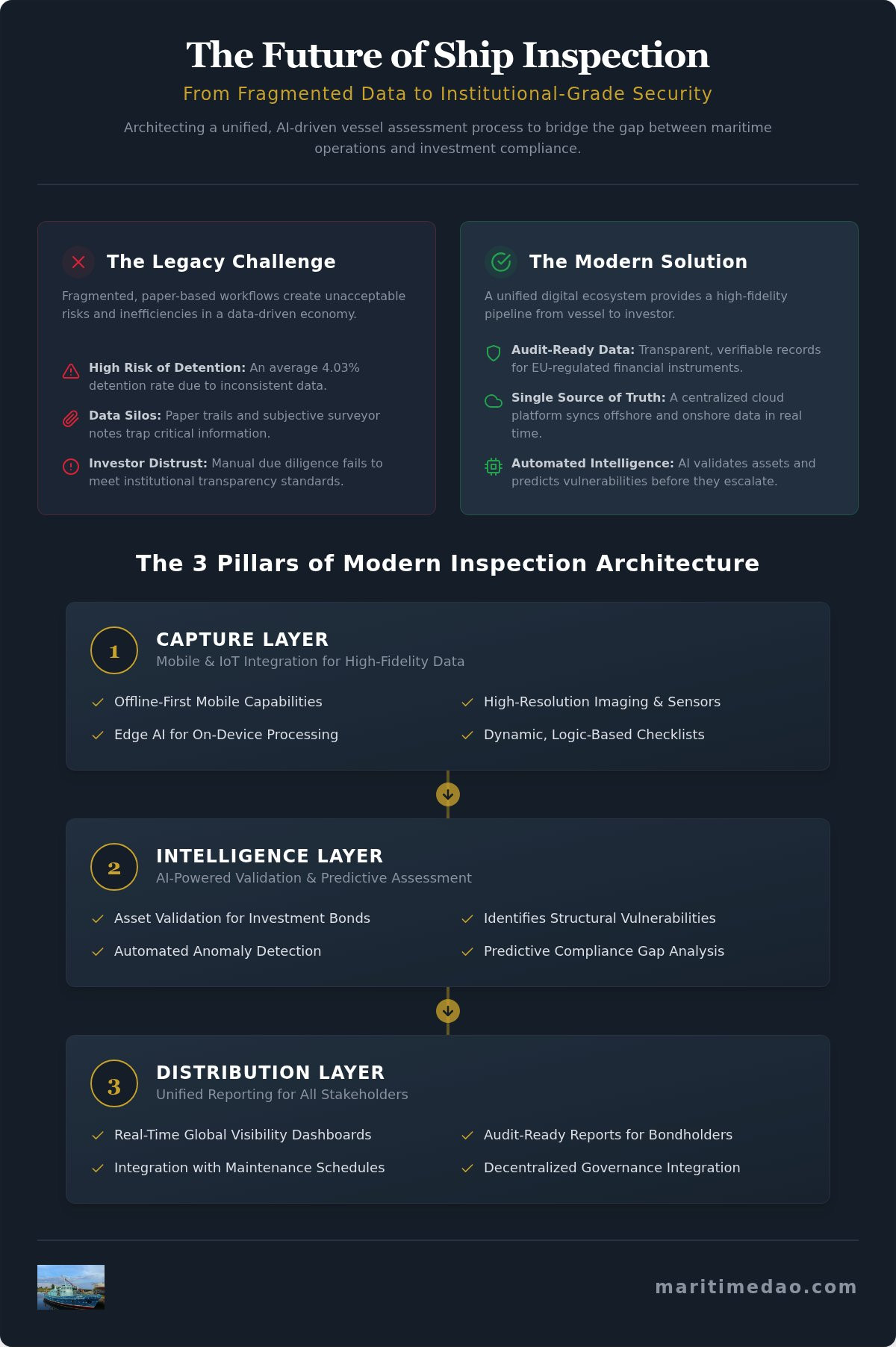
The modern digital ship inspection workflow is a unified system designed for the precise capture, analysis, and reporting of vessel integrity data. It represents a fundamental shift away from the legacy model of siloed, paper-based reports toward a connected ecosystem where technical operations meet financial accountability. In this structured framework, ship inspection data management serves as a high-fidelity pipeline that synchronizes offshore findings with onshore management in real time. By 2026, the industry’s standards have evolved. We’ve moved beyond simple descriptive reporting to embrace automated intelligence. This shift enables predictive vessel assessments, where AI identifies structural vulnerabilities or compliance gaps before they escalate into operational failures.
Why Manual Inspection Workflows Fail in 2026
Manual workflows are no longer viable in a high-stakes maritime economy. The cost of latency is simply too high. Delayed reports often stall chartering agreements or trigger insurance premiums that erode profit margins. Paper-based condition assessments are inherently subjective and prone to human error, creating inconsistencies that institutional investors find unacceptable. When you’re managing portfolios tied to maritime investment bonds, manual due diligence doesn’t scale. A global fleet requires a standardized, rapid verification process that manual surveys can’t provide with the necessary speed or precision. It’s a systemic inefficiency that modern technical managers can no longer afford to ignore.
The Regulatory Shift Toward Verifiable Digital Records
Regulatory pressure has accelerated the transition from trust-based surveys to data-verified records. As of January 1, 2026, revised IMO procedures mandate electronic record-keeping and digital logbooks to ensure transparency across international ports. This shift is mirrored in the financial sector. EU regulations now demand granular asset assessments for maritime debt instruments, requiring that ship inspection data management be both transparent and auditable. Modern inspection platforms often integrate data from Voyage Data Recorders (VDR) to provide an objective history of vessel performance and safety. This convergence of technical and financial oversight ensures that every asset is governed by a transparent, verifiable data trail, reducing risk for institutional bondholders while increasing operational visibility for owners.
Core Components of a Modern Digital Inspection Architecture
A sophisticated digital architecture is the bedrock of effective ship inspection data management. It replaces the haphazard collection of PDFs and spreadsheets with a structured, three-tiered framework comprising Capture, Intelligence, and Distribution. This unified ecosystem ensures that data flows seamlessly from the physical hull to the institutional dashboard, providing a centralized cloud-based Single Source of Truth that governs the entire fleet. By aligning technical operations with this architectural blueprint, owners can ensure that their data is both operationally useful and investment-ready.
Technical reliability begins at the edge. Maritime environments, particularly deep tanks and remote engine rooms, are notorious for connectivity dead zones. A resilient architecture must utilize offline-first mobile capabilities, enabling surveyors to capture high-fidelity data regardless of network availability. By implementing Edge AI, visual data is processed directly on the surveyor’s device. This immediate processing allows for the rapid identification of structural anomalies, ensuring that critical safety issues are flagged before the vessel departs. This level of local intelligence is a prerequisite for any modern system aiming to master ship inspection data management at scale.
The Data Capture Layer: Mobile and IoT Integration
The Capture Layer serves as the sensory input for the entire system. It utilizes high-resolution imaging and thermal sensors to document vessel condition with forensic detail. Instead of static forms, surveyors use dynamic, logic-based digital checklists that adapt in real-time to the specific vessel type and previous findings. This approach standardizes data entry across global ports, ensuring that information remains consistent whether the ship is in Singapore or Rotterdam. Once connectivity is restored, this on-site data syncs with vessel logbooks and maintenance schedules to provide a comprehensive operational history.
The Intelligence Layer: AI-Powered Condition Assessment
Raw data gains institutional value through the Intelligence Layer. Modern AI Ship Inspection tools analyze visual inputs to identify corrosion, fatigue, or structural anomalies automatically. This technology moves beyond the limitations of binary Pass/Fail assessments, introducing nuanced risk-scoring models that reflect the true state of the asset. By standardizing report output, the system eliminates the subjectivity often found in manual surveys. This level of precision is essential for maintaining the integrity of Maritime DAO and its underlying financial instruments, where data-driven transparency is the primary safeguard for capital. This structured approach to intelligence ensures that every stakeholder, from the chief engineer to the institutional bondholder, shares a clear, verified view of fleet integrity.
AI-Driven Accuracy: Traditional Software vs. ShipCheckAI
The distinction between standard digital checklists and AI-enhanced assessment workflows is a matter of structural depth. Traditional software merely digitizes the paper form, creating a flat record that still requires manual synthesis and human interpretation. ShipCheckAI represents a superior tier of ship inspection data management, where automated intelligence actively validates every data point against an expansive global library of vessel conditions. This system doesn’t just record observations; it interprets them, reducing the critical time-to-report from several days to mere minutes. By providing a unified platform for diverse inspection types, owners can maintain a consistent data pedigree for an asset throughout its entire operational lifecycle. This historical benchmarking is essential for identifying long-term degradation patterns that isolated, event-based surveys often miss.
Optimizing Pre-purchase and Condition Surveys
ShipCheckAI serves as the technical cornerstone for AI in maritime due diligence. In the high-stakes environment of a pre-purchase survey, speed and accuracy are the primary drivers of success. The system automates the detection of non-compliance with international maritime standards, flagging potential liabilities that a human surveyor might overlook during a compressed inspection window. For institutional investors, this translates into a transparent health score that quantifies the risk associated with a potential acquisition. This level of granular visibility ensures that the physical reality of the vessel is accurately reflected in its financial valuation, providing a secure foundation for capital deployment within the DAO ecosystem.
Standardizing Ship Survey Automation for Global Fleets
Achieving uniformity across different vessel types, such as Bulk carriers, Tankers, and Container ships, has traditionally required a rotating roster of highly specialized human niche experts. Digital ship survey automation removes this operational bottleneck by embedding expert-level knowledge directly into the inspection workflow. Every survey conducted through the system is governed by the same rigorous logic, ensuring that a report generated in Singapore matches the fidelity of one produced in Rotterdam. This consistency is vital for meeting the high threshold required for AI ship inspection tool standards. By reducing the reliance on subjective human interpretation, fleet managers can implement a model of continuous operational verification. This systematic approach ensures that ship inspection data management remains a reliable pillar of institutional trust, regardless of a vessel’s location or class.
Implementing a Compliant Workflow for Maritime Investment
Implementing a compliant workflow is the definitive step in transforming raw vessel data into institutional value. This transition requires a methodical four-step deployment that aligns technical maintenance with financial oversight. First, technical managers must define specific KPIs and compliance benchmarks that reflect both maritime safety standards and investor risk appetites. Second, the organization should deploy ShipCheckAI across technical management teams and third-party surveyors. This ensures that ship inspection data management is standardized at the point of capture, eliminating the inconsistencies that plague manual reporting. Third, this high-fidelity data must be integrated with financial reporting systems to provide the transparency required for bond issuance. Finally, owners must establish a continuous feedback loop where inspection results directly inform maintenance CAPEX, ensuring that asset value is preserved through proactive, data-driven intervention.
Meeting EU Financial Regulation Standards
Digital workflows are the primary mechanism for satisfying the rigorous transparency requirements of EU regulated ship investment bonds. By creating an immutable audit trail for vessel condition and valuation, owners can effectively reduce the risk premium typically associated with maritime debt. Institutional bondholders require verifiable proof of asset integrity before committing significant capital. A unified digital architecture provides this evidence, offering a transparent view of the vessel’s health that is both auditable and secure. This level of forensic detail is no longer optional; it’s a structural requirement for any owner seeking to access the global bond market.
Bridging the Gap Between Technical and Financial Data
The ultimate goal of a modern workflow is converting technical survey findings into actionable financial risk metrics. This process bridges the gap between the engine room and the boardroom, ensuring that ship inspection data management serves the strategic needs of the entire organization. The Maritime DAO ecosystem plays a central role here, acting as the governing body that validates and secures asset assessment data. This governed structure ensures maritime investment compliance throughout the entire asset lifecycle, from initial acquisition to eventual decommissioning. By aligning physical reality with digital governance, owners can unlock new levels of capital efficiency.
To begin architecting your investment-grade technical workflow, you can unify your fleet operations within our regulated financial framework today.
The Future of Vessel Assessment in a Regulated DAO Ecosystem
The evolution of the maritime industry is no longer a speculative premise. It is governed by the convergence of automated intelligence, decentralized structures, and institutional finance. A unified digital workflow serves as the definitive gateway to a more inclusive financial landscape, effectively democratizing access to ship finance for a global audience. This synergy between AI-driven inspections and decentralized governance ensures that every vessel is a transparent, high-fidelity asset. Maritime DAO leads this frontier of regulated innovation, providing a methodical framework that unites physical trade, legal security, and institutional capital.
The transition toward this ecosystem represents a fundamental shift in how we perceive asset value. By moving away from event-based surveys and toward a model of continuous operational verification, we create a more resilient industry. This transformation relies on the integration of technical operations with sophisticated financial governance, ensuring that the physical reality of the global fleet is always reflected in its digital representation. It’s a first-of-its-kind approach that empowers owners, protects investors, and stabilizes the maritime debt market through sheer data transparency.
The Role of ShipCheckAI in Asset-Backed Security
ShipCheckAI acts as the reliable gatekeeper for asset-backed security within our ecosystem. By automating the verification of vessel integrity, the platform protects the capital of maritime bondholders with forensic precision. We’ve entered the era of Real-Time Due Diligence, where ship inspection data management provides a continuous, audit-ready stream of condition data. This evolution is essential for scaling global maritime investment, as it replaces subjective trust with a standardized digital workflow that satisfies the most rigorous institutional compliance standards. The result is a tripartite value proposition: enhanced safety, reduced financial risk, and increased capital efficiency.
Join the Maritime DAO Ecosystem
Transitioning to this modern model is a strategic imperative for ship owners looking to access sophisticated capital markets. The process begins with the deployment of ShipCheckAI to unify fleet assessment needs under a single, transparent dashboard. By integrating your physical assets with our digital governance layer, you ensure long-term structural integrity and financial viability. This is the definitive path to bridging the gap between traditional maritime operations and the future of regulated innovation. We invite you to explore the Maritime DAO platform and begin your integration into the world’s most advanced maritime finance ecosystem today.
Architecting the Future of Maritime Asset Integrity
The transition from fragmented, paper-based surveys to a unified digital architecture is now the definitive requirement for the maritime landscape. By integrating technical operations with a sophisticated financial governance layer, owners can transform physical vessel condition into institutional-grade security. Robust ship inspection data management serves as the fundamental pipeline that ensures this transparency, providing bondholders with the verifiable proof they require to commit capital with confidence.
Maritime DAO provides the essential framework for this evolution, offering an ecosystem where ShipCheckAI validates the assets underlying EU-regulated ship investment bonds. This synergy between automated intelligence, regulated innovation, and legal security empowers stakeholders to operate within a transparent, governed environment. It’s a first-of-its-kind model that protects capital while democratizing access to global trade. We invite you to take the next step in your fleet’s digital transformation. Access Institutional Maritime Assets and AI-Driven Inspection Tools today and secure your position in the future of maritime finance. Your journey toward a more transparent and efficient fleet starts here.
Frequently Asked Questions
What are the main stages of a digital ship inspection workflow?
The workflow consists of three primary stages: data capture, automated intelligence, and institutional distribution. In the capture phase, surveyors utilize mobile tools to record high-fidelity visual and sensor data directly at the source. This information then passes through an intelligence layer where AI validates findings against global benchmarks. Finally, the processed data is distributed to a unified cloud ecosystem, ensuring that all stakeholders have real-time visibility into fleet integrity.
How does AI improve the accuracy of vessel condition assessments?
AI enhances accuracy by eliminating the subjectivity inherent in manual human surveys. By utilizing automated intelligence, systems identify structural anomalies, corrosion patterns, and non-compliance issues that might be overlooked by the human eye. This objective analysis ensures that ship inspection data management remains consistent across global ports. It transforms raw visual inputs into precise risk-scoring models, providing a forensic level of detail that legacy paper-based checklists simply cannot achieve.
Can a digital workflow help in meeting EU maritime financial regulations?
Yes, a digital workflow is essential for satisfying the transparency requirements of EU-regulated ship investment bonds. These regulations demand an immutable audit trail that proves the condition and valuation of the underlying assets. By implementing a standardized digital process, owners provide institutional-grade evidence of compliance and integrity. This verifiable data reduces the risk premium for investors and ensures that the vessel remains a qualified asset within a regulated financial framework.
What hardware is required for a modern ship inspection workflow?
A modern workflow primarily requires high-specification mobile devices equipped with high-resolution cameras and thermal imaging sensors. These devices act as the primary capture tools for surveyors in the field. Additionally, integration with onboard IoT sensors and Voyage Data Recorders (VDR) provides a more comprehensive data set. No specialized server hardware is typically needed on the vessel, as most systems utilize cloud-based architectures for data storage and intelligence processing after the capture phase.
How do digital inspection reports benefit maritime bond investors?
Digital inspection reports provide bond investors with real-time visibility and forensic transparency regarding the assets they fund. Instead of relying on annual, trust-based surveys, investors gain access to a continuous verification stream that validates vessel integrity. This high-fidelity data reduces investment risk and ensures that the underlying asset maintains its value throughout the bond’s lifecycle. It creates a governed environment where financial performance is directly linked to the physical condition of the fleet.
Is it possible to perform digital inspections while offline at sea?
Yes, offline-first mobile capabilities are a fundamental component of a resilient digital architecture. Surveyors can capture detailed data, high-resolution images, and sensor readings in remote environments like deep tanks or engine rooms without an active internet connection. Once the device reconnects to the ship’s network or a port-side signal, the system automatically synchronizes the data with the centralized cloud ecosystem. This ensures that ship inspection data management remains uninterrupted regardless of the vessel’s geographic location.
How does ShipCheckAI handle different types of maritime surveys?
ShipCheckAI utilizes dynamic, logic-based modules to support multiple inspection types, including pre-purchase, condition, and compliance surveys. The platform adapts its assessment criteria based on the specific survey objective and vessel class, whether it’s a tanker, bulk carrier, or container ship. This versatility ensures that technical managers use a single, unified tool for all assessment needs. By standardizing diverse survey outputs, the system maintains a consistent data pedigree across the entire fleet lifecycle.