
In the institutional maritime landscape of 2026, a vessel’s value is no longer defined by its steel alone, but by the verifiable data stream that governs its operational future. You recognize that unplanned downtime remains the primary predator of maritime yields, often exacerbated by manual inspection reports that lack the granular precision required by modern bondholders. The shift toward AI for vessel integrity assessment represents a fundamental evolution in how we protect capital, moving away from the fallibility of human-only observation toward a unified system of predictive intelligence.
This guide explores how AI-powered predictive maintenance transforms ship inspections from reactive cost centers into strategic assets for maritime investors and operators. We’ll examine the integration of ShipCheckAI with the latest IMO guidelines to deliver reduced OPEX, verified regulatory compliance, and the structural transparency essential for EU-regulated ship investment bonds. By bridging the gap between physical heavy industry and sophisticated financial frameworks, these technological pillars ensure that asset integrity is both visible and governed. Through this methodical approach, we’ll outline how to secure maritime assets within a transparent and regulated ecosystem.
Key Takeaways
- Transition from rigid, scheduled survey cycles to continuous, AI-driven condition monitoring to eliminate the volatility of unplanned operational downtime.
- Deploy ShipCheckAI to synthesize high-resolution drone imagery and engine telemetry into a unified, transparent record of vessel health.
- Leverage AI for vessel integrity assessment to provide the granular data necessary to lower risk premiums and satisfy the rigorous due diligence of institutional bondholders.
- Implement a strategic maintenance roadmap that utilizes edge-computing sensors to detect structural and mechanical anomalies before they compromise asset value.
- Understand how predictive intelligence functions as a regulatory gatekeeper for vessels seeking to back EU-regulated ship investment bonds within the Maritime DAO ecosystem.
The Evolution of Maritime Maintenance: From Scheduled Surveys to Real-Time Prediction
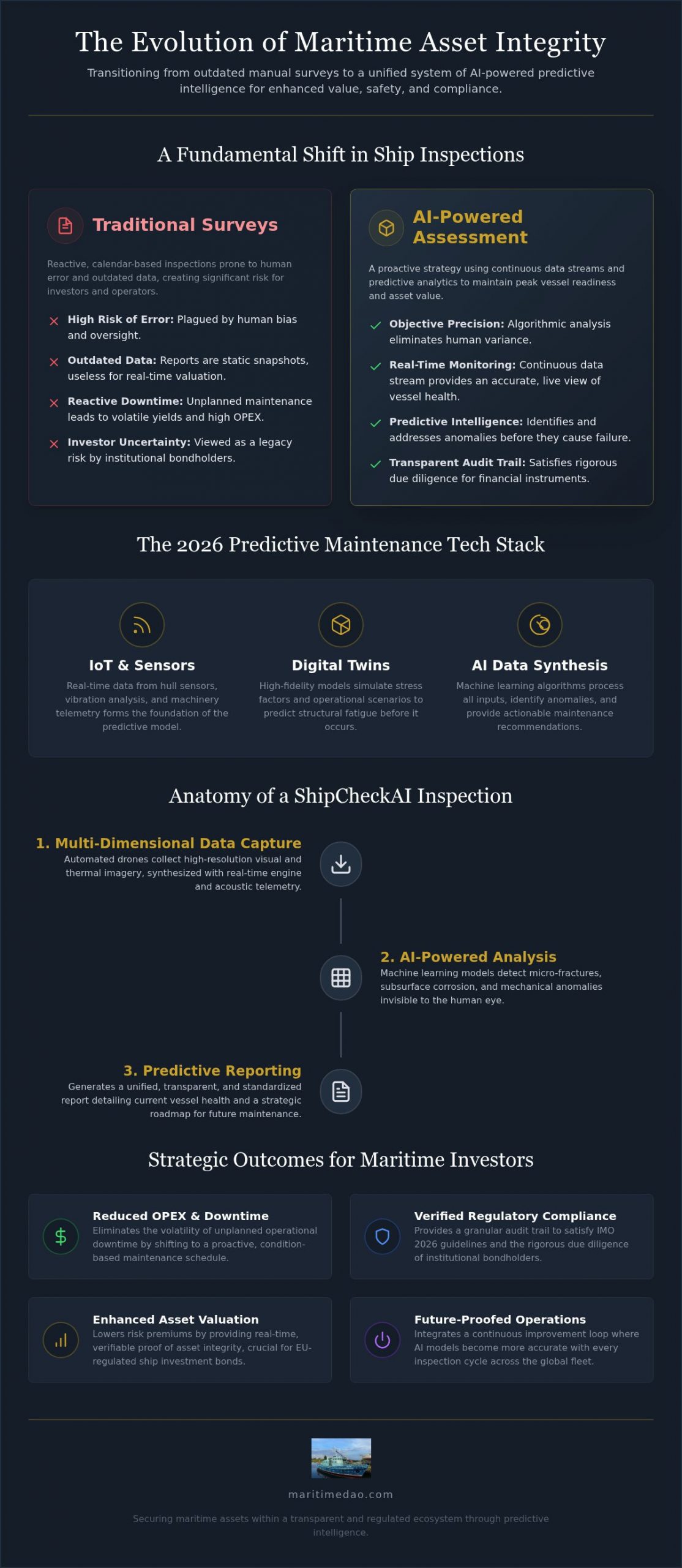
Maritime maintenance has moved beyond the era of static, calendar-based interventions that frequently resulted in either unnecessary expenditure or catastrophic failure. In 2026, the industry views maintenance as a continuous data stream, where Predictive maintenance replaces traditional dry-dock schedules with AI-driven condition-based monitoring. This transition empowers operators to move from a reactive stance to a proactive strategy of preventing failure through deep IoT integration. Predictive ship inspection is defined as the rigorous synthesis of real-time sensor data and automated AI analysis to maintain vessel readiness.
Why Traditional Ship Inspections Fail in the Modern Era
Manual surveys are plagued by human bias and the high cost of oversight errors, which can lead to inaccurate reporting of a vessel’s true state. A report that’s six months old serves little purpose in a market where asset value fluctuates based on immediate operational efficiency. Inaccurate data also compromises environmental compliance; sub-optimal maintenance leads to poor carbon intensity (CII) ratings and excessive fuel consumption. Implementing AI for vessel integrity assessment eliminates these blind spots, providing a unified and transparent audit trail for institutional lenders who require real-time proof of asset condition. This transparency is vital for bondholders who view manual inspection reports as a legacy risk that can no longer be tolerated in a regulated financial ecosystem.
The 2026 Technology Stack: IoT, Digital Twins, and AI
The current technological ecosystem utilizes hull sensors and vibration analysis to create high-fidelity predictive models that identify anomalies before they escalate. These inputs are processed through digital twins that simulate various stress factors to predict structural fatigue before it occurs, ensuring that maintenance is performed exactly when needed. This unified approach integrates three distinct layers: local machinery telemetry, structural hull monitoring, and global positioning intelligence. Combined with satellite telemetry, this stack enables real-time monitoring of fleet health across global trade routes, aligning with the IMO’s 2026 guidelines for AI integration. This level of AI for vessel integrity assessment ensures that every maritime asset is governed by data, providing the structural security needed for regulated investment frameworks and ship investment bonds.
The Anatomy of an AI-Powered Ship Inspection
The shift from manual subjectivity to algorithmic precision is best exemplified by the multi-layered architecture of ShipCheckAI. This system replaces the fallible human eye with a high-fidelity data ingestion process that synthesizes high-resolution drone footage, thermal imaging, and real-time engine telemetry. By utilizing AI for vessel integrity assessment, operators can identify micro-fractures and subsurface corrosion patterns that remain invisible to even the most experienced marine surveyors. This objective approach eliminates the variance found in traditional paper-based surveys, delivering a standardized report in a fraction of the time. The system unites visual data, acoustic telemetry, and structural modeling to provide a comprehensive view of asset health.
Machine learning plays a critical role in this ecosystem, as the underlying models refine their diagnostic accuracy over thousands of inspection cycles. This continuous improvement ensures that the system doesn’t just record data but interprets it within the context of global fleet benchmarks. As noted by industry leaders, implementing an AI-powered system to predict maintenance issues has already proven effective in high-stakes naval environments. These same rigorous standards are now available to commercial maritime investors, ensuring that asset assessments are grounded in empirical evidence rather than anecdotal observation.
ShipCheckAI: Multi-Dimensional Vessel Assessment
The assessment process is divided into distinct operational gateways to ensure total coverage. Automated drones conduct comprehensive visual inspections of the hull, utilizing thermal imaging to detect structural anomalies and heat signatures that indicate potential fatigue. In the engine room, acoustic AI monitors machinery to detect subtle mechanical deviations and wear patterns before they manifest as critical failures. All these data points are unified through our AI ship inspection tool, creating a single source of truth for asset managers. This integrated ecosystem ensures that every component is governed, monitored, and transparently reported.
Standardizing Data for Global Port State Control
Consistency is the hallmark of regulated innovation. By automating the “Record of Inspection,” ShipCheckAI ensures that every assessment meets international IMO and flag state standards with absolute precision. This standardization facilitates seamless compliance audits and the issuance of digital certificates, which are essential for vessels operating in highly scrutinized jurisdictions. Proactive deficiency identification significantly reduces the risk of port detention, protecting the vessel’s operational schedule and its standing within the Maritime DAO ecosystem. This methodical approach to AI for vessel integrity assessment provides the verified data required to support institutional-grade ship investment bonds.
Predictive Maintenance as a Catalyst for Maritime Investment Transparency
Asset valuation in the 2026 maritime sector relies on empirical data rather than speculative estimates. Predictive data directly impacts the risk premium assigned by institutional lenders, as it provides a granular view of operational risk that traditional surveys cannot match. The integrity of EU regulated ship investment bonds is inherently tied to the physical state of the underlying vessel, making continuous monitoring a financial necessity. By utilizing AI for vessel integrity assessment, issuers can offer a level of transparency that satisfies the most rigorous institutional due diligence requirements. This data-driven approach ensures that capital is protected, governed, and deployed with absolute precision.
Beyond simple maintenance, these systems serve as a critical defense against “greenwashing” in maritime ESG reporting. Immutable data logs provide a verifiable record of fuel efficiency and hull condition, ensuring that environmental claims are backed by physical reality. Asset-backed securities in the modern era rely on this automated verification to maintain their credit ratings and investor trust. This ecosystem creates a unified standard where physical integrity and financial performance are inextricably linked, opening up new opportunities for global capital to enter the shipping industry with confidence.
Securing Capital through Verified Asset Integrity
Investors in 2026 demand real-time health data before any significant capital deployment, viewing legacy inspection methods as a systemic risk. There’s a direct, measurable relationship between predictive maintenance maturity and residual asset value; a vessel with a documented history of AI-monitored health commands a higher price in the secondary market. ShipCheckAI provides the necessary “proof of condition” for institutional debt instruments, acting as a reliable gatekeeper for asset-backed financing. This methodical verification process ensures that every dollar of investment is supported by a high-fidelity digital twin of the physical asset.
Compliance and Governance in a Decentralized Ecosystem
Transparency has become the ultimate competitive advantage in the global shipping capital markets. By using blockchain technology to secure inspection logs, the Maritime DAO ensures that data remains tamper-proof and accessible to authorized stakeholders. This governance framework allows the DAO to maintain high asset maintenance standards across its entire fleet, protecting the interests of bondholders and operators alike. This unified system of AI for vessel integrity assessment and decentralized governance creates a secure bridge between traditional heavy industry and the future of institutional finance.
Implementing a Predictive Maintenance Strategy for Global Fleets
Transitioning from legacy reactive maintenance to a predictive framework requires a disciplined, multi-stage roadmap that aligns physical operations with institutional financial standards. This process begins by establishing a rigorous baseline to identify existing structural and mechanical vulnerabilities. By utilizing AI for vessel integrity assessment, fleet managers can move beyond the limitations of manual oversight and build a foundation for long-term asset security.
- Step 1: Baseline Assessment. Conduct an exhaustive initial review using AI in maritime due diligence to map the current state of the vessel and its historical performance.
- Step 2: Sensor Deployment. Install edge-computing sensors across critical machinery and hull stress points to capture real-time telemetry without overwhelming satellite bandwidth.
- Step 3: Data Integration. Synthesize disparate data streams into a unified AI-driven operational dashboard for centralized governance and reporting.
- Step 4: Technical Training. Empower technical staff to interpret predictive alerts, shifting the operational culture from responding to failures to managing early-stage anomalies.
- Step 5: Feedback Optimization. Establish continuous feedback loops where actual maintenance outcomes refine the digital twin’s predictive accuracy over time.
Overcoming the Challenges of Digital Transformation
A primary hurdle in this evolution is the presence of data silos between the crew, the owner, and the charterer. Unified platforms bridge these gaps, ensuring that all stakeholders operate from a single source of truth. Managing the initial CAPEX is best handled through phased sensor deployment, allowing the long-term OPEX savings to fund subsequent stages of the rollout. With maritime cyber incidents rising 17% according to the 2026 CTIME report, ensuring robust cybersecurity for onboard IoT networks is a non-negotiable pillar of this strategy. This methodical approach ensures that the relationship between physical assets and digital governance remains secure.
Measuring Success: KPIs for Predictive Ship Inspections
The efficacy of a predictive strategy is measured through empirical performance indicators. A significant reduction in Mean Time Between Failures (MTBF) for critical engine components demonstrates the system’s ability to prevent catastrophic loss. This directly translates to a decrease in unplanned downtime and off-hire days, maximizing the vessel’s earning potential and protecting investor yields. Additionally, verified data leads to improved safety scores and substantial insurance premium reductions, as underwriters increasingly favor vessels governed by AI for vessel integrity assessment. To secure your fleet within this regulated framework, join the Maritime DAO ecosystem and leverage our institutional-grade assessment tools.
The Future of Regulated Innovation: ShipCheckAI and Maritime DAO
Maritime DAO establishes itself as the preeminent leader in unified maritime asset management, bridging the gap between heavy industry and institutional finance. In this ecosystem, ShipCheckAI functions as the definitive gatekeeper, ensuring that only vessels meeting rigorous standards are eligible for asset-backed financing. By mandating AI for vessel integrity assessment, the DAO creates a secure environment where physical condition and financial performance are perfectly aligned. This methodical approach ensures that every vessel within the fleet is governed by data, monitored by intelligence, and secured by a regulated framework, providing a first-of-its-kind bridge between the physical and digital worlds.
Unifying Physical Assets with Digital Finance
The Maritime DAO ecosystem provides the structural integrity required to transform traditional shipping into a transparent digital asset class. AI provides the granular transparency necessary for fractional ship ownership models, allowing a broader range of investors to participate in global trade with reduced entry barriers. To maintain institutional grade security, we ensure all inspections are EU compliant, adhering to the latest 2026 regulatory mandates including the IMO guidelines for AI integration. This synergy between automated intelligence and legal governance opens up unprecedented opportunities for capital deployment while maintaining the sober reliability of traditional finance.
We’re moving toward the era of the ‘self-reporting’ ship, a concept where the vessel manages its own lifecycle through integrated intelligence. In this model, AI for vessel integrity assessment triggers automated maintenance protocols via smart contracts without the need for manual intervention or administrative delay. When edge-computing sensors detect a deviation in hull stress or engine vibration, the system independently schedules dry-docking and secures the necessary funding from treasury reserves. This autonomous governance ensures that assets remain in peak condition, protecting the long-term yields of bondholders and ensuring continuous operational readiness across global trade routes.
Conclusion: The Strategic Necessity of Predictive Data
The shift from reactive repairs to proactive governance is now a strategic necessity for any serious maritime participant. Data-backed maritime assets represent the future of the industry, offering a level of security that legacy systems simply cannot provide. By uniting physical integrity, automated intelligence, and decentralized finance, we’ve built a system that identifies inefficiencies and builds high-tech solutions to fix them. The long-term value of these assets is secured by their transparency and their ability to thrive in a regulated environment. We invite you to explore the Maritime DAO bond platform to discover how secure, transparent returns are being redefined through the power of regulated innovation and data-driven asset management.
Securing the Future of Maritime Capital Through Predictive Intelligence
The transition from legacy maintenance models to a continuous, data-driven framework is no longer a choice but a prerequisite for institutional participation in 2026. By integrating AI for vessel integrity assessment, operators can transform physical assets into transparent financial instruments that satisfy the most rigorous due diligence standards. This evolution ensures that asset health is governed by empirical evidence, effectively reducing the risk premiums that have historically hindered maritime investment. The synergy between ShipCheckAI and a unified financial ecosystem provides the structural security necessary for a new era of global trade.
As we bridge the gap between heavy industry and decentralized technology, the opportunity to participate in a regulated, high-stakes market becomes accessible to a global audience. This methodical approach to asset management protects capital while driving operational efficiency across the fleet. We invite you to Explore EU-Regulated Ship Investment Bonds at Maritime DAO and leverage our institutional grade maritime asset assessment tools. It’s time to embrace a future where technology and finance unite to create lasting value on the high seas.
Frequently Asked Questions
What is the difference between predictive and preventive ship maintenance?
Preventive maintenance relies on predetermined schedules or usage intervals to replace components before they fail, regardless of their actual state. In contrast, predictive maintenance utilizes real-time data and AI for vessel integrity assessment to monitor the specific condition of machinery and hull structures. This approach allows for interventions only when data indicates a likely failure, which significantly reduces unnecessary part replacements and labor costs while ensuring higher asset reliability through continuous monitoring.
How does AI improve the accuracy of a pre-purchase ship inspection?
AI enhances pre-purchase inspections by providing an objective, data-driven analysis of a vessel’s structural and mechanical health. By processing high-resolution imagery and ultrasonic sensor data, AI identifies micro-fractures, corrosion patterns, and engine anomalies that the human eye might overlook. This objective assessment removes surveyor bias and provides potential investors with a transparent, empirical record of the asset’s true condition, which is essential for accurate valuation and risk mitigation in 2026.
Can ShipCheckAI reduce the cost of my annual vessel surveys?
ShipCheckAI optimizes the survey process by identifying specific areas of concern before a physical inspection begins. This targeted approach reduces the time surveyors spend on-site and minimizes the need for extensive, generalized inspections. By maintaining a continuous record of health, the tool allows for credit toward annual requirements in certain jurisdictions, potentially lowering total survey expenditure. These efficiencies translate into direct OPEX savings for fleet operators and higher transparency for institutional stakeholders.
Are predictive maintenance records accepted by EU financial regulators?
EU financial regulators increasingly recognize high-fidelity predictive records as valid evidence of asset integrity, particularly when backing regulated debt instruments. Within the Maritime DAO framework, these records provide the transparency required by EU-regulated ship investment bonds. This verified data stream serves as a critical component of institutional due diligence, ensuring that the physical asset meets the necessary governance and safety standards required for sophisticated capital investment across the European Union.
How does predictive maintenance impact the yield on ship investment bonds?
Predictive maintenance directly influences bond yields by reducing the risk premium associated with unplanned operational downtime. When a vessel’s integrity is governed by continuous AI monitoring, the probability of catastrophic failure decreases, providing more stable and predictable cash flows. This operational stability allows for more favorable financing terms and enhances the overall return on investment for bondholders, as the asset maintains its earning potential with fewer off-hire days and lower emergency repair costs.
What types of sensors are required for AI-powered ship inspections?
AI-powered assessments require a multi-layered sensor ecosystem to capture comprehensive asset telemetry. This includes vibration sensors for engine diagnostics, thermal imaging for electrical systems, and ultrasonic thickness gauges for hull integrity. Additionally, edge-computing IoT devices process data locally before transmitting it to a unified dashboard. These sensors work in tandem to feed the digital twin, providing the granular data necessary for a high-fidelity AI for vessel integrity assessment and long-term structural monitoring.
How does the Maritime DAO ensure the security of ship inspection data?
The Maritime DAO employs decentralized blockchain technology to create immutable logs of all inspection data and maintenance actions. This ensures that records can’t be tampered with or modified by unauthorized parties, maintaining a transparent audit trail for investors and regulators. Data transmission is protected by institutional-grade encryption protocols, while access is governed by the DAO’s permissioned framework. This unified security architecture provides the structural trust required for significant capital investments in the digital maritime era.
Can predictive maintenance help in achieving IMO 2030 and 2050 decarbonization goals?
Predictive maintenance is a critical tool for achieving IMO decarbonization targets by ensuring optimal vessel efficiency. AI monitoring identifies hull fouling and engine inefficiencies early, allowing for interventions that minimize fuel consumption and carbon emissions. By maintaining the vessel in peak condition, operators can significantly improve their Carbon Intensity Indicator (CII) ratings. This data-driven approach supports the transition to a sustainable maritime industry while ensuring that assets remain compliant with evolving environmental regulations.