
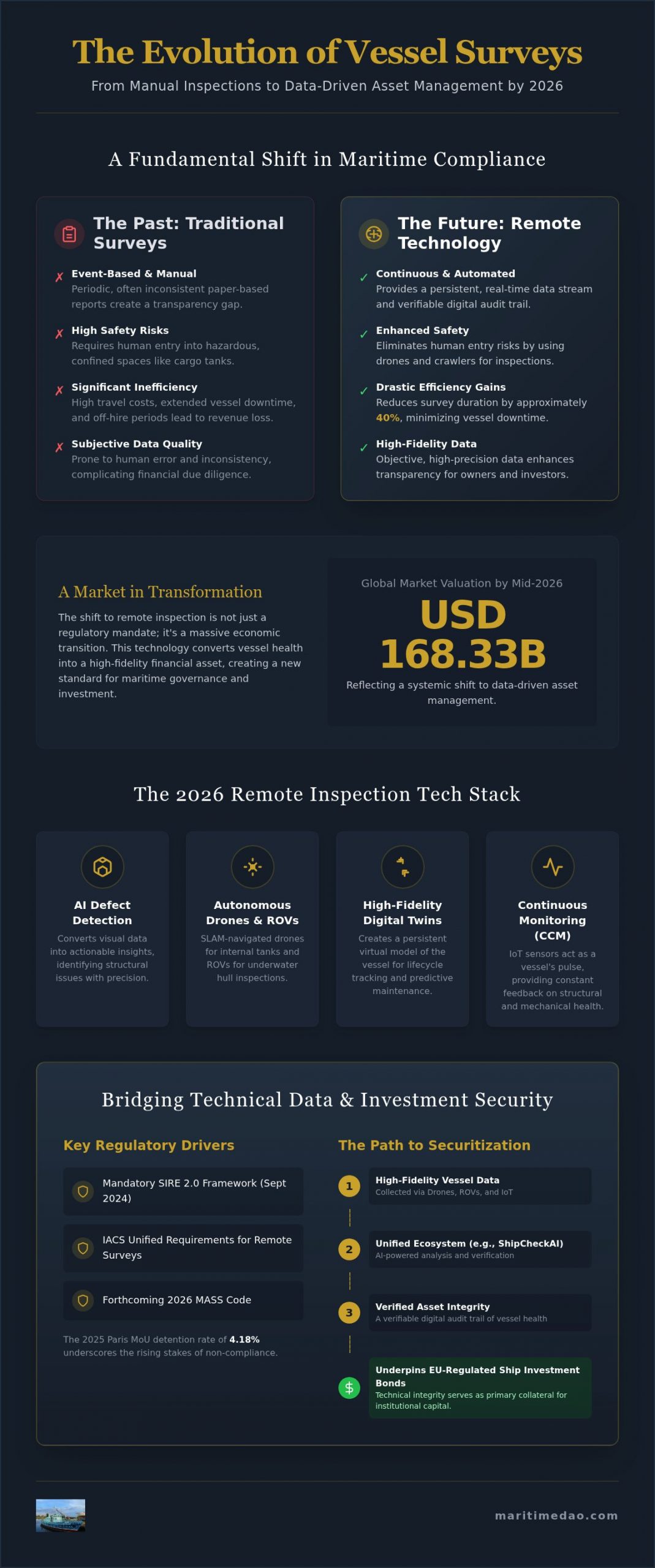
The era of event-based maritime compliance has officially ended, replaced by a mandate for continuous operational verification that traditional manual surveys can no longer satisfy. By mid-2026, the global market for remote ship inspection technology has reached a valuation of USD 168.33 billion, reflecting a systemic shift toward data-driven asset management. For shipowners and institutional investors, the friction of physical surveys, ranging from high travel costs to the inherent safety risks of manual tank inspections, is no longer a necessary cost of doing business. You likely recognize that the old model of paper-based reports often yields inconsistent data quality, creating a transparency gap that complicates financial due diligence and regulatory standing.
This strategic guide details how the integration of AI-powered defect detection, drones, and digital twins converts vessel health into a high-fidelity financial asset. We’ll examine how these systems reduce vessel downtime, enhance data accuracy, and ensure full compliance with the latest IACS and IMO remote survey standards. By exploring the unified ecosystem of ShipCheckAI and its role in governing EU-regulated ship investment bonds, you’ll discover a methodical framework for securing structural integrity, optimizing capital allocation, and navigating the 2026 MASS Code. We provide the technical roadmap required to bridge the gap between heavy industry and high finance.
Key Takeaways
- Identify how autonomous drones and underwater ROVs modernize hull and tank assessments by replacing high-risk manual inspections with high-precision digital data.
- Navigate the evolving regulatory landscape of 2026, including the mandatory SIRE 2.0 framework and the latest IACS Unified Requirements for remote surveys.
- Implement a scalable roadmap for remote ship inspection technology that leverages Starlink connectivity and unified platforms to minimize vessel downtime.
- Understand the direct correlation between technical health and financial security through the use of ShipCheckAI to underpin EU-regulated ship investment bonds.
- Transition from traditional, inconsistent paper reports to a data-driven ecosystem that enhances transparency for owners and institutional investors alike.
The Evolution of Vessel Surveys: Why Remote Inspection Technology is Essential in 2026
Vessel surveys are no longer isolated events in a ship’s lifecycle. Remote ship inspection technology has transitioned from a niche alternative into a unified ecosystem of sensors, AI, and robotics that defines modern maritime governance. This shift is fueled by a convergence of economic pressures and heightened ESG accountability. With the mandatory implementation of SIRE 2.0 on September 2, 2024, the industry saw findings per vessel increase significantly, requiring a more granular approach to data acquisition. By utilizing Remote Visual Inspection (RVI), operators can now replace subjective reports with a verifiable digital audit trail. This transparency is essential for the next generation of maritime finance, where technical integrity serves as the primary collateral for institutional capital.
The Cost of Inefficiency: Beyond Travel Expenses
The hidden costs of traditional manual inspections extend far beyond travel logistics. Vessel downtime and off-hire periods represent significant revenue leakage that fleet managers can’t ignore. There’s also a critical safety imperative. Manual inspections often require human entry into hazardous confined spaces, presenting avoidable risks to life and limb. By deploying remote ship inspection technology, companies eliminate these dangers while simultaneously improving data accuracy. Research indicates that utilizing drones and crawlers can reduce survey duration by approximately 40%. This efficiency ensures that maintenance capital is deployed precisely, protecting the ship’s long-term hull integrity and the owner’s bottom line.
Continuous Condition Monitoring (CCM) as the New Standard
We’re witnessing a fundamental change in how seaworthiness is proven. Continuous Condition Monitoring (CCM) shifts the evidentiary burden from a periodic surveyor visit to a persistent, real-time data stream. IoT sensors acting as a vessel’s pulse provide constant feedback on structural stresses and mechanical performance. This environment enables true predictive maintenance, allowing operators to address minor issues before they escalate into catastrophic failures. The 2025 Paris MoU detention rate of 4.18% underscores the rising stakes of non-compliance. This level of technical oversight is a prerequisite for sophisticated financial instruments, such as EU regulated ship investment bonds, where the relationship between physical assets and digital governance is deeply linked.
The 2026 Remote Inspection Tech Stack: AI, Drones, and Digital Twins
The modern remote ship inspection technology stack is a sophisticated triad of hardware, intelligence, and virtual modeling. It replaces the fragmented data collection of the past with a unified stream of actionable insights. Central to this ecosystem are autonomous drones, underwater Remotely Operated Vehicles (ROVs), and AI-driven digital twins. Together, they form a robust framework that governs asset health and informs institutional investment decisions. Underwater ROVs complement this by conducting comprehensive hull and propeller inspections without the need for divers or expensive dry-docking. These units provide a continuous view of the vessel’s submerged surfaces, ensuring that biofouling and plate deformation are monitored with surgical precision.
SLAM Drones and Autonomous Navigation
Simultaneous Localization and Mapping, or SLAM, allows drones to function as visionary architects in GPS-denied environments. Unlike consumer units that rely on satellite signals, SLAM-navigated drones use onboard sensors to build a real-time map of their surroundings while simultaneously tracking their own position within it. This capability is vital for surveying complex cargo tanks and internal structures where metal bulkheads block external signals. By 2026, these units carry high-resolution thermal and ultrasonic sensors capable of detecting sub-millimeter structural thinning. This level of detail aligns with ABS Remote Inspection Techniques, providing a degree of accuracy that manual visual checks simply cannot replicate.
AI and Computer Vision in Condition Assessment
Artificial intelligence serves as the analytical engine of this tech stack, processing vast quantities of visual data to identify corrosion, cracks, and coating breakdown. These algorithms are trained on millions of maritime-specific images, allowing them to distinguish between superficial surface rust and structural degradation. To ensure reliability, the industry has adopted a “human-in-the-loop” model. In this framework, AI acts as a high-speed filter, flagging anomalies for a qualified surveyor’s final validation. This synergy ensures that the data meets the rigorous standards required for AI in maritime due diligence. It’s a methodical approach that prioritizes precision over speculative automation.
To bridge the gap between technical raw data and financial security, these various inputs are often unified into a single digital twin. This virtual replica allows for sophisticated scenario testing and trend analysis, projecting the future condition of the hull based on current wear patterns. For those looking to integrate these capabilities into a regulated framework, utilizing a platform like ShipCheckAI ensures that every data point is governed, transparent, and ready for audit. This structured approach to asset assessment turns a physical vessel into a predictable financial instrument.
Navigating the Regulatory Framework: IACS, Flag States, and Remote Survey Acceptance
The transition from physical to digital oversight is governed by a complex hierarchy of international standards and regional mandates. Central to this transition is the International Association of Classification Societies (IACS), which provides the Unified Requirements that define how remote ship inspection technology is integrated into class surveys. While the International Maritime Organization (IMO) works toward global harmonization, the practical application of these tools still requires a nuanced understanding of current legal distinctions. It’s critical to differentiate between “Remote Inspection,” which refers to the act of data collection via sensors or robotics, and “Remote Survey,” which is the formal certification process executed by a classification society. This distinction ensures that while the method of data acquisition changes, the accountability for seaworthiness remains with accredited professionals.
IACS Unified Requirements and the Surveyor’s Role
Class societies utilize rigorous criteria to approve RIT service suppliers, ensuring that the data captured is of sufficient quality to replace physical attendance. Even with advanced robotics, a remote survey isn’t an automated event; it still requires the final sign-off of a qualified surveyor who reviews the data stream in real-time or asynchronously. To prove “equivalence” to a traditional survey, operators must provide exhaustive documentation, including connectivity logs, equipment calibration certificates, and detailed risk assessments. The ABS Guidance on Remote Inspection Technologies serves as a primary reference for establishing these protocols, bridging the gap between raw technical output and regulatory acceptance. This structured approach maintains the high-stakes reliability required for institutional asset management.
Flag State Acceptance and Global Trade Compliance
Acceptance isn’t uniform across the globe. Leading jurisdictions like Singapore and the Marshall Islands have pioneered the adoption of remote survey protocols, recognizing their efficiency in maintaining fleet readiness. However, other Flag States remain cautious, creating a fragmented landscape that fleet managers must navigate with precision. This variability directly impacts maritime investment compliance, as a vessel’s marketability is increasingly tied to its ability to clear inspections in diverse ports. Utilizing non-approved RIT vendors carries significant risk. If a Port State Control (PSC) inspection finds that a remote survey was conducted without proper authorization, the vessel faces potential detention. With the Paris MoU detention rate reaching 4.18% in 2025, the margin for error in regulatory documentation has never been thinner. Choosing an ecosystem that aligns with these global standards isn’t just an operational choice; it’s a financial necessity.
Implementing Remote Inspections: A Strategic Roadmap for Fleet Managers
Transitioning to remote ship inspection technology requires a methodical shift from legacy workflows to a digitally integrated ecosystem. It isn’t merely a hardware upgrade; it’s a five-stage evolution that begins with the physical environment and culminates in the seamless integration of technical data into financial decision-making. This roadmap ensures that every data point captured by sensors or robotics contributes to a verifiable record of seaworthiness and asset value.
- Step 1: Infrastructure Audit. Assess current VSAT or Starlink capabilities to ensure the high-bandwidth, low-latency connectivity required for real-time surveyor interaction.
- Step 2: Platform Selection. Adopt a unified tool like ShipCheckAI to centralize data from drones, ROVs, and IoT sensors into a single, auditable dashboard.
- Step 3: Personnel Training. Standardize protocols across crew and shore-based analysts to maintain data hygiene and ensure RIT equipment is deployed correctly.
- Step 4: Governance Framework. Define clear ownership, access, and privacy parameters for all captured inspection assets to protect proprietary operational data.
- Step 5: PMS Integration. Link inspection outputs directly to the vessel’s Planned Maintenance System (PMS) to automate repair scheduling and spare parts procurement.
Infrastructure Readiness and Connectivity
High-bandwidth, low-latency satellite internet serves as the essential backbone of remote ship inspection technology. Without reliable connectivity, real-time surveyor interaction and high-definition video streaming become impossible. Fleet managers must also invest in “Edge Computing” hardware. These onboard systems process large visual files locally before transmitting optimized data packets to the cloud, reducing bandwidth costs. Cybersecurity remains a non-negotiable pillar. All remote data transmission must be encrypted to protect the vessel’s operational integrity and comply with IACS Unified Requirements E26 and E27.
Data Governance and Ownership
As maritime data becomes a primary asset, the question of ownership is paramount. Whether the data belongs to the owner, the class society, or the software provider determines how it can be used for future transactions. Implementing a blockchain-based governance framework ensures that inspection records are immutable and transparent, preventing any retrospective tampering. This level of integrity is a core component in understanding how to invest in maritime assets, where institutional confidence relies on verifiable technical health. Transparency isn’t just about compliance; it’s about building a risk profile that attracts significant capital. To begin your transition into this data-driven era, explore the capabilities of ShipCheckAI for fleet-wide assessment.
Maritime DAO and ShipCheckAI: Bridging the Gap Between Technical Data and Investment Security
Technical health is the primary currency of modern maritime finance. In an era where institutional capital demands absolute transparency, viewing vessel surveys as a mere operational cost is a strategic oversight. By integrating remote ship inspection technology directly into the capital allocation process, the Maritime DAO transforms raw technical data into a robust financial asset. This integration ensures that every vessel within the ecosystem is not only seaworthy but also financially optimized for the global market. The relationship between physical structural integrity and digital governance is now inseparable, providing a foundation of trust that traditional maritime finance has historically lacked.
ShipCheckAI: More Than Just Software
ShipCheckAI serves as the analytical engine of this ecosystem, delivering a tripartite value proposition of efficiency, accuracy, and compliance. It’s a comprehensive AI ship inspection tool designed to support the entire lifecycle of a vessel, from high-stakes pre-purchase assessments to mandatory annual surveys. By centralizing multi-dimensional data, the tool creates a high-fidelity risk profile that directly informs the issuance of EU regulated ship investment bonds. This ensures that bondholders aren’t relying on speculative reports, but on a verifiable “trust layer” of data that has been scrubbed, analyzed, and governed by automated intelligence. It’s a methodical approach to due diligence that replaces human error with algorithmic precision.
The Future of Regulated Maritime Innovation
The convergence of tokenized governance and AI-driven inspections marks the beginning of a unified maritime ecosystem. This model democratizes access to significant capital investments while maintaining the sober reliability required by institutional finance. The role of remote ship inspection technology in this framework is to act as a permanent gatekeeper, ensuring that only vessels meeting the highest technical and regulatory standards are eligible for funding. Transparency isn’t just a feature of the Maritime DAO; it’s the core governing principle that protects the interests of all stakeholders, from the shipowner to the retail investor.
We invite forward-thinking stakeholders to explore the maritime DAO investment model as the new gold standard for ship finance. By bridging the gap between heavy industry and decentralized technology, we’re building a more inclusive and secure future for global trade. Join the evolution of maritime finance and technology at Maritime DAO, where structural integrity meets institutional security.
Securing the Future of Maritime Asset Governance
The 2026 maritime landscape demands a transition from legacy survey methods to a governed, digital-first approach. Adopting remote ship inspection technology isn’t just an operational choice; it’s a strategic necessity for those seeking to secure institutional-grade investment. We’ve explored how a unified tech stack of AI, drones, and digital twins provides the technical health data required for modern financial due diligence. By aligning these innovations with IACS and IMO standards, fleet managers can effectively reduce vessel downtime while enhancing the marketability of their assets.
This structural integrity is the core of our ecosystem. ShipCheckAI offers a robust multi-inspection capability that feeds directly into an EU-regulated financial framework, providing AI-driven transparency for bondholders. This synergy between heavy industry and high finance ensures that every structural detail is accounted for and every investment is protected by verifiable data. It’s time to move beyond the limitations of manual surveys and embrace a more resilient, transparent future. Explore ShipCheckAI and our EU-regulated investment ecosystem to start your journey toward regulated maritime innovation. We look forward to building this new frontier with you.
Frequently Asked Questions
What is the difference between a remote inspection and a remote survey?
Remote inspection is the technical process of data acquisition using tools like drones or sensors, whereas a remote survey’s the formal certification act performed by a classification society. While the inspection provides the raw evidence, the survey represents the legal validation of that evidence. This distinction ensures that the responsibility for seaworthiness remains governed by accredited professionals within a transparent, regulated maritime ecosystem that values structural integrity and institutional accountability.
Are remote ship inspections accepted by all classification societies in 2026?
Major IACS members, such as ABS and DNV, fully accept remote methods when conducted by approved service suppliers under specific Unified Requirements. While acceptance is widespread in 2026, individual societies maintain distinct protocols for establishing equivalence to physical attendance. It’s essential to verify that your chosen technology provider holds the necessary class approvals to ensure that the inspection results are valid for statutory and class certification purposes across all major global jurisdictions.
How much can a fleet owner save by implementing remote inspection technology?
Fleet owners typically see a 40% reduction in survey duration by implementing remote ship inspection technology, which eliminates surveyor travel and vessel off-hire periods. For underwater hull assessments, ROV-based methods can reduce inspection time by up to 60% compared to traditional diver-led operations. These efficiencies maximize vessel uptime and reduce the administrative overhead associated with coordinating physical attendances across global ports, directly enhancing the vessel’s overall financial performance.
What are the primary hardware requirements for conducting a remote vessel survey?
The hardware ecosystem includes high-resolution autonomous drones for internal tanks, survey-grade ROVs for hull inspections, and reliable high-bandwidth connectivity like Starlink or VSAT. It’s necessary to have onboard Edge Computing units to process and optimize large visual data files before transmission. These tools must be calibrated and maintained to meet the rigorous standards defined by classification societies, ensuring that the captured data’s institutional-grade quality and suitable for technical audits.
How does AI improve the accuracy of ship hull inspections compared to human divers?
AI improves accuracy by providing objective, repeatable analysis of structural surfaces, identifying sub-millimeter defects that human eyes might overlook in low-visibility environments. Divers face limitations from physical fatigue and environmental hazards, but AI algorithms process thousands of high-definition images to detect corrosion and coating breakdown with consistent precision. This data-driven approach creates a more reliable trust layer for owners and investors who require a precise, verifiable audit trail of the vessel’s hull.
Is the data from remote inspections secure enough for financial due diligence?
Data from remote ship inspection technology is highly secure when managed within a blockchain-governed ecosystem that ensures immutability and transparency. This level of security’s a prerequisite for institutional capital allocation, as it prevents retrospective tampering with vessel health records. By providing a transparent and auditable digital trail, this data becomes a high-fidelity asset that underpins complex financial instruments like EU-regulated ship investment bonds and other forms of regulated maritime debt.
Can remote inspection technology be used for pre-purchase vessel assessments?
This technology’s increasingly the preferred method for pre-purchase assessments because it provides a comprehensive, objective view of a vessel’s condition without the logistical delays of physical travel. Prospective buyers can review high-definition video and AI-flagged anomalies from anywhere in the world, facilitating faster decision-making. These tools allow for a deeper level of technical due diligence, ensuring that the investment risk profile’s accurately understood before any significant capital is committed.
How does ShipCheckAI integrate with existing maritime regulatory frameworks?
ShipCheckAI’s integration with regulatory frameworks occurs by standardizing multi-source inspection data to meet IACS Unified Requirements and IMO standards. The platform serves as a unified gateway that aligns technical outputs with the compliance needs of flag states and classification societies. By automating the documentation process and ensuring data hygiene, it’s a bridge between physical asset health and the rigorous legal requirements of the 2026 maritime industry, ensuring full financial and operational compliance.