
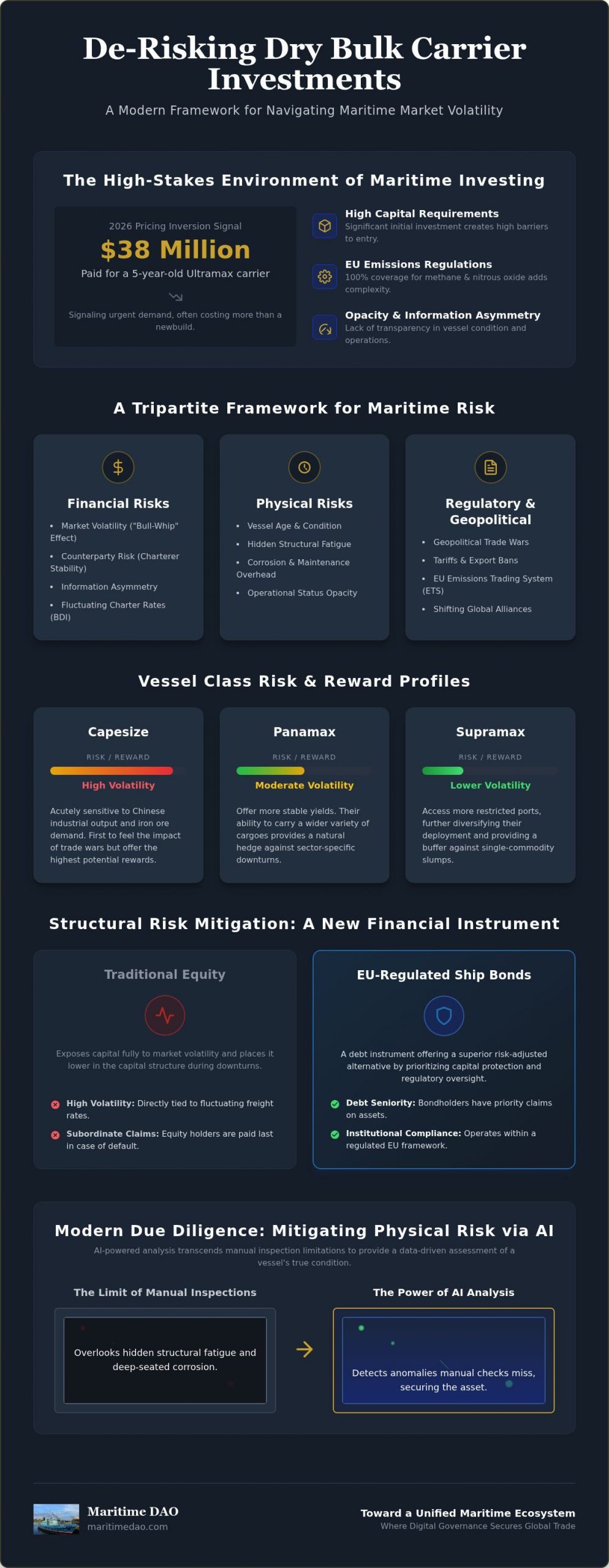
Why would an institutional investor pay $38 million for a five-year-old Ultramax bulk carrier when a newbuild often costs less? This 2026 pricing inversion signals a market defined by urgent demand, yet the underlying risks of investing in bulk carriers remain as volatile as the trade routes they traverse. You’ve likely felt the pressure of high capital requirements and the opacity of vessel condition reporting, especially as the expanded EU Emissions Trading System now mandates 100% coverage of methane and nitrous oxide emissions between EU ports. It’s a high-stakes environment where geopolitical trade wars can stall even the most robust portfolios.
We’ll show you how to transform these systemic uncertainties into manageable variables. You’ll learn to master the complexities of dry bulk investment risks while leveraging regulated financial instruments and AI due diligence to protect your capital. This guide provides a clear framework for categorizing maritime risks, contrasts the security of regulated bonds against traditional equity, and offers a roadmap for using AI to de-risk your entry into global trade. By integrating institutional-grade compliance with automated intelligence, we can finally bridge the gap between physical asset volatility and financial security.
Key Takeaways
- Identify and categorize maritime volatility through a tripartite framework of financial, physical, and regulatory pillars to create a structured defense against sudden market shifts.
- Learn why EU-regulated ship investment bonds offer a superior risk-adjusted alternative to traditional equity by providing debt seniority and institutional-grade compliance.
- Discover how to mitigate the risks of investing in bulk carriers by utilizing ShipCheckAI to detect hidden structural fatigue and corrosion that manual inspections often overlook.
- Explore the transition toward a unified maritime ecosystem where digital governance and transparent legal frameworks secure physical global trade assets for a new class of investors.
Market Dynamics and the Volatility of Dry Bulk Shipping
The dry bulk market serves as the fundamental architecture of global raw material trade. It facilitates the movement of iron ore, coal, and grain across every major ocean. At its core, a bulk carrier is a specialized vessel designed to transport unpackaged cargo in large volumes. However, for the modern investor, this sector is defined by its extreme volatility. Small fluctuations in industrial demand often trigger a “Bull-Whip” effect, where minor changes in consumer needs lead to disproportionate swings in charter rates. This inherent sensitivity makes understanding the risks of investing in bulk carriers a central requirement for any disciplined portfolio.
Historical data reveals the cyclical nature of this industry. The 2008 financial crisis saw rates collapse from historic highs, while the supply chain shifts of 2024 and 2025 highlighted how geopolitical bottlenecks in the Red Sea can artificially inflate costs. Investors utilize the Baltic Dry Index (BDI) as a primary risk indicator. The BDI tracks the price of moving raw materials by sea, providing a transparent, real-time snapshot of global economic health and shipping demand. It’s the pulse of the industry, signaling when capacity is tight or when a market correction is imminent.
Understanding Vessel Classes: Capesize vs. Panamax vs. Supramax
Vessel selection determines the risk-return profile of a maritime investment. The market is typically categorized by three distinct classes: Capesize, Panamax, and Supramax. Each class responds differently to global economic shifts:
- Capesize: These vessels offer high rewards but remain acutely sensitive to Chinese industrial output and iron ore demand. They’re the first to feel the impact of trade wars.
- Panamax and Supramax: These ships provide lower, more stable yields. Their ability to carry a wider variety of cargoes and access more restricted ports offers a natural hedge against sector-specific downturns.
- Maintenance and Age: A vessel’s age correlates directly with market risk. Older ships face higher maintenance overheads and increased regulatory scrutiny, especially as environmental standards tighten in 2026.
Supply and Demand Imbalances in 2026
The 2026 market is shaped by a complex supply-demand imbalance. The current order book for Ultramax vessels has reached 25% of the existing fleet, with deliveries expected to hit an 11-year peak this year. This influx of new capacity could pressure freight rates if demand doesn’t keep pace. Simultaneously, “slow steaming” practices effectively reduce the global supply of available tonnage. These factors, combined with the expansion of the EU Emissions Trading System to include methane and nitrous oxide, suggest a volatile 2026-2028 window. Investors must look for indicators of the next cyclical trough to time their entry effectively within this shifting ecosystem.
Categorizing Core Risks: Economic, Geopolitical, and Environmental
Effective risk management in maritime finance requires a tripartite framework that segments exposure into financial, physical, and regulatory pillars. This structured approach allows investors to isolate specific variables rather than viewing market volatility as an undifferentiated mass. The risks of investing in bulk carriers are unique compared to other maritime sectors; these vessels are the primary instruments of industrial competition. While container shipping facilitates consumer trade and tankers secure energy supplies, bulk carriers transport the raw materials that fuel national economies. This makes them exceptionally vulnerable to geopolitical trade wars, where commodities like iron ore and grain become the first targets for tariffs or export bans.
Information asymmetry remains a persistent challenge for the uninitiated investor. The “not knowing” risk, which involves a lack of transparency regarding a vessel’s real-time operational status, can lead to significant capital erosion. This is compounded by counterparty risk within a fragmented market. Evaluating the stability of charterers is essential, as the failure of a single industrial partner during a market downturn can leave an asset stranded without cash flow. Investors seeking to manage these multi-layered exposures often look toward regulated investment frameworks that prioritize transparency over traditional opacity.
Geopolitical and Macroeconomic Exposure
Trade route disruptions serve as immediate catalysts for volatility. Bottlenecks at the Suez and Panama Canals, whether caused by geopolitical friction or climate-induced water level shifts, force vessels into longer voyages. While this may temporarily tighten supply and lift freight rates, it simultaneously increases fuel consumption and operational complexity. Macroeconomic shifts, particularly interest rate fluctuations in major industrial nations, also impact leveraged maritime assets. Furthermore, the expansion of regional carbon taxes, such as the EU Emissions Trading System (ETS), adds a direct cost layer to voyages involving European ports, requiring precise fiscal planning to maintain profitability.
Environmental and Regulatory Compliance (IMO 2030/2050)
The industry is currently navigating a period of “Green Risk,” where non-compliant vessels face the danger of becoming stranded assets. Investing in high-emission tonnage without a clear retrofitting strategy is a high-stakes gamble. The cost of installing scrubbers or transitioning to LNG-dual fuel and ammonia-ready designs is substantial, yet necessary for long-term value preservation. The Carbon Intensity Indicator (CII) is an operational measure that rates a vessel’s efficiency based on the grams of CO2 emitted per unit of cargo capacity and distance traveled. Failing to meet these evolving standards reduces an asset’s marketability and its ability to secure premium charters in a decarbonizing global economy.
Structural Risk Mitigation: Regulated Bonds vs. Direct Equity
Traditional shipping finance has long been characterized by a sharp divide between the high-risk appetite of equity owners and the conservative requirements of institutional lenders. When evaluating the risks of investing in bulk carriers, it’s essential to understand where your capital sits within the capital stack. Shipping equity is inherently speculative; it captures the full upside of surging charter rates but remains the first layer of capital to be wiped out during a market correction. In contrast, maritime bonds introduce a layer of structural protection that prioritizes capital preservation through debt seniority. By positioning yourself as a lender rather than an owner, you gain a protected claim on cash flows that remains senior to any equity distributions.
The transparency gap in traditional private equity shipping often leaves investors in the dark regarding operational expenditures and vessel health. This lack of public oversight is a systemic risk that many have simply accepted as part of the industry’s culture. However, EU regulated ship investment bonds have emerged as a primary solution to this opacity. These instruments provide a compliant framework that subjects maritime assets to the same rigorous reporting standards found in traditional financial markets. This shift toward regulated innovation ensures that the relationship between physical assets and financial governance is transparent, methodical, and legally sound.
The Security of Asset-Backed Securities (ABS)
Asset-backed structures transform the physical vessel from a liability-prone machine into a robust piece of collateral. For the bondholder, the ship acts as a tangible security that underpins the investment’s value. The most critical component of this arrangement is the “First Priority Mortgage.” This legal instrument ensures that bondholders have the primary claim on the asset’s value in the event of a default. Compared to traditional corporate debt, which may rely on vague cash flow projections, maritime ABS is anchored by a high-value physical asset that can be liquidated or re-chartered. This structural integrity allows for predictable yields even when the broader dry bulk market experiences short-term turbulence.
Regulatory Oversight and Investor Protection
In 2026, the distinction between offshore structures and EU-regulated instruments has never been more significant. EU-regulated frameworks offer superior legal recourse and ensure that every transaction is governed by established financial laws. Central to this protection is the evolution of “Know Your Vessel” (KYV) protocols alongside traditional “Know Your Customer” (KYC) standards. These dual layers of verification ensure that the asset being financed is environmentally compliant and operationally sound. Adhering to maritime investment compliance standards isn’t just a regulatory hurdle; it’s a strategic defense mechanism that protects both retail and institutional capital from the systemic inefficiencies of the legacy shipping world.
Modern Due Diligence: Mitigating Physical Risk via AI
Manual oversight has historically been the primary source of error in maritime asset assessment. In 2026, the human element is increasingly viewed as a liability in high-stakes due diligence. The physical risks of investing in bulk carriers are often obscured by the vessel’s complex internal architecture. Issues such as deep-seated corrosion, engine fatigue, and cargo gear wear can evade standard manual inspections. By leveraging automated intelligence, investors can now transform static condition reports into dynamic risk scores that provide a real-time reflection of asset health. Implementing AI in maritime due diligence establishes a verifiable data layer that significantly lowers insurance premiums and enhances investor confidence.
The ShipCheckAI Framework
Standardizing vessel assessments is essential for institutional-grade transparency. The ShipCheckAI framework automates the inspection process to eliminate the inconsistencies and subjective biases inherent in manual reporting. It utilizes a tripartite approach that combines visual data, acoustic sensors, and historical performance metrics to build a comprehensive 360-degree asset profile. This AI ship inspection tool provides the empirical evidence needed to reduce pre-purchase uncertainty and validate the integrity of the underlying collateral. By removing the guesswork from physical inspections, the system ensures that every governed asset meets strict operational standards before capital is committed.
Predictive Maintenance as a Financial Safeguard
Mechanical failure represents a primary threat to consistent yield in the dry bulk sector. When a carrier goes “off-hire” due to an unplanned breakdown, the resulting loss of revenue can jeopardize the performance of the entire investment structure. AI provides a defensive barrier by identifying potential failures before they manifest as physical disruptions. This predictive capability integrates real-time inspection data with bond performance metrics, creating a unified ecosystem of operational and financial governance. As drone technology and remote sensors become standard, this ecosystem will offer even greater granularity in asset monitoring. You can access our AI-driven risk management platform to ensure your maritime investments are protected by the latest in automated due diligence.
Navigating the Future: Regulated Innovation with Maritime DAO
The convergence of physical global trade and digital financial governance represents a paradigm shift in how capital interacts with heavy industry. For decades, the risks of investing in bulk carriers were exacerbated by fragmented communication and manual administrative processes. Today, a unified ecosystem allows for seamless capital deployment and real-time asset assessment. By integrating blockchain-based governance with institutional reliability, we can eliminate the structural inefficiencies that once made maritime finance the exclusive domain of a few private firms. This evolution transforms the ship from a distant, opaque asset into a transparent, governed financial instrument.
Transitioning to a maritime DAO investment structure is the logical conclusion of the “Regulated Innovation” trend. This model democratizes access while simultaneously reducing individual exposure to single-vessel risk through fractionalization. Instead of concentrating capital in one carrier, investors can participate in a diversified pool of regulated bonds. This ensures that a single operational failure doesn’t compromise their entire portfolio. It’s a methodical approach to scaling maritime exposure without the historical baggage of direct equity ownership, providing a bridge between the physical world of global trade and the digital world of secure finance.
Governance and Transparency
Smart contracts are the backbone of this new transparency. They automate bond coupon payments, which reduces administrative risk and ensures timely distributions to all bondholders. The DAO serves as a collective gatekeeper, vetting new vessel acquisitions for the bond pool using the multi-layered AI assessments previously mentioned. This on-chain reporting provides an immutable audit trail, ensuring that long-term value is governed by data rather than opaque management decisions. It’s a system where structural integrity is built into the code, providing a level of security that legacy shipping finance simply can’t match.
Getting Started: A 2026 Strategy for Bulk Carrier Investment
Evaluating a maritime bond offering requires a disciplined focus on three variables: yield, term, and asset quality. Investors should consult the 2026 investor guide to maritime assets to understand how to allocate capital within this evolving sector. A final de-risking checklist should include:
- Regulatory Alignment: Verification of EU Taxonomy and ETS compliance for the underlying fleet.
- Physical Validation: Review of the AI-generated physical health scores for all collateral vessels.
- Capital Priority: Assessment of the bond’s seniority within the maritime capital stack.
- Legal Clarity: Confirmation of the DAO’s legal standing and regulatory jurisdiction.
Securing Your Position in the 2026 Maritime Economy
The landscape of global trade is undergoing a structural transformation. While the risks of investing in bulk carriers have historically centered on market opacity and physical asset degradation, the tools available to modern investors have evolved. We’ve explored how debt seniority through regulated bonds provides a safety net that equity simply can’t match. We’ve also examined the role of automated intelligence in replacing subjective manual inspections with empirical data. By shifting from speculative ownership to governed debt, you align your capital with the transparency of institutional finance.
It’s time to bridge the gap between physical global trade and digital financial governance. Explore EU-Regulated Ship Investment Bonds on Maritime DAO to access institutional-grade maritime debt instruments. Our ecosystem is regulated by European financial authorities and powered by ShipCheckAI vessel assessments to ensure structural integrity and transparency. Secure your future in maritime finance with a partner dedicated to methodical, high-stakes innovation.
Frequently Asked Questions
What are the main risks of investing in bulk carriers?
The primary risks involve market volatility driven by the “Bull-Whip” effect, physical degradation of the vessel, and shifting regulatory mandates. Market dynamics are highly sensitive to industrial demand for commodities like iron ore and grain. Physical risks often stem from hidden structural fatigue or corrosion that manual checks miss. Additionally, investors face regulatory exposure as the industry transitions toward decarbonization, requiring assets to meet strict environmental standards to remain operationally viable.
How does a maritime bond differ from shipping equity in terms of risk?
Maritime bonds offer debt seniority and are secured by the physical vessel as collateral, whereas shipping equity sits at the bottom of the capital stack. In a market downturn, equity holders are the first to experience capital loss. Bondholders, however, maintain a prioritized claim on cash flows and asset value through a First Priority Mortgage. This structural protection makes bonds a more conservative instrument for capital preservation compared to the speculative nature of direct ship ownership.
Can AI really reduce the risk of ship investments?
AI significantly reduces information asymmetry by providing dynamic, data-driven assessments of a vessel’s health. Tools like ShipCheckAI eliminate the subjective bias of manual inspections by analyzing multi-layered data points, including acoustic sensors and historical performance. This technology identifies latent structural defects before they manifest as costly mechanical failures. By transforming static reports into predictive risk scores, AI empowers investors to make decisions based on empirical evidence rather than opaque surveyor summaries.
Is the dry bulk market too risky for retail investors in 2026?
The dry bulk market is no longer unmanageably volatile for retail participants due to the emergence of regulated, fractionalized instruments. While the risks of investing in bulk carriers remain, EU-regulated ship investment bonds allow individuals to participate without the high capital requirements of traditional ship brokerage. Fractionalization spreads exposure across a governed ecosystem, enabling investors to diversify their portfolios while benefiting from institutional-grade oversight and transparent legal frameworks.
What happens to my investment if a bulk carrier is involved in an accident?
Investments are protected through a combination of comprehensive maritime insurance and the inherent value of the asset-backed structure. Most bond offerings require the vessel to maintain Hull and Machinery (H&M) as well as Protection and Indemnity (P&I) insurance. If an accident occurs, insurance proceeds typically serve to repair the asset or compensate the bondholders. Because the bond is secured by a First Priority Mortgage, investors have a senior claim on these recoveries and the underlying scrap or resale value.
How do environmental regulations like the EU Taxonomy affect investment risk?
Environmental regulations create “stranded asset” risk for vessels that fail to meet evolving carbon intensity standards. The EU Taxonomy and the Carbon Intensity Indicator (CII) mandate specific efficiency thresholds that influence a vessel’s marketability and charter rates. Ships that don’t comply face restricted access to European ports and lower asset valuations. Investors must prioritize vessels with clear retrofitting strategies or those that already utilize eco-friendly designs to ensure long-term viability in a decarbonizing global economy.