
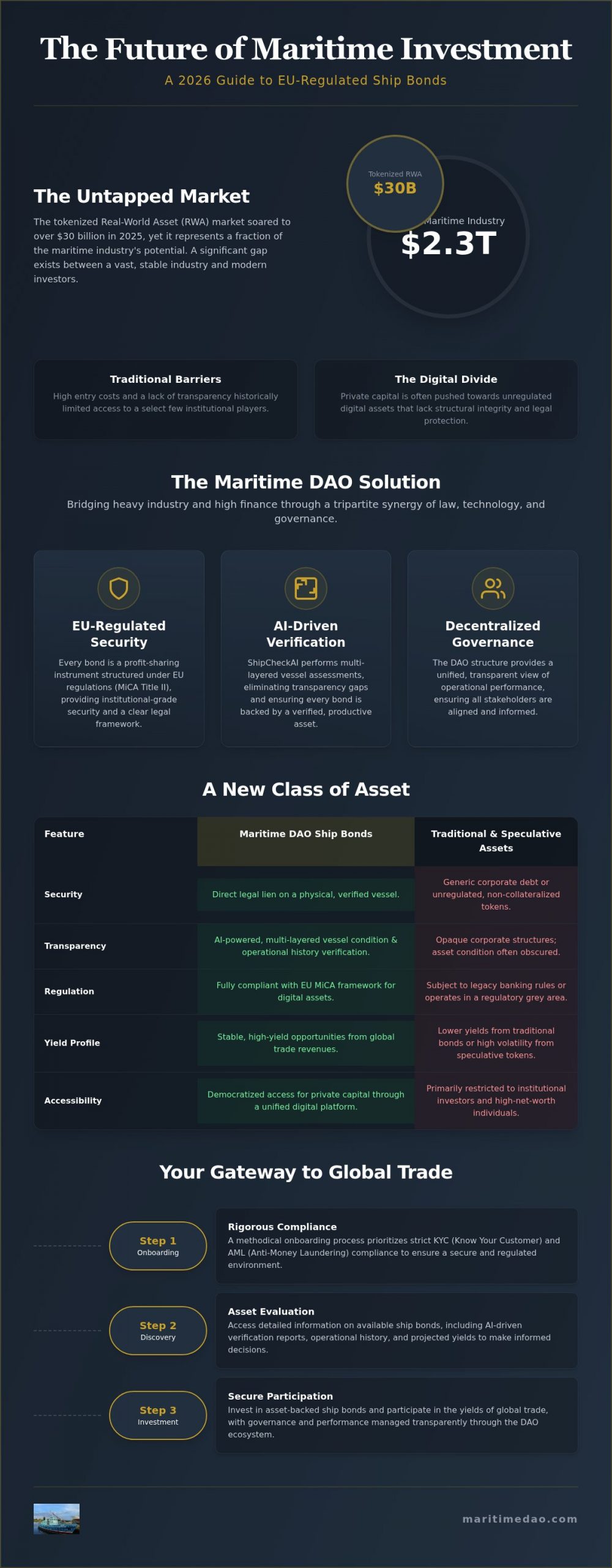
The tokenized Real-World Asset market expanded by 260% in 2025, reaching a valuation over $30 billion, yet the $2.3 trillion maritime industry remains largely inaccessible to the modern investor. You’re likely aware that high entry barriers and a chronic lack of transparency regarding vessel conditions have historically restricted maritime debt to a small circle of institutional players. This exclusion often forces private capital into unregulated digital assets that lack structural integrity. Our 2026 guide introduces a sophisticated ship bond investment platform designed to dismantle these barriers through a tripartite synergy of EU regulation, AI-driven asset verification, and decentralized governance. We bridge the gap between heavy industry and high finance.
You’ll discover how to access stable, high-yield opportunities from global trade without the legal uncertainty of speculative ship tokens. We’ll detail how the Maritime DAO ecosystem utilizes ShipCheckAI to perform multi-layered inspections, ensuring every bond is backed by a verified, productive asset. By grounding digital innovation in the sober reliability of the EU’s MiCA and Marine Equipment Directive frameworks, we provide a clear roadmap for your capital. This article outlines the operational pillars that unite, govern, and open up global shipping opportunities. It’s time to move beyond speculation into a unified, transparent investment framework.
Key Takeaways
- Learn how a modern ship bond investment platform democratizes access to high-yield maritime debt by bridging the gap between institutional finance and private capital.
- Understand the structural integrity of EU-regulated profit-sharing bonds, which provide a secure legal framework for investors seeking exposure to the global shipping fleet.
- Discover how ShipCheckAI utilizes multi-layered vessel assessments to eliminate the transparency gaps that have traditionally plagued maritime asset management.
- Evaluate the stability of global trade yields compared to traditional fixed-income assets, positioning maritime debt as a robust pillar for diversified portfolios.
- Master the transition into the Maritime DAO ecosystem through a methodical onboarding process that prioritizes rigorous KYC and AML compliance.
What is a Ship Bond Investment Platform?
A ship bond investment platform serves as a sophisticated digital gateway, connecting global capital with the capital-intensive world of maritime operations. It transforms the traditional debt instrument into a transparent, accessible vehicle for wealth preservation and growth. Historically, maritime finance was a closed ecosystem, dominated by private equity and legacy banking institutions. Today, the 2026 shipping economy relies on asset-backed securities to fund a global fleet valued at $2.3 trillion. This shift represents a move toward regulated innovation, where technological ambition is grounded in the sober reliability of institutional finance. The platform identifies systemic inefficiencies and builds high-tech solutions to fix them, acting as a reliable gatekeeper for significant capital.
The Evolution of Maritime Financing
The landscape of ship finance has undergone a structural transformation. Traditional bank-led models, once the primary source of capital, have faced increasing regulatory pressure and ESG-driven constraints. This has created a systemic opening for bond-based models that offer more flexible, diversified funding. The democratization of these assets allows global investors to participate in the yields of international trade, a sector previously reserved for high-net-worth individuals. 2026 stands as a pivotal year for EU regulated ship investment bonds because it marks the full implementation of unified digital asset frameworks across the continent. This evolution ensures that maritime debt is no longer an opaque asset class but a transparent component of a modern portfolio.
Core Components of a Specialized Platform
A dedicated ship bond investment platform must offer more than just a trading interface; it must provide a comprehensive ecosystem for risk management and asset governance. The structure is designed to show breadth and connectivity through three primary pillars:
- Asset-Level Transparency: Generic corporate bonds often obscure the underlying risk, whereas ship-backed securities provide direct exposure to physical vessels with verified operational histories.
- Regulatory Compliance: Operating within EU-compliant frameworks is non-negotiable for institutional credibility. This ensures that every digital token is governed by established legal precedents rather than speculative hype.
- Governance: Decentralized Autonomous Organizations (DAOs) offer a unified structure that ensures all stakeholders have a transparent view of operational performance. This bridge between heavy industry and high finance creates a first-of-its-kind environment for secure capital deployment.
This tripartite approach ensures that every investment is governed by code, verified by intelligence, and protected by law. It provides the breadth and connectivity required to manage complex maritime assets in a digital age, ensuring that the relationship between physical assets and digital governance is clearly understood. By moving from the “what” to the “how” with logical precision, these platforms open up opportunities that were once entirely out of reach for the private investor.
The Mechanics of EU-Regulated Maritime Debt Instruments
The ship bond investment platform operates at the precise nexus of maritime law and modern digital finance. Each instrument is structured as a profit-sharing bond under European regulations, specifically aligning with MiCA Title II to provide institutional-grade security for global investors. This architecture represents a first-of-its-kind integration where the physical vessel serves as the foundational collateral for the digital instrument. The Maritime DAO acts as the authoritative gatekeeper, governing the entire lifecycle from issuance to maturity while ensuring strict adherence to EU-compliant frameworks. By uniting physical assets, digital governance, and legal accountability, the platform transforms an opaque industry into a transparent ecosystem for capital growth.
Understanding Asset-Backed Security in Shipping
Asset-backed security in this sector relies on a direct legal lien against a commercial vessel. The ship acts as collateral, providing bondholders with a secured claim that mitigates the risks associated with unsecured debt. Before any bond is issued, ShipCheckAI performs multi-layered vessel inspections to establish a transparent baseline for asset valuation and operational integrity. This rigorous due diligence is essential in 2026, as the EU Emissions Trading System and FuelEU Maritime regulations impose strict financial costs on carbon-intensive assets. Investors are increasingly recognizing the institutional case for maritime bond yields as a hedge against market volatility, specifically when those yields are anchored to the essential flow of global trade. You can explore our regulated offerings to see how these security layers function in real-time.
The Role of Tokenization in Liquidity
Tokenization serves as the technological pillar that enables fractional ownership, significantly increasing market efficiency for maritime debt. By breaking down high-value maritime assets into smaller, accessible units, the platform democratizes an industry that once required millions in entry capital. It’s vital to distinguish these regulated tokenized assets from speculative digital coins; the former are governed by strict financial laws and represent real-world industrial value. Blockchain technology establishes a permanent, immutable ledger of ownership that ensures every bondholder possesses a verifiable claim against the underlying maritime asset. This system creates a unified, transparent, and governed marketplace where liquidity and security coexist. The result is a methodical expansion of the maritime credit market, allowing for the steady, educational progression of capital into the high-stakes world of global shipping.
Comparing Ship Bonds to Traditional Fixed-Income Assets
Evaluating the yield-to-risk ratio of maritime debt requires a departure from standard corporate finance metrics. While corporate debentures often rely on the fluctuating valuations of intangible assets or consumer sentiment, a ship bond investment platform provides access to debt anchored in the physical reality of global trade. Shipping remains the indispensable backbone of the world economy, transporting over 80% of global trade volume. This heavy industry stability offers a unique hedge against equity market volatility, as maritime bonds typically demonstrate a low correlation with broader stock indices. By positioning capital in a sector driven by essential logistics rather than speculative growth, investors achieve a level of structural integrity rarely found in traditional fixed-income markets.
Yield Performance and Market Volatility
Maritime bond yields present a significant premium when compared to standard 10-year government notes, which often struggle to outpace core inflation. Shipping debt remains notably resilient during inflationary cycles because vessel charter rates and asset values frequently adjust upward in tandem with rising global prices. This intrinsic link to the physical world protects purchasing power while delivering consistent distributions. For those seeking to optimize their entry into this sector, understanding how to invest in maritime assets is crucial for navigating the nuances of regulated shipping finance. The platform’s ecosystem ensures that yields aren’t just figures on a screen but are governed by the operational performance of the global fleet.
Risk Mitigation Through Technical Oversight
The primary objection to maritime debt usually centers on industry-specific risks like vessel depreciation or mechanical failure. However, a modern ship bond investment platform eliminates the “blind” nature of traditional corporate debt through continuous technical oversight. We utilize a tripartite security model: automated intelligence, multi-layered inspections, and transparent governance. Unlike traditional shipping syndicates that operate in opaque silos, our DAO-governed framework provides a unified view of asset health through the following pillars:
- ShipCheckAI Integration: Real-time monitoring and multi-layered vessel assessments replace manual, error-prone surveys, ensuring asset integrity is verified rather than assumed.
- Asset-Backed Security: Every bond is tied to a specific, productive vessel; this ensures that collateral isn’t a theoretical concept but a tangible, income-generating asset.
- Governed Transparency: Immutable blockchain records provide bondholders with a clear, audited trail of compliance and asset performance, acting as a reliable gatekeeper for your capital.
This methodical approach to risk transforms maritime debt from a high-stakes gamble into a sophisticated financial instrument. It’s a system designed to bridge the gap between heavy industry and high finance, providing the democratization of complex financial structures without compromising on security or order.
The Importance of AI-Driven Due Diligence in Maritime Finance
Technological ambition meets institutional rigor in our approach to asset verification. ShipCheckAI serves as the fundamental cornerstone of our ship bond investment platform, providing a level of due diligence that was previously impossible in the maritime sector. Historically, vessel inspections were manual, infrequent, and prone to human error, creating a systemic transparency gap between the physical ship and the financial instrument. By replacing these legacy methods with automated intelligence, we ensure that every bond is backed by a verified, productive asset. This transition from subjective surveys to objective, data-driven assessments is what defines the era of regulated innovation in maritime credit. Confidence is earned through data, and our platform acts as the reliable gatekeeper for your capital.
ShipCheckAI: Multi-Layered Vessel Assessment
ShipCheckAI functions through a tripartite inspection protocol that evaluates the core pillars of maritime value. The system performs comprehensive assessments of hull integrity, engine performance, and regulatory compliance, ensuring that every vessel meets the strict standards required for bond issuance. This multi-layered approach utilizes computer vision and sensor data to detect structural fatigue or operational inefficiencies that a human inspector might overlook. By following a rigorous AI in maritime due diligence checklist, the platform ensures that only the highest-quality assets enter the bond market. Efficiency is maximized as these inspections are conducted at a fraction of the time required for traditional surveys. By anchoring financial projections in high-fidelity physical data, automated intelligence ensures that the underlying economic models aren’t corrupted by the “garbage-in, garbage-out” inaccuracies that plague manual reporting.
Continuous Monitoring for Bondholders
The shift from one-time surveys to ongoing vessel health tracking represents a paradigm shift for the ship bond investment platform. Continuous monitoring allows the Maritime DAO to update asset-backed security ratings in real-time, providing bondholders with an unprecedented view of their investment’s performance. When a vessel’s operational data is streamed directly to the blockchain, the relationship between physical assets and digital governance becomes immutable. The integration of AI ship inspection tools is particularly valuable for maintaining secondary market bond prices, as buyers can verify the current condition of the underlying collateral before completing a trade. This unified ecosystem ensures that transparency isn’t a static event but a continuous service. You can access our AI-verified debt instruments to see how this technical oversight protects your yields in a volatile global market.
Investing in Global Trade: Getting Started with Maritime DAO
Maritime DAO functions as the definitive bridge between the heavy industry of global shipping and the precision of modern fintech. Entering this ecosystem requires more than a digital wallet; it demands an alignment with the sober reliability of institutional finance. Our ship bond investment platform simplifies the transition for investors by providing a unified, transparent gateway to asset-backed debt. The onboarding process is methodical and exhaustive, ensuring that every participant meets the rigorous KYC and AML compliance standards mandated by EU-regulated frameworks. This commitment to order and security distinguishes the platform from the speculative circles of digital assets, positioning it as a reliable gatekeeper for significant capital. By grounding digital innovation in legal reality, we provide an environment where high-stakes emotional registers are met with systemic stability.
Navigating the Platform Ecosystem
Once verified, users gain access to a comprehensive marketplace of ship investment bonds. Each listing is accompanied by a detailed ShipCheckAI assessment report, providing a multi-layered view of vessel integrity and operational history. Capital allocation occurs through a streamlined interface where investors can select specific bonds based on their risk appetite and desired yields. This process is governed by the maritime investment compliance standards that define our ecosystem. By integrating physical asset data with digital governance, the platform ensures that the relationship between collateral and capital is always clear. The user experience is designed to lead you through a multi-layered ecosystem without overwhelming you, ensuring that the structural integrity of your investment is understood at every step. You don’t just invest; you participate in a system where technological and operational pillars integrate seamlessly.
The Future of Decentralized Maritime Governance
The long-term vision of Maritime DAO extends beyond simple debt issuance; it aims to build a unified global shipping finance market. Bondholders don’t just hold debt; they participate in the governance of the DAO, influencing operational pillars and future asset selections through transparent voting mechanisms. This decentralized structure ensures that the platform remains accountable to its stakeholders while respecting the legacy systems of maritime trade. We are building a world where the democratization of complex financial structures is the standard, not the exception. The structure is designed to show breadth and connectivity, using active verbs to describe how different systems unite, govern, and open up opportunities. It’s time to join the evolution of maritime finance and secure your position in the future of global trade. The transition from legacy systems to regulated innovation is here, and the gateway is open for your participation.
Navigating the Future of Maritime Finance
The evolution of maritime finance in 2026 demands a departure from opaque legacy systems in favor of a unified, transparent ecosystem. We’ve explored how a dedicated ship bond investment platform integrates AI-driven due diligence with the structural integrity of European financial law. By anchoring digital instruments to physical assets through ShipCheckAI verified vessel reports, the Maritime DAO provides a reliable gatekeeper for institutional and private capital alike. This first-of-its-kind regulated maritime DAO ensures that every bond is compliant with EU financial regulations, offering a level of security previously reserved for the world’s largest banks.
You now possess the roadmap to access high-yield maritime debt within a governed, inclusive framework. The relationship between physical global trade and digital governance is no longer a theoretical ambition; it’s a functional reality. We invite you to Explore EU-Regulated Ship Bonds on Maritime DAO and secure your position at the intersection of heavy industry and high finance. The horizon of maritime investment is clear, and the opportunity to participate in the bedrock of global trade is yours to seize.
Frequently Asked Questions
Is a ship bond investment platform safer than traditional shipping stocks?
Ship bonds offer a superior security profile compared to equity because they represent a senior claim against physical collateral. While stocks fluctuate based on quarterly earnings and market speculation, a ship bond investment platform provides exposure to fixed-income debt instruments secured by productive vessels. This structural integrity ensures that bondholders are prioritized in the capital stack, offering more predictable outcomes than the volatile equity markets of the global shipping fleet.
How does EU regulation protect bondholders on the Maritime DAO platform?
Bondholders are protected by a unified legal framework that aligns with EU MiCA Title II regulations and established maritime law. These regulations mandate strict transparency, capital requirements, and disclosure standards for all digital debt instruments issued. By operating within an EU-compliant framework, the platform provides a level of legal recourse and institutional oversight that isn’t available in unregulated offshore markets. This ensures all investments are governed by recognized European financial authorities.
What happens if a vessel fails its ShipCheckAI inspection?
If a vessel fails a multi-layered ShipCheckAI assessment, it’s immediately disqualified from the bond issuance process until all technical deficiencies are rectified. The platform acts as a reliable gatekeeper, ensuring that only assets with verified hull integrity and engine performance serve as collateral. This no-compromise approach to due diligence prevents substandard vessels from entering the ecosystem, maintaining the high-stakes security register required for institutional-grade maritime debt investments.
Can retail investors access the same ship bonds as institutional firms?
The platform democratizes access to maritime debt by utilizing tokenization to lower entry barriers for private investors. Historically, these high-yield bonds were restricted to institutional syndicates due to massive capital requirements. By breaking down debt into fractional units, a modern ship bond investment platform allows retail participants to co-invest alongside institutional firms. Every investor receives the same regulatory protection and asset-level transparency, regardless of their total capital allocation.
How does the DAO structure handle bond defaults or restructuring?
The DAO structure utilizes transparent governance protocols and automated smart contracts to execute recovery procedures in the event of a default. Because each bond is secured by a legal lien against a physical vessel, the DAO can initiate maritime foreclosure or restructuring processes as governed by the stakeholder vote. This unified approach ensures that recovery efforts are methodical and transparent, bridging the gap between digital governance and the physical world of maritime law.
What are the liquidity options for tokenized ship bonds in 2026?
Tokenized ship bonds benefit from enhanced liquidity through integrated secondary marketplaces where investors can trade their holdings in real-time. Unlike traditional private maritime debt, which often requires multi-year lock-up periods, these digital instruments can be liquidated more efficiently. The platform’s ecosystem maintains price stability by providing continuous access to ShipCheckAI data, allowing buyers to verify the current condition of the underlying asset before completing a transaction on the blockchain.
How often is the vessel condition updated via ShipCheckAI?
Vessel conditions are updated through a tripartite monitoring system that includes:
- Scheduled deep-dive technical assessments.
- Real-time operational data streaming via onboard sensors.
- Automated compliance checks against EU maritime standards.
This continuous oversight ensures that asset-backed security ratings remain accurate throughout the bond’s lifecycle. By moving beyond annual surveys, we provide bondholders with a transparent, up-to-date view of their collateral’s health.
Are maritime bonds considered asset-backed securities (ABS)?
Yes, maritime bonds issued through the platform are structured as asset-backed securities because their value and yield are directly anchored to a physical vessel. The ship serves as tangible collateral, providing a primary source of repayment through its operational earnings. This financial architecture differs from unsecured corporate debt, as it provides bondholders with a direct claim against a productive industrial asset. It’s a first-of-its-kind model that combines heavy industry stability with modern financial engineering.