
For decades, the $1 trillion maritime industry operated as an opaque fortress, accessible only to legacy shipping dynasties and elite institutional desks. This era of exclusivity has ended. The integration of regulated maritime debt and AI-driven transparency has fundamentally altered the landscape of ship investment for accredited investors, transforming a complex physical asset class into a structured, institutional-grade financial opportunity.
You likely recognize that while asset-backed debt offers predictable income and essential diversification, the traditional lack of visibility into vessel health and regulatory compliance creates unacceptable risk. We promise to demystify this sector by providing a comprehensive due diligence framework designed specifically for the 2026 market. This guide moves beyond speculative hype to focus on the structural integrity of your capital.
This article details how to assess the viability of maritime opportunities through a methodical, high-tech lens. We will analyze the impact of the full EU ETS implementation, the current 6% to 8% interest rate environment, and the specific metrics required to evaluate EU-regulated ship investment bonds and automated inspection ecosystems. You will gain the clarity needed to lead in this first-of-its-kind investment frontier.
Key Takeaways
- Understand the transition from traditional bank-led finance to bond-based capital markets, opening new entry points for private capital via asset-backed securities.
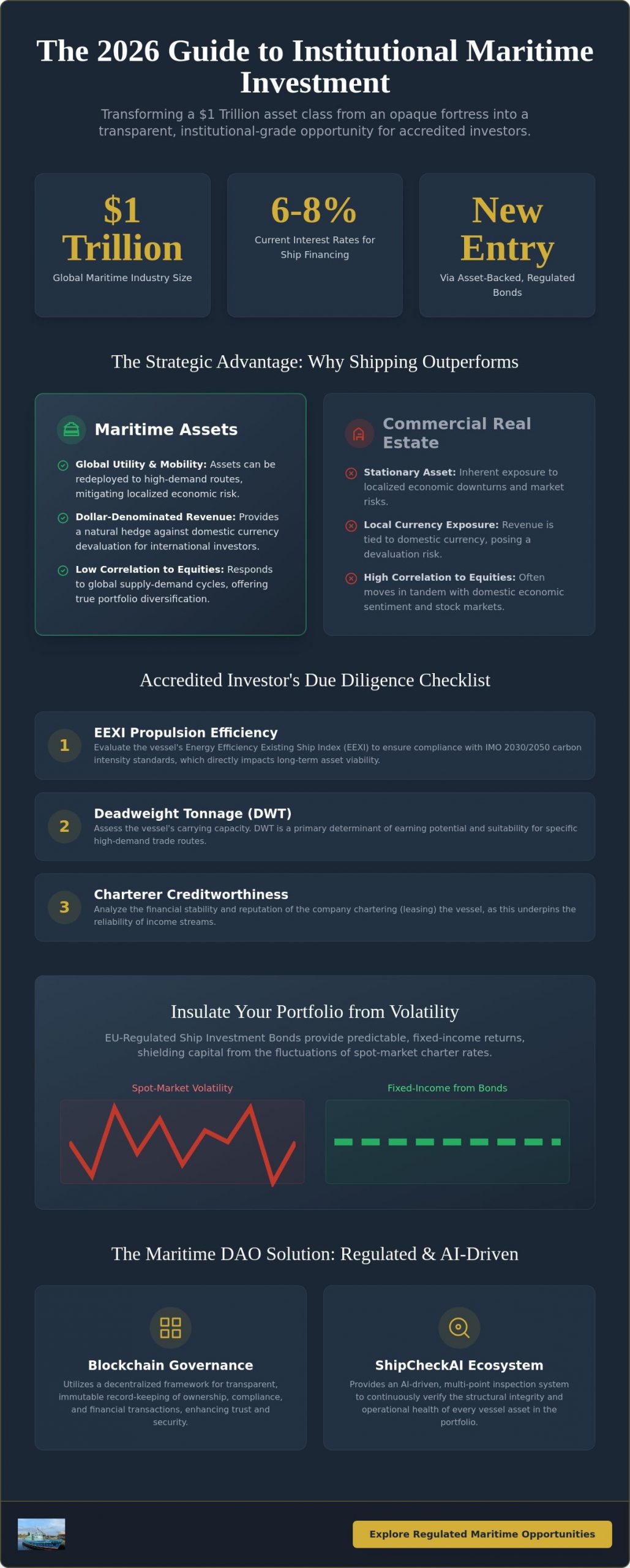
- Master a rigorous due diligence framework for ship investment for accredited investors that prioritizes EEXI propulsion efficiency, deadweight tonnage, and charterer creditworthiness.
- Learn why the global mobility of maritime assets provides a superior yield profile and inherent risk-mitigation strategy compared to stationary commercial real estate.
- Discover how EU-regulated Ship Investment Bonds insulate your portfolio from spot-market volatility, ensuring predictable income through structured, fixed-income debt instruments.
- Explore how the integration of blockchain governance and ShipCheckAI provides a transparent, multi-point inspection ecosystem to verify the structural integrity of every vessel asset.
Defining Ship Investment for Accredited Investors in 2026
The global maritime industry is currently undergoing a structural transformation. For decades, ship finance remained the exclusive domain of commercial banks and specialized lending syndicates. Today, this paradigm is shifting toward decentralized, bond-based capital markets that prioritize transparency, compliance, and asset-backed security. Ship investment for accredited investors now primarily takes the form of private placements in maritime debt or equity, frequently structured as EU-regulated ship investment bonds. This evolution allows sophisticated capital to enter a $1 trillion industry that was previously shielded by high entry barriers and opaque brokerage networks.
In 2026, several factors have converged to make this a pivotal year for maritime finance. Global trade routes are re-aligning in response to geopolitical shifts, while ship financing interest rates have stabilized between 6% and 8% for creditworthy borrowers. This environment creates a unique opportunity for an alternative investment into an asset related to worldwide shipping. These investments provide a unified gateway into the physical world of global trade, governed by legal frameworks that protect institutional interests and foster long-term growth.
Accreditation Standards for Maritime Finance
Participation in these specialized offerings requires adherence to rigorous regulatory standards. In the United States, SEC Rule 501 defines an accredited investor as an individual with an annual income exceeding $200,000, or a net worth over $1 million excluding their primary residence. Similarly, EU MiFID II criteria ensure that participants possess the necessary financial sophistication to evaluate complex asset-backed debt. Maritime DAOs and institutional platforms prioritize these standards to maintain ecosystem stability; they ensure that capital originates from professional sources capable of navigating a high-stakes financial register. This distinction separates retail-grade speculation from institutional-grade ship bonds.
The Institutional Case for Maritime Asset Diversification
Maritime assets offer a compelling strategic advantage because of their low correlation with traditional equity markets. While the S&P 500 may fluctuate based on domestic economic sentiment, vessel assets respond to global supply-demand dynamics and trade flow cycles. Ships represent “hard assets” that serve as a robust hedge against currency devaluation and inflationary pressures. Unlike fixed real estate, a vessel is a mobile utility that can be redeployed to high-demand routes, such as the Transpacific trade where spot rates have seen significant volatility in recent months. Maritime alternative investments function as a foundational strategic pillar for 2026 portfolios seeking predictable yield and structural diversification.
The Strategic Advantage: Why Shipping Outperforms Traditional Private Equity
While traditional private equity often gravitates toward commercial real estate, maritime assets offer a distinct structural advantage known as “Global Utility.” Unlike a fixed office building or multi-family complex, a vessel is a mobile, productive asset. It can move to where demand is highest. If trade flows shift from the Atlantic to the Pacific, the asset follows the revenue. This flexibility is a critical differentiator in ship investment for accredited investors, as it mitigates the localized economic risks inherent in stationary real estate. Ships represent a unified ecosystem of global trade, governed by international law and optimized by technological intelligence.
Shipping revenue is almost exclusively dollar-denominated. For an accredited investor based outside the United States, this provides a natural hedge against domestic currency devaluation. Additionally, the impact of IMO 2030 and 2050 environmental regulations has fundamentally altered asset valuations. These mandates impose strict carbon intensity standards on the global fleet, accelerating the demolition of older, inefficient vessels. This regulatory pressure creates a supply-side scarcity that supports higher residual values for compliant, modern ships, ensuring they remain competitive in a decarbonizing world.
Maritime Bonds vs. Private Equity Real Estate
Private equity real estate often requires capital lock-ups of seven to ten years. In contrast, the emergence of tokenized ship bonds offers a more flexible liquidity profile without sacrificing institutional oversight. Investors can evaluate the institutional case for maritime bond yields as a benchmark for predictable, asset-backed income. While real estate rental yields can fluctuate based on occupancy and local maintenance costs, maritime debt is typically secured by fixed-rate charters. These charters provide a level of cash flow predictability that rivals high-grade corporate debt.
Risk-Adjusted Returns in the 2026 Shipping Market
One of the most overlooked safety nets in maritime finance is the “scrap value” floor. Even at the end of its operational life, a vessel retains significant residual value based on its steel weight; this is a tangible recovery mechanism unavailable to tech startups or unsecured debt. This floor, combined with long-term time charters from reputable global carriers, ensures that bond interest payments are prioritized. It is a fact that global maritime investment platforms have lowered the cost of entry for accredited individuals, providing a unified architecture for managing these high-stakes assets. Investors looking to diversify away from saturated real estate markets should consider how regulated maritime debt integrates into a balanced 2026 portfolio.
The Accredited Investor’s Maritime Due Diligence Checklist
Successful ship investment for accredited investors in 2026 demands a rigorous, multi-layered evaluation of both the financial instrument and the underlying physical asset. Unlike venture capital, where the focus lies on burn rates and market fit, maritime due diligence centers on industrial utility and regulatory adherence. Given the expanding global maritime market size, investors must utilize a standardized framework to filter institutional-grade opportunities from speculative ventures. This process ensures that capital is deployed into assets that are structurally sound, legally protected, and operationally efficient.
A comprehensive checklist for 2026 should include:
- Vessel Specification: Verify the ship’s age, deadweight tonnage (DWT), and propulsion efficiency. In the current regulatory climate, EEXI (Energy Efficiency Existing Ship Index) compliance is non-negotiable for maintaining long-term asset value.
- Charter Quality: Analyze the creditworthiness and balance sheet of the entity leasing the vessel. A bond’s reliability is directly linked to the charterer’s ability to fulfill long-term obligations through various market cycles.
- Regulatory Instrument: Confirm that the investment is structured as an EU-regulated ship investment bond, ensuring it operates within a recognized legal framework that prioritizes transparency.
- Technical Assessment: Review recent physical inspections and maintenance logs to ensure the vessel meets safety standards. This includes verifying the frequency of dry-docking and engine overhauls.
- Governance Structure: Evaluate the role of the DAO or managing entity in overseeing the asset-backed securities, governing distributions, and protecting bondholder rights.
Physical Asset Verification (The ‘Steel’ Check)
Traditional ‘paper’ surveys, which rely on historical logs and manual reports, are no longer sufficient for institutional standards. These legacy methods often overlook subtle structural fatigue or propulsion inefficiencies that impact profitability. The modern approach utilizes AI in maritime due diligence to synthesize real-time data from multiple sensor arrays and independent third-party assessments. This technology removes human bias, identifies systemic risks, and provides a transparent audit trail for every vessel in the portfolio. It acts as a reliable gatekeeper for your capital.
Legal and Structural Compliance
The prospectus serves as the foundational legal document for any maritime debt instrument. Investors must scrutinize key clauses regarding bondholder protection, collateral priority, and default recourse. Jurisdictional analysis is equally critical; EU-regulated frameworks typically offer superior investor recourse compared to offshore or unregulated structures. A robust maritime DAO implements strict KYC and AML requirements for all accredited participants. This methodical approach ensures the ecosystem remains compliant with global financial standards while fostering a secure environment for significant capital deployment.
Mitigating Risk: Addressing the #1 Objection to Ship Investment
The most persistent objection to ship investment for accredited investors is the perceived volatility of the maritime market. Critics often point to the dramatic fluctuations of container spot rates, which have seen increases of over 100% on Transpacific routes since early 2026, as evidence of instability. However, this perspective conflates equity ownership in a single vessel with the structural seniority of asset-backed debt. Regulated ship bonds insulate capital from the daily oscillations of the spot market by utilizing fixed-rate time charters and senior-secured positions. This architecture ensures that interest payments are serviced before equity distributions, providing a reliable buffer against market contraction. Ship investment for accredited investors thus functions more like a fixed-income instrument than a speculative commodity play.
A secondary layer of protection exists through comprehensive insurance protocols. Hull and Machinery (H&M) coverage protects the physical integrity of the asset, while Protection and Indemnity (P&I) clubs provide mutual insurance for third-party liabilities. These mechanisms, when combined with the legal protections of an EU-regulated framework, create a robust risk-mitigation ecosystem that prioritizes capital preservation. These layers work together to unify, secure, and diversify the investor’s exposure to global trade.
Technology as a Risk Mitigant
Institutional reliability is now reinforced by automated intelligence. Real-time data feeds from ShipCheckAI function as an early warning system, allowing managers to monitor vessel health with surgical precision. By identifying potential mechanical failures before they escalate, predictive maintenance significantly reduces “off-hire” time, which is the period a vessel is non-productive and costly. AI-driven vessel inspections eliminate human subjectivity, providing a transparent audit trail that enhances both operational accuracy and investor confidence. This technological pillar ensures the asset remains a high-performing component of the global trade infrastructure.
Market Cycle Management
Sophisticated participants recognize that shipping operates in distinct, predictable cycles. Counter-cyclical investing allows for the acquisition of maritime debt during low-cycle periods when credit spreads are traditionally higher. Integrating maritime alternative investments into a balanced 60/40 portfolio provides a “hard asset” anchor that is decoupled from traditional tech-heavy indices. This strategic diversification is essential for navigating the complex macro-economic landscape of 2026. If you’re ready to explore these asset-backed opportunities, you can access regulated maritime debt through our unified gateway.
The Maritime DAO Solution: Regulated, AI-Driven, and Transparent
The convergence of distributed ledger technology and maritime operations has created a first-of-its-kind ecosystem for global capital. By integrating EU-regulated ship investment bonds with blockchain governance, Maritime DAO provides a unified architecture that addresses the systemic lack of transparency in traditional shipping finance. This model ensures that every asset-backed security is governed by smart contracts that automate distributions, verify compliance, and provide real-time visibility into vessel performance. For those seeking ship investment for accredited investors, this transition from opaque brokerage to a transparent, digital-first gateway represents a fundamental shift in how maritime debt is managed and monitored.
The structural integrity of the portfolio is maintained through a tripartite system of automated intelligence, legal oversight, and physical verification. Unlike legacy systems that rely on annual paper reports, this digital-first approach utilizes real-time reporting to track vessel efficiency, CO2 emissions under the EU ETS, and financial health. This level of granularity ensures that bondholders aren’t just passive participants but are part of a governed ecosystem where data drives every decision. It’s a methodical way to open up a traditionally exclusive industry to a global audience while maintaining a high-stakes emotional register appropriate for significant capital. For a deeper understanding of how fractional structures and tokenized debt are reshaping access to this sector, the comprehensive overview of alternative ship financing models provides essential context on the evolution away from legacy banking constraints.
Bridging Legacy Industry with Future Finance
The ShipCheckAI advantage lies in its ability to standardize vessel condition reports through automated, multi-point inspections for every asset in the portfolio. By utilizing multiple sensor arrays and AI-driven analysis, the platform identifies mechanical risks and propulsion inefficiencies before they impact the bottom line. This technology provides a reliable audit trail for every vessel, ensuring that bondholders have an objective view of the physical asset backing their debt. You can learn more about the specifics of capital allocation and asset selection in our primary guide on how to invest in maritime assets. This integration of physical reality and digital governance is what defines the 2026 maritime investment landscape.
The Accredited Onboarding Process
Accessing institutional-grade maritime debt in 2026 requires a methodical verification process designed to ensure regulatory compliance and ecosystem stability. This sequence is designed to lead the reader through a multi-layered ecosystem without overwhelming them. The onboarding process involves:
- Regulatory Verification: Submission of professional investor credentials to meet MiFID II or SEC Rule 501 standards.
- Portfolio Selection: Evaluating specific EU-regulated ship investment bonds based on yield profile, vessel type, and charter duration.
- Capital Allocation: Configuring a secure digital gateway to receive real-time distributions and exercise governance rights.
Minimum commitment levels are structured to maintain the institutional register of the DAO, ensuring that all participants are aligned with the long-term stability of the maritime sector. If you’re prepared to diversify into a $1 trillion global industry through a transparent, asset-backed framework, explore EU-Regulated Ship Investment Bonds at Maritime DAO.
The Future of Maritime Capital Allocation
The 2026 landscape has redefined the parameters of success in the shipping sector. By moving beyond opaque brokerage models and embracing asset-backed, regulated frameworks, you position your capital within a high-performing global utility. This transition is anchored by three critical pillars: an EU-Regulated Financial Framework, the predictive power of ShipCheckAI proprietary inspection tech, and the structural security of physical collateral. These elements work in unison to provide a level of transparency previously unavailable to private capital. It’s a methodical way to secure institutional-grade yields.
You’ve learned how to navigate the complexities of maritime due diligence and why the global mobility of vessels offers a superior risk-adjusted return compared to traditional private equity. Ship investment for accredited investors is no longer a “black box” but a governed, institutional-grade opportunity. It’s time to bridge the gap between legacy industry and future finance. Secure Your Position in the 2026 Maritime Bond Offering and lead the next era of global trade diversification. We invite you to join this first-of-its-kind ecosystem of regulated innovation.
Frequently Asked Questions
What defines an accredited investor for ship investment in 2026?
An accredited investor is defined by specific financial thresholds or professional certifications that signal institutional-grade sophistication. In the United States, this includes individuals with an annual income over $200,000 or a net worth exceeding $1 million, excluding their primary residence. European standards under MiFID II require similar levels of financial capability. These criteria ensure that ship investment for accredited investors remains a stable ecosystem governed by participants capable of evaluating complex, asset-backed debt.
How do maritime bonds differ from traditional shipping stocks?
Maritime bonds represent senior-secured debt, whereas shipping stocks are equity positions in a corporation. Bondholders receive prioritized interest payments backed by physical vessel assets and fixed-rate charters. This structure insulates investors from the daily volatility of the spot market. Stocks, conversely, expose participants to corporate overhead and fluctuating freight rates, offering less predictability than the asset-backed debt found in specialized maritime portfolios. It is a shift from speculation to structured income.
What is the typical yield for EU-regulated ship investment bonds?
Yields for EU-regulated ship investment bonds reflect the current institutional credit environment and the inherent utility of the underlying assets. While specific returns vary by vessel type and charter duration, they generally align with the 2026 market where ship financing rates for creditworthy borrowers range between 6% and 8%. These bonds provide a structured income stream governed by legal frameworks that protect capital. They offer a compelling alternative to the tightening cap rates found in commercial real estate.
How does ShipCheckAI improve the due diligence process for investors?
ShipCheckAI utilizes automated intelligence to provide a transparent, multi-point assessment of a vessel’s structural and operational health. It eliminates the subjectivity found in traditional manual surveys by synthesizing real-time data from engine sensors and hull inspections. This technology allows investors to verify EEXI compliance and predict maintenance failures before they impact revenue. It acts as a reliable gatekeeper, ensuring every asset in the portfolio meets institutional standards while removing human bias from the assessment.
Is maritime investment considered a high-risk asset class?
Maritime assets have a historical reputation for volatility, but modern ship investment for accredited investors utilizes debt instruments to mitigate this risk. By securing capital against physical collateral and long-term charters, the risk profile is significantly reduced compared to direct vessel ownership. The presence of a scrap value floor further ensures a tangible recovery mechanism. This structured approach transforms a traditionally high-stakes industry into a stable, income-generating asset class that is decoupled from traditional equity markets.
Can non-EU residents invest in EU-regulated maritime debt?
Non-EU residents can typically access EU-regulated maritime debt if they meet the necessary accreditation and KYC/AML requirements. These instruments are designed for a global audience of sophisticated individuals and institutions seeking to diversify into dollar-denominated trade assets. The regulatory framework provides a unified gateway that ensures all participants, regardless of their geographic location, benefit from the same high standards of governance and legal recourse. It is a truly inclusive institutional ecosystem.
What happens if a vessel in the investment pool is damaged or lost?
Comprehensive insurance layering, including Hull and Machinery (H&M) and Protection and Indemnity (P&I) coverage, protects the investment pool against physical loss or damage. If a vessel is lost, the insurance payout covers the asset’s appraised value, which is then used to satisfy bondholder claims. This collateralized structure ensures that capital is recovered even in extreme scenarios. It provides a level of security that unsecured private equity simply cannot match, grounding the investment in physical reality.
How does tokenization impact the liquidity of ship investments?
Tokenization enhances liquidity by allowing for fractionalized ownership and more efficient secondary market transfers. Unlike traditional private equity real estate, which often requires a ten-year capital lock-up, tokenized ship bonds can be traded within a governed digital ecosystem. This flexibility doesn’t compromise regulatory oversight. Instead, it provides a methodical way for accredited participants to manage their exposure to the maritime industry with greater agility and transparency, bridging the gap between legacy assets and modern finance. Investors seeking to understand the full spectrum of structures available should explore the landscape of alternative ship financing models and fractional ship investment to see how these mechanisms are governed within regulated frameworks.