
The traditional ship inspection is no longer a mere technical formality; it has evolved into the primary data layer for global maritime finance. For years, stakeholders have struggled with inconsistent data from manual surveys and delayed reporting that stalls critical capital deployment. You’ve likely experienced how these friction points obscure the true valuation of asset-backed securities. A modern vessel condition report platform solves this by bridging the gap between physical maintenance and institutional investment. This shift is vital as the industry faces new 2026 mandates, including the IMDG Code Amendment 42-24 and the mandatory installation of electronic inclinometers for large vessels.
This guide demonstrates how ShipCheckAI utilizes automated intelligence to transform raw inspection data into actionable financial intelligence for global maritime stakeholders. We’ll examine how high-fidelity data and instant cross-fleet comparisons ensure compliance with the latest safety and environmental standards, such as the 2026 ban on PFOS fire-extinguishing media. You’ll discover the mechanisms behind regulatory-compliant reporting for EU bond issuance and how a unified assessment framework provides the transparency required for the next generation of maritime capital. We’ll break down the integration of AI-powered inspections into a governed ecosystem that prioritizes structural integrity, legal clarity, and operational efficiency.
Key Takeaways
- Transition from static, analog reporting to dynamic, AI-queriable databases that function as a unified ecosystem for asset management.
- Utilize cloud-native architecture and multi-modal data ingestion to maintain a transparent, 24/7 record of vessel integrity and operational status.
- Discover how a modern vessel condition report platform accelerates capital deployment by delivering preliminary assessments in hours while removing subjective bias from condition grading.
- Evaluate platform scalability and essential compliance certifications, such as ISO and IIMS, to ensure reporting meets the rigorous standards of institutional due diligence.
- Explore how ShipCheckAI bridges the gap between physical maritime assets and digital finance to provide the structural integrity required for EU-regulated ship investment bonds.
The Evolution of Vessel Condition Reporting in 2026
A modern vessel condition report platform is far more than a digital checklist; it’s a unified data ecosystem that serves as the single source of truth for an asset’s structural and operational health. The industry has reached a turning point where static PDF reports, once the standard for decades, are being replaced by dynamic, AI-queriable databases. This evolution is driven by the need for high-fidelity data that can be instantly analyzed to meet the rigorous demands of institutional finance. For those participating in EU regulated ship investment bonds, real-time condition data is no longer optional. It’s the fundamental layer that supports asset valuation and risk assessment in a volatile global market. By standardizing these outputs, the maritime sector reduces friction in insurance underwriting and capital deployment, ensuring that every stakeholder operates from a transparent, governed foundation.
From Manual Surveys to Automated Intelligence
Legacy on-hire and off-hire manual reporting often suffers from subjective bias and inconsistent detail, leading to disputes during vessel redelivery. These traditional methods struggle to keep pace with the 2026 standards for data granularity required for institutional compliance. The emergence of AI-driven anomaly detection allows for the automated identification of hull fatigue or machinery wear that a human eye might miss. While these platforms augment the process, they remain grounded in classification society standards to ensure that every digital assessment aligns with globally recognized maritime safety and structural integrity benchmarks. This shift enables a proactive operational model where maintenance is predicted rather than just recorded, allowing managers to address issues before they escalate into costly failures.
The Tripartite Value of Digital Asset Reports
The transition to a digital-first assessment model provides a tripartite value proposition that unites the disparate interests of the maritime community. First, it offers operational transparency for shipowners and technical managers, allowing them to optimize maintenance schedules and protect the long-term value of their fleet. Second, it provides critical risk mitigation for charterers, establishing a clear, indisputable baseline of condition during delivery and redelivery to prevent costly legal friction. Finally, it ensures investment security for bondholders by integrating AI in maritime due diligence. This comprehensive approach transforms the vessel condition report platform into a gateway for democratized maritime finance, where transparency and governance open up new opportunities for global capital. It’s a system designed to unite physical assets with digital oversight, creating a reliable bridge for institutional investors entering the maritime space.
Core Architecture of an Institutional-Grade Platform
The architecture of a modern vessel condition report platform must satisfy the dual requirements of technical precision and financial reliability. It’s built on cloud-native infrastructure to ensure global stakeholders have 24/7 access to critical asset data, regardless of their time zone or location. This system doesn’t just store text; it ingests multi-modal data including high-resolution photos, 4K video, real-time sensor telemetry, and detailed surveyor notes. While traditional surveys have long been governed by frameworks like U.S. Code Title 46: Shipping, modern platforms provide the digital layer needed to enforce these laws in a transparent, real-time environment. By integrating directly with existing ERP and fleet management software, the platform creates a unified ecosystem where data flows seamlessly between technical departments and executive boardrooms. To maintain the highest levels of structural integrity, these platforms utilize blockchain-anchored audit trails. This ensures that once a condition report is finalized, it remains immutable, preventing any unauthorized tampering or data manipulation that could mislead investors or insurers.
ShipCheckAI: The Engine of Accuracy
ShipCheckAI serves as the analytical core of this architecture, utilizing advanced machine learning to identify complex corrosion patterns and structural fatigue that might escape traditional visual inspections. It replaces subjective human judgment with an automated grading system that standardizes ratings across an entire fleet. Whether an asset is rated as “Fair,” “Good,” or “Excellent,” the classification is backed by empirical data rather than individual surveyor bias. This rigorous approach to ShipCheckAI vessel assessment provides the validation required for high-stakes maritime bonds. The system continuously learns from new data, refining its predictive capabilities to offer shipowners a proactive maintenance roadmap that preserves asset value over time.
Data Governance and Transparency
Security and oversight are paramount in a system designed for institutional capital. The platform operates under decentralized autonomous organization (DAO) oversight, ensuring that governance isn’t centralized in a single entity but distributed among stakeholders. This structure is specifically engineered to meet EU financial regulation standards for transparency, providing a clear window into asset health for auditors and regulators. Role-based access control further secures the environment, allowing investors, technical staff, and independent auditors to access only the information relevant to their specific duties. If you’re looking to enhance your fleet’s financial transparency, exploring the Maritime DAO ecosystem offers a clear path to unite physical assets, digital governance, and institutional capital.
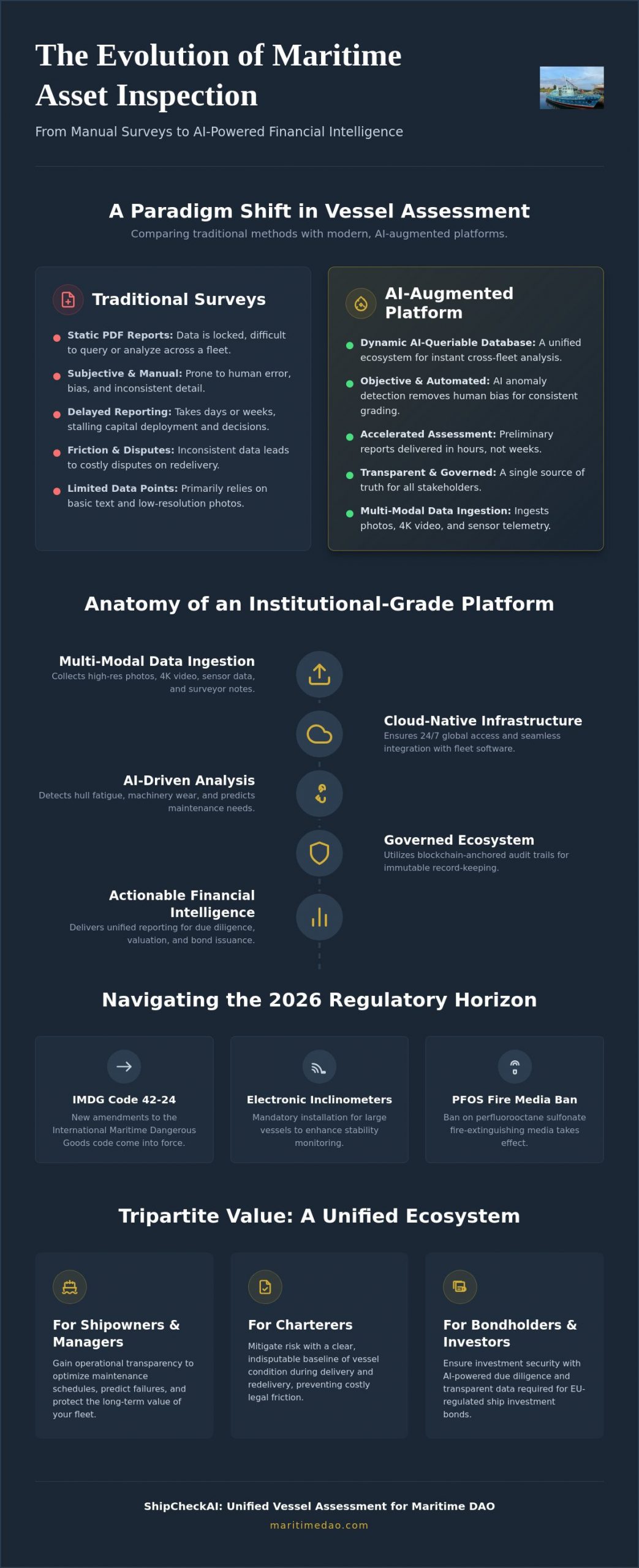
Comparing Traditional Surveys with AI-Augmented Assessments
The transition from legacy maritime inspections to a modern vessel condition report platform represents a fundamental shift in how asset value is verified. Traditional surveys often rely on the subjective judgment of an individual inspector, a process that can take days to finalize and even longer to circulate among stakeholders. In contrast, AI-augmented platforms deliver preliminary results in hours, providing immediate clarity for time-sensitive transactions. By removing human bias from condition grading, these systems ensure that a vessel’s “Good” or “Fair” rating is based on empirical data rather than personal opinion. This consistency is vital for global fleets where uniform standards are required to maintain the structural integrity of a diverse portfolio. Additionally, AI doesn’t just look at the present; it analyzes years of historical data alongside current high-fidelity photos to predict future maintenance needs, transforming a reactive log into a proactive financial tool.
Cost-efficiency is another primary driver for this digital adoption. Research from 2026 indicates that remote surveys can decrease inspection costs by 25% for class societies by reducing the necessity for repeat physical visits. This efficiency is achieved through high-fidelity data capture that allows onshore technical teams to conduct deep-dive analyses without the logistical burden of travel. It’s a methodical approach that replaces the “snapshot” nature of traditional surveys with a continuous, governed stream of asset intelligence.
The Hybrid Model: Human Expertise + AI Precision
While technology provides the analytical engine, certified surveyors remain essential for navigating the nuances of physical inspections. An AI powered vessel survey doesn’t replace the human element; it empowers it. Inspectors on-site use automated tools to capture standardized evidence, which is then verified through protocols that combine machine vision with professional judgment. This hybrid model ensures that every anomaly detected by the AI is contextualized by a maritime expert, creating a unified assessment that satisfies both technical and legal requirements. It’s a bridge between legacy expertise and the future of automated intelligence.
Risk Mitigation and Dispute Resolution
High-stakes maritime operations require indisputable evidence to settle charter disputes and manage risk. By utilizing time-stamped, high-resolution visual data, stakeholders can resolve disagreements over vessel condition during delivery or redelivery with absolute transparency. This level of detail is particularly critical for predictive modeling, as it identifies hidden risks that could negatively impact bond yields or insurance premiums. Standardizing vessel assessment for financing across global fleets allows institutional investors to deploy capital with confidence, knowing that the underlying assets are governed by a methodical, data-driven framework. This alignment of physical condition and financial oversight is the cornerstone of modern maritime due diligence.
Selecting a Platform for Global Maritime Due Diligence
Selecting a vessel condition report platform is a high-stakes decision that bridges the gap between technical assessment and institutional financial oversight. When evaluating a provider, you must prioritize scalability for large-scale maritime asset portfolios. A system that functions adequately for a single vessel may buckle when tasked with managing the complex, high-volume data streams of a global fleet. Beyond raw capacity, look for structural integrity through recognized credentials such as ISO 9001 or IIMS (International Institute of Marine Surveying) certifications. These standards ensure the provider adheres to rigorous quality management and professional surveying protocols. The platform’s data output must also demonstrate financial readiness, meaning the information is structured to be consumed immediately by investment committees and risk underwriters without the need for manual translation or secondary analysis.
In the context of 2026, where the maritime digitalization market is projected to reach $241.25 billion, the speed and reliability of data processing have become significant competitive advantages. Reliable platforms offer 24/7 technical support and a global surveyor reach to ensure that inspections can be initiated and managed in any major port worldwide. This global presence, combined with institutional-grade security, transforms a simple reporting tool into a comprehensive gateway for maritime due diligence.
Integration with Maritime Capital Markets
Institutional stakeholders require data that integrates directly with bond issuance and asset-backed security (ABS) pricing workflows. A high-quality vessel condition report platform creates a transparent link between condition scores and financial valuation, allowing for more accurate pricing of maritime debt. By automating maritime investment compliance, these platforms reduce the administrative burden on issuers and provide bondholders with the clarity they demand. If you’re ready to align your fleet with these institutional standards, you can explore the Maritime DAO governance framework to see how we unify asset data with regulated finance.
User Experience and Mobile Functionality
Operational reality often involves remote port environments with limited or intermittent connectivity. A robust platform must offer offline capabilities, allowing inspectors to capture high-fidelity data securely and sync it once a connection is re-established. For the boardroom, executive dashboards provide real-time monitoring of fleet health, highlighting anomalies across thousands of data points with logical precision. Customizable reporting formats ensure that whether you’re presenting to a technical manager, a legal auditor, or a financial investor, the output meets their specific requirements and regulatory expectations.
ShipCheckAI: Unified Vessel Assessment for Maritime DAO
ShipCheckAI stands as the definitive vessel condition report platform, engineered specifically to solve the systemic inefficiencies that have long plagued legacy maritime assessments. It functions as the critical link between the physical world of global trade and the digital world of institutional finance. By providing a unified assessment framework, it ensures that every data point captured on deck is immediately available as actionable financial intelligence for global stakeholders. This integration is essential for those seeking the strategic advantage offered by maritime DAO investment principles, where transparency, structural integrity, and decentralized governance are the primary drivers of capital deployment. As the industry moves toward a more regulated digital frontier, ShipCheckAI provides the reliable gatekeeper needed to validate asset integrity with absolute precision.
A Unified Ecosystem for Maritime Assets
The Maritime DAO ecosystem unites inspection, governance, and financing into a single, cohesive workflow, effectively removing the siloed approach that has traditionally slowed down maritime capital markets. This ecosystem is designed to show breadth and connectivity, using active verbs to describe how different systems unite to open up new opportunities for global trade. ShipCheckAI serves as a tripartite solution that empowers shipowners with technical clarity, provides investors with risk-adjusted security, and equips inspectors with automated precision. By standardizing the data layer, we’re building the foundation for the future of automated maritime capital deployment. This methodical transition ensures that the relationship between physical assets and digital governance is clearly understood at every step of the investment lifecycle.
Getting Started with Maritime DAO
Onboarding institutional investors and ship managers into this high-tech ecosystem is a methodical process designed for maximum legal clarity and operational efficiency. It begins with the integration of fleet data into the ShipCheckAI environment, followed by the verification of asset integrity according to our governed standards. Once the onboarding is complete, participants gain exclusive access to the 2026 suite of EU regulated ship investment bonds. This structural bridge allows for the democratization of complex financial structures while maintaining the sober reliability of traditional finance. The pace of this transition is steady and educational, ensuring that your organization is fully equipped to navigate the intersection of heavy industry and high finance. You can optimize your maritime due diligence with ShipCheckAI at Maritime DAO to begin your transition toward a more transparent, data-driven maritime investment strategy.
Advancing Toward a Unified Maritime Capital Frontier
The maritime industry’s digital transformation is no longer a future projection; it’s a present reality for those managing high-stakes capital. Adopting a sophisticated vessel condition report platform is the first step toward securing asset integrity in an era of heightened regulatory scrutiny. We’ve explored how AI-driven accuracy with ShipCheckAI removes subjective bias, providing the structural transparency required for institutional-grade debt instruments. This ecosystem, compliant with EU maritime financial regulations and governed by a transparent DAO framework, ensures that every stakeholder operates from a foundation of verified truth. By integrating these technological pillars, you don’t just record a vessel’s state; you unlock its potential as a reliable financial asset. The path to modernized maritime finance is built on data integrity, legal clarity, and structural innovation. This transition empowers a traditionally exclusive industry to become accessible to global audiences while maintaining the sober reliability of high finance. We invite you to lead this evolution by securing your fleet’s future through methodical, data-driven governance.
Access the ShipCheckAI Platform for Institutional Vessel Assessments
Frequently Asked Questions
What is a vessel condition report platform?
It’s a unified digital ecosystem that centralizes technical assessments, visual evidence, and operational data into a single source of truth for maritime assets. Unlike traditional paper-based logs, this platform transforms static observations into dynamic, queriable asset intelligence. It allows global stakeholders to monitor structural health and maintenance status in real time, ensuring that every participant operates from a transparent and governed data foundation that supports institutional decision-making.
How does AI improve the accuracy of a vessel condition report?
AI improves accuracy by utilizing machine learning algorithms to identify subtle corrosion patterns and structural fatigue that are often missed by the naked eye. By analyzing high-resolution visual data against vast historical datasets, the platform removes human subjectivity from the grading process. This ensures that every vessel condition report platform output is standardized, providing a consistent rating that institutional investors can rely on for precise risk assessment.
Can a digital platform replace a physical ship survey?
A digital platform functions as a powerful augmentation rather than a total replacement for certified physical surveys. While it enables high-fidelity remote assessments that can reduce physical visit requirements by 25% for class societies, the human element remains essential for nuanced inspections. The platform acts as a hybrid bridge, combining machine precision with professional judgment to create a more comprehensive and legally defensible record of an asset’s condition.
How do vessel condition reports impact maritime bond yields?
Condition reports impact bond yields by providing the transparent data required to accurately price asset-backed securities. High-fidelity reports reduce the risk premium associated with technical uncertainty, allowing issuers to demonstrate superior asset maintenance to investors. When a vessel condition report platform validates structural integrity, it builds institutional confidence, which can lead to more favorable borrowing terms and tighter spreads in the regulated ship investment bond market.
What technical features are essential for a 2026 ship inspection tool?
Essential features include cloud-native infrastructure for global access, multi-modal ingestion for 4K video and sensor telemetry, and offline mobile functionality for remote port environments. Additionally, a 2026 tool must offer blockchain-anchored audit trails to ensure data immutability and seamless integration with existing ERP systems. These pillars work together to provide a transparent, governed, and scalable solution that meets the rigorous demands of modern maritime finance and technical management.
Is data on a maritime DAO platform secure and tamper-proof?
Yes, data security is maintained through decentralized governance and blockchain technology which creates an immutable record of all inspection entries. Once a report is finalized and anchored to the ledger, it cannot be altered or manipulated without authorization from the governing framework. This structural integrity prevents fraudulent reporting and ensures that auditors, technical staff, and investors have access to a verified and tamper-proof history of the asset’s operational life.
How does ShipCheckAI handle different ship inspection types?
ShipCheckAI utilizes specialized machine learning modules tailored for various assessment types, including on-hire/off-hire surveys, pre-purchase inspections, and routine condition monitoring. The system automatically adjusts its analytical parameters based on the vessel category and the specific requirements of the inspection. This flexible architecture ensures that whether the goal is technical maintenance or financial due diligence, the resulting intelligence is precise, standardized, and ready for institutional consumption.
What are the EU regulatory requirements for vessel assessments in 2026?
In 2026, EU regulations demand higher data granularity for environmental compliance and safety documentation, including mandatory reporting on PFOS concentrations and IMDG cargo classifications. Assessments must also align with transparency standards required for bond issuance under EU financial frameworks. These mandates prioritize regulated innovation, requiring that all vessel data be verifiable, auditable, and stored within a secure ecosystem that respects both maritime safety laws and institutional governance requirements.