
In 2026, the traditional marine survey is no longer a reliable safeguard; it’s a liability for any institution seeking to deploy capital at scale. Relying on fragmented data from manual inspections often leads to costly delays and regulatory friction, particularly as the EU ETS now requires companies to surrender allowances for 70% of their reported emissions. Achieving a truly streamlined maritime asset assessment requires a shift from manual oversight to unified, AI-driven frameworks that bridge the gap between heavy industry and institutional finance.
You likely recognize that the high cost of traditional surveys and the complexity of asset-backed bond issuance remain significant barriers to efficient growth. This guide will show you how to eliminate technical friction and dismantle regulatory silos by leveraging AI-powered assessment frameworks for maritime investments. We’ll explore how ShipCheckAI and EU-regulated bond structures unite to deliver faster capital deployment, higher accuracy in vessel condition reporting, and seamless integration with modern financial governance.
Key Takeaways
- Transition from fragmented manual surveys to a streamlined maritime asset assessment workflow to eliminate the technical friction that delays institutional capital deployment.
- Leverage ShipCheckAI as the core engine for multi-type vessel evaluations, achieving a tripartite value of speed, accuracy, and regulatory compliance.
- Replace legacy “siloed” inspection methods with unified digital frameworks to significantly reduce time-to-report metrics and enhance data integrity.
- Implement a methodical two-step due diligence process that integrates automated historical data screening with AI-verified physical condition reporting.
- Discover how verified asset intelligence serves as the essential gateway for issuing secure, EU-regulated ship investment bonds within a transparent ecosystem.
The Evolution of Streamlined Maritime Asset Assessment in 2026
Streamlined maritime asset assessment represents a fundamental departure from the static, paper-based protocols of the past. It’s a unified digital workflow that integrates physical vessel condition with financial compliance data in real time. In 2026, the industry has shifted toward “Real-Time Integrity,” where automated intelligence monitors hull health and engine efficiency without the week-long delays of legacy systems. By utilizing tools like ShipCheckAI, investors can now bypass the manual bottlenecks that once stalled capital deployment. This evolution is not merely a technological upgrade; it’s a structural necessity for a market that demands instant, verifiable data.
The High Cost of Traditional Inspection Frictions
Traditional 20th-century surveys often require vessels to deviate from profitable routes or remain idle for days. This unplanned downtime creates a significant economic ripple effect, eroding the profitability of the asset before a single bond is even issued. Beyond the direct costs, manual condition reports are prone to human error, leading to inconsistent data that complicates the due diligence process for institutional lenders. Assessment friction is the primary barrier to maritime liquidity. When data remains trapped in physical silos, the entire financial ecosystem slows down, increasing the cost of capital for shipowners.
Regulatory Drivers for Digital Transparency
The shift toward digital transparency is accelerated by rigorous EU financial regulations. For instance, the EU Green Bond Standard (EuGB) and updated ETS requirements mandate that vessel data be granular, accessible, and immutable. This has led to the rise of the digital twin for vessel bondholders, a living data model that provides a transparent view of the ship’s operational health. This transparency serves a tripartite purpose: it mitigates risk through precise modeling, optimizes bond yields by increasing investor confidence, and ensures continuous compliance with international safety standards. In this governed ecosystem, the relationship between physical assets and digital finance becomes seamless, providing a secure foundation for the next generation of streamlined maritime asset assessment.
By digitizing the assessment process, stakeholders can move from reactive maintenance to predictive governance. This transition doesn’t just save time; it fundamentally changes how maritime assets are valued in the global capital markets. As we move deeper into 2026, the ability to provide a transparent, AI-verified record of a vessel’s condition is becoming the gold standard for securing institutional-grade investment.
ShipCheckAI: Leveraging Intelligence for Multi-Type Vessel Evaluation
ShipCheckAI serves as the core engine for modern maritime due diligence. It’s a first-of-its-kind platform that replaces manual ambiguity with algorithmic precision, acting as a bridge between physical vessel operations and institutional capital markets. By integrating disparate data streams, it delivers a tripartite value proposition: unprecedented speed in reporting, surgical accuracy in defect detection, and absolute alignment with EU financial compliance standards. This streamlined maritime asset assessment framework ensures that every vessel is evaluated against a unified benchmark, providing the standardized data institutional investors require to manage risk effectively.
Unlike traditional surveys that focus on one area at a time, ShipCheckAI processes multiple inspection types simultaneously. It cross-references hull integrity, engine performance, and emissions output to create a comprehensive data profile. This holistic approach eliminates the silos that typically plague maritime assessments, allowing for a more transparent view of an asset’s true value and operational viability.
Automating Pre-Purchase and Condition Surveys
In the high-stakes environment of pre-purchase surveys, timing is everything. ShipCheckAI identifies structural anomalies significantly faster than human divers, using computer vision to scan for micro-fractures or corrosion that often escape the naked eye. This capability is bolstered by the integration of drone and sensor data into a single, transparent dashboard. For a detailed breakdown of the technical requirements, investors should consult the AI in maritime due diligence checklist. Research from the AI in Maritime Surveillance report emphasizes that such intelligence is critical for identifying risks before they manifest as operational failures.
Predictive Maintenance vs. Reactive Assessment
The true power of this system lies in its predictive capacity. While legacy reports provide a snapshot of the past, AI-driven assessments predict future asset depreciation based on real-world wear patterns and environmental stressors. For example, AI-powered systems can now detect 95% of potential engine failures before they occur, which can reduce unplanned downtime by up to 50%. This foresight directly enhances bondholder security by ensuring that the underlying collateral remains viable throughout the life of the investment. Predictive assessment transforms a static report into a dynamic asset-tracking tool that monitors value in real time. Organizations looking to integrate these insights into their portfolio can explore the Maritime DAO ecosystem to see how these metrics support regulated ship investment bonds.
Legacy Surveys vs. Modern Digital Assessment Frameworks
The maritime sector has transitioned from the fragmented “Siloed Approach” of 2020 to the “Unified Ecosystem” of 2026. In the previous decade, a typical vessel survey required a physical inspector to board, take manual notes, and spend up to three weeks finalizing a report. Today, the streamlined maritime asset assessment model utilizes ShipCheckAI to deliver comprehensive condition data in under 48 hours. This massive reduction in time-to-report is vital when mezzanine debt rates carry premiums between 10% and 15%; every day of delayed capital deployment is an expensive oversight that erodes investor returns.
Beyond speed, the shift focuses on the cost-per-assessment in a high-interest environment. Traditional surveys were expensive, one-off events that provided zero ongoing value. Modern frameworks integrate assessment data into the broader financial governance of the asset. For modern tonnage in 2026, where LTV ratios typically range between 60% and 80%, lenders require more than a snapshot. They demand an auditable, persistent digital record that proves the asset’s value hasn’t depreciated beyond the agreed-upon risk parameters.
Data Integrity and the Blockchain Layer
Maritime DAO utilizes a decentralized governance layer to secure assessment data, ensuring that vessel records remain immutable from the moment of capture. This is a critical requirement for EU-regulated compliance, particularly for issuers of tokenized bonds who must demonstrate absolute transparency to institutional gatekeepers. By anchoring inspection results to a blockchain, we eliminate the risk of “creative” reporting that often plagued paper-based surveys. For a deep dive into how these systems integrate with physical hardware, refer to the AI Ship Inspection Tool Guide.
Reducing Human Subjectivity in Technical Audits
Expert opinions are inherently subjective, often varying based on a surveyor’s individual experience or geographical location. Machine learning normalizes these standards by applying a consistent algorithmic truth across the global fleet. In distressed asset sales or high-stakes acquisitions, this automated workflow prevents data manipulation and ensures that the condition of the vessel is reported without bias. We’ve moved away from the era of qualitative expert opinion toward a quantitative reality where multi-spectral analysis and sensor data define the asset’s health. This transition protects bondholders by providing a reliable, standardized metric for risk, ensuring that the streamlined maritime asset assessment remains the primary source of truth for all stakeholders.
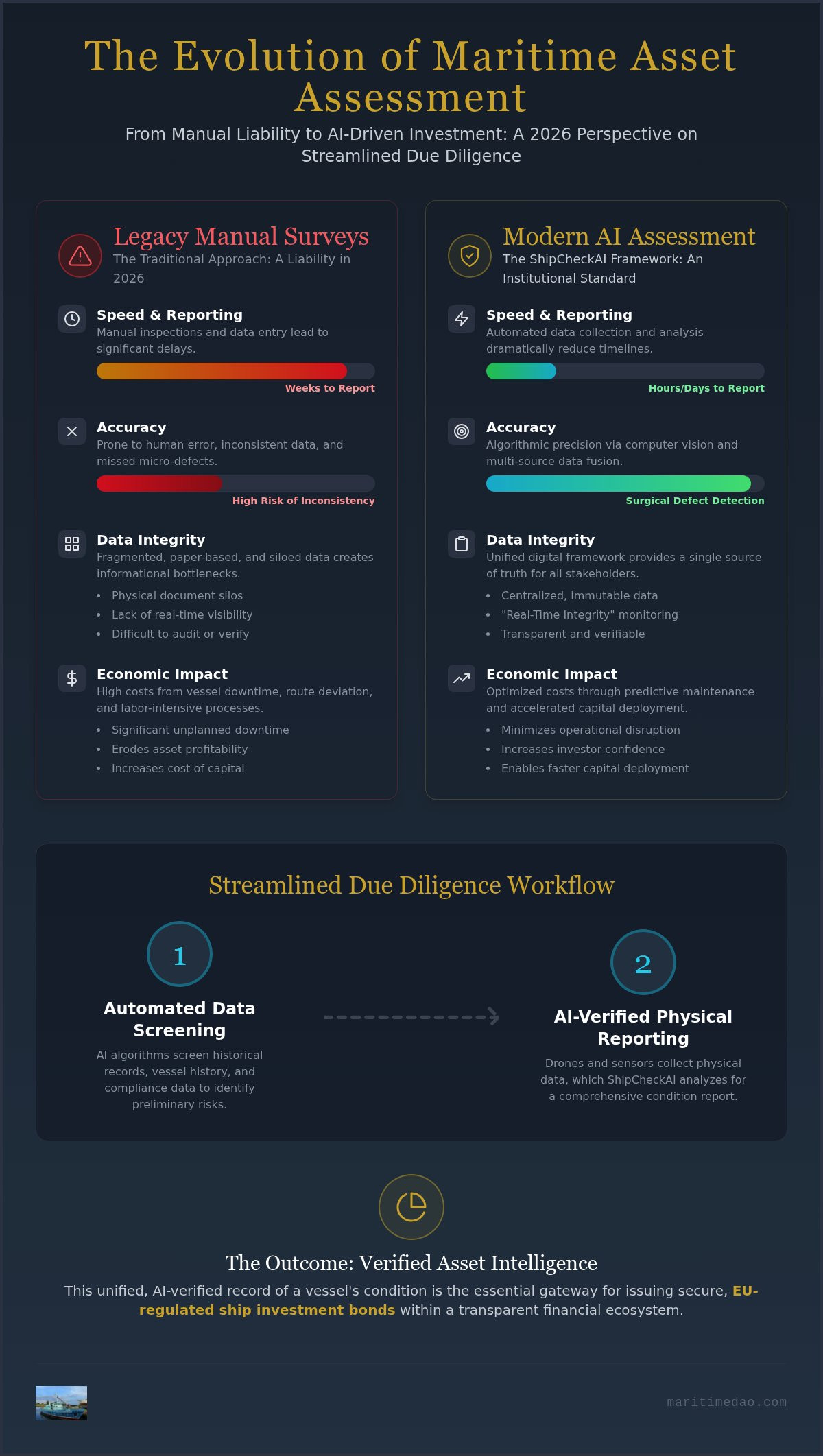
A Step-by-Step Workflow for Streamlined Asset Due Diligence
The transition from manual surveys to a streamlined maritime asset assessment requires a methodical, software-driven blueprint. In 2026, the process is no longer a series of isolated events but a continuous, integrated pipeline that connects physical vessel health to financial governance. This workflow ensures that every data point, from engine vibration to carbon intensity, is captured with institutional-grade precision. By following a structured five-step approach, shipowners and investors can eliminate the ambiguity that typically stalls capital markets.
- Step 1: Initial digital screening and historical data ingestion. The system analyzes the vessel’s track record, including its Carbon Intensity Indicator (CII) performance against the 2026 reduction factor of 11% relative to the 2019 baseline.
- Step 2: Deployment of ShipCheckAI for multi-type physical assessment. Autonomous drones and sensors scan the hull and machinery, detecting potential failures with a 95% accuracy rate.
- Step 3: Verification of technical data against EU financial regulation standards. Captured metrics are cross-referenced with EU ETS requirements, ensuring the asset can meet the 100% emission surrender rate mandated for 2026.
- Step 4: Generation of the investment-grade condition report. A unified digital record is compiled, providing a transparent view of the asset’s current value and future depreciation risks.
- Step 5: Integration into the bond issuance governance layer. The verified report is anchored to the blockchain, serving as the collateral foundation for EU-regulated ship investment bonds.
Aligning Technical Data with EU Financial Regulations
Technical data is only valuable to an institutional investor if it translates into regulatory compliance. For EU-regulated ship investment bonds, the due diligence process must account for the FuelEU Maritime regulation and the EU Green Bond Standard (EuGB). ShipCheckAI outputs map directly to these compliance checklists, transforming raw sensor data into actionable financial intelligence. This alignment is critical for maintaining high LTV ratios and securing favorable interest rates in a competitive market. For a comprehensive list of these requirements, consult the Maritime Investment Compliance standards.
Standardizing Reports for Global Capital Deployment
Unified reporting formats are the cornerstone of fractional ownership and global maritime debt markets. When reports are standardized, the Maritime DAO can validate assessment outcomes with surgical precision, reducing the risk of data manipulation in distressed asset sales. This level of transparency increases investor confidence, as stakeholders don’t have to decipher disparate survey formats from various jurisdictions. It’s this consistency that allows for the rapid issuance of tokenized bonds, similar to the LOTOSS Bonds approved in March 2026. To begin the process of digitizing your fleet’s due diligence, explore the Maritime DAO ecosystem to see how a streamlined maritime asset assessment can unlock new avenues for capital.
The Future of Maritime Finance: Assessment-Backed Bond Issuance
The adoption of a streamlined maritime asset assessment framework is the essential gateway to the Maritime DAO ecosystem. It’s no longer enough to conduct an inspection only at the point of sale; the future of maritime finance depends on continuous, AI-verified transparency. This structural shift allows institutional stakeholders to move away from opaque, private placements toward a unified market of liquid, assessment-backed securities. We envision a “Self-Assessing” global fleet where vessels autonomously report their operational integrity and carbon footprint directly to the governance layer, ensuring that the relationship between physical risk and financial reward is always in balance.
By modernizing evaluation protocols, the industry can finally bridge the gap between the physical world of global trade and the digital world of regulated finance. As EU ETS requirements reach a 100% surrender rate in 2026, the ability to provide immutable data on vessel performance becomes a prerequisite for any significant capital investment. ShipCheckAI doesn’t just provide a report; it provides the structural integrity needed to support complex financial instruments in a high-stakes environment.
Unifying Asset Intelligence with Bond Yields
There’s a direct correlation between the granularity of assessment data and the pricing of maritime debt. When ShipCheckAI provides real-time monitoring of a vessel’s condition, it reduces the risk premium required by bondholders. This ongoing oversight ensures that the collateral for EU-regulated bonds remains within the strict parameters required for institutional transparency, preventing the value erosion typically caused by unplanned downtime. Investors seeking to understand the secondary market implications of these structures should review the guide to EU Regulated Ship Investment Bonds.
Joining the Maritime DAO Ecosystem
Onboarding into this ecosystem requires a commitment to digital transparency and governed innovation. Asset owners gain access to a global pool of capital by integrating their fleets into a streamlined maritime asset assessment pipeline, while investors benefit from decentralized governance that protects the integrity of every technical audit. This platform acts as both a visionary architect and a reliable gatekeeper for the next generation of maritime trade, offering a secure environment for the democratization of complex financial structures. To take the first step toward modernizing your evaluation protocols and exploring institutional-grade shipping debt, consult our How to Invest in Maritime Assets guide.
Navigating the New Frontier of Maritime Capital
The transition from 20th-century manual oversight to a unified digital ecosystem is no longer a strategic choice; it’s a structural necessity for the 2026 market. By implementing a streamlined maritime asset assessment, stakeholders can finally bridge the gap between heavy industry and institutional finance with surgical precision. This shift ensures that every vessel in your portfolio is backed by AI-driven vessel integrity reports and governed within a transparent, EU-regulated compliance framework. As the industry moves toward a self-assessing global fleet, the ability to provide immutable data will define the leaders in maritime capital deployment.
To secure your position at the intersection of maritime operations and decentralized technology, you need the right tools and a governed environment. Explore EU-Regulated Ship Investment Bonds and ShipCheckAI to unlock access to institutional-grade maritime debt instruments designed for a new era of transparency. The future of global trade is being built on data that’s verified, secure, and ready for investment. We look forward to seeing your fleet lead the way in this transformative landscape.
Frequently Asked Questions
What is streamlined maritime asset assessment?
Streamlined maritime asset assessment is a unified digital workflow that integrates physical vessel condition reporting with institutional financial governance. Unlike traditional surveys that rely on manual notes and subjective expert opinion, this framework utilizes automated intelligence to create a transparent, real-time record of an asset’s health. This approach eliminates the data silos that typically delay capital deployment in the maritime sector.
How does AI improve the accuracy of ship inspections?
AI enhances accuracy by utilizing computer vision and advanced sensors to identify structural anomalies, such as micro-corrosion or hull fractures, that often escape the human eye. In 2026, AI-powered systems like ShipCheckAI demonstrate a 95% success rate in detecting potential engine failures before they occur. This predictive capability transforms raw technical data into a reliable source of truth for investors and regulators alike.
Are AI-driven vessel reports accepted by EU regulators?
Yes, AI-driven reports are increasingly recognized as the gold standard for meeting the granular data requirements of EU financial regulations. Frameworks like the EU Green Bond Standard (EuGB) and the EU ETS mandate high levels of transparency that traditional surveys can’t provide. These automated reports map directly to regulatory compliance checklists, ensuring that vessel data is verifiable and ready for institutional bond issuance.
How much time can ShipCheckAI save in the due diligence process?
ShipCheckAI significantly accelerates the due diligence timeline by reducing the standard time-to-report from several weeks to under 48 hours. By processing multiple inspection types simultaneously, the platform eliminates the need for lengthy vessel deviations or idle periods. This efficiency can reduce unplanned downtime by up to 50%, allowing for much faster capital deployment and more agile portfolio management.
What types of ship inspections can be streamlined with AI?
A wide array of technical audits can be optimized through a streamlined maritime asset assessment, including pre-purchase surveys, annual condition reports, and hull integrity scans. The platform also automates emissions monitoring for CO2, methane, and nitrous oxide, which is critical for 2026 EU ETS compliance. This comprehensive approach ensures that every operational and environmental metric is captured within a single, unified digital framework.
How does Maritime DAO secure vessel assessment data?
Maritime DAO secures vessel data by anchoring every assessment report to a decentralized blockchain ledger. This process creates an immutable and transparent record that can’t be manipulated or altered after the inspection is complete. By utilizing decentralized governance, the ecosystem ensures that the relationship between the physical vessel and its digital twin remains secure, providing institutional-grade integrity for all stakeholders.
Can streamlined assessment help in securing lower maritime bond rates?
Yes, the increased accuracy and transparency of AI-driven assessments directly reduce the risk premium required by institutional lenders. When investors have access to real-time, verifiable condition data, they’re more likely to offer favorable bond rates and higher loan-to-value (LTV) ratios, which typically range between 60% and 80% for modern tonnage. This reduction in the cost of capital is a direct result of enhanced asset governance.
What is the role of decentralized governance in asset evaluation?
Decentralized governance acts as both a visionary architect and a reliable gatekeeper for the asset evaluation process. It provides a methodical framework for validating inspection outcomes and ensures that assessment data remains independent from the influence of any single party. This structural integrity prevents data manipulation in distressed asset sales, fostering a more inclusive and transparent environment for global maritime investments.