
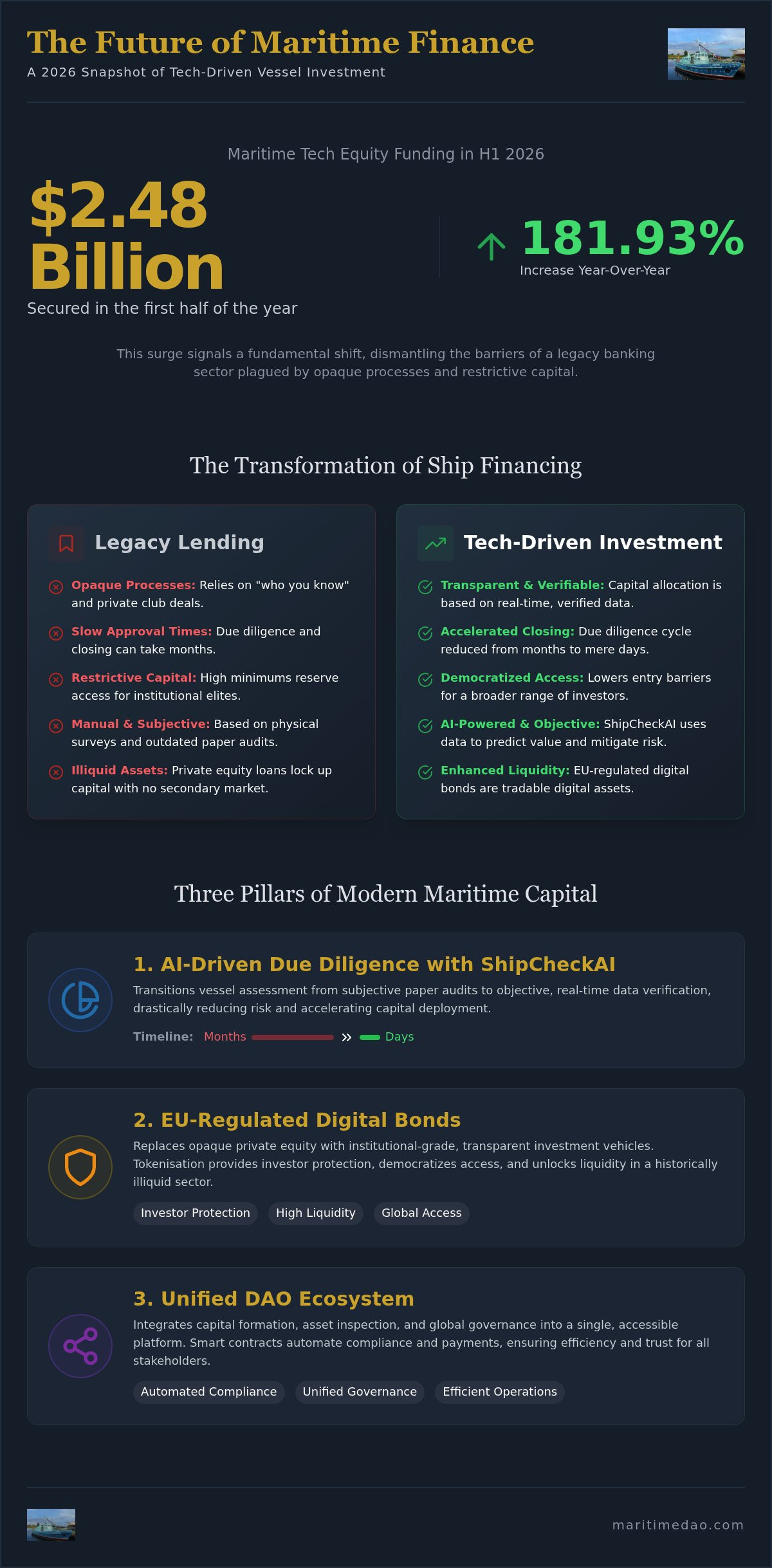
In the first half of 2026, maritime tech companies secured $2.48 billion in equity funding, marking a staggering 181.93% increase compared to the same period last year. This surge signals a fundamental shift as maritime investment technology dismantles the barriers of a legacy banking sector that’s long relied on opaque valuation processes and restrictive capital requirements. You’ve likely experienced the frustration of slow approval times from traditional lenders or the persistent lack of real-time asset monitoring that often makes ship financing feel like a black box.
This article explores how AI-driven inspections and EU-regulated digital bonds are transforming vessel financing into a transparent, high-tech investment ecosystem. We’ll detail how automated due diligence, institutional-grade governance, and accessible capital structures unite to modernize the industry. You’ll learn how these technological pillars integrate to deliver faster closing times, lower risk through ShipCheckAI verification, and a unified gateway to EU-regulated investment vehicles that were once reserved for a small circle of institutional elites.
Key Takeaways
- Understand how the integration of AI and blockchain creates a more resilient, transparent framework for vessel financing in 2026.
- Discover how maritime investment technology utilizes predictive AI and decentralized governance to solve the systemic inefficiencies of traditional ship lending.
- Learn why EU-regulated digital bonds are replacing legacy private equity loans by lowering entry barriers and offering institutional-grade transparency.
- See how ShipCheckAI transitions due diligence from subjective paper audits to objective, real-time data verification for lower-risk capital allocation.
- Explore the strategic benefits of a DAO structure for unifying capital, asset inspection, and global governance into a single, accessible platform.
The Evolution of Vessel Financing Technology in 2026
Maritime capital is currently undergoing a structural renovation. In 2026, the definition of maritime investment technology has expanded beyond simple digital ledger entries to include a unified ecosystem of artificial intelligence, blockchain governance, and IoT-enabled asset tracking. Traditional ship finance, once dominated by a handful of European banks and bilateral club deals, is struggling to meet the demands of a global fleet now valued at over 2.3 trillion dollars. These legacy institutions often rely on manual, relationship-based lending that fails to account for rapid regulatory shifts, such as the 2026 EU ETS allowance surrender deadlines or the new emission control requirements in the Canadian Arctic and Norwegian Sea.
The industry is moving away from the “who you know” model toward a system of data-verified capital allocation. This transition replaces opaque private equity loans with transparent, high-tech investment vehicles. By integrating real-time operational data with automated compliance checks, shipping becomes a more viable alternative investment for a broader range of global stakeholders. This new era is built on three distinct pillars: automated due diligence, smart contract governance, and real-time asset monitoring. These systems unite to provide a level of structural integrity that traditional lenders simply can’t match in the current high-speed market.
From Manual Surveys to AI-Driven Risk Assessment
The technical audit is no longer a bottleneck. Legacy lenders used to wait weeks for physical surveys that were often outdated by the time a loan closed. Today, ShipCheckAI utilizes machine learning to predict vessel depreciation and market value by analyzing multi-type inspection logs against real-time operational data. By simulating ship performance through digital twins, lenders can visualize risk profiles before capital is ever deployed. This reduces the due diligence cycle from months to days, ensuring that AI in maritime due diligence is the new baseline for institutional-grade financing.
The Rise of Regulated Digital Maritime Bonds
Tokenisation has matured into a core institutional standard. It’s no longer a speculative trend but a structural necessity for liquidity. EU-regulated frameworks now provide a layer of investor protection that was previously missing from the opaque world of private equity ship loans. These digital maritime bonds democratise access, allowing investors to understand how to invest in maritime assets without the high minimum thresholds of traditional banking clubs. By converting physical vessels into regulated digital assets, the industry is unlocking liquidity in a sector that was historically illiquid and exclusive.
Core Technologies Driving Modern Maritime Capital Markets
The transition from relationship-based lending to data-verified capital allocation relies on a sophisticated technological foundation. While legacy institutions struggle with manual processes, modern maritime investment technology integrates artificial intelligence, blockchain, and IoT into a unified governing layer. This ecosystem doesn’t just store data; it actively validates the health and compliance of the underlying assets. For bondholders, this means moving from static quarterly reports to a dynamic environment where vessel performance, market valuation, and regulatory standing are visible in real time.
Artificial intelligence now extends far beyond simple data analysis, powering predictive maintenance models that protect the residual value of a vessel. By combining these insights with IoT-driven telemetry, platforms can provide bondholders with live data on fuel consumption, engine health, and emissions profiles. This is particularly critical in 2026, as ships of 5,000 GT and above must strictly account for CO2 and methane emissions under the expanded EU ETS and UK ETS frameworks. Smart contracts automate the operational heavy lifting, ensuring that interest payments and compliance reporting are executed without the delays inherent in traditional banking systems.
AI Ship Inspection Tools: The Data Foundation
The integrity of any maritime bond rests on the physical condition of the ship. Traditional surveys are often subjective and prone to human error, but AI ship inspection tools like ShipCheckAI eliminate this bias. By integrating multi-type inspections-including pre-purchase audits, condition reports, and hull assessments-into a single high-fidelity report, lenders gain a comprehensive view of the asset. There’s a direct correlation between this high-fidelity data and more favorable financing terms. When risk is quantified through objective AI verification, the uncertainty that typically drives up interest rates is significantly reduced.
Decentralised Governance in Maritime Finance
Governance is the bridge between digital innovation and institutional reliability. The maritime DAO investment model provides a unified framework for global stakeholders to participate in collective ownership with total transparency. Unlike opaque private equity structures, a DAO ensures that every capital deployment and management decision is recorded on an immutable ledger. This isn’t just a technical achievement; it’s a legal one. With jurisdictions like the Marshall Islands recognizing DAOs as separate legal entities as of late 2025, the industry now has a robust bridge between decentralized technology and traditional maritime law. To see this governance in action, you can explore the Maritime DAO ecosystem and its regulated bond structures.
Comparing Legacy Lending with Tech-Driven Investment Bonds
Traditional ship finance has long operated as an exclusive club, where $15M minimum transactions and 60% LTV caps are the standard. This legacy model relies on manual paper trails and annual audits that offer little visibility into a vessel’s daily operational health. In contrast, maritime investment technology utilizes digital asset-backed securities to provide a more flexible, data-driven alternative. These modern platforms replace the opaque relationship-based lending of the past with a transparent ecosystem where capital is allocated based on verified asset performance rather than historical banking ties.
The cost of capital is also shifting. While top-tier owners might secure bank rates at 100-150 basis points over SOFR, the rigid requirements often exclude high-potential projects. Tech-enabled platforms offer more competitive yields by stripping away the layers of administrative overhead and intermediary fees that plague traditional institutions. By automating the verification process, these platforms can deliver capital at a lower cost to the shipowner while providing higher risk-adjusted returns to the investor. This structural shift moves maritime debt from a restricted, illiquid asset into a high-tech investment ecosystem.
Speed and Efficiency in Capital Deployment
The delta in operational speed is profound. A traditional bank approval process can easily stretch across six months, requiring endless rounds of manual documentation and committee reviews. Modern platforms utilize smart contracts to execute financing in as little as 48 hours once the asset data is verified. This efficiency is driven by a streamlined maritime investment compliance framework that automates KYC/AML checks. By removing these manual bottlenecks, cross-border vessel financing becomes a seamless digital transaction rather than a bureaucratic ordeal.
Investor Accessibility and Liquidity
Accessibility was historically the greatest barrier to maritime capital. Fractionalisation has changed this, allowing for smaller, more diversified portfolios that were previously impossible for non-institutional players. Instead of single-ship exposure, investors can now participate in diverse vessel pools, significantly mitigating risk. The emergence of secondary markets for EU regulated ship investment bonds further enhances this ecosystem by providing liquidity in a sector that was once synonymous with locked-in capital. This democratisation ensures that maritime debt is no longer a restricted asset class but an accessible, liquid component of a modern investment strategy.
Implementing AI-Driven Due Diligence for Vessel Assessments
The integrity of maritime investment technology depends entirely on the quality of the underlying asset data. In the past, lenders relied on subjective manual surveys that often failed to capture the true technical health of a vessel. Today, the industry has shifted toward objective, AI-verified condition reports. This transition is not merely about efficiency; it’s about structural transparency. By standardizing inspection data across diverse vessel types, including tankers, bulkers, and container ships, platforms can provide a unified risk assessment that was previously impossible. Hard data replaces gut feeling.
Institutional-grade capital now demands this level of precision. Implementing AI in maritime due diligence has become a standard requirement for issuing regulated bonds in 2026. AI models excel at detecting minute structural anomalies, such as early-stage hull fatigue or hidden corrosion, that human inspectors might overlook during a standard walk-through. This objective layer of verification ensures that bondholders aren’t just trusting a relationship. They are instead relying on hard, audited data that is resistant to human bias or error.
ShipCheckAI: A Multi-Type Inspection Framework
ShipCheckAI serves as the essential multi-type inspection framework that powers this new due diligence standard. It integrates high-resolution drone footage and real-time sensor data into sophisticated AI valuation models. This process creates the comprehensive technical assessment necessary for bond issuance. Every finding is recorded on a blockchain, creating a tamper-proof history of the ship’s condition. This immutable record provides a permanent technical passport for the vessel. It ensures that the ship’s history cannot be manipulated to inflate market value or hide past repairs.
From Condition Reports to Financial Risk Profiles
Converting technical data into financial risk profiles is the final step in modernizing maritime capital. By translating ship condition into standardized credit scores, platforms can predict future performance with institutional accuracy. This continuous assessment directly impacts insurance premiums and bond yields. When a vessel is monitored in real time, the risk of sudden asset-backed security value degradation is minimized. This systematic approach maintains the structural integrity of the entire investment ecosystem. To see how these assessments protect capital, you can explore the ShipCheckAI integration within the Maritime DAO platform.
The Maritime DAO Ecosystem: Navigating Regulated Innovation
The Maritime DAO represents the structural culmination of the technological pillars discussed throughout this guide. It unifies financing, inspection, and governance into a single, cohesive platform that functions as a gateway to global trade. By utilizing maritime investment technology to orchestrate these distinct services, the ecosystem replaces fragmented legacy processes with a unified governing layer. This decentralized approach ensures that every stakeholder, from institutional bondholders to individual investors, operates within a transparent framework where capital deployment is governed by code and verified by data.
The strategic advantage of understanding how to invest in maritime assets through a DAO structure lies in its inherent efficiency and scalability. Unlike traditional ship finance models that are often restricted by national borders or bureaucratic bottlenecks, a DAO operates globally while remaining strictly compliant with evolving digital asset regulations. In 2026, this includes full alignment with the Markets in Crypto-Assets (MiCA) regulation and other EU frameworks, providing a level of legal certainty that previous iterations of blockchain finance lacked. The future roadmap for tech-enabled capital points toward a fully automated industry where vessel performance directly triggers financial executions without manual intervention.
EU-Regulated Ship Investment Bonds: A Compliant Framework
Regulatory compliance is not an afterthought; it’s the cornerstone of the ecosystem. Every bond issued within the platform is governed by an EU-regulated framework that provides robust protection for capital. This process ensures that capital allocation occurs within a transparent, governed environment where legal and technological safeguards work in tandem. By bridging the gap between traditional maritime law and decentralized technology, the platform offers a secure vehicle for institutional and private capital to flow into the global shipping fleet with minimized counterparty risk.
Getting Started with Vessel Financing Technology
For shipowners and investors ready to transition away from legacy banking, the onboarding process is methodical and data-driven. Shipowners can list their assets for financing by initiating a technical audit through the platform. This is where ShipCheckAI plays its most critical role, providing the objective technical baseline required for any new vessel to enter the ecosystem. Investors can then access the Maritime DAO platform to browse verified opportunities and participate in bond issuances. To begin the transition, stakeholders should follow these actionable steps:
- Vessel Technical Audit: Initiate a multi-type AI inspection to establish a verified condition report.
- Asset Tokenisation: Convert physical vessel equity or debt into regulated digital bonds.
- Governance Participation: Use the DAO structure to monitor asset performance and participate in management decisions.
- Compliance Verification: Ensure all participants meet the automated KYC/AML standards required for EU-regulated vehicles.
The Future of Regulated Maritime Capital
The transition toward a data-verified maritime economy is no longer a distant vision; it’s a structural reality. By integrating AI-driven due diligence with decentralized governance, maritime investment technology has successfully bridged the gap between the physical world of global trade and the digital world of institutional finance. Shipowners and investors are no longer tethered to the slow, opaque cycles of legacy banking. Instead, they operate within a unified ecosystem where every asset’s condition is verified by ShipCheckAI, every transaction is secured by an EU-regulated framework, and every decision is guided by institutional-grade transparency. This evolution provides the structural integrity required to democratize access to high-stakes capital while maintaining the sober reliability that global shipping demands. It’s a first-of-its-kind architecture designed to govern, unify, and open up opportunities across the entire maritime sector. You can now engage with a system that values security as much as it values innovation.
Explore EU-Regulated Ship Investment Bonds on Maritime DAO
The opportunity to modernize your approach to maritime capital and participate in a more transparent, efficient future is here. We look forward to seeing you at the forefront of this new financial frontier.
Frequently Asked Questions
What is vessel financing technology and how does it differ from traditional banking?
Vessel financing technology is an integrated ecosystem that replaces manual banking processes with automated due diligence, blockchain governance, and real-time asset monitoring. Unlike traditional banking, which relies on relationship-based lending and slow paper audits, this high-tech approach uses data-verified capital allocation to increase speed and transparency. It transitions the maritime sector from an exclusive club into an accessible, institutional-grade investment environment.
How does AI improve the accuracy of ship inspections for financing?
AI improves inspection accuracy by eliminating human bias and detecting structural anomalies that manual surveys often miss. By analyzing high-resolution drone footage and sensor data, machine learning models provide objective assessments of hull integrity and engine health. This shift to automated intelligence ensures that financing decisions are based on the actual technical condition of the asset rather than subjective reports.
Are EU-regulated ship investment bonds safe for retail investors?
EU-regulated ship investment bonds provide a compliant framework that offers significant legal and technological safeguards for all participants. These instruments operate under strict transparency requirements and institutional-grade governance structures, ensuring that capital is governed by established legal frameworks. While all investments carry risk, the regulated nature of these bonds provides a level of security and order that is often absent in unregulated digital assets.
How do smart contracts automate interest payments in maritime finance?
Smart contracts automate interest payments by executing predefined code once specific conditions, such as the arrival of a payment date, are met. This removes the need for manual bank processing and reduces the risk of human error or delay in the distribution of yields. In maritime investment technology, these digital agreements ensure that bondholders receive their distributions with programmatic precision and total transparency.
What types of vessels are eligible for financing through Maritime DAO?
Eligible vessels typically include major commercial categories such as tankers, bulkers, and container ships that meet strict technical and regulatory standards. Every ship must undergo a comprehensive assessment through ShipCheckAI to verify its operational health and compliance with global environmental regulations. This vetting process ensures that only high-quality, asset-backed opportunities enter the financing ecosystem, protecting the structural integrity of the bonds.
How does ShipCheckAI handle different types of maritime inspections?
ShipCheckAI handles various inspection types, including pre-purchase audits, condition reports, and hull assessments, through a unified multi-type framework. It integrates diverse data streams, such as drone imagery and IoT telemetry, to create a comprehensive digital twin of the vessel. This allows for a standardized evaluation process that remains consistent across different ship types and global jurisdictions, providing a reliable technical passport for the asset.
What are the benefits of using a DAO for vessel ownership and governance?
A DAO provides a unified governance layer that ensures every decision regarding capital deployment and vessel management is transparent and immutable. It democratizes access to a traditionally exclusive industry, allowing global stakeholders to participate in a governed ecosystem with institutional-grade security. This model creates a bridge between the physical world of global trade and the digital world of blockchain, fostering a more inclusive and efficient capital market.
How can I verify the physical condition of a ship before investing in a bond?
You can verify a ship’s physical condition by accessing the AI-verified inspection logs and digital twins hosted on the blockchain. Every bond issuance is supported by a tamper-proof record of the vessel’s technical history, allowing you to review objective data on its structural health and performance. This level of maritime investment technology ensures that you aren’t relying on a relationship, but on hard, audited technical facts before deploying capital.