
Why should an industry that moves 90% of global trade remain locked behind the opaque doors of legacy banking and exclusive brokerage circles? For decades, maritime investment has been defined by high barriers to entry and a chronic lack of transparent vessel condition data. You’ve likely felt the frustration of managing complex jurisdictional regulations while trying to verify the physical integrity of a multi-million dollar asset. The emergence of the maritime fintech platform is finally dismantling these silos; it’s unifying ship inspection, capital allocation, and compliance into a single, governed ecosystem.
We’ll show you how these platforms are revolutionizing the sector by bridging the gap between physical shipping assets and regulated financial markets. You’ll discover how to identify institutional-grade investment vehicles and leverage automated intelligence to streamline your due diligence. This article explores the 2026 fintech landscape, focusing on how unified data and legal frameworks like the EU AI Act are creating a more inclusive and secure frontier for global trade finance.
Key Takeaways
- Understand why the traditional, opaque models of ship finance are being replaced by data-driven ecosystems that prioritize transparency and structural integrity.
- Explore how a modern maritime fintech platform integrates asset verification, regulated financial instruments, and automated intelligence to lower barriers to entry.
- Identify the transition from speculative digital assets to EU-regulated ship investment bonds that offer institutional-grade security for global investors.
- Learn how ShipCheckAI and advanced automated intelligence mitigate risk by providing verifiable, fraud-resistant data on physical vessel conditions.
- Discover the benefits of the “Regulated DAO” model, which combines decentralized governance with established legal frameworks to protect capital and streamline operations.
The Evolution of Maritime Finance: Why Traditional Models are Changing
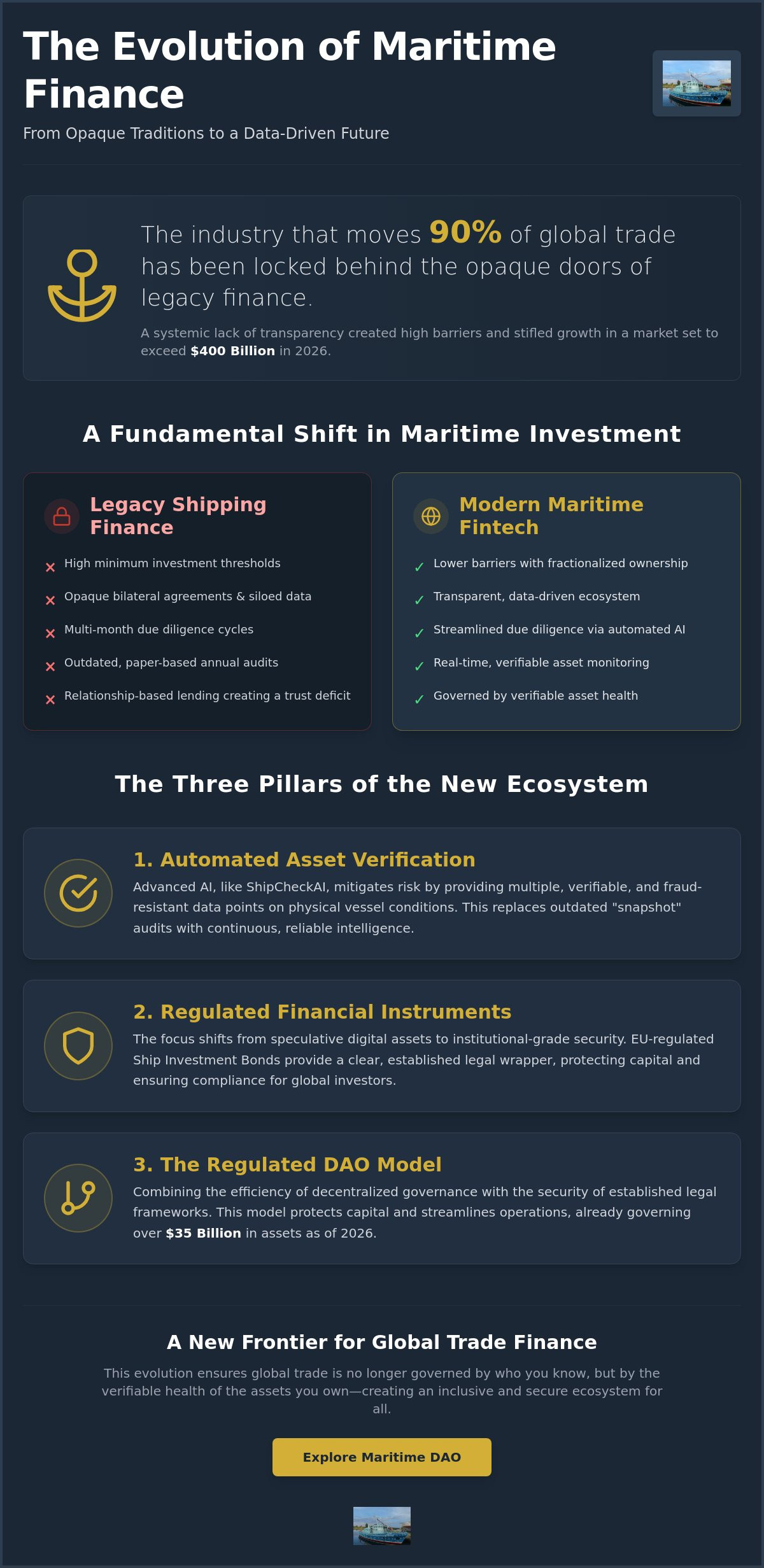
The maritime industry has long operated as a fortress of capital, accessible only to those with significant institutional backing or deep-rooted private equity connections. Historical shipping investment models relied heavily on opaque bilateral agreements and high-barrier bank loans that effectively excluded the mid-market. This exclusivity wasn’t just a matter of wealth; it was a byproduct of the fragmented data surrounding vessel inspections and operational health. When information is siloed, risk is difficult to price, leading to a natural consolidation of power among a few elite players.
2026 represents a definitive tipping point for this sector. With the ship finance market estimated to exceed $400 billion this year, the cost of systemic inefficiency has become unsustainable. We’re seeing a shift where the maritime fintech platform is no longer a peripheral experiment but a core infrastructure requirement. The demand for 24/7 liquidity in a traditionally illiquid asset class has forced a reconciliation between physical shipping operations and digital capital markets.
The Problem with Legacy Shipping Finance
Traditional finance has struggled with high minimum investment thresholds that prevent diverse participation. Investors often face multi-month due diligence cycles that delay vessel acquisitions and miss market windows. The “black box” nature of ship condition reporting has historically led to capital misallocation. Without a unified way to verify the physical state of a vessel, institutions have had to rely on annual paper-based audits that are outdated the moment they’re signed. This creates a trust deficit that complicates regulatory compliance across different jurisdictions.
Digital Transformation as a Competitive Necessity
Survival in the current market requires a transition from relationship-based lending to data-driven debt instruments. A modern maritime fintech platform replaces the uncertainty of manual reporting with real-time asset monitoring and automated intelligence. This isn’t just about efficiency; it’s about structural integrity. We’ve moved beyond the era of speculative claims into an era of governed, transparent operations.
- Ship managers can now reduce operational overhead by automating compliance workflows and reporting.
- Investors gain access to EU-regulated Ship Investment Bonds that offer a clear legal wrapper for their capital.
- Tools like ShipCheckAI provide multiple, verifiable inspections that move beyond the limitations of legacy “snapshot” audits.
This evolution ensures that global trade is no longer governed by who you know, but by the verifiable health of the assets you own. The industry is moving toward a unified ecosystem where asset verification, governance, and capital access work in concert to provide institutional-grade security for a global audience.
Defining the Modern Maritime Fintech Platform in 2026
A maritime fintech platform is far more than a simple payment gateway for crew wages or vendor invoices. It is a unified digital ecosystem that integrates maritime asset management, rigorous regulatory compliance, and direct capital market access. While early iterations of fintech in this space focused on operational banking, the 2026 landscape is defined by investment-centric platforms that utilize banking aggregation APIs from Wealthreader to facilitate the deployment of significant capital into verified vessels. It’s a shift from administrative utility to structural transformation.
This sophisticated architecture rests on three distinct pillars: Asset Verification through automated intelligence, Financial Instruments in the form of regulated debt, and Governance via decentralized structures. The maritime DAO investment model has emerged as the primary vehicle for this evolution. With over $35 billion in assets governed by DAOs in 2026, these structures allow for fractionalized ownership without sacrificing the oversight required by institutional investors. The ecosystem functions through the unification of asset verification, debt issuance, and transparent governance.
Core Components of an Institutional-Grade Platform
To achieve institutional-grade reliability, a platform must operate within established legal boundaries. This includes utilizing EU-regulated frameworks for investor protection, ensuring that capital remains secure and governed by recognized jurisdictions. AI-powered diagnostic tools, such as ShipCheckAI, provide continuous asset assessment, replacing static annual reports with a live feed of operational health. These insights are recorded on blockchain-based ledgers to create an immutable history of ownership and yield distribution. Research into sustainable maritime governance and digital technologies highlights that such integration is essential for managing the environmental and legal complexities of modern trade. With the August 2, 2026, deadline for compliance with the EU AI Act’s high-risk system requirements, these diagnostic tools must now meet the highest transparency standards.
The Integrated Ecosystem Approach
Standalone tools are rapidly being replaced by all-in-one maritime fintech platforms because fragmented data creates risk. There is a powerful synergy between real-time inspection data and bond pricing; when a vessel’s condition is transparently verified, the risk premium on the associated debt can be adjusted with surgical precision. A maritime fintech platform serves as a critical bridge between the physical world of global shipping assets and the digital landscape of regulated capital markets. By unifying these disparate elements, platforms create a more resilient and accessible financial environment. If you’re looking to explore these new structures, understanding institutional-grade maritime finance is the first step toward modernizing your portfolio.
Key Trends Shaping Maritime Fintech: Tokenization and Regulation
The transition from speculative “utility tokens” to EU regulated ship investment bonds marks the definitive maturity of the digital asset space. This isn’t just a technical upgrade; it’s a fundamental shift toward institutional-grade security and long-term capital preservation. A modern maritime fintech platform thrives by offering fractionalized access to the $14 trillion shipping industry, allowing both retail and accredited investors to participate in an asset class once reserved for an exclusive circle of institutional players. By utilizing smart contracts for automated yield distribution, these platforms eliminate the administrative friction and human error that have historically plagued maritime dividends.
The Move Toward Regulated Maritime Debt
In 2026, asset-backed securities are significantly outperforming traditional shipping equity in the private credit markets. This preference stems from the clarity provided by European regulations like MiCA, which have standardized how digital debt is issued, governed, and protected. Regulation has become a competitive feature rather than a hurdle, providing the structural integrity required for large-scale capital deployment from institutional funds. These bonds offer a structured exit strategy, giving investors a clear timeline and legal recourse that speculative digital assets never could. It’s about building a reliable bridge between legacy finance and decentralized efficiency, where every bond is anchored to a physical, revenue-generating hull.
Transparency Through Tokenization
Tokenization serves as more than just a means of division; it’s a powerful tool for secondary market liquidity and price discovery. Historically, maritime assets suffered from a heavy “illiquidity discount” because selling a fraction of a vessel was a legal and administrative nightmare. A maritime fintech platform solves this by creating a transparent, liquid environment where tokens can be traded on regulated exchanges with minimal slippage. Bondholders now benefit from real-time auditing, using the platform to track vessel performance, fuel consumption, and charter rates as they happen. This level of granular oversight ensures that the relationship between the physical asset and the digital representation remains absolute, verifiable, and governed by code. Achieving this level of accountability requires a comprehensive commitment to maritime investment transparency, which has become an essential, verifiable asset-protection standard in 2026.
Operational Integrity: Why AI and Regulation are Non-Negotiable
The primary objection to any maritime fintech platform is the inherent trust gap between a digital interface and a physical vessel. Investors frequently ask how they can trust the digital representation of a ship that is thousands of miles away. Historically, maritime finance relied on subjective human surveys that were prone to bias, error, or even intentional misrepresentation. By integrating AI in maritime due diligence, the industry is moving from a system of assumed trust to one of verifiable, objective truth. This transition ensures that the digital data accurately reflects the physical reality of the asset, providing a secure foundation for capital deployment.
Regulatory compliance serves as the essential trust layer for global stakeholders. It isn’t enough to have good data; that data must be governed by a legal framework that protects investors and ensures accountability. In 2026, the intersection of automated intelligence and strict jurisdictional oversight has created a “regulated innovation” environment where fraud is significantly harder to execute. This structural integrity is what allows institutional capital to enter the space with confidence, knowing that both the asset and the investment vehicle are under constant, transparent scrutiny. Institutional stakeholders navigating overlapping EU ETS mandates, FuelEU Maritime reporting, and IMO standards will find that a comprehensive approach to maritime investment compliance is now an indispensable component of any credible capital deployment strategy.
ShipCheckAI and Asset Verification
ShipCheckAI represents a fundamental shift in how the industry handles vessel integrity. Rather than relying on a single, static survey, the platform conducts multiple ship inspection types via automated AI systems that analyze everything from structural thickness to operational telemetry. This objective approach dramatically reduces human error in pre-purchase and statutory surveys, which have historically been the “black boxes” of ship finance. There’s a direct correlation between high-quality, AI-verified inspection data and lower insurance premiums. Insurers and lenders now prioritize assets that maintain a transparent, continuous record of health, as it significantly lowers the risk profile of the entire investment.
The Compliance Framework
Operational integrity requires a robust legal wrapper. Utilizing a maritime inspection compliance tool is now standard practice to ensure bond security and meet the rigorous demands of institutional auditors. These platforms incorporate advanced KYC/AML standards, ensuring that while the environment is decentralized, it remains fully compliant with international financial laws. With the August 2, 2026, deadline for the EU AI Act’s high-risk system requirements, these transparency measures are no longer optional. AI-driven data verification is the only way to scale maritime fintech safely. To understand how these systems protect your interests, you can review our regulated maritime investment bonds.
Maritime DAO: The Logical Conclusion of Maritime Fintech
The Maritime DAO represents the structural synthesis of the technological and financial advancements defining the modern era. It functions as the operational layer where EU-regulated ship investment bonds converge with the diagnostic precision of ShipCheckAI technology. This model isn’t a speculative experiment. It’s a governed ecosystem that identifies systemic inefficiencies and provides a high-tech, legally sound solution for institutional-grade capital deployment. By unifying asset verification, debt issuance, and capital allocation, the maritime fintech platform ensures that every investment is backed by a verifiable, physical hull.
The Maritime DAO Ecosystem
This ecosystem serves as a unified gateway for both capital deployment and continuous vessel assessment. Unlike traditional models where investors are passive observers, a Regulated DAO empowers stakeholders through transparent governance. Community members participate in defining risk parameters and governing asset selection, ensuring that the collective interest remains aligned with structural integrity. This model is particularly superior for cross-border maritime asset management; it utilizes smart contracts to execute complex jurisdictional requirements while maintaining a single, immutable record of truth. With over $35 billion in assets already governed by DAOs in 2026, the shift toward decentralized but regulated oversight is well underway.
Future Outlook: Shipping Finance in the Digital Age
The trajectory of this sector suggests a massive expansion. Projections for the tokenized real-world asset (RWA) market indicate a potential reach of $16 trillion by 2030, with maritime assets forming a critical pillar of this growth. Getting started with EU-regulated ship investment bonds is the first step toward securing a position in this evolving landscape. It’s a move away from the “black box” of legacy finance and toward a future defined by order, security, and democratization. The relationship between physical assets and digital governance is now clearly understood, providing a path for capital to flow with surgical precision.
If you’re ready to transition from a spectator to a participant in this new era, learning how to invest in maritime assets through a regulated maritime fintech platform is essential. The bridge between heavy industry and high finance has been built. Join the evolution of maritime finance and take your place in a transparent, governed, and high-stakes financial frontier.
Navigating the Future of Regulated Maritime Capital
The transition toward a unified maritime fintech platform is no longer a theoretical projection; it’s a structural necessity for the 2026 global economy. We’ve moved beyond the era of fragmented data and exclusive high-barrier lending into a landscape defined by transparency and institutional-grade security. By integrating automated intelligence with established legal frameworks, the industry is finally bridging the gap between physical assets and digital capital markets. This evolution ensures that global trade finance is no longer governed by proximity or heritage, but by the verifiable health of the assets themselves.
This new paradigm empowers a global audience to participate in the $14 trillion shipping sector through a first-of-its-kind regulated maritime DAO structure. It’s a methodical ecosystem that provides the structural integrity required for significant capital deployment. The era of the “black box” in shipping finance has been replaced by a transparent, governed, and unified frontier that values order above speculation. Explore Regulated Maritime Investment with Maritime DAO to leverage our EU-regulated financial framework and proprietary ShipCheckAI technology as you modernize your portfolio. The future of maritime finance is here, and it’s built on a foundation of absolute transparency.
Frequently Asked Questions
What is a maritime fintech platform and how does it work?
A maritime fintech platform is a unified digital ecosystem that bridges the gap between physical shipping assets and global capital markets. It works by integrating automated asset verification, regulated debt instruments, and decentralized governance into a single, transparent structure. This architecture allows investors to deploy capital with institutional-grade security while vessel owners gain access to a broader, more liquid pool of financing.
Are maritime fintech investments regulated by the EU?
Yes, institutional-grade platforms operate within established legal frameworks such as the Markets in Crypto-Assets (MiCA) regulation and the EU AI Act. Ship investment bonds are structured as regulated debt instruments, ensuring that capital is governed by recognized jurisdictional standards. This “regulated innovation” approach provides the legal recourse and transparency necessary for significant financial commitments in a high-stakes industry.
How does ShipCheckAI improve the security of maritime bonds?
ShipCheckAI enhances bond security by replacing subjective human surveys with objective, multi-layered data analysis. It provides an immutable record of a vessel’s structural integrity and operational health, ensuring that the bond is anchored to a verified physical asset. This continuous monitoring reduces the trust gap and prevents the capital misallocation often seen in traditional, opaque shipping finance models.
Can retail investors participate in maritime fintech platforms?
Fractionalization allows both retail and accredited investors to participate in a maritime fintech platform. By lowering the historically high minimum investment thresholds, these platforms democratize access to the $14 trillion shipping industry. This inclusivity is managed through automated compliance tools that ensure all participants meet necessary KYC and AML requirements within a regulated environment.
What are the risks of investing in a maritime DAO?
Primary risks include shipping market volatility, operational asset failure, and shifts in geopolitical trade routes. A regulated DAO addresses these concerns through transparent governance and legal wrappers that provide structural order. Unlike speculative digital assets, a regulated DAO prioritizes asset-backed security and methodical risk management to protect stakeholder interests through automated reporting.
How do tokenized ship bonds differ from traditional shipping stocks?
Tokenized ship bonds are debt instruments with structured yields and defined maturity, whereas shipping stocks represent equity in a larger corporation. Tokenization provides 24/7 secondary market liquidity and real-time transparency, allowing bondholders to track vessel performance directly. This model reduces the traditional “illiquidity discount” and provides a clearer exit strategy than volatile maritime equities.
What types of ship inspections can be performed via AI?
AI platforms perform structural thickness assessments, operational telemetry analysis, and statutory compliance audits. These systems analyze vast amounts of data to identify wear, predict maintenance needs, and verify environmental governance standards. This move toward continuous, automated reporting ensures that the vessel’s condition is never a “black box” for its financial stakeholders.
Why is 2026 a critical year for maritime fintech adoption?
2026 is the tipping point due to the August 2 deadline for EU AI Act compliance for high-risk systems. It’s also the year the maritime DAO market has reached a mature $35 billion in governed assets. These regulatory and technological milestones have created the perfect environment for the mass adoption of integrated fintech ecosystems across the global shipping sector.