
The global shipping finance market is projected to reach $114.8 billion by 2034, yet the era of the exclusive, private bank deal is already ending. In 2026, the traditional opacity of maritime capital markets has become a significant liability for investors seeking predictable returns in a volatile global economy. You are likely familiar with the systemic friction of high entry barriers, the lack of verifiable vessel data, and the intricate regulatory hurdles that have historically cordoned off this heavy industry from the broader institutional landscape.
This guide demonstrates how a unified ecosystem of regulated innovation is dismantling those barriers, replacing antiquated debt structures with transparent, AI-driven, and EU-governed financial instruments. You will discover how to access stable maritime yields through Ship Investment Bonds while utilizing ShipCheckAI to maintain rigorous, data-backed risk assessments. We will analyze the transition from speculative lending to a methodical framework that integrates automated intelligence, legal transparency, and institutional reliability to redefine the future of global trade finance.
Key Takeaways
- Understand how modern maritime capital markets are evolving from bank-led monopolies into a diversified ecosystem of transparent debt securities and institutional-grade instruments.
- Identify the structural differences between traditional shipping finance and modern regulated models to navigate historical entry barriers and liquidity constraints.
- Discover how ShipCheckAI utilizes automated intelligence to provide verifiable vessel data, effectively bridging the gap between physical assets and digital investment security.
- Evaluate the protective framework of EU-regulated Ship Investment Bonds to ensure your capital is governed by recognized legal standards and financial transparency.
- Master best practices for 2026 by aligning your investment horizon with specific vessel cycles and strategic global trade routes for optimized risk-adjusted returns.
What are Maritime Capital Markets in 2026?
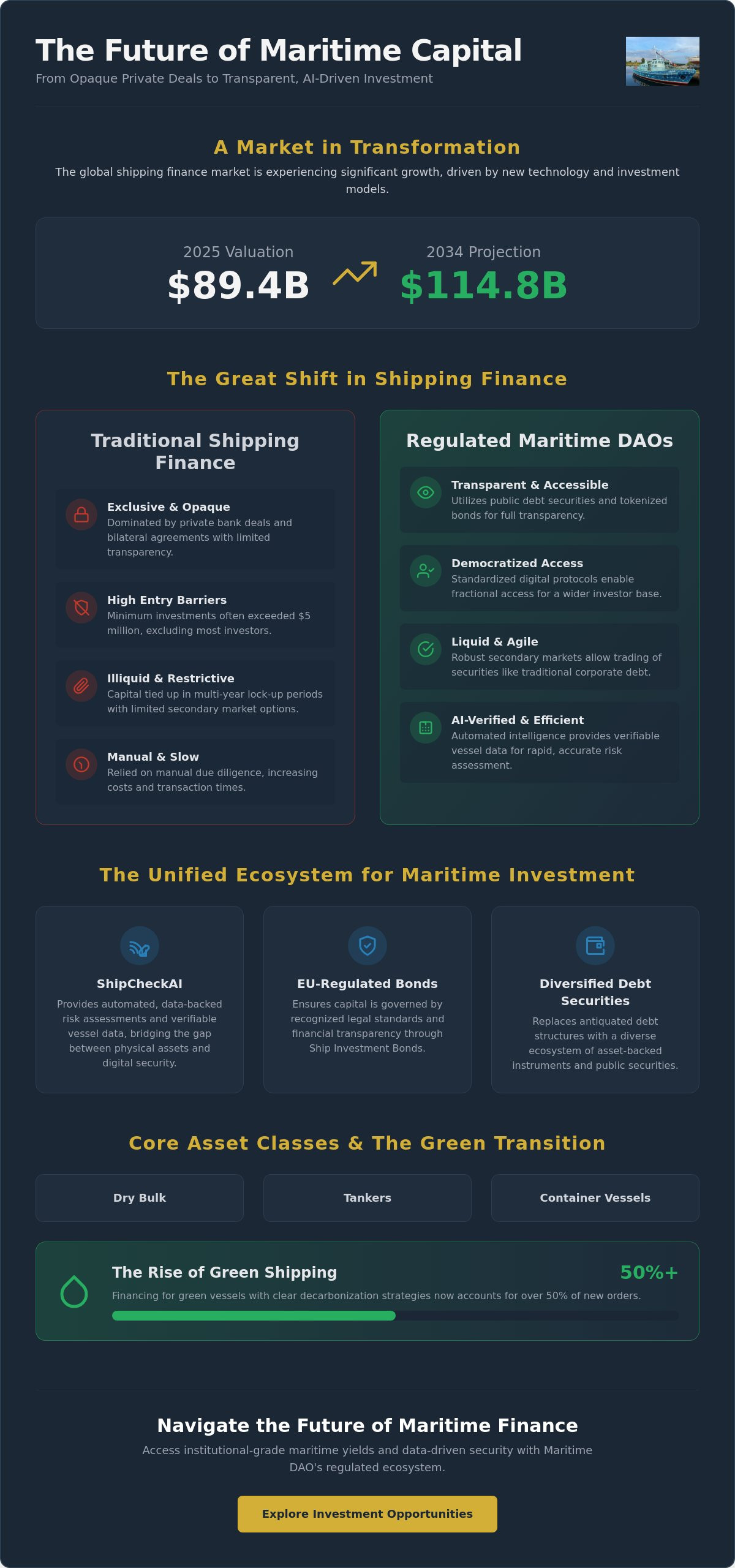
The maritime capital markets of 2026 function as a sophisticated network of institutional and retail capital designed to fuel global shipping infrastructure and vessel acquisitions. This ecosystem represents the structural backbone of international trade, providing the liquidity necessary for the physical movement of the world’s essential commodities. While the history of shipping investments was once defined by localized, private bank relationships, the current landscape has transitioned into a transparent, globalized marketplace. This evolution is driven by a fundamental shift from a market that was once 90% bank-led to a diverse mix of debt securities, asset-backed instruments, and tokenized bonds.
The global shipping finance market reached a valuation of $89.4 billion in 2025; it is now on a trajectory toward $114.8 billion by 2034. This growth is sustained by a new hierarchy of participants, including veteran ship owners, institutional bondholders, and decentralized autonomous organizations (DAOs) that govern the flow of capital. These entities unite, govern, and facilitate trade through a unified digital architecture that prioritizes transparency over the opaque handshakes of previous decades. In this environment, capital is no longer a restricted resource but a democratized tool for industrial expansion.
The Shift from Private Debt to Public Securities
Traditional bank lending has contracted significantly as regulatory capital requirements under Basel frameworks have tightened. In this environment, ship financing bonds have emerged as the primary alternative to syndicated loans. These instruments offer a tripartite value proposition: they provide ship owners with flexible capital, offer investors predictable yields, and ensure high levels of transparency through digital governance. By moving from private debt to public or semi-public securities, the maritime capital markets have effectively reduced the friction associated with cross-border maritime debt.
Core Asset Classes within Maritime Finance
Investment collateral within these markets is primarily concentrated in three core sectors: dry bulk, tankers, and container vessels. In 2026, the focus has shifted toward green shipping bonds and ESG-compliant debt, as vessels with clear decarbonization strategies now access capital on more competitive terms. Financing for green vessels now accounts for over 50% of new orders, reflecting a systemic alignment with EU financial standards. The emergence of robust secondary markets for maritime securities has further increased liquidity, allowing institutional bondholders to trade positions with the same ease as traditional corporate debt. This structural integrity ensures that maritime assets are no longer isolated but are instead fully integrated into the global financial architecture.
Traditional Shipping Finance vs. Regulated Maritime DAOs
The structural transformation of maritime capital markets has established a clear division between the legacy private debt model and the emerging framework of regulated Decentralized Autonomous Organizations (DAOs). Traditional shipping finance has historically functioned as an exclusive club, defined by high capital requirements and opaque bilateral agreements. This legacy system relies on centralized intermediaries, manual due diligence, and restrictive lock-up periods that limit capital agility. In contrast, the modern DAO-led model provides a unified ecosystem where fractional access, AI-verified condition reports, and EU-regulated governance protocols converge to create a more inclusive financial environment.
Institutional Barriers to Entry
For decades, retail and mid-market investors were systematically excluded from maritime assets due to prohibitive entry minimums, which frequently exceeded $5 million per transaction. The immense cost of traditional due diligence and the legal complexities of cross-border maritime structuring made small-scale participation impossible. Adopting a maritime DAO investment strategy eliminates these structural overheads by utilizing standardized digital protocols. This shift enables investors to access high-value assets without the friction of multi-year lock-up periods or the necessity of a massive balance sheet, effectively democratizing a once-sequestered industry. The 2026 trend of maritime investment for retail investors demonstrates precisely how these structural changes are opening institutional-grade opportunities to a far broader pool of capital allocators.
Transparency and Governance Comparison
Centralized decision-making in traditional finance often leads to significant information asymmetry, where only the primary lenders possess a true understanding of a vessel’s operational health. While legacy audits are typically annual and paper-based, modern DAOs leverage real-time asset monitoring and automated intelligence. Many of these advancements align with the 2024 Shipping and Logistics Trends that predicted a surge in industry-wide digitalization. Governance is now managed through immutable smart contracts that automate dividend distribution and voting rights, replacing manual processing with algorithmic precision. This ensures that every bondholder operates within a transparent, governed, and secure framework.
Assessing the risk profile of these two models reveals a fundamental shift from speculative equity stakes to stable, asset-backed debt instruments. While legacy models often carried the high-stakes risk of physical ship ownership, modern EU-regulated instruments prioritize security and predictable yields. If you’re seeking to diversify your portfolio with institutional-grade assets, exploring the potential of EU-regulated Ship Investment Bonds offers a path toward stable maritime yields within a compliant architecture. This transition from opaque private debt to transparent public securities represents the most significant evolution in maritime capital markets since the inception of containerization.
The Role of AI and Data in Maritime Capital Efficiency
Systemic information asymmetry has long been the primary barrier to capital efficiency within maritime capital markets. Historically, the physical distance between an investor and their collateral meant that vessel condition reports were often outdated, subjective, or incomplete by the time a transaction reached closing. This lack of real-time visibility forced lenders to price in significant risk premiums, which ultimately increased the cost of capital for ship owners and reduced the predictability of yields for bondholders. In 2026, the integration of automated intelligence and real-time telemetry has fundamentally solved this transparency gap, transforming shipping finance into a data-driven discipline.
Modern capital efficiency is now defined by the ability to integrate physical asset performance directly into financial modeling. By utilizing predictive maintenance protocols, the ecosystem can protect collateral value before mechanical failures occur. This shift from reactive to proactive risk management ensures that the underlying assets of EU-regulated Ship Investment Bonds maintain their structural integrity and revenue-generating potential throughout the duration of the debt cycle.
ShipCheckAI: A New Standard for Vessel Assessment
ShipCheckAI represents a critical evolution in how the industry conducts technical due diligence. This platform performs multi-dimensional inspections that go beyond surface-level checks, utilizing multiple inspection layers to verify the operational health of a vessel. By synthesizing these data points, the system creates a “digital twin” for investors, providing a persistent and verifiable record of the ship’s condition. Utilizing AI in maritime due diligence allows for the rapid generation of asset-backed securities, significantly reducing the time-to-issuance for maritime bonds. This automated survey process replaces weeks of manual auditing with near-instantaneous, algorithmic verification, ensuring that capital can move at the speed of global trade.
Data-Driven Risk Mitigation
The correlation between inspection accuracy and bond yields is now a measurable reality in the 2026 market. AI-driven systems analyze historical telemetry to predict hull degradation and mechanical failure with high degrees of precision, allowing bondholders to assess risk with institutional-grade certainty. These predictive models serve as a reliable gatekeeper, identifying potential liabilities before they impact a vessel’s chartering capacity or resale value. There is a direct link between high-fidelity data and capital preservation; portfolios that utilize ShipCheckAI reported fewer defaults and more stable yields during the volatile trade cycles of 2025. This methodical approach to risk ensures that maritime capital markets remain a safe harbor for significant capital investments, grounded in the sober reliability of automated intelligence—a data-driven standard also utilized by platforms like TickerAI for discovering stock market opportunities.
Compliance and Regulation in Modern Maritime Markets
The legal architecture of maritime capital markets has undergone a radical transformation to meet the demands of 2026. Institutional investors no longer ask if decentralized maritime finance is legal; they ask which specific jurisdiction provides the highest level of structural security. By 2026, the European Union has emerged as the global leader in this space, leveraging frameworks like the Markets in Crypto-Assets (MiCA) regulation to create a unified, transparent environment. This regulated innovation ensures that every transaction is grounded in verified legal standards—often supported by specialized bank instrument validation services—effectively neutralizing the risks associated with the speculative era of digital assets. Robust AML and KYC protocols are now integrated directly into the blockchain layer, ensuring that the global maritime investment ecosystem remains compliant with international financial oversight.
Legal clarity is further supported by the Republic of the Marshall Islands, which established a comprehensive legal framework for Decentralized Autonomous Organizations (DAOs) back in 2024. This evolution allows modern maritime entities to operate with the same institutional reliability as traditional shipping corporations while maintaining the efficiency of decentralized technology. By aligning with these recognized standards, the industry has successfully bridged the gap between the physical world of global trade and the digital world of high finance.
EU Regulated Ship Investment Bonds
EU Regulated Ship Investment Bonds represent the pinnacle of this new financial order. Unlike speculative tokens that often lack underlying asset verification, these bonds are strictly governed by European financial standards. The structural requirements for EU regulated ship investment bonds demand total transparency regarding vessel condition, ownership structures, and operational compliance. This oversight serves as a reliable gatekeeper for global maritime capital, providing a level of security that unregulated markets cannot match. Bondholders benefit from a system that unites physical industrial value, legal transparency, and institutional reliability within a single instrument.
Investor Protections and Legal Recourse
Asset-backed securities in the shipping sector are now legally tethered to real-world performance metrics. In 2026, maritime investment compliance protocols require issuers to provide real-time reporting on everything from mechanical health to environmental impact. For instance, ships calling at EU ports must now surrender allowances for 70% of their reported 2025 emissions, a mandate that is integrated directly into the bond’s risk assessment. These transparency requirements ensure that legal recourse is a functional component of the investment. If a vessel fails to meet the IMO fire safety standards or the mandatory IMDG Code amendments effective as of January 1, 2026, bondholders are protected by predefined smart contract triggers and institutional legal covenants.
Secure your portfolio within a governed ecosystem by exploring our EU-regulated Ship Investment Bonds today.
Navigating the 2026 Maritime Market: Best Practices
Successfully participating in the 2026 maritime capital markets requires a transition from speculative sentiment to methodical risk assessment. Investors must first define their investment horizon with precision. While short-term yields are typically captured through asset-backed debt instruments like EU-regulated Ship Investment Bonds, long-term asset appreciation remains tethered to the cyclical value of the physical fleet. Diversification is no longer optional; it’s a structural necessity. You should spread capital across various vessel types, such as dry bulk carriers and tankers, while considering geographic trade routes to mitigate the impact of localized geopolitical disruptions or shifting port fees.
With interest rates for new vessel financing holding at 5 to 6 percent above the Secured Overnight Financing Rate (SOFR) in 2026, the cost of capital remains a primary driver of market behavior. This environment favors investors who prioritize platforms with integrated AI due diligence tools and a clear understanding of maritime bond yield mechanics and how EU-regulated frameworks govern returns. Verifying the regulatory status of every instrument is the final, non-negotiable step. Ensuring that your maritime debt is governed by recognized European standards provides the legal structural integrity required for significant capital allocations. This methodical approach unites technical data, legal compliance, and strategic diversification into a single, cohesive investment strategy.
How to Evaluate a Maritime Investment Platform
A rigorous assessment of any maritime investment platform must focus on three pillars: governance, transparency, and liquidity. You should utilize a checklist that verifies the presence of 24/7 asset monitoring and automated reporting. Understanding how to invest in maritime assets in 2026 requires a hybrid approach that respects both traditional maritime expertise and cutting-edge financial engineering. Platforms that utilize ShipCheckAI to provide multiple inspection layers offer a superior level of risk mitigation, effectively bridging the gap between digital ownership and the physical reality of global trade operations.
The Future of Maritime Capital Markets
The trajectory of the industry points toward the comprehensive tokenization of the global merchant fleet. We’re witnessing a world where every vessel functions as a liquid, digital asset within a unified ecosystem. This merger of physical ship operations and digital capital markets creates unprecedented opportunities for institutional allocators. As the IMO’s MASS Code for autonomous ships enters its voluntary phase in July 2026, the technical and financial data layers of the industry will become even more integrated. The next steps for the maritime capital markets involve the normalization of these regulated instruments, positioning shipping finance as a transparent, high-integrity pillar of the global alternative asset landscape.
Architecting the Next Era of Global Shipping Finance
The transition within maritime capital markets has reached a critical inflection point, moving away from the exclusionary structures of the past toward a future defined by transparency and institutional reliability. We’ve analyzed how the integration of automated intelligence with rigorous legal frameworks has successfully bridged the gap between physical industrial assets and digital financial governance. This evolution ensures that risk assessment is no longer a reactive process but a proactive, data-driven discipline that protects both capital and collateral through every trade cycle.
You now have the structural tools to navigate this landscape with confidence, leveraging a tripartite ecosystem of security, efficiency, and compliance. Our asset-backed security structure is supported by an EU-regulated framework and the precision of ShipCheckAI due diligence, providing a sovereign level of oversight for every bondholder. This represents a first-of-its-kind opportunity to participate in the bedrock of global trade through a secure, methodical architecture that prioritizes order and legal integrity.
Explore EU-Regulated Ship Investment Bonds on Maritime DAO and secure your position in the evolving world of maritime finance. The horizon of global trade is open, and the infrastructure to govern it is ready for your participation.
Frequently Asked Questions
How do maritime capital markets differ from traditional stock markets?
Maritime capital markets focus on asset-backed debt and infrastructure rather than corporate equity. They provide direct exposure to the physical value of global trade through instruments secured by tangible collateral, such as specific vessels or entire fleets. Unlike traditional stock markets that react to corporate sentiment, these markets are grounded in the operational performance and intrinsic value of heavy industrial assets.
Are maritime bonds considered safe-haven assets in 2026?
Maritime bonds function as stable alternative assets that provide a hedge against inflation and equity volatility due to their link to essential global commodities. While they don’t replace traditional safe-havens like sovereign debt, they offer predictable yields rooted in the physical necessity of shipping. This industrial foundation ensures that the bonds remain resilient even when speculative digital markets experience significant fluctuations.
What is the role of a DAO in shipping finance?
A Decentralized Autonomous Organization acts as the governance layer and digital gatekeeper for modern shipping finance. It automates yield distribution, manages voting rights, and ensures that all operations follow predefined smart contracts within a unified ecosystem. This structure replaces centralized intermediaries with a transparent, governed framework that facilitates global capital flow without the administrative friction of legacy systems.
How does ShipCheckAI improve the value of ship investment bonds?
ShipCheckAI enhances bond value by providing verifiable, multi-dimensional data on the underlying vessel’s mechanical and structural health. By eliminating information asymmetry, this tool allows for precise risk assessment and prevents the pricing of unnecessary risk premiums. The resulting transparency ensures that the collateral’s integrity is documented, which directly supports the bond’s security, marketability, and institutional credibility.
Can retail investors access EU-regulated maritime debt?
Retail investors can now access institutional-grade yields through fractional ownership models introduced by the evolution of maritime capital markets. Historically, these opportunities were restricted to private banks and institutional players with multimillion-dollar entry minimums. Modern EU-regulated frameworks have dismantled these barriers, allowing smaller allocators to participate in the same governed debt instruments that fuel international trade. For a detailed breakdown of how this shift is unfolding, the comprehensive maritime investment for retail investors trend analysis outlines the specific mechanisms driving this democratization in 2026.
What are the primary risks involved in maritime capital markets?
The primary risks include geopolitical disruptions, fluctuations in freight rates, and mechanical asset failure. While AI-driven due diligence mitigates technical liabilities, investors must still account for global trade tariffs and evolving environmental mandates. Compliance with the EU Emissions Trading System and IMO decarbonization standards also influences the long-term profitability and operational viability of specific vessel classes within a portfolio.
How is the yield on a ship investment bond calculated?
Yields are typically calculated based on a vessel’s charter income minus operational expenses and debt service requirements. The fixed interest rate is often pegged to a benchmark such as SOFR, with an additional margin that reflects the specific risk profile of the asset. This methodical formula ensures that bondholders receive predictable returns derived directly from the ship’s actual commercial performance and technical efficiency. For a comprehensive breakdown of how these calculations are structured within modern EU frameworks, the 2026 institutional reference guide on maritime bond yield provides detailed analysis of the mechanics driving returns in today’s regulated market.
Why is EU regulation important for maritime digital assets?
EU regulation provides a standardized legal framework that ensures investor protection and institutional transparency across the maritime capital markets. Standards such as MiCA and specific bond mandates require rigorous reporting and asset verification. This oversight transforms the sector into a governed environment where institutional allocators can deploy capital with the same certainty found in traditional fixed-income sectors.