
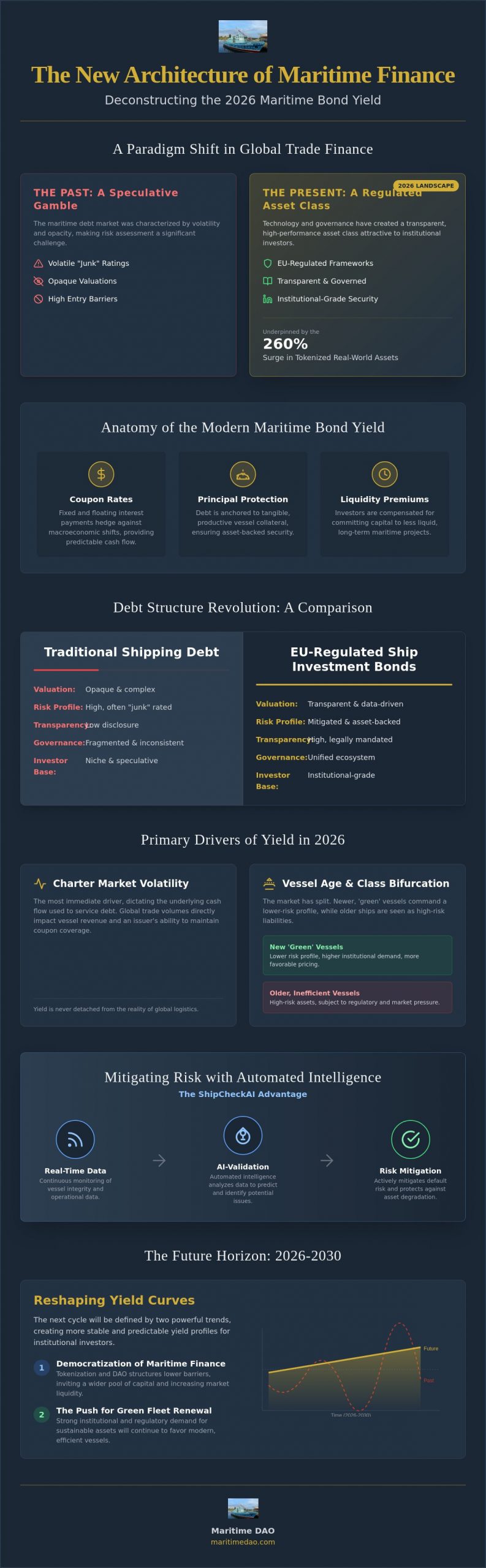
Why did the maritime debt market, once synonymous with volatile “junk” ratings and opaque valuations, suddenly become the center of institutional interest in 2026? As the tokenized Real-World Asset market surged by 260% over the last year, the traditional maritime bond yield has transitioned from a speculative gamble into a transparent, high-performance asset class governed by rigorous EU frameworks. You’ve likely felt the frustration of navigating a sector where aging fleets and fluctuating charter rates made risk assessment feel like sailing without a compass. It’s a landscape that has long demanded a more sophisticated approach to transparency and structural integrity.
This guide provides a clear framework for evaluating the modern maritime bond yield by demonstrating how regulated innovation is dismantling the barriers of the past. You’ll discover the critical mechanics of shipping debt and how the synergy between EU-regulated Ship Investment Bonds and automated intelligence creates a unified ecosystem for capital. We will compare traditional debt structures with these new regulated instruments; we’ll also explore how ShipCheckAI mitigates default risk through real-time, AI-validated data on vessel integrity. This is the new architecture of global trade finance, where technology and governance unite to open up institutional-grade opportunities.
Key Takeaways
- Understand the modern definition of maritime bond yield as a sophisticated institutional metric; this transition marks a shift from historical volatility toward a transparent, governed asset class.
- Identify the primary drivers of yield, including the correlation between charter market volatility and vessel age, to better assess the stability of issuer cash flow.
- Analyze the critical differences between traditional shipping debt and EU-regulated Ship Investment Bonds to prioritize transparency and legal frameworks in your asset allocation.
- Discover how ShipCheckAI integrates automated intelligence into the due diligence process, offering real-time vessel inspections that actively mitigate the risk of asset degradation.
- Explore how the democratization of maritime finance and the push for green fleet renewal are reshaping yield curves for the 2026-2030 cycle.
What is Maritime Bond Yield? Defining the 2026 Landscape
The maritime bond yield is the effective rate of return an investor receives on a debt instrument secured by or issued within the shipping sector. While a standard Bond (finance) represents a loan to an entity, maritime debt is uniquely tied to the physical productivity of global trade assets. In 2026, this metric has evolved beyond a simple interest payment. It now reflects a complex interplay between vessel operational efficiency, regulatory adherence, and market demand. It’s a high-stakes indicator that tells a story of global logistics and financial governance.
Institutional investors typically distinguish between Current Yield and Yield to Maturity (YTM). Current yield provides a snapshot of the annual income relative to the bond’s current market price. YTM offers a more comprehensive view; it accounts for the total anticipated return if the bond is held until its expiration, including the reinvestment of coupons. In the maritime world, YTM is the gold standard for long-term fleet renewal strategies. For example, the Seanergy Maritime Holdings Corp. bond priced in July 2026 at a 4.90% annual coupon demonstrates how established players are now accessing capital markets with clearly defined, competitive rates.
Maritime yields traditionally trade at a premium compared to sovereign debt or technology bonds. This spread exists because shipping involves specialized operational risks, including charter rate volatility and complex international compliance. However, 2026 marks a structural shift. The industry is moving away from the “unsecured junk” reputation of previous decades. Instead, we’re seeing the rise of asset-backed, regulated debt securities that provide institutional-grade security through structural integrity and transparency.
The Core Components of Shipping Bond Returns
Returns in this sector are built upon three foundational pillars: coupon rates, principal protection, and liquidity premiums. In the 2026 rate environment, issuers often utilize a mix of fixed and floating interest payments to hedge against macroeconomic shifts. Principal protection is reinforced by the underlying vessel collateral, ensuring that the debt is anchored to a tangible, productive asset. Investors also earn a liquidity premium for committing capital to longer-term maritime projects. These assets are less liquid than high-frequency equities, yet they offer more robust, predictable cash flows that are less sensitive to consumer tech cycles.
Why 2026 is a Turning Point for Maritime Debt
The landscape has been fundamentally altered by a new commitment to transparency and legal frameworks. EU financial regulations now mandate stricter disclosure for maritime securities, which has effectively eliminated the “opacity tax” that previously suppressed valuations. At the same time, tokenization has reduced the entry barrier yield penalty by allowing for more efficient, digital-first issuance of debt. The growth of the tokenized Real-World Asset (RWA) market, which expanded significantly in 2025, has provided the infrastructure for these modern instruments. Ultimately, maritime bond yield is a function of vessel productivity and regulatory compliance.
Primary Drivers of Yield in Maritime Capital Markets
The maritime bond yield is a precise reflection of several interlocking market forces. Unlike traditional corporate debt where credit ratings dominate the conversation, shipping finance requires a deep understanding of the physical asset’s earning potential. Charter market volatility remains the most immediate driver, as it dictates the underlying cash flow used to service debt. When global trade volumes fluctuate, the revenue generated by a vessel can shift rapidly, impacting the issuer’s ability to maintain high coupon coverage. These dynamics ensure that yield is never detached from the reality of global logistics.
Vessel age and class represent the second critical pillar of the 2026 landscape. The market has effectively bifurcated. Older, less efficient ships are increasingly viewed as high-risk assets, while newer, ‘green’ vessels command a lower-risk profile and more favorable pricing. This shift is driven by institutional demand for assets that align with the Poseidon Principles for responsible maritime finance. These principles have established a framework where sustainability is a financial necessity that directly influences bond pricing and investor appetite. A ship’s carbon intensity now carries as much weight as its deadweight tonnage.
Vessel Utilization and Charter Rates
Asset productivity is measured through Time Charter Equivalent (TCE) rates, which serve as the primary engine for bond stability. High TCE rates ensure that issuers have the liquidity to meet their interest obligations without straining their balance sheets. The balance between long-term charters and spot market exposure is vital; long-term agreements provide the predictability that institutional investors crave, while spot exposure offers upside during market peaks. Maritime DAO leverages real-time data to monitor these utilization metrics, ensuring that the yield consistency promised to bondholders is backed by verifiable operational performance.
The ‘Green’ Shipping Influence
Decarbonization mandates are the current reality of the 2026 maritime ecosystem. Vessels ready for LNG or Methanol fuels are now the preferred collateral for asset-backed securities. There’s a clear divergence in yield profiles between traditional bunker-fuel vessels and their modern, eco-friendly counterparts. Understanding these shifts is essential for any modern allocator. For a deeper analysis of how these technological shifts are reshaping the industry, you can explore our Maritime Capital Markets: A 2026 Guide.
Macroeconomic cycles and interest rate fluctuations also play their part, yet the “Regulatory Premium” is the distinct feature of the current era. EU compliance ensures a level of transparency that reduces the risk of default, allowing for more precise yield calculations. If you’re looking to capitalize on this shift, reviewing our EU-regulated Ship Investment Bonds can provide the necessary framework to validate asset condition before commitment.
Comparing Yield Profiles: Traditional vs. Regulated DAO Bonds
The risk-reward spectrum in maritime finance has historically been polarized. On one end, conservative bank debt provides modest returns with heavy operational restrictions; on the other, unregulated “junk” bonds offer a high maritime bond yield but often collapse under the weight of opaque vessel valuations. In 2026, the emergence of regulated DAO structures has introduced a sophisticated middle ground. These instruments utilize decentralized governance to eliminate the “middleman tax” while maintaining the sober reliability of institutional frameworks. This isn’t just a technological shift. It’s a structural evolution that prioritizes transparency and legal certainty.
Traditional high-yield instruments in the maritime bond market frequently fail because bondholders lack real-time visibility into the asset’s physical condition. When a vessel’s maintenance is neglected, the underlying value erodes long before the market notices. Regulated DAO bonds solve this by integrating automated intelligence into the governance layer. This lowers operational overhead and ensures that a larger portion of the cash flow is directed toward investor returns rather than administrative intermediaries.
Yield Comparison Framework
To understand where the “sweet spot” for institutional portfolios lies, it’s necessary to compare these instruments across key performance metrics. Modern maritime DAO bonds often outperform traditional debt by capturing the liquidity premium without the volatility of unregulated paper.
| Metric | Traditional Bank Debt | Unregulated High-Yield | Maritime DAO Regulated Bonds |
|---|---|---|---|
| Average Yield Range | 4% – 6% | 10% – 15% | 7% – 11% |
| Transparency Level | High (Bank only) | Low (Opaque) | High (AI-Verified) |
| Collateral Type | Vessel Mortgage | Corporate Guarantee | Asset-Backed SPV |
| Regulatory Status | Banking Covenants | Minimal Oversight | EU-Regulated |
The Role of Asset-Backed Security (ABS)
Modern ship financing bonds are distinct from general corporate debt because they are structured as bankruptcy-remote securities. Unlike corporate bonds that rely on the total health of a parent company, these instruments are tied to specific vessel Special Purpose Vehicles (SPVs). If a parent company faces financial distress, the vessel remains a protected asset reserved for bondholders. Physical collateralization floor-prices the bond’s risk, ensuring that the liquidation value of the steel provides a tangible safety net that corporate paper simply cannot match. These structures unite capital, govern assets, and open up institutional opportunities through a unified, transparent ecosystem.
Mitigating Yield Risk with AI and ShipCheckAI Technology
The stability of a maritime bond yield is fundamentally tethered to the physical readiness of the underlying vessel. While market fluctuations are expected, the most significant risk to institutional returns is unforeseen asset degradation or extended off-hire time. When a ship stops moving, the cash flow stops flowing. Historically, this risk was difficult to quantify because investors relied on outdated, manual reports that offered little more than a static snapshot of a dynamic asset. This lack of visibility created a systemic inefficiency that often led to unexpected defaults.
ShipCheckAI has effectively closed this information gap by providing real-time condition assessments directly to bondholders. This technology functions as a visionary architect of transparency, identifying operational issues before they manifest as financial losses. By utilizing automated intelligence to analyze structural integrity and compliance, the system generates proactive alerts that prevent small maintenance requirements from escalating into catastrophic failures. This methodical approach ensures that the bond remains anchored by a high-performing, well-maintained asset that continues to generate revenue.
AI-Driven Due Diligence for Yield Security
The industry is witnessing a decisive move away from traditional annual inspections in favor of continuous, AI-powered surveys. These AI ship inspection tools do more than just monitor steel; they actively reduce insurance premiums by proving a lower risk profile to underwriters. This reduction in operational cost directly increases the net yield available to investors. These continuous assessments also allow for more accurate Loan-to-Value (LTV) ratios, providing a clearer picture of the bond’s security margin throughout its entire lifecycle. It’s a system designed to unite capital with verifiable data.
Transparency as a Yield Stabilizer
Transparency is no longer a luxury; it’s a stabilizer. Traditional shipping debt often suffered from “Black Box” syndrome, where the true condition of the collateral was hidden from the lender until it was too late to intervene. In 2026, transparent assets trade at tighter, more predictable spreads because the market can price risk with academic precision. Investor confidence is built on a foundation of verifiable data, not speculative hope. For those conducting their own assessments, our AI in maritime due diligence checklist provides the practical steps needed to validate vessel integrity.
If you’re ready to explore how AI-backed security can protect your capital, consider reviewing our current EU-regulated Ship Investment Bonds to see these technologies in action.
The Future of Maritime Bond Yields in the DAO Ecosystem
The horizon for maritime finance is expanding beyond traditional institutional silos. The integration of maritime investment for retail participants is already altering the yield curves of 2026 by providing a broader base of liquidity. This influx of capital reduces the “liquidity penalty” often found in private placements, allowing for a more standardized maritime bond yield that reflects the actual productivity of the global fleet. As the market matures, the distinction between retail accessibility and institutional security continues to dissolve. This democratization is not merely a trend; it’s a structural realignment of how global trade is funded.
Looking toward the 2026-2030 cycle, yield trends will be defined by the intersection of environmental mandates and fleet demographics. The necessity for fleet renewal is critical. Approximately one-third of the global dry bulk fleet, representing nearly 362 million DWT, currently exceeds 15 years in age. This massive requirement for capital can only be met through innovative, asset-backed securities that prioritize green technology. Regulated maritime debt has emerged as the premier alternative asset for 2026 because it offers a unique combination of physical collateral, digital transparency, and legal certainty. Maritime DAO is standardizing these “Institutional-Grade” yields for global stakeholders by providing a unified ecosystem where capital and heavy industry meet.
Building a Diversified Maritime Debt Portfolio
Constructing a resilient maritime debt strategy requires a balance between yield and duration across multiple vessel classes. Diversification across Dry Bulk, Tankers, and Container ships ensures that a portfolio isn’t overly exposed to the specific charter rate cycle of a single segment. A sophisticated portfolio strategy utilizes these distinct asset classes to create yield stability throughout various macroeconomic shifts. Investors looking to participate in this evolution can begin by onboarding with the Maritime DAO investment ecosystem. This platform acts as a bridge, allowing for the methodical allocation of capital into assets that are governed by code and protected by law.
Final Recommendation: The Regulated Path
The choice for modern allocators is clear. EU-regulated bonds outperform traditional “junk” alternatives by replacing speculative risk with structural integrity. The 2026 landscape demands a platform that integrates automated intelligence, regulatory compliance, and physical asset verification to secure a sustainable maritime bond yield. By choosing a regulated path, you ensure that your capital is part of a transparent system that values order and security. We invite you to Explore EU Regulated Ship Investment Bonds with Maritime DAO to see how we are transforming shipping debt into a high-performance institutional asset class.
Navigating the New Era of Maritime Capital
The transition from speculative shipping debt to a transparent, asset-backed ecosystem is now complete. In 2026, institutional success is defined by a commitment to structural integrity and automated due diligence. We’ve explored how a stable maritime bond yield is no longer a matter of chance; it’s secured through a tripartite approach that combines rigorous EU-regulated frameworks, physical asset-backed security, and real-time AI-powered vessel inspections. This unified system effectively eliminates the opacity of the past, ensuring that capital is governed by logic and protected by law. By integrating ShipCheckAI technology, the “information gap” that once plagued this industry has been replaced by a reliable flow of verifiable, institutional-grade data.
This structural evolution positions regulated maritime debt as a premier alternative asset for the modern era. It’s a landscape where innovation and compliance unite to open up opportunities that were previously reserved for a closed circle of insiders. The architecture for a more inclusive and secure financial frontier is ready for those who value order and transparency. You can take the next step toward a sophisticated debt strategy today. Secure Institutional Maritime Yields with Maritime DAO and join a community that’s redefining the intersection of heavy industry and high finance. The future of global trade finance is transparent, governed, and ready for your capital.
Frequently Asked Questions
What is a typical maritime bond yield range in 2026?
In the 2026 landscape, a typical maritime bond yield for EU-regulated, asset-backed instruments generally ranges between 7% and 11%. This reflects a sophisticated middle ground between conservative bank debt, which often yields 4% to 6%, and unregulated high-yield paper that carries significantly higher default risks. These rates are driven by the physical productivity of the vessel and the efficiency of the underlying charter agreements.
How do EU regulations protect investors in ship investment bonds?
EU regulations protect investors by mandating a high-stakes framework for transparency, disclosure, and legal structural integrity. These frameworks ensure that bond issuers operate within a governed ecosystem, providing clear legal recourse and standardized reporting. This regulatory oversight effectively eliminates the opacity that historically characterized maritime debt, transforming it into a reliable institutional asset class.
Is maritime bond yield higher than traditional real estate bonds?
Maritime bond yields generally trade at a premium compared to traditional real estate bonds due to the specialized nature of the assets and the complexities of global logistics. While real estate offers fixed-location stability, maritime debt captures the dynamic productivity of global trade. This “maritime premium” compensates investors for specialized operational risks while often providing higher net returns for institutional allocators.
What happens to my yield if the vessel is involved in an accident?
If a vessel is involved in an accident, the bond’s principal is typically protected by comprehensive Hull and Machinery (H&M) and Protection and Indemnity (P&I) insurance. While the yield may experience temporary volatility due to off-hire time, the underlying asset-backed security ensures that the collateral value remains intact. The SPV structure further isolates the asset, preventing the accident from impacting other investments in the ecosystem.
Can retail investors access institutional maritime bond yields?
Retail investors can now access institutional-grade maritime bond yield opportunities through tokenized platforms that utilize decentralized technology. These systems lower traditional entry barriers, allowing a global audience to participate in debt securities that were previously exclusive to large-scale funds. This democratization is supported by the same EU-regulated frameworks that govern institutional capital, ensuring a unified level of security.
How does ShipCheckAI actually improve bond security?
ShipCheckAI improves bond security by replacing static, annual inspections with continuous, AI-powered vessel monitoring. This technology identifies structural risks and maintenance needs in real-time, preventing asset degradation before it impacts financial performance. By providing bondholders with verifiable data on the vessel’s physical condition, it closes the information gap and ensures the collateral maintains its value.
What are the primary risks associated with maritime bond yields?
The primary risks include charter market volatility, unforeseen vessel off-hire time, and shifts in global trade policy. Investors must also consider the age and class of the fleet, as older vessels may face higher operational costs or stricter environmental compliance requirements. Utilizing automated intelligence and choosing regulated, asset-backed structures are the most effective ways to mitigate these systemic risks.
How does tokenization affect the liquidity of maritime bonds?
Tokenization significantly enhances liquidity by allowing for fractional ownership and the potential for secondary market trading of maritime debt. This digital infrastructure enables faster settlement cycles and provides a unified ecosystem where investors can manage their positions with greater flexibility. It transforms traditionally illiquid shipping loans into dynamic, digital-first securities that are accessible and transparent.