
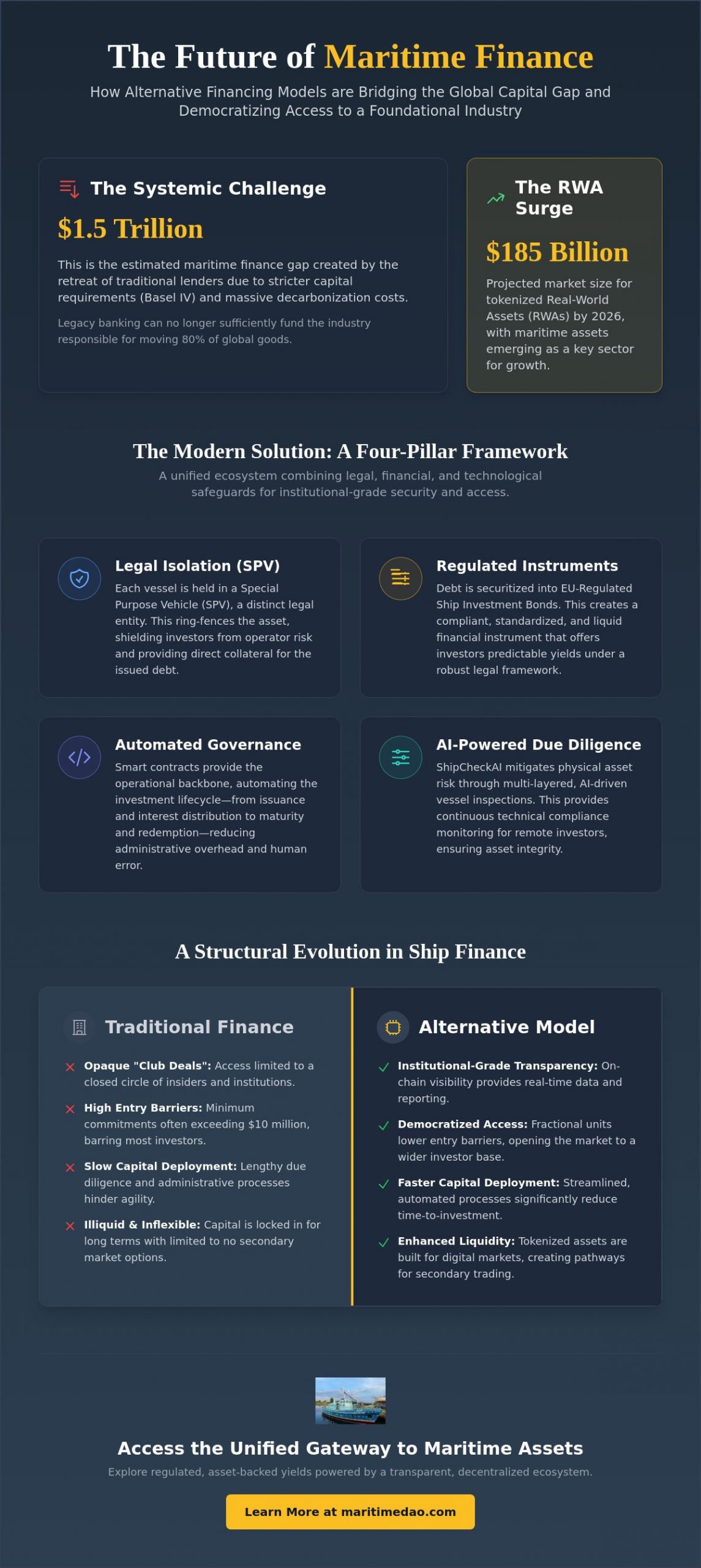
With the tokenized real-world asset (RWA) market surging to $185 billion in 2026, the era of exclusive, closed-door maritime deals has reached a definitive end. The rise of alternative ship financing models represents a structural evolution, moving away from legacy banking constraints toward a unified, digital ecosystem governed by transparency and code. You likely recognize that while 80% of global goods move by sea, the capital required to participate in this trade has historically been locked behind high entry barriers and opaque regulatory borders.
This guide explores how regulated, fractional structures and tokenized debt are bridging the $1.5 trillion maritime capital gap to offer investors a path to diversified portfolios with predictable yields. We will examine how EU-regulated frameworks, AI-powered vessel inspections, and decentralized governance unite to provide the legal certainty required for modern maritime investment. By the end of this article, you’ll understand how these technological and operational pillars integrate to democratize access to high-stakes global trade while maintaining the sober reliability of institutional finance.
Key Takeaways
- Understand how fractional ship investment utilizes Special Purpose Vehicles (SPVs) and tokenized debt to bridge the $1.5 trillion maritime capital gap.
- Analyze the structural advantages of alternative ship financing models that prioritize institutional-grade transparency and offer significantly faster capital deployment than traditional banking.
- Discover the legal security provided by EU-regulated Ship Investment Bonds, which offer a compliant wrapper for investors seeking predictable yields from global trade.
- Learn to mitigate physical asset risk by leveraging ShipCheckAI for multi-layered, AI-driven vessel inspections that ensure continuous technical compliance for remote investors.
- Explore how the Maritime DAO ecosystem serves as a unified gateway, integrating regulated financial instruments with decentralized governance to democratize access to maritime assets.
The Evolution of Alternative Ship Financing and the Maritime Capital Gap
The global maritime sector is navigating a liquidity transition of historic proportions. Fractional ship investment, defined as the tokenization of maritime debt into accessible, regulated units, has emerged as the primary mechanism for institutional and private capital to enter this space. This transition addresses a systemic shortfall; current estimates suggest a $1.5 trillion maritime finance gap created by the retrenchment of traditional commercial lenders. While shipping was once characterized by opaque “club deals” accessible only to a closed circle of high-net-worth individuals, the industry is moving toward transparent, on-chain alternative ship financing models that offer real-time visibility, legal certainty, and improved liquidity. As a result, maritime alternative investments are rapidly becoming a staple in diversified institutional portfolios seeking uncorrelated returns.
Why Traditional Ship Finance is No Longer Sufficient
The tightening of credit is not a temporary fluctuation but a structural reality. Under the Basel IV framework, traditional banks have faced increased capital requirements, making long-term vessel loans less attractive for their balance sheets. Additionally, stringent environmental regulations require massive capital expenditure for fleet decarbonization, further straining legacy lending capacities. This environment has created a critical need for mid-sized shipowners to find flexible, non-dilutive capital that doesn’t rely on a single banking relationship. Digital platforms provide the solution by significantly reducing the administrative, legal, and operational costs associated with multi-investor syndicates; they automate compliance, distribution, and governance through unified smart contract architectures.
Democratizing Access to Maritime Yields
Historically, participating in an alternative investment within the shipping sector required a minimum commitment often exceeding $10 million, effectively barring most participants. Modern structures lower this barrier to entry by dividing debt into fractional units, allowing for a more inclusive distribution of maritime yields. By utilizing a global maritime investment platform, investors can access a retail-institutional bridge that provides the same level of due diligence and security once reserved for the world’s largest banks. The Maritime Capital Gap is the systemic shortfall between the financing requirements of the global fleet and the diminishing credit supply from traditional commercial banks, serving as the primary catalyst for 2026’s fractional debt boom.
Mechanics of Fractional Ship Investment: SPVs and Tokenized Bonds
The transition from traditional lending to fractional participation requires a robust synthesis of maritime law and digital infrastructure. At the core of alternative ship financing models sits the Special Purpose Vehicle (SPV), a distinct legal entity designed to hold the title of a single vessel while shielding investors from the operator’s external financial risks. This structure ensures that the vessel remains a ring-fenced asset, serving as direct collateral for the debt issued, providing legal certainty, and establishing a clear hierarchy of claims. By securitizing this debt into EU regulated ship investment bonds, the industry creates a standardized, liquid financial instrument that maintains the rigorous protections of traditional bond markets while leveraging the efficiency of blockchain technology.
Smart contracts provide the operational backbone for these digital bonds, automating the lifecycle of the investment from issuance and distribution to final redemption. These protocols govern interest distributions, maturity dates, and strict transfer restrictions, ensuring that the asset remains within a perimeter of verified participants. The Evolution of Alternative Ship Financing has shifted the focus from manual, paper-based administration to high-integrity automated systems that eliminate human error, reduce overhead costs, and provide real-time auditability. This technological layer doesn’t replace the law; it enforces it with mathematical precision, ensuring that the relationship between physical assets and digital governance is clearly understood at every step.
The SPV Wrapper: Legal Security for Digital Assets
The SPV acts as the bridge between maritime law and digital finance, providing a familiar legal framework for institutional capital, isolating asset-specific risks, and facilitating automated governance. It isolates the ship asset from the operator’s broader corporate liabilities, ensuring that bondholders have a clean, first-priority claim on the physical vessel. This collateralization is essential for risk mitigation, as it provides fractional debt holders with the same legal recourse as a traditional bank in the event of a default. For those looking to deepen their understanding of these structures, exploring the technical specifications of regulated bonds can provide clarity on how physical assets are digitized.
On-Chain Governance and MiCA Compliance
In 2026, the regulatory landscape is defined by the full implementation of the Markets in Crypto-Assets (MiCA) regulation, which provides a comprehensive framework for investor protection and institutional reliability. Maritime DAO integrates maritime investment compliance directly into the bond’s logic, ensuring that only KYC-verified investors can hold or trade these assets. This unified approach to governance, compliance, and transparency creates a secure environment for significant capital deployment, allowing investors to participate in global trade with the same confidence they would bring to traditional capital markets.
Comparing Alternative Models with Traditional Ship Finance
Traditional maritime lending is defined by its inertia. While a commercial bank may require three to six months to finalize a vessel mortgage through rigorous committee reviews, alternative ship financing models operate on a timeline measured in days. This discrepancy in capital velocity isn’t merely a convenience; it’s a strategic advantage for shipowners needing to execute on time-sensitive acquisitions or retrofits. For the participant, this efficiency creates a liquidity premium, as secondary markets for fractional units allow for exits that were previously impossible in the illiquid world of direct ship ownership. The transition from legacy systems to digital debt structures represents a shift from static, paper-based agreements to dynamic, liquid assets.
Cost of Capital and Investor Yields
Shipowners are increasingly willing to pay interest rates ranging from 8% to 14% for private maritime funding, recognizing that the speed and flexibility of fractional debt outweigh the lower margins of restrictive bank loans. These ship investment for accredited investors opportunities provide fixed-income characteristics that serve as a robust hedge against inflation. Because the underlying revenue is tied directly to the movement of 80% of the world’s goods, the asset class remains grounded in physical utility. By removing layers of intermediary fees typical of legacy syndications, decentralized models preserve a larger portion of the yield for the capital providers, ensuring that risk-adjusted returns remain competitive even in volatile markets.
Transparency and Real-Time Reporting
Legacy finance relies on quarterly statements and periodic audits, leaving participants in the dark between reporting cycles. In contrast, a global maritime investment platform provides 24/7 visibility into asset performance through real-time, on-chain data. Automated intelligence systems continuously monitor technical compliance, drastically reducing the information asymmetry that has historically plagued remote maritime investments. This unified approach ensures that every participant has access to the same high-fidelity operational truth. Decisions are no longer based on months-old snapshots but on a continuous stream of verified data that reflects the actual condition and earning potential of the vessel.
Technical Due Diligence: Mitigating Risk with ShipCheckAI
While the legal and digital frameworks of alternative ship financing models provide the necessary structural security, the ultimate performance of the investment depends on the physical operationality of the underlying asset. Vessel condition remains the primary risk factor for fractional debt holders, as technical failures or regulatory detentions can immediately disrupt the cash flows required for interest distributions. With Port State Control detentions for DNV-classed vessels increasing by 23% in Q1 2026 compared to 2025, the need for rigorous, automated oversight has never been more urgent. ShipCheckAI addresses this vulnerability by providing a multi-layered, AI-driven inspection protocol that moves beyond the subjective limitations of traditional maritime surveys. By generating an objective, automated audit trail, this system ensures that every bond issuance is backed by verified data, transforming technical due diligence into a transparent, quantifiable component of the investment lifecycle.
Verifying Physical Asset Integrity via AI
ShipCheckAI utilizes advanced diagnostic algorithms to analyze hull integrity and engine performance, allowing for the prediction of maintenance liabilities before they escalate into capital-intensive failures. This level of granular visibility is critical for ensuring compliance with evolving International Maritime Organization (IMO) standards and preventing the “greenwashing” of asset reports. By integrating these findings into the AI in maritime due diligence process, investors can verify that a vessel’s environmental and technical claims are grounded in physical reality. ShipCheckAI provides a verifiable link between the physical ship and the digital bond.
Standardizing Vessel Assessment for Global Bondholders
The entry of institutional capital into fractional maritime debt requires a standardized language of risk. Traditional ship surveys often suffer from human error and regional bias, which creates friction for secondary market valuations and institutional entry. By employing automated intelligence, the assessment process becomes objective and repeatable, providing a consistent data set that global bondholders can trust. This standardization is essential for the growth of alternative ship financing models, as it allows for the accurate pricing of risk across diverse fleets. When every vessel in a portfolio is assessed through the same high-fidelity lens, the information asymmetry mentioned previously is effectively eliminated, fostering a more resilient and liquid marketplace. To see how these inspections secure your portfolio, explore the Maritime DAO platform.
Accessing the Maritime DAO Ecosystem for Regulated Yields
Maritime DAO serves as the visionary architect and unified gateway for institutional and accredited participants seeking to navigate the complexities of global trade. By integrating legal bond wrappers, AI-driven technical verification, and decentralized governance, the platform provides a comprehensive ecosystem for how to invest in maritime assets with institutional-grade security. This model is redefining the landscape of alternative ship financing models by providing a high-tech solution to systemic liquidity inefficiencies. The synergy between EU-regulated bond issuance and ShipCheckAI vessel assessments ensures that every unit of debt is backed by a verified physical asset, creating a first-of-its-kind bridge between legacy industry and the digital frontier.
The Role of Governance in Decentralized Maritime Finance
Governance within the ecosystem is not merely a technical feature but a strategic pillar that ensures long-term stability and order. Token holders influence the selection of assets, define risk parameters, and oversee the evolution of maritime DAO investment protocols through a transparent, methodical process. This tripartite structure—comprising asset selection, technical oversight, and automated governance—removes the opacity of traditional shipping finance. Transparency acts as the foundation of modern maritime governance, allowing for a democratized yet deeply serious approach to managing significant capital investments in the global fleet.
Onboarding: From Verification to Asset Selection
The transition from observer to participant is a methodical process designed to maintain the structural integrity of the ecosystem. Onboarding begins with rigorous KYC and AML compliance checks to meet the high standards of EU-regulated maritime debt instruments. Once verified, investors gain access to a curated marketplace of bonds, each accompanied by ShipCheckAI-verified condition reports that detail maintenance histories and technical compliance. This data-driven approach allows participants to select assets based on objective performance metrics rather than speculative hype. By the end of 2026, fractional ship investment is expected to be the new industry standard, offering a regulated pathway to predictable yields from the movement of global goods. Join the Maritime DAO to access regulated fractional ship investments.
Securing the Next Frontier of Global Trade Finance
The maritime industry has reached a pivotal juncture where the physical world of global commerce and the digital world of high finance finally align. By utilizing compliant SPV structures to isolate assets and leveraging AI-powered vessel inspection via ShipCheckAI, the sector has effectively eliminated the opacity that once hindered remote participation. These alternative ship financing models have evolved from a niche necessity into a robust, institutional-grade ecosystem that offers both structural integrity and diversified yields. This transformation ensures that the relationship between physical assets and digital governance is clearly understood at every step.
This shift represents a fundamental democratization of an industry that moves 80% of the world’s goods. You now have the practical tools to move beyond traditional banking limitations and participate in a unified, transparent market governed by code and law. We invite you to Explore EU-Regulated Ship Investment Bonds on Maritime DAO and discover how our EU-regulated framework for maritime debt is setting the new standard for maritime participation. It’s time to anchor your portfolio in the reliable, governed future of global trade.
Frequently Asked Questions
What is fractional ship investment and how does it work?
Fractional ship investment is the process of securitizing maritime debt into digitized, regulated units that allow multiple participants to share in the yields of a single vessel. It works through a Special Purpose Vehicle (SPV) that holds the legal title to the ship while issuing tokenized bonds to investors. This structure democratizes access to a traditionally exclusive asset class by lowering entry barriers, enabling a broader range of capital to support global trade operations.
How are EU-regulated ship investment bonds different from standard crypto tokens?
EU-regulated ship investment bonds are sophisticated financial instruments governed by the Markets in Crypto-Assets (MiCA) framework rather than speculative digital assets. Unlike standard tokens, these bonds are legally tied to physical maritime assets through robust SPV structures and offer defined investor protections. They provide a transparent, institutional-grade bridge between decentralized technology and established maritime law, ensuring that every unit represents a compliant claim on real-world vessel revenue.
What legal protections do investors have in a fractional ship financing model?
Participants benefit from a tripartite layer of protection comprising asset isolation, regulatory compliance, and direct collateralization. The SPV structure ensures that the vessel is ring-fenced from the operator’s broader liabilities, while the bond itself is typically secured by a first-priority mortgage on the physical ship. These alternative ship financing models are governed by strict EU financial standards, providing investors with the same legal recourse and security found in traditional maritime debt markets.
How does ShipCheckAI verify the condition of a vessel for bondholders?
ShipCheckAI utilizes advanced diagnostic algorithms and automated surveys to provide an objective, real-time assessment of a vessel’s technical integrity. The system analyzes critical parameters such as hull condition and engine performance to predict maintenance liabilities and ensure compliance with international standards. By generating a transparent audit trail, it eliminates the bias of traditional surveys and provides bondholders with high-fidelity data regarding the physical health of their underlying investment.
Can I trade my fractional maritime debt units on a secondary market?
Secondary market trading is a core feature of the digital ecosystem, providing a liquidity premium that traditional maritime investments typically lack. Verified participants can trade their fractional units on compliant exchange platforms, allowing for more flexible entry and exit strategies. This functionality is governed by smart contracts that automatically enforce transfer restrictions and ensure that all trades remain within the regulatory perimeter of the original bond issuance.
What are the minimum investment requirements for maritime DAO bonds?
The minimum investment for participating in fractional maritime debt through the platform is $1,000. This threshold is strategically designed to lower the barrier to entry while maintaining the serious, high-stakes register appropriate for institutional-grade assets. By standardizing these units, the ecosystem allows for a more inclusive distribution of maritime yields, enabling both private and institutional investors to build diversified portfolios of real-world assets without the multi-million dollar requirements of legacy finance.
How are yields and interest payments distributed to fractional investors?
Yields and interest payments are distributed automatically through smart contract logic that ensures precision, transparency, and speed. Payments are typically derived from the vessel’s charter revenue and are allocated to bondholders proportionally based on the number of fractional units they hold. This automated system removes the administrative delays associated with traditional banking, providing investors with predictable cash flows that are recorded on-chain for real-time auditability and verification.
Is fractional ship investment available to retail investors in the EU?
Fractional ship investment is accessible to a broad range of participants, though specific offerings may be restricted to accredited or institutional investors based on regional regulatory requirements. In the EU, the MiCA framework provides a unified path for regulated platforms to offer tokenized assets, provided they adhere to strict transparency and disclosure mandates. Alternative ship financing models prioritize compliance to ensure that all participants, regardless of their classification, operate within a secure and legally recognized financial ecosystem.