
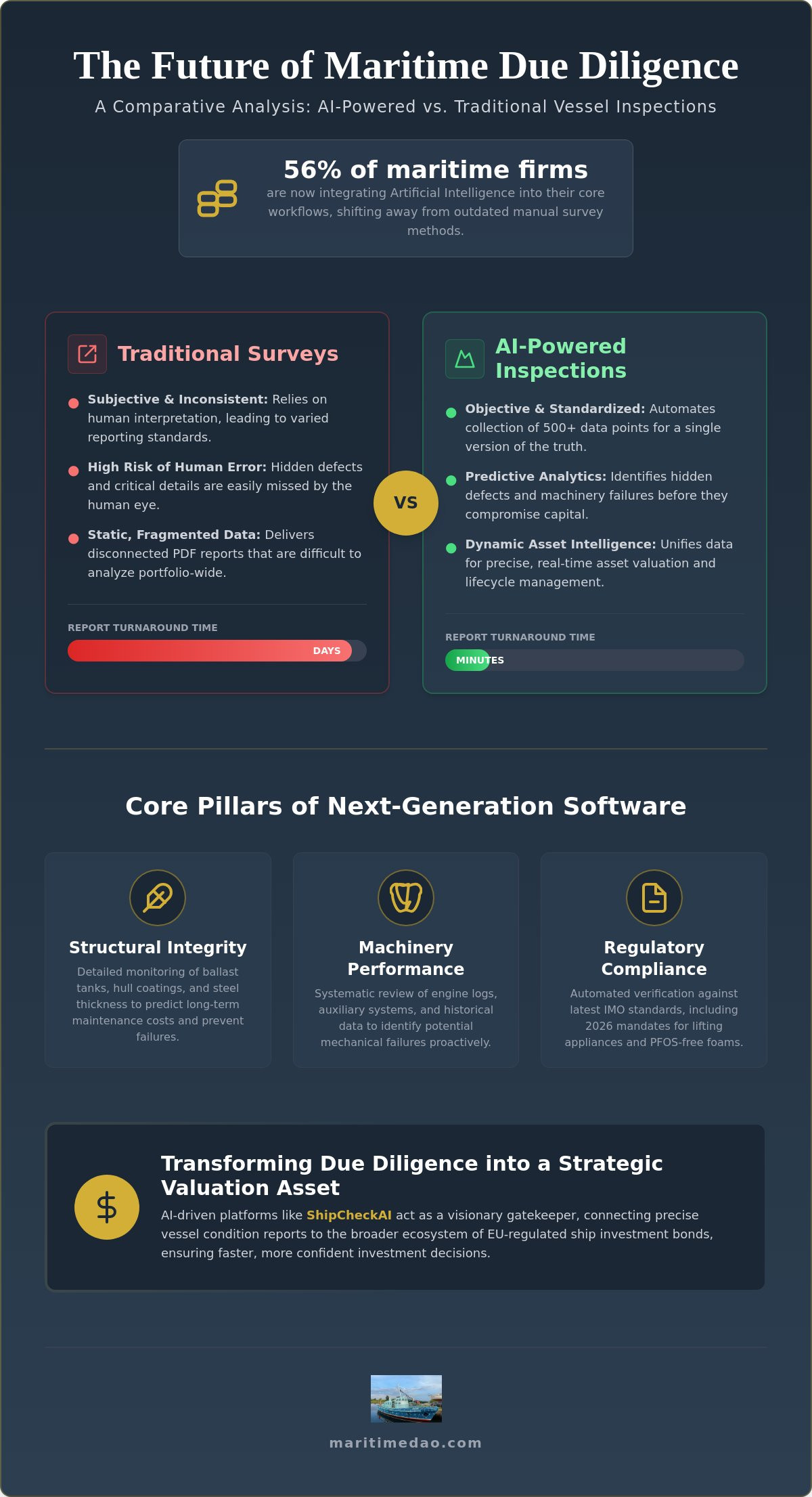
With 56% of maritime organizations now integrating artificial intelligence into their core workflows, the reliance on manual, subjective vessel surveys has become a systemic risk to capital. You recognize that traditional due diligence often suffers from inconsistent reporting and hidden defects that human eyes simply cannot detect, particularly as 2026 IMO mandates for lifting appliances and PFOS foam compliance tighten the margin for error. Adopting advanced pre-purchase ship inspection software is no longer a tactical choice; it’s a fundamental requirement for protecting institutional investments in a sophisticated global market.
This 2026 buyer’s guide reveals how AI-driven intelligence transforms the inspection process from a static document into a dynamic valuation tool. You will discover how these platforms unify fragmented data, govern regulatory compliance, and open up opportunities for more precise asset lifecycle management. We explore the transition toward standardized reporting, the integration of predictive maintenance insights, and the specific technological pillars that enable faster, more confident investment decisions for the modern fleet owner.
Key Takeaways
- Learn how pre-purchase ship inspection software transforms vessel due diligence from a manual checklist into a strategic valuation asset by automating the collection of over 500 critical data points.
- Understand the impact of AI-driven predictive analytics in identifying hidden structural defects and machinery failures before they compromise your investment capital.
- Discover how real-time cloud synchronization reduces report turnaround times from days to minutes, facilitating faster and more precise investment decision-making.
- Explore the integration of standardized inspection protocols and secure data governance to ensure transparency and structural integrity across a unified maritime portfolio.
- See how ShipCheckAI acts as a visionary gatekeeper, connecting precise vessel condition reports to the broader ecosystem of EU-regulated ship investment bonds.
What is Pre-Purchase Ship Inspection Software?
Modern pre-purchase ship inspection software is defined as a unified digital ecosystem engineered to assess vessel condition, regulatory compliance, and financial risk through a singular, transparent interface. Unlike legacy methods that rely on fragmented observations, these platforms govern the entire due diligence process by uniting data streams, automating reporting, and opening up opportunities for more accurate asset valuation. This technology represents a fundamental transition from static PDF reports toward dynamic, AI-powered asset intelligence. It provides a methodical framework for institutional investors to verify the structural and operational integrity of a vessel before significant capital is deployed.
At its core, the software automates the collection of over 500 distinct data points across the hull, machinery, and technical documentation. This depth of analysis is essential. It grounds traditional vessel safety surveys in a data-rich environment that minimizes human error and subjective bias. By creating a secure and immutable audit trail, the software ensures that every stakeholder, from the technical superintendent to the investment committee, operates from a single version of the truth. Reliability is the new standard.
The Shift from Manual Surveys to Digital Intelligence
Traditional paper-based surveys frequently fail to meet the demands of the modern maritime market. They are often characterized by inconsistent terminology, subjective interpretations, and slow turnaround times that can delay critical transactions. The integration of digital platforms enhances ship inspection efficiency by centralizing global fleet assessments under a unified institutional oversight. This transition allows firms to manage risk across their entire maritime portfolio with the same rigor found in high-finance asset management. Digital adoption isn’t just about speed; it’s about structural integrity in decision-making.
Key Inspection Categories Covered by Software
Advanced tools provide a comprehensive breakdown of various ship inspection types, ensuring that no critical component is overlooked during the due diligence phase. The software typically categorizes findings into three operational pillars:
- Structural Integrity: Detailed monitoring of ballast tank conditions, hull coatings, and steel thickness to predict long-term maintenance costs.
- Machinery Performance: Systematic review of engine room documentation, auxiliary systems, and maintenance logs to identify potential mechanical failures.
- Regulatory Compliance: Automated verification of adherence to the latest IMO standards, including the 2026 requirements for lifting appliances and PFOS-free firefighting foams.
This systematic approach ensures that pre-purchase ship inspection software delivers a transparent, governed, and unified view of the asset’s true value. It transforms a simple walkthrough into a sophisticated financial audit.
Essential Features of Next-Generation Inspection Tools
Next-generation pre-purchase ship inspection software serves as more than a recording device; it functions as a sophisticated diagnostic engine. While legacy tools focus on aesthetic report layouts, modern institutional-grade platforms prioritize deep technical data that informs capital allocation. These systems unite visual evidence with automated intelligence, ensuring that every finding is governed by objective metrics rather than surveyor intuition. Reliability is paramount. By moving beyond the digital notepad concept, the software acts as a bridge between the physical world of maritime operations and the structured world of institutional finance.
AI-driven predictive analytics represent the pinnacle of this evolution. By analyzing historical wear patterns, the software identifies potential steel renewal requirements or imminent machinery failure months before they manifest as operational crises. This foresight allows financiers to translate technical conditions into precise numerical asset grades, effectively bridging the gap between the engine room and the balance sheet. Real-time cloud synchronization ensures that this data reaches the investment committee instantly, creating a transparent, high-speed feedback loop between the physical asset and the financial decision-maker.
Integrated photo and video documentation are no longer standalone attachments. Instead, they are linked directly to specific technical findings, providing an immutable visual record of a vessel’s condition. By aligning with safety frameworks established by the Oil Companies International Marine Forum (OCIMF), these platforms ensure that every inspection meets the rigorous standards expected by global charterers and insurers. This level of detail is essential for maintaining the structural integrity of a maritime portfolio.
Predictive Insights and Risk Mitigation
Forecasting future capital expenditure (CAPEX) is critical for institutional due diligence. By leveraging ship inspection accuracy, investors can mitigate the risk of hidden defects that typically escape manual observation. Automated summaries of findings provide executives with immediate clarity on high-risk items, allowing for rapid risk assessment without wading through hundreds of raw data points. For those seeking to secure their maritime interests, exploring a unified asset intelligence platform can provide the necessary governance for high-stakes decisions.
Mobile Functionality for Surveyors
The efficacy of pre-purchase ship inspection software depends on its performance in the field. Surveyors often work in remote maritime environments or shielded engine rooms where connectivity is non-existent. Modern tools provide robust offline capabilities, allowing for full data entry and voice-to-text documentation without an active internet connection. Once the surveyor returns to a networked area, the system initiates automated synchronization, transmitting real-time data from the vessel directly to the investment committee’s dashboard. This ensures that information flow remains methodical and expansive, regardless of location.
AI vs. Manual Reporting: A Comparative Analysis
Manual surveys are inherently limited by the physical capacity of the surveyor and the subjective nature of human observation. While a veteran engineer brings valuable experience, their findings are often influenced by environmental factors, fatigue, or the restrictive time constraints of a port stay. In contrast, pre-purchase ship inspection software introduces a level of industrial discipline that manual reporting cannot replicate. It replaces fragmented notes with a unified, governed, and transparent data model that evaluates every vessel against a rigid institutional standard. This transition ensures that capital is never deployed based on a single individual’s opinion, but rather on a foundation of verifiable asset intelligence.
The speed of this transition is transformative for maritime finance. What traditionally took days of manual transcription and photo sorting is now accomplished in minutes through automated data processing. This efficiency allows investment committees to act with the agility of the digital world while maintaining the sober reliability of traditional finance. By analyzing thousands of data points simultaneously, the software identifies subtle structural anomalies and mechanical discrepancies that a human eye might overlook during a high-pressure site visit. This first-pass accuracy significantly lowers operational overhead by reducing the need for costly, repetitive follow-up surveys.
The Role of the Idwal Grade and Similar Benchmarks
Standardized scoring is the foundation of institutional trust in the shipping industry. Banks and financiers increasingly demand numerical grades, such as the industry-recognized Idwal Grade, to quantify risk and compare assets across global markets. These benchmarks provide a comparable measure of asset integrity across diverse fleets, ensuring that every vessel is measured against the same yardstick. By leveraging AI in maritime due diligence, firms can establish their own internal governance protocols. This allows them to unify their data, enforce higher standards, and mitigate risk across a sprawling international portfolio.
Eliminating Human Error in Technical Assessments
Human error remains the primary vulnerability in traditional technical assessments. Modern pre-purchase ship inspection software mitigates this risk by automatically cross-referencing classification society documents with physical findings captured on-site. Discrepancies in engine room logs, which might suggest deferred maintenance or irregular performance data, are instantly flagged for human review. In 2026, AI-powered vessel surveys eliminate subjective bias by cross-referencing sensory data against historical benchmarks to produce an immutable, mathematically verified condition report. This methodical approach ensures that the relationship between physical assets and digital governance is clearly understood at every step of the investment lifecycle.
Implementation: Integrating Software into the Investment Workflow
Successful implementation of pre-purchase ship inspection software requires a fundamental shift from viewing technology as a standalone utility to treating it as a core pillar of the investment lifecycle. This integration process ensures that digital findings aren’t merely archived but are actively governed to drive capital decisions. To achieve this, institutional investors must establish a unified digital ecosystem that unites field data, governs operational risk, and opens up opportunities for automated asset management. Reliability is built through a methodical approach to data intake and processing.
The first gateway to successful adoption is the establishment of standardized protocols. By defining specific inspection criteria across an entire maritime portfolio, firms ensure that every asset is measured against a singular institutional benchmark. Data governance represents the second pillar; reports must be stored in a secure, immutable environment to prevent tampering or loss of technical history. Bridging the gap between traditional surveyors and high-tech tools is equally critical. Training programs should focus on empowering veteran inspectors with AI capabilities, ensuring that human expertise is amplified by machine precision. Finally, API integration allows this technical data to flow seamlessly into existing asset management and financial software, creating a unified view of the portfolio’s health.
Transparency Through Blockchain and DAO Governance
Maritime DAO utilizes decentralized technology to secure asset assessment data, identifying a systemic need for transparency in global trade finance. By recording inspection outcomes on a blockchain, the ecosystem creates an immutable audit trail that is essential for maintaining maritime investment compliance. This “regulated innovation” builds a bridge of trust between technical inspectors and bondholders. It ensures that the condition of a physical vessel is transparently reflected in its digital representation, protecting the structural integrity of the investment vehicle. To see how these governed data streams power modern portfolios, you can explore the institutional maritime investment ecosystem today.
Evaluating ROI on Inspection Software
Calculating the return on investment for pre-purchase ship inspection software involves more than just comparing license fees to surveyor costs. The true value lies in risk mitigation and operational speed. By identifying critical defects early, firms avoid the massive capital losses associated with “bad” acquisitions or unexpected steel renewals. Rapid due diligence also facilitates faster deal closing, allowing investors to capitalize on market fluctuations before competitors. Over the long term, verified asset integrity can even lead to reduced insurance premiums, as underwriters gain confidence in the transparent, data-backed maintenance history of the fleet. This methodical approach to valuation transforms a technical expense into a strategic financial asset.
ShipCheckAI: The Institutional Standard for Vessel Assessment
ShipCheckAI represents the definitive evolution of pre-purchase ship inspection software, serving as the core technical engine that unites physical asset condition with institutional capital requirements. It’s the architecture behind the AI ship inspection tool, designed to provide a methodical, transparent, and governed assessment of maritime assets. By prioritizing structural integrity and regulatory adherence, the platform acts as a reliable gatekeeper for investors who require more than a simple checklist. It transforms raw technical data into a unified asset grade that aligns with the sober reliability of high-stakes finance.
A primary differentiator of this ecosystem is its seamless connectivity to EU regulated ship investment bonds. While traditional platforms operate in isolation, ShipCheckAI integrates condition reports directly into the compliance framework of regulated debt instruments. This multi-type capability allows the tool to serve as a single source of truth for pre-purchase due diligence, insurance underwriting, and ongoing condition monitoring. It’s built to meet the most rigorous European financial standards, ensuring that every finding is audit-ready and legally robust.
Why ShipCheckAI Outperforms Traditional Platforms
Traditional platforms often lack the connectivity required for modern maritime capital markets. ShipCheckAI outperforms these legacy systems by utilizing advanced AI algorithms specifically trained on 2026 maritime technical data, including the latest IMO safety standards for lifting appliances and container reporting. The platform’s DAO-governed structure ensures global transparency, preventing the data silos that often plague traditional brokerage services. This regulated innovation ensures that every stakeholder, from the technical inspector to the asset manager and the bondholder, has access to an immutable, high-fidelity record of the vessel’s condition.
Next Steps: Securing Your Maritime Assets
Securing your maritime assets in a volatile global market requires a commitment to data-driven governance. You can access ShipCheckAI for your next vessel acquisition to ensure that your due diligence is powered by the industry’s most sophisticated pre-purchase ship inspection software. For those looking to expand their portfolio through regulated debt instruments, consulting with Maritime DAO experts provides a pathway to institutional-grade opportunities. Join the future of maritime DAO investment today to experience the intersection of heavy industry and high finance.
Securing the Next Frontier of Maritime Capital
The transition from subjective manual checklists to a unified digital ecosystem is the defining shift of 2026. By adopting advanced pre-purchase ship inspection software, you ensure that every vessel in your portfolio is governed by institutional standards rather than individual opinion. This methodical approach unites technical precision with financial reliability, opening up opportunities for more secure capital deployment in an increasingly complex global market. Reliability isn’t just a goal; it’s the structural foundation of modern maritime investment.
ShipCheckAI stands as the premier solution for this new era, integrating AI-powered predictive analytics with a robust EU-regulated compliance framework. It’s built on a foundation of immutable blockchain-backed data governance, ensuring that your asset assessments remain transparent, unified, and audit-ready. You can now bridge the gap between the physical reality of the engine room and the digital requirements of high finance. Optimise your vessel due diligence with ShipCheckAI and secure the structural integrity of your maritime interests today. The future of global trade is governed, transparent, and ready for your next strategic move.
Frequently Asked Questions
What is the primary benefit of using AI for pre-purchase ship inspections?
The primary benefit lies in the transition from subjective human observation to predictive asset intelligence. By utilizing advanced algorithms, the software identifies structural anomalies and machinery wear patterns that are often invisible to the naked eye. This foresight allows institutional investors to forecast future capital expenditure with high precision, effectively mitigating the risk of hidden defects before capital is deployed.
Can pre-purchase software replace a physical marine surveyor?
No, pre-purchase software is designed to augment human expertise rather than replace it. It functions as a sophisticated diagnostic engine that empowers surveyors with standardized data collection and real-time analysis tools. While the software governs the data model, the surveyor provides the essential physical presence and contextual judgment required to verify complex onboard systems and environmental conditions.
How does ShipCheckAI integrate with EU-regulated investment bonds?
ShipCheckAI serves as the technical due diligence pillar within the maritime investment ecosystem. It generates the high-fidelity condition reports required to satisfy the rigorous transparency and risk assessment standards of EU-regulated ship investment bonds. This integration ensures that the physical integrity of the vessel is mathematically verified and transparently linked to the regulated financial instrument.
Is pre-purchase ship inspection software compatible with all vessel types?
Yes, modern pre-purchase ship inspection software is engineered with modular architecture to accommodate a wide range of vessel types. Whether assessing a bulk carrier, a tanker, or a container ship, the platform utilizes specific technical modules that align with the unique structural and machinery requirements of each class. This versatility ensures a unified institutional standard across a diverse global fleet.
How does blockchain technology ensure the integrity of ship inspection reports?
Blockchain technology creates a secure, immutable audit trail for every data point collected during an inspection. By recording findings on a decentralized ledger, the system prevents unauthorized alterations and ensures that the technical history of the vessel remains transparent. This structural integrity is vital for building trust between technical inspectors, asset managers, and institutional bondholders.
What data points are most critical for a pre-purchase vessel assessment?
The most critical data points include structural integrity metrics, machinery performance history, and regulatory compliance status. Specific focus is placed on ballast tank conditions, engine room maintenance logs, and adherence to 2026 IMO mandates regarding lifting appliances and PFOS-free firefighting foams. These indicators provide a comprehensive view of the vessel’s operational health and future financial liability.
How long does it take to generate a report using ShipCheckAI?
Final reports are generated in minutes once the surveyor initiates the cloud synchronization process. This represents a significant reduction from traditional manual reporting, which often takes several days to compile and format. Rapid processing allows investment committees to review findings almost instantly, facilitating faster decision-making in high-stakes maritime transactions where timing is a critical factor.
Is the data from digital inspections recognised by maritime insurance underwriters?
Yes, maritime insurance underwriters increasingly prefer digital inspection data due to its transparency and standardized format. The depth of analysis provided by AI-powered tools often exceeds traditional survey requirements, giving insurers greater confidence in the asset’s risk profile. Standardized reports ensure that all technical findings are presented in a methodical, audit-ready structure that meets global underwriting benchmarks.