
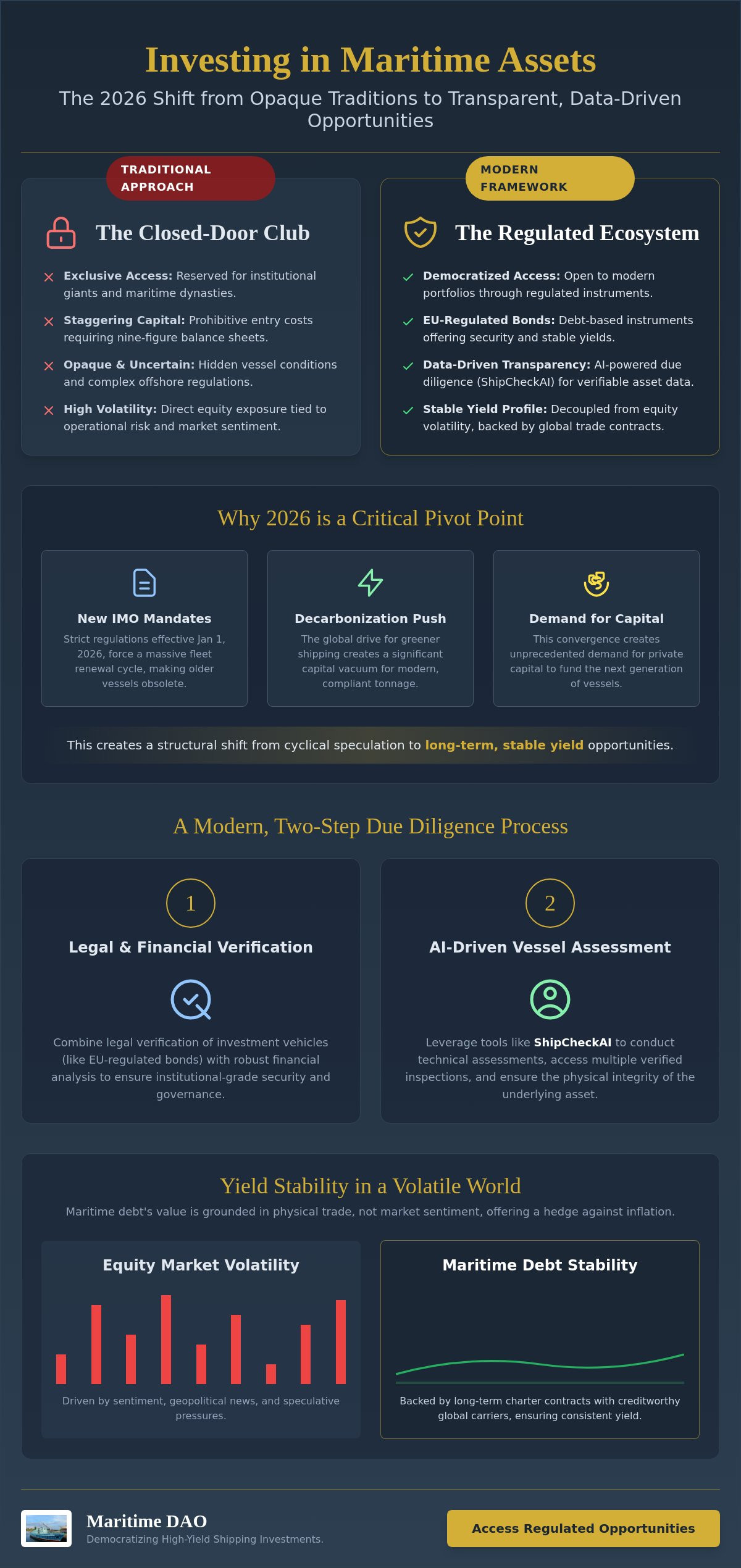
For decades, the high-yield world of global shipping finance remained a closed-door club reserved exclusively for institutional giants and legacy maritime dynasties. You’ve likely recognized the immense potential of the sea, yet the barriers; staggering capital requirements, opaque vessel conditions, and the fog of offshore regulatory uncertainty; have kept these real-world assets out of reach for the modern portfolio. Learning how to invest in maritime assets shouldn’t require a decade of industry connections or a nine-figure balance sheet.
This guide introduces a systematic framework for accessing high-yield shipping opportunities through EU-regulated Ship Investment Bonds and AI-driven due diligence. We’ll explore how ShipCheckAI provides verifiable asset data to eliminate operational blind spots, ensuring your capital is backed by physical integrity even as global container freight rates surge in this June 2026 peak season. You’ll discover how the convergence of traditional finance, maritime operations, and automated intelligence has transformed shipping into a transparent, governed ecosystem. We’re moving beyond speculative hype into a new era of regulated innovation where stable yields from global trade are finally accessible, secure, and data-driven.
Key Takeaways
- Understand how to invest in maritime assets by transitioning from opaque private equity models to transparent, debt-based instruments within an EU-regulated framework.
- Identify the critical 2026 market drivers, including decarbonization mandates and vessel renewal cycles, that are creating unprecedented demand for private capital.
- Master a two-step due diligence process that combines legal verification of investment vehicles with technical, AI-driven assessments of physical vessel conditions.
- Evaluate the distinct risk-yield profiles of containerships, tankers, and dry bulk sectors to align your portfolio with current global trade volatility and freight rate trends.
- Explore the future of maritime finance where decentralized governance and institutional-grade security unite to democratize high-yield shipping investments.
The Strategic Case for Maritime Asset Investment in 2026
Maritime asset investment is the strategic allocation of capital into the physical vessels and infrastructure that facilitate over 90% of global trade. Historically, this sector operated as a closed loop of private equity and family-owned fleets, often obscured by complex offshore structures. However, the 2026 landscape has transformed this asset class into a transparent, institutional-grade opportunity. Understanding how to invest in maritime assets now requires a focus on structural demand rather than speculative timing, as the industry moves toward a model of regulated innovation.
The year 2026 represents a critical pivot point for the global shipping industry. New International Maritime Organization (IMO) mandates, including mandatory roll-motion monitoring and strict firefighting foam prohibitions effective January 1, 2026, are forcing a massive fleet renewal cycle. This regulatory pressure, combined with the global push for decarbonization, has created a significant capital vacuum. As older vessels face technical obsolescence, the demand for modern, compliant tonnage provides a robust foundation for maritime alternative investments to flourish within a balanced portfolio. This shift represents a transition from cyclical speculation to a focus on structural, long-term yield.
Modernizing a Legacy Industry
The transition from opaque, family-governed shipping to unified, data-driven ecosystems is well underway. Institutional investors aren’t deterred by the traditional “opacity premium” because technology now provides granular visibility into vessel performance. By leveraging tools like ShipCheckAI, investors can access multiple verified inspections, ensuring that the physical integrity of an alternative investment into a maritime asset is never in question. This transparency unites physical operations, legal governance, and financial reporting into a single, cohesive framework. Global trade resilience continues to support vessel charter rates, even as geopolitical shifts redistribute trade lanes and demand more efficient, specialized tonnage. We’re seeing a fundamental democratization of an industry that was once the exclusive domain of the few.
Yield vs. Volatility: The 2026 Outlook
A primary advantage of the current market is the decoupling of maritime debt from traditional equity volatility. While stock markets may fluctuate based on sentiment, maritime assets are grounded in the physical necessity of moving goods across oceans. These investments serve as an effective hedge against terrestrial inflation; as the cost of raw materials and labor rises, the replacement value of the global fleet increases proportionally. When considering how to invest in maritime assets, it’s vital to recognize that maritime yield remains remarkably stable when backed by long-term charter contracts with creditworthy global carriers. This stability, governed by EU-regulated instruments, offers a sanctuary from the erratic swings of purely digital or speculative markets. The result is a sophisticated balance between cutting-edge technological ambition and the sober reliability of institutional finance.
Navigating the 2026 Maritime Landscape: From Equity to Regulated Bonds
Traditional ship equity has long been the primary gateway for capital, offering high-reward potential tempered by intense operational demands. This model typically requires investors to manage technical maintenance, insurance, and complex chartering logistics, creating a steep learning curve for those unfamiliar with the high seas. For many, the question of how to invest in maritime assets without assuming the role of a physical shipowner has led to the development of sophisticated debt instruments. However, for those who choose the direct ownership route, professional ship brokering is essential; click here to learn how BTR Marine Services LLC supports the sale and purchase of vessels. While government programs like maritime grants and financing support national infrastructure, private investors increasingly favor the agility and security of the bond market.
The 2026 shift toward EU Regulated Ship Investment Bonds represents a significant departure from the ‘offshore’ risks that once plagued the industry. These instruments provide a compliant, asset-backed framework that protects capital through rigorous legal oversight and standardized reporting. By choosing fractional participation over direct vessel ownership, investors can bypass the multi-million dollar entry barriers while maintaining exposure to the global shipping trade. This evolution from opaque private deals to transparent financial products ensures that capital is governed by law rather than just industry relationships.
The Architecture of Regulated Maritime Debt
Regulated maritime debt is built upon a tripartite foundation of physical security, legal governance, and financial transparency. These bonds are typically secured by the vessel itself, ensuring that the underlying asset provides tangible collateral for the debt. The EU regulatory framework acts as a superior trust-layer, enforcing strict compliance standards that were previously absent in private shipping arrangements. Investors receive predictable coupon payments derived directly from vessel charter income. This creates a reliable stream of revenue that is independent of terrestrial market cycles, providing a sober alternative to more volatile asset classes.
Tokenization and Fractional Ownership
Blockchain technology serves as the modern ledger for these high-value assets, facilitating fractional ownership without the speculative volatility of digital currencies. This transition isn’t about crypto hype; it’s about using distributed technology to govern, verify, and transfer ownership in a unified ecosystem. Understanding how to invest in maritime assets through these regulated channels is key to modern portfolio management. The emergence of alternative ship financing models has been instrumental in bridging the $1.5 trillion maritime capital gap, enabling investors to access tokenized debt structures with predictable yields and EU-regulated legal certainty. In a maritime DAO investment structure, governance is decentralized yet strictly bound by legal smart contracts. This model ensures every participant has a transparent view of the asset’s performance and a voice in strategic decisions. If you’re ready to explore these modern gateways, you can view current bond opportunities to see these frameworks in action.
A Step-by-Step Guide to Maritime Due Diligence and Vessel Assessment
Securing capital in the shipping sector requires a methodical transition from broad market analysis to granular asset verification. Investors often struggle with the inherent opacity of physical fleets, but a systematic framework eliminates these blind spots. When evaluating how to invest in maritime assets, your due diligence must unite technical inspection, legal verification, and commercial forecasting into a single, cohesive audit. This process ensures that every dollar of capital is backed by a physical asset that is both operationally sound and legally unencumbered.
- Step 1: Verify Regulatory Status. Confirm the investment vehicle is an EU-regulated instrument, such as a Ship Investment Bond, to ensure institutional-grade investor protection.
- Step 2: Technical Due Diligence. Assess the physical condition of the vessel, focusing on structural integrity and machinery health.
- Step 3: AI-Driven Auditing. Utilize ShipCheckAI to process multiple inspection types, removing human bias from the assessment.
- Step 4: Charter Review. Analyze the vessel’s historical employment and the strength of future charter contracts to project reliable cash flows.
- Step 5: Counterparty Risk Assessment. Evaluate the track record and financial stability of the ship manager and operator responsible for daily functions.
The Role of AI in Asset Verification
ShipCheckAI has revolutionized the due diligence phase by automating complex inspection protocols that once took weeks to complete. By synthesizing data from multiple inspections, the tool identifies structural anomalies that manual surveys often overlook. This technology moves the industry beyond the outdated ‘once-a-year’ physical survey model, offering continuous condition monitoring that reflects the vessel’s true state. AI-driven data prevents capital loss by providing a real-time, objective audit of a vessel’s structural health that bypasses the subjectivity and delays of manual reporting. This creates a transparent ecosystem where the relationship between physical assets and digital governance is clearly understood. Qualified investors seeking a structured entry point can also benefit from the comprehensive ship investment for accredited investors due diligence checklist, which details how to assess maritime opportunities through a methodical, high-tech lens.
Financial and Legal Audit Checklist
A rigorous audit must also address the legal ‘cleanliness’ of the asset, ensuring it’s free of hidden liens, mortgages, or maritime encumbrances. In 2026, this assessment must include a vessel’s ‘Green Rating’ to ensure compliance with the latest IMO mandates. For example, ships constructed after January 1, 2026, must be free of PFOS-based firefighting foams, and containerships over 3,000 gross tonnage must now be fitted with electronic inclinometers for roll-motion monitoring. Understanding how to invest in maritime assets means verifying these technical upgrades are already in place to avoid future capital expenditures. Institutional stakeholders must also account for the overlapping EU ETS mandates and FuelEU Maritime reporting requirements that now define maritime investment compliance in 2026, as sanctions and environmental penalties represent a growing source of portfolio risk. For a deeper dive into these requirements, consult our AI in maritime due diligence checklist to ensure your portfolio meets every modern standard.
Evaluating Risk and Yield in Global Shipping Markets
Risk management in the shipping sector requires a nuanced understanding of how different vessel classes respond to global economic shifts. While the broader market offers significant upside, the risk profiles of dry bulk carriers, tankers, and containerships are fundamentally distinct. Containerships, for instance, are currently experiencing a sharp surge in volatility. As of June 2026, Drewry’s World Container Index increased by 23% in a single week, with freight rates from Shanghai to Rotterdam climbing to 3,579 USD per FEU. Understanding how to invest in maritime assets involves recognizing these sector-specific drivers; where container rates are driven by consumer demand and port congestion, tankers respond to energy security and geopolitical redistribution of oil routes.
Market cyclicality remains a primary consideration for entry timing. In June 2026, the idle fleet of container ships sits at a historic low of approximately 0.6% of total global capacity, signaling an extremely tight supply-demand balance. This environment favors early entry into modern tonnage but requires robust mitigation strategies to handle potential technical failures or geopolitical disruptions, such as the ongoing conflicts affecting Middle Eastern trade lanes. To manage these variables, sophisticated investors utilize a tripartite approach of comprehensive insurance, sectoral diversification, and regulated bond structures to insulate their capital from localized shocks.
The Maritime Risk Matrix
The core of maritime risk lies in the choice between the high-volatility spot market and the sober stability of long-term time charters. Spot rates offer the potential for rapid gains during peak seasons, yet they expose the portfolio to sudden downturns. Conversely, long-term charters provide predictable cash flows that act as a buffer against market swings. Geopolitical factors also dictate asset value, as shifts in trade routes can turn a strategic vessel into a stranded asset overnight. Furthermore, technological obsolescence is a mounting concern; ships constructed without the latest environmental upgrades, such as the mandatory roll-motion monitoring systems required for new containerships as of January 1, 2026, face significant depreciation as “non-green” vessels in a decarbonizing world. Investors seeking to navigate these complexities can find a comprehensive overview of alternative ship financing models and fractional investment structures that are specifically designed to mitigate these sector-specific risks through diversified, regulated exposure.
Yield Benchmarking for 2026
Maritime debt instruments typically offer a yield premium over traditional corporate bonds, reflecting the specialized nature of the asset class. However, the internal rate of return (IRR) is heavily influenced by vessel age and the associated depreciation schedule. Younger, more efficient vessels command higher charter rates and satisfy the stringent fuel oil safety declarations now required by the IMO. Building a resilient strategy requires a global maritime investment platform that provides real-time data on these variables. By synthesizing technical health, regulatory compliance, and market demand, you can determine how to invest in maritime assets while maintaining an institutional-grade risk profile. If you are ready to analyze specific high-yield opportunities, you can explore our current regulated bond offerings to begin diversifying your portfolio.
Accessing the Future: Regulated Frameworks and Maritime DAO
The evolution of maritime finance reaches its logical conclusion in the Maritime DAO. This structure represents a sophisticated synthesis of physical heavy industry and institutional digital finance, moving beyond the fragmented systems of the past. By combining EU-regulated ship investment bonds with decentralized governance, the platform eliminates the structural inefficiencies that historically limited access to this asset class. Understanding how to invest in maritime assets in this new era requires a shift from passive observation to active participation within a governed, unified ecosystem that prioritizes legal integrity over speculative hype.
Getting started within this framework is a methodical and secure process. It begins with rigorous account verification to ensure compliance with global financial standards, followed by a transparent capital allocation phase. The roadmap for 2026 is defined by the rapid deployment of compliant tonnage, particularly vessels that meet the new IMO safety standards effective as of January 1, 2026. As the platform expands, upcoming vessel issuances will focus on high-efficiency containerships and tankers, all monitored by the latest iterations of our AI due diligence tools. This systematic approach ensures that your entry into the shipping market is both strategic and protected by institutional-grade safeguards.
The Maritime DAO Advantage
The primary advantage of the Maritime DAO is the total transparency provided by its unified ecosystem. By integrating ShipCheckAI directly into the bond issuance process, the platform provides a verifiable audit trail for every physical asset. This empowers investors through governed, automated intelligence, ensuring that every decision is backed by granular technical data rather than industry hearsay. This model successfully bridges the gap between the physical reality of global trade and the digital precision of modern asset management. It creates a first-of-its-kind environment where physical vessel integrity and digital financial governance are inextricably linked.
Next Steps for Your Portfolio
Transitioning into maritime assets involves more than just capital; it requires a commitment to a data-driven strategy. Consulting with maritime finance experts within our regulated framework allows you to align your allocation with specific sectoral trends, whether you’re targeting the tight capacity of the container market or the structural demand in dry bulk. Once your investment is active, you can monitor your assets through the integrated AI inspection dashboard, receiving real-time updates on technical health and regulatory status. This level of visibility was previously impossible for anyone outside of the largest institutional shipowners. If you are ready to secure your position in the global trade infrastructure, you can Explore EU-Regulated Ship Investment Bonds at Maritime DAO to begin your journey into the future of shipping finance.
Charting Your Course in the New Era of Shipping Finance
The transition from legacy shipping models to a unified, tech-enabled financial ecosystem is no longer a future premise; it’s the current standard for 2026. You’ve discovered that mastering how to invest in maritime assets requires a precise combination of physical trade resilience, technical verification, and decentralized governance. By utilizing EU-regulated instruments and the automated intelligence of ShipCheckAI, you can bypass traditional barriers to entry while maintaining the sober reliability of asset-backed debt. This framework doesn’t just democratize access; it enforces a level of transparency and legal structural integrity that was previously unattainable in global shipping.
We’ve identified the systemic inefficiencies of the past and built a high-tech bridge to the future of global trade. Now is the time to align your portfolio with the physical infrastructure that powers the world economy. Through transparent DAO governance and institutional-grade security, you can participate in a market that remains decoupled from terrestrial volatility. Secure your position in the global shipping market with Maritime DAO and join a community of investors who value order, security, and regulated innovation.
Frequently Asked Questions
Is maritime investment safe for individual investors in 2026?
Maritime investment has become significantly safer due to the transition from opaque offshore deals to EU-regulated financial instruments. By utilizing debt-based structures rather than direct equity, investors enjoy a superior trust-layer protected by standardized legal frameworks. When you learn how to invest in maritime assets through these governed channels, your capital is secured by physical collateral and verified through automated intelligence.
What is the minimum investment for EU-regulated ship bonds?
Minimum investment requirements are determined by the specific terms of each bond issuance within the platform. These thresholds are designed to democratize access to the shipping industry, allowing for fractional participation that was previously impossible for non-institutional players. You should review the specific prospectus for each offering on the Maritime DAO dashboard to confirm current entry requirements and capital allocation limits.
How does ShipCheckAI improve the security of my maritime investment?
ShipCheckAI enhances security by synthesizing data from multiple technical inspections to provide a unified view of a vessel’s physical health. This system identifies structural anomalies and machinery risks that traditional manual surveys might overlook; effectively removing human bias from the due diligence process. It ensures that every investment is backed by verifiable asset data, providing a transparent audit trail that protects your capital from unforeseen operational failures.
Can I sell my maritime asset tokens on a secondary market?
Secondary market liquidity is facilitated through the blockchain-based ledger that tracks fractional ownership of the underlying ship investment bonds. This technology allows for the efficient transfer of ownership between verified participants within a regulated ecosystem. While liquidity depends on market demand, the use of decentralized technology ensures that every transaction is transparent, governed by smart contracts, and compliant with relevant financial regulations.
What are the tax implications of investing in maritime debt instruments?
Tax treatment for maritime debt typically differs from traditional equity investments and varies significantly based on your primary jurisdiction. Many investors find that regulated bonds offer a more straightforward reporting structure compared to complex private shipping partnerships. You should consult with a qualified tax professional to understand how income from vessel chartering and bond coupons will impact your specific financial situation.
How do maritime assets perform during a global economic downturn?
Maritime assets often demonstrate resilience during economic volatility because they are grounded in the physical necessity of global trade. While spot freight rates may fluctuate, vessels secured under long-term time charters provide a stable yield that is decoupled from terrestrial market cycles. This makes understanding how to invest in maritime assets a valuable strategy for those seeking a tangible hedge against inflation and traditional equity downturns.
What is the difference between a maritime DAO and a traditional shipping fund?
A maritime DAO utilizes decentralized governance and blockchain technology to provide real-time transparency that traditional shipping funds lack. Unlike legacy funds that often operate with delayed reporting and centralized decision-making, a DAO empowers participants through an integrated ecosystem of automated intelligence and smart contracts. This model ensures that every investor has a unified view of asset performance, technical health, and regulatory compliance.
How does the ‘Green Transition’ affect the value of older vessels?
The ‘Green Transition’ and evolving IMO regulations are creating a clear divide between modern, compliant tonnage and aging fleets. Vessels that don’t meet the January 1, 2026, standards for fire safety and roll-motion monitoring face rapid depreciation and technical obsolescence. This shift reinforces the case for investing in modern assets that satisfy strict environmental mandates, as these ships command higher charter rates and maintain superior long-term value. Those who meet the qualifying criteria can explore the full scope of these considerations in our dedicated guide to ship investment for accredited investors, which outlines the 2026 compliance and assessment framework in detail.